Mushroom Supplement Quality & Sourcing
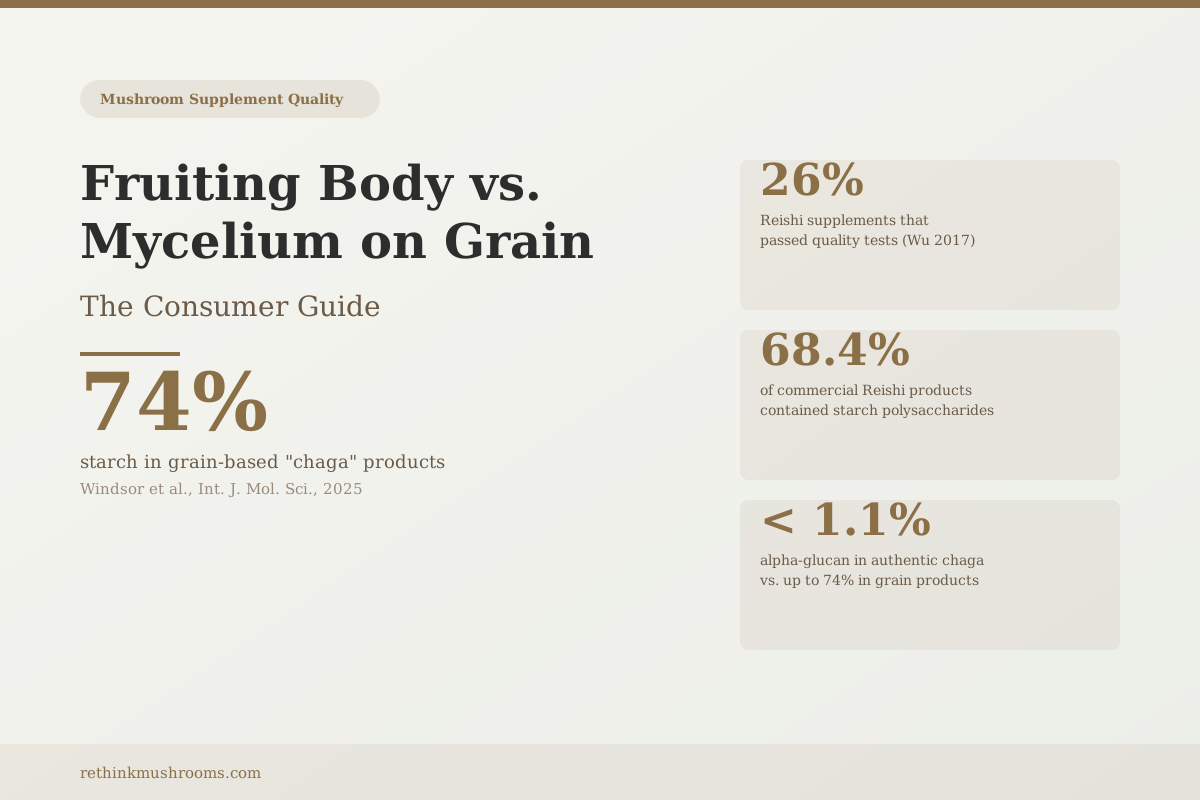
74% starch
Windsor et al. (2025) found grain-based 'chaga' supplement products contained up to 74% alpha-glucan starch by weight. Authentic chaga contains less than 1.1% alpha-glucan.
Windsor et al., International Journal of Molecular Sciences, 2025
26%
of Reishi supplements passed quality tests (Wu 2017)
68.4%
of commercial Reishi products contained starch polysaccharides
< 1.1%
alpha-glucan in authentic chaga vs. up to 74% in grain products
Windsor et al., International Journal of Molecular Sciences, 2025
 View as image ↗
When Wu and colleagues tested 19 commercially available Reishi supplements in 2017, only 5 passed quality standards. The other 14 contained starch-like polysaccharides rather than bioactive beta-glucans. Sixty-eight percent of the Reishi supplements on U.S. store shelves were delivering grain starch instead of the compound listed as the active ingredient.[2]
The fruiting body vs. mycelium on grain question is the explanation behind that failure. This guide covers what those terms mean, what peer-reviewed studies have found in commercial products, and how to check what you are actually buying before spending money on a mushroom supplement.
The full science of choosing a mushroom supplement covers the complete decision framework. This article focuses on the single variable that most consistently separates higher-quality products from lower-quality ones: which part of the fungus went into the capsule.
Key Takeaways
- Wu et al. (2017) tested 19 Reishi supplements: only 5 (26.3%) passed quality tests, and 68.4% contained starch-like polysaccharides instead of bioactive beta-glucans
- Windsor et al. (2025) found grain-based "chaga" products contained 33.1-74.0% alpha-glucan starch, while authentic chaga contains only 0.8-1.1% alpha-glucan
- Berger et al. (2022) confirmed fruiting bodies and mycelium concentrate different metabolite profiles, with fruiting bodies generally richer in triterpenoids and structural polysaccharides
- Lion's Mane is the key exception: hericenones (fruiting body only) and erinacines (mycelium only) are distinct non-overlapping compounds — Spangenberg et al. (2025) found erinacines are among the most potent known NGF stimulators
- Jedrejko et al. (2022) found that Cordyceps fruiting bodies delivered the highest post-digestion bioavailable cordycepin, even when some commercial supplements showed higher raw content before digestion
- For most mushroom species, fruiting body supplements with a verified beta-glucan percentage represent the most defensible quality standard; Lion's Mane is the one species-specific exception
Fruiting Body vs. Mycelium on Grain: What You're Actually Buying
A mushroom's fruiting body is the visible structure: the cap, stem, and gills. It is the part people have consumed as food and medicine for centuries. It is where most of the studied bioactive compounds concentrate, including the beta-glucans responsible for immune effects and the triterpenoids associated with adaptogenic properties.
Mycelium is the network of thread-like filaments that grows underground or inside a substrate. It is the vegetative body of the fungus, analogous to roots. Mycelium produces bioactive compounds too, but in different ratios and different types than the fruiting body.
Mycelium on grain (often abbreviated MOG) is a specific production method. Mycelium is grown on a grain substrate, typically rice, oats, or sorghum. After fermentation, the entire mixture is dried and ground into powder. The problem is biological and unavoidable: the mycelium grows into the grain, not on top of it. The threads penetrate and colonize the substrate. When the mixture is dried and ground, there is no way to separate the mycelium from the grain. The powder is a blend of fungal mycelium and grain starch.
How much grain ends up in the powder depends on the species and production conditions. For many products, the proportion of grain starch is substantial. Windsor et al. (2025) found grain-based chaga products containing 33.1-74.0% alpha-glucan, and alpha-glucan is how starch is measured.[3] That is not a trace contaminant. It is the majority of the product by weight.
MOG products exist primarily because they are cheaper to produce than cultivated fruiting bodies. Fruiting body cultivation requires controlled growing conditions, adequate fruiting time, and species-specific care. Mycelium fermentation on grain is faster, less labor-intensive, and produces more powder volume per unit of input. A smaller portion of that volume is bioactive fungal material.
The starch filler problem and what to look for on labels are covered in more depth in The Starch Filler Problem: Why Mycelium on Grain May Be Mostly Rice and How to Spot a Mycelium-on-Grain Supplement: Label Red Flags.
The Lab Data: 74 Percent Starch in Grain-Based "Chaga" Products
Two studies provide the clearest empirical picture of what is actually in commercial mushroom supplements.
Wu et al. (2017), Reishi. Wu's team purchased 19 Ganoderma lucidum (Reishi) dietary supplements from U.S. retailers and tested them using established analytical methods.[2] The results were stark:
- Only 5 of 19 products (26.3%) contained detectable branched 1,3-beta-D-glucan, which is the immune-active form of beta-glucan found in mushroom fruiting bodies.
- 13 of 19 products (68.4%) tested positive for starch-like polysaccharides. Starch is an alpha-glucan, not a beta-glucan. It is grain, not mushroom.
- 58% of products lacked detectable triterpenes, a class of compounds specific to Reishi fruiting bodies with documented biological activity.
The products that failed were not random. Products derived from mycelium on grain consistently failed to deliver the compounds associated with bioactive Reishi. Products labeled simply as "Reishi extract" without fruiting-body specification were among the worst performers.
Windsor et al. (2025), Chaga. Windsor's team tested authentic wild Inonotus obliquus (chaga) alongside commercially available chaga supplements, including grain-fermented formulations.[3] The alpha-glucan findings were the most dramatic in the MOG literature:
- Authentic chaga sclerotia: 0.8-1.1% alpha-glucan. This is the baseline for a real chaga product.
- Grain-fermented chaga products: 33.1-74.0% alpha-glucan.
A product sitting at 74% alpha-glucan is approximately 74% grain starch. The Lugol's iodine reagent test confirmed this visually: grain-based products turned navy to purple when exposed to Lugol's. Authentic chaga remained negative.
These two studies represent different species, different research teams, different journals, and different years. They reach the same conclusion: the gap between label claims and actual beta-glucan content in grain-based products is not marginal.
Why the Biochemical Difference Matters Beyond the Label
The fruiting body vs. mycelium distinction is not just a labeling problem. The two parts of the fungus produce genuinely different chemical profiles, and those differences are biologically meaningful.
Berger and colleagues published a systematic metabolite comparison in Microorganisms in 2022, analyzing both fungal parts across multiple species.[1] Their findings: fruiting bodies and mycelium concentrate different metabolites. Fruiting bodies are generally richer in phenolics, triterpenoids, and structural polysaccharides like beta-glucans. Mycelium shows different protein and smaller-metabolite ratios depending on species and growth conditions.
For most immune-supportive mushroom species, the triterpenoids and beta-glucans found predominantly in fruiting bodies are the compounds with the most documented biological activity. A product that substitutes grain starch for these compounds is not delivering an equivalent product in a different form. It is delivering a substantively different and largely unstudied mixture.
The Cordyceps data from Jedrejko and colleagues (2022) illustrates this with unusual specificity.[6] The team measured cordycepin — the primary bioactive alkaloid in Cordyceps militaris — in fruiting bodies, mycelium, and commercial supplements, then ran each through simulated intestinal digestion. One commercial supplement showed the highest raw cordycepin content before digestion, at 81.4 mg per 100g dry weight. But after simulated digestion, self-cultivated fruiting bodies (25.8 mg/100g raw) and commercially obtained fruiting bodies (25.9 mg/100g raw) delivered the highest bioavailable cordycepin. The supplement with the highest raw number did not win on the measure that matters for a person consuming the capsule.
This is a meaningful distinction. A supplement can look good on a certificate of analysis while delivering less where it counts.
The Lion's Mane Exception: The One Case Where Mycelium Has Unique Compounds
Everything above points toward fruiting body as the better source for most species. Lion's Mane is the exception, and the exception is genuine.
Friedman's 2015 comprehensive review in the Journal of Agricultural and Food Chemistry established the key fact: Lion's Mane contains two distinct classes of compounds that stimulate nerve growth factor (NGF), and these classes are not interchangeable.[4]
Hericenones are found only in the fruiting body. They are the compounds that drove early Lion's Mane research and remain the primary bioactive studied in most human clinical trials of the fruiting body extract.
Erinacines are found only in the mycelium. They are a structurally different family of diterpenoids. Friedman's review noted their potency, and subsequent research has confirmed and quantified it.
Spangenberg and colleagues published a 2025 systematic review in Frontiers in Pharmacology focused specifically on erinacines across preclinical models.[5] The findings:
- Erinacine A, the most studied, crosses the blood-brain barrier — a property that makes it accessible to neurons in a way that larger molecules often are not.
- Preclinical assays show erinacines produce greater NGF secretion volumes than hericenones.
- The erinacines are not found in any amount in the fruiting body and cannot be obtained from a fruiting-body-only product.
This creates a genuine case for Lion's Mane mycelium products, but with an important qualification. The mycelium must be produced on a substrate that allows actual erinacine concentration. A MOG product with high grain starch content is not a high-erinacine product — it is a diluted product that also lacks hericenones.
A truly "full spectrum" Lion's Mane product would contain both fruiting body (for hericenones) and clean mycelium (for erinacines). What that term means in practice on supplement labels is explored in What "Full Spectrum" Really Means on Mushroom Supplement Labels.
For all species other than Lion's Mane, the erinacine exception does not apply. The fruiting body vs. mycelium comparison reverts to the general case, where fruiting body products with verified beta-glucan content are the more defensible choice.
How to Check Your Supplement in 5 Steps
These five steps can be applied to any mushroom supplement before purchase or to a product already in your cabinet.
Step 1: Find the "part used" disclosure. Look for a line that specifies "fruiting body," "mycelium," or "full spectrum." If the label says "mushroom powder" without specifying the part, that absence is itself informative. Products with nothing to hide typically label the source clearly.
Step 2: Check whether a beta-glucan percentage is listed. A label that says "polysaccharides: 40%" is not the same as "beta-glucans: 30%." Polysaccharide percentage includes both beta-glucans (bioactive mushroom compounds) and alpha-glucans (starch from grain). Products that list only "polysaccharides" without specifying the beta-glucan sub-fraction may be obscuring a high starch proportion. Look for a specific beta-glucan number.
Step 3: Search for indicator terms. The terms "mycelium biomass," "myceliated grain," "full spectrum" (without fruiting body specification), and "myceliated rice" or "myceliated oats" all indicate a MOG product. Their presence does not mean the product is useless, but it warrants the additional checks below.
Step 4: Request or search for a Certificate of Analysis. A COA from a third-party lab that uses the Megazyme beta-glucan assay distinguishes beta-glucan content from alpha-glucan content. If a company cannot provide this, or provides only a total polysaccharide figure, the starch content is not being disclosed.
Step 5: Apply the iodine starch test at home. Windsor et al.'s 2025 Chaga study documented this test with peer-reviewed methodology.[3] Dissolve a small amount of supplement powder in water and add a drop of Lugol's iodine solution (available at pharmacies and online). Grain starch causes a navy-to-purple color reaction. Authentic mushroom fruiting body material does not. A positive result confirms significant starch content; a negative result does not guarantee quality but is a useful preliminary screen.
The label red-flag guide in How to Spot a Mycelium-on-Grain Supplement: Label Red Flags covers additional terms and signals to check.
Species by Species: Which Form the Data Supports
Reishi. The Wu 2017 study is a Reishi-specific dataset, and it is the most damning evidence against MOG products for any single species.[2] Triterpenes — the compound class most associated with Reishi's adaptogenic and liver-supportive properties — are largely absent in grain-grown mycelium and were undetectable in 58% of commercial Reishi products tested. For Reishi, fruiting body (or hot-water extract from fruiting body) is the only well-supported form. MOG Reishi products are not a validated alternative.
Lion's Mane. As covered above, the erinacine exception is real. A high-erinacine mycelium product that also includes some fruiting body extract represents the most complete Lion's Mane offering. For cognitive or neurological applications, a product that specifies erinacine content or uses both parts is worth seeking out. A MOG-only product without erinacine testing data provides no assurance of the compounds that drive preclinical results.
Chaga. Windsor 2025 closed the Chaga question with the sharpest data in this cluster.[3] Authentic chaga is not a cultivated mushroom in the conventional sense — it is a sclerotia (a hardened parasitic growth on birch trees). It cannot be grown on grain and produce an authentic product. Grain-fermented "chaga" is effectively a grain product with incidental mycelium. Only wild-harvested or authentic sclerotia-based Chaga is defensible.
Cordyceps. Jedrejko 2022 showed that fruiting body delivers the most bioavailable cordycepin after digestion.[6] Note that true wild Cordyceps sinensis is rare and expensive; most commercial Cordyceps supplements are Cordyceps militaris, which can be cultivated as fruiting bodies. A Cordyceps militaris fruiting body supplement with verified cordycepin content is the evidence-supported choice.
Other species (Turkey Tail, Shiitake, Maitake, Tremella). The Berger 2022 metabolite comparison shows fruiting bodies generally concentrate the polysaccharides and secondary metabolites associated with each species' activity.[1] In the absence of species-specific quality failure data, the default recommendation from the research is fruiting body with verified beta-glucan content.
Why fruiting body products typically cost more than MOG products is explained in the dual-extract production guide. The cost premium reflects the production difference, not just branding.
The broader context for mushroom supplement quality — how widespread these failures are across the market and what the regulatory environment does and does not require — is covered in The Mushroom Supplement Quality Crisis: Why Most Products Fail.
The Bottom Line
The peer-reviewed evidence supports a clear default: for most mushroom species, fruiting body supplements with a verified beta-glucan percentage offer more reliable bioactive content than mycelium on grain products. The Wu 2017 Reishi data and Windsor 2025 Chaga data document the scale of the quality problem in commercial MOG products. The one exception is Lion's Mane, where erinacines (mycelium-only, confirmed by Spangenberg 2025) are more potent NGF stimulators than the fruiting-body compounds and cannot be obtained from a fruiting-body product alone.
Frequently Asked Questions
Sources & References
- 1RTHM-00743·Berger, Ralf G et al. (2022). “Mycelium vs. Fruiting Bodies of Edible Fungi-A Comparison of Metabolites..” Microorganisms.Study breakdown →PubMed →↩
- 2RTHM-00499·Wu, Ding-Tao et al. (2017). “Evaluation on quality consistency of Ganoderma lucidum dietary supplements collected in the United States..” Scientific reports.Study breakdown →PubMed →↩
- 3RTHM-02209·Windsor, Coleton et al. (2025). “What This 2025 Chaga Supplement Authentication Study Actually Found.” International journal of molecular sciences.Study breakdown →PubMed →↩
- 4RTHM-00371·Friedman, Mendel (2015). “Chemistry, Nutrition, and Health-Promoting Properties of Hericium erinaceus (Lion's Mane) Mushroom Fruiting Bodies and Mycelia and Their Bioactive Compounds..” Journal of agricultural and food chemistry.Study breakdown →PubMed →↩
- 5RTHM-02184·Spangenberg, E T et al. (2025). “Unveiling the role of erinacines in the neuroprotective effects of Hericium erinaceus: a systematic review in preclinical models..” Frontiers in pharmacology.Study breakdown →PubMed →↩
- 6RTHM-01545·Jędrejko, Karol et al. (2022). “Cordyceps militaris-Fruiting Bodies, Mycelium, and Supplements: Valuable Component of Daily Diet..” Antioxidants (Basel.Study breakdown →PubMed →↩