Mushroom Extraction Methods & Supplement Forms
2 solvents, 2 compound classes
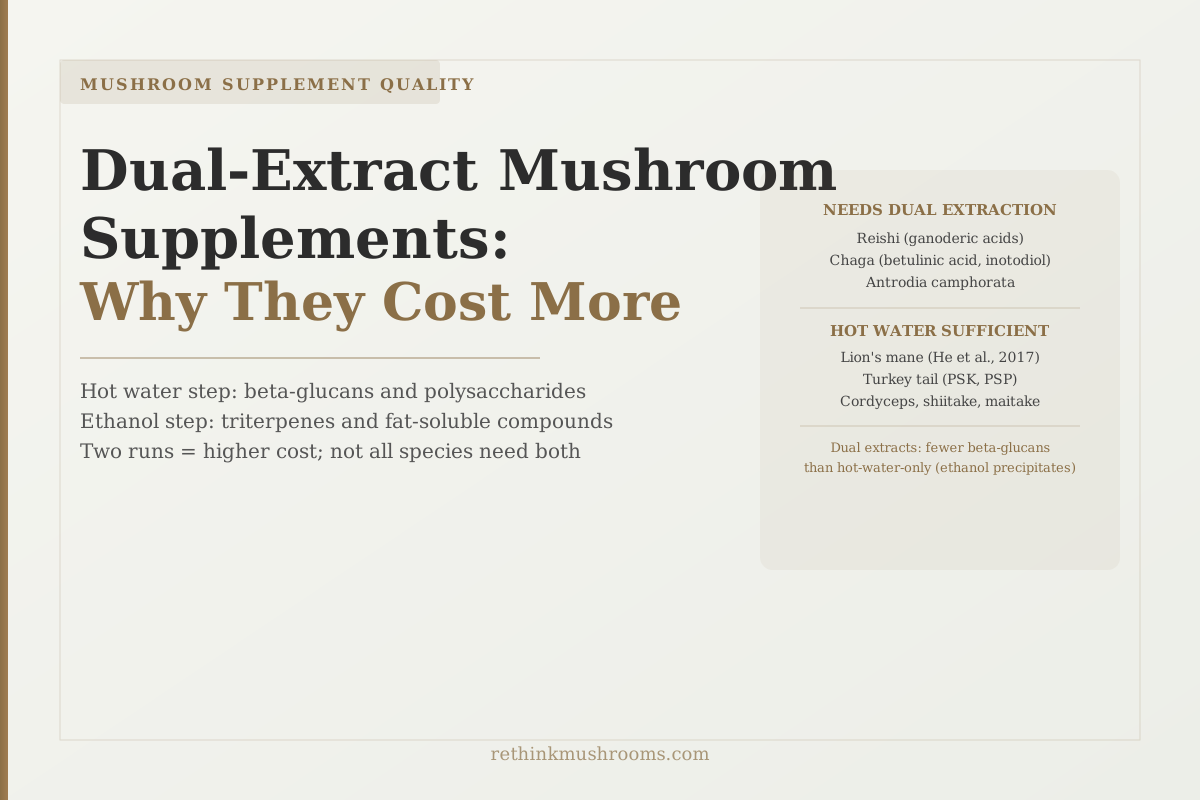
Dual-extracted supplements run a hot water decoction for beta-glucans and an ethanol soak for triterpenes. Two separate extraction runs, combined into one product. That processing cost is why they sell for more.
Petrović et al., Food & Function, 2014
Reishi, Chaga
species where dual extraction captures distinct active fractions
Lion's mane
primary bioactives are water-soluble; hot water extraction is sufficient (He et al., 2017)
Fewer beta-glucans
dual extracts typically contain less than hot-water-only extracts
Petrović et al., Food & Function, 2014
 View as image ↗
Dual-extracted mushroom supplements cost more because they require two separate extraction runs instead of one. Hot water captures the water-soluble compounds (primarily beta-glucans, the polysaccharides most studied for immune effects). Ethanol captures the fat-soluble compounds (triterpenes like reishi's ganoderic acids and chaga's betulinic acid). Two solvents, two processing passes, two sets of equipment. The extra cost is real and reflects real chemistry. But here is the part most product descriptions leave out: not all mushrooms have meaningful fat-soluble compounds worth capturing, and dual extraction typically produces fewer beta-glucans per gram than hot-water-only extraction does. Whether dual extraction is worth the premium depends entirely on which species you are buying and what you are trying to get from it. For a broader framework on evaluating mushroom supplement quality, see How to Choose a Mushroom Supplement: The Science-Based Buyer's Guide.
Key Takeaways
- Dual extraction uses two sequential solvents: hot water to extract beta-glucans (water-soluble polysaccharides) and ethanol to extract triterpenes (fat-soluble compounds like reishi's ganoderic acids)
- The higher price reflects genuine production costs: two extraction passes, additional solvents, and longer processing time, not marketing premium
- Reishi and chaga have significant fat-soluble triterpenoid fractions alongside polysaccharides; for these species, dual extraction captures both active compound classes
- Lion's mane polysaccharides are primarily water-soluble beta-glucans. He et al.'s 2017 review of lion's mane bioactives shows no significant fat-soluble fraction that ethanol extraction would add meaningfully to
- Dual extracts typically contain lower beta-glucan percentages than hot-water-only extracts because ethanol, a precipitating agent for polysaccharides, reduces the total polysaccharide concentration during the ethanol step
- For species without significant triterpene content (turkey tail, cordyceps, shiitake, maitake), hot-water-only extraction is the more appropriate and more beta-glucan-dense method
What Dual Extraction Actually Is
Dual extraction is a two-stage process designed to capture two chemically incompatible compound classes from the same mushroom source.
Stage one is a hot water decoction: dried mushroom material is simmered in water at near-boiling temperature for several hours. Water is a polar solvent; it dissolves the polar, water-soluble compounds, primarily beta-glucans and other polysaccharides, along with water-soluble nucleosides and minor antioxidants. Heat also softens the chitin cell walls, releasing compounds that would otherwise remain trapped inside the cell structure.
Stage two is an ethanol maceration: the spent or fresh mushroom material is soaked in food-grade alcohol (typically 40-70% ethanol) for weeks. Ethanol is partially non-polar, which allows it to dissolve the fat-soluble compounds: the triterpene family (ganoderic acids in reishi, betulinic acid and inotodiol in chaga) that hot water cannot touch.
The two extracts are then combined, usually at a ratio of roughly two parts water extract to one part ethanol extract, producing a single product that contains both compound classes.
A 2014 laboratory study by Petrović et al. directly compared hot water, ethanol, and methanol extracts from the same mushroom species and found significantly different compound profiles and biological activities depending on solvent choice.[1] This confirms the core premise of dual extraction: if different solvents yield different compounds with different biological effects, a single-solvent product is leaving part of the compound profile behind.
Why It Costs More: The Production Reality
Dual extraction is not just the same process run twice. The two steps have different equipment requirements, different processing times, and different quality control considerations.
The hot water decoction requires heat-controlled vessels, extended time (typically two to four hours at sustained temperature), and filtration equipment to separate the liquid extract from the solid biomass. The ethanol maceration requires sealed vessels to prevent evaporation, temperature control to avoid degrading ethanol-soluble compounds, and a waiting period of four to eight weeks for full triterpenoid extraction kinetics. Each step produces a separate liquid that must be analyzed, concentrated if necessary, and then blended.
Responsible producers also test each fraction separately for compound content before combining, checking beta-glucan percentage in the water fraction and triterpenoid profile in the ethanol fraction, to ensure the final product meets the claimed specifications. This testing adds cost that single-extraction products do not incur.
The premium for dual extraction over hot-water-only extraction in comparable species typically runs 30-60% higher on a per-gram basis. For species like reishi and chaga where both fractions contribute documented bioactivity, that premium reflects genuine value. For species where the ethanol step adds little, it reflects an unnecessary production cost passed on to the consumer.
The Species That Benefit From Both Steps: Reishi and Chaga
Two species dominate the argument for dual extraction: reishi and chaga. Both contain large, well-studied triterpenoid fractions alongside their polysaccharide content, and the two compound classes have distinct biological effects.
Reishi's polysaccharides (beta-glucans) are water-soluble and captured in the hot water step. Reishi's ganoderic acids, which are the triterpenoids responsible for the bitter taste and much of the studied cardiovascular and liver-related activity, are fat-soluble and require ethanol extraction. A hot-water-only reishi product captures the immune-modulating polysaccharide fraction and completely misses the ganoderic acid fraction. An ethanol-only product does the reverse.
Chaga similarly divides along this line. Its polysaccharides are water-soluble, and its triterpenoids, including betulinic acid (a compound with substantial cell-biology research attention) and inotodiol, require alcohol extraction. Single-solvent chaga products provide an incomplete compound picture.
These are the two species where dual extraction is genuinely justified by the chemistry. For both, the extra cost reflects a product that contains compounds a single-solvent alternative does not.
Goodridge, Wolf, and Underhill's 2009 review of beta-glucan recognition by the innate immune system established that the immune-activating effects of mushroom polysaccharides depend on Dectin-1 receptor binding, which requires structurally intact beta-glucans.[3] Batbayar, Kim, and Kim's 2011 study detailed how this Dectin-1 activation triggers NF-kB and MAPK signaling pathways that regulate innate immune responses.[4] These findings are not directly about dual extraction, but they provide the mechanism that explains why compound completeness matters: both the polysaccharide fraction and the triterpenoid fraction contribute to the studied bioactivity of species like reishi, and a product missing either fraction is working with an incomplete compound profile.
For species-specific analysis of how extraction quality affects supplement value, see How Extraction Methods Determine Supplement Quality.
The Species Where Hot Water Extraction Is Sufficient
The dual extraction case falls apart for several popular mushroom species because their primary bioactive compounds are predominantly water-soluble.
He et al.'s 2017 comprehensive review of lion's mane polysaccharide structures found that the species' key beta-glucans have beta-1,3-D and beta-1,6-D linkages and are primarily water-soluble, so they come out efficiently in hot water extraction.[2] The other major bioactive category in lion's mane fruiting bodies, the hericenones, are mildly lipophilic (fat-compatible) and do require some alcohol extraction for full capture. But the erinacines found in lion's mane mycelium are also water-soluble. For most lion's mane products, hot water extraction captures the compounds most relevant to the nerve-growth-factor research, and dual extraction adds processing cost without proportionally adding the compounds researchers have focused on.
Turkey tail's key studied compounds, PSK (polysaccharide K) and PSP (polysaccharide peptide), are water-soluble. Hot water extraction is the appropriate method, and it is what most clinical research on turkey tail has used. Adding an ethanol step captures minor fat-soluble secondary compounds that are not the basis of the published evidence.
Cordyceps, shiitake, and maitake all fall into the same category: their primary studied bioactives are polysaccharides and nucleosides, which are water-soluble. Their documented activity in human and animal research is largely tied to the water-extractable fraction, and the published clinical evidence is based on water extracts or whole-mushroom preparations rather than dual-extracted products.
Dual extract labeling on these species is not necessarily deceptive, but the extra cost does not represent extra value for the compounds those species are specifically researched for. For how to interpret the label you are reading, see What to Look for on a Mushroom Supplement Label.
The Counter-Intuitive Trade-Off: Dual Extracts Have Fewer Beta-Glucans
Here is the detail that dual-extract marketing almost never mentions: ethanol is routinely used in biochemistry laboratories to precipitate polysaccharides out of aqueous solution. When you add ethanol to a water extract, the polysaccharides crash out as a solid precipitate. This is not a side effect or a problem; it is the basis of a standard polysaccharide purification technique.
When dual extraction combines a water extract with an ethanol extract, some of the polysaccharides in the water fraction precipitate in the presence of the alcohol fraction. The result is that dual extracts typically test at lower beta-glucan percentages than comparable hot-water-only extracts from the same species.
This is not a reason to avoid dual extraction for reishi and chaga. The triterpenoid compounds that ethanol captures are worth the polysaccharide trade-off for those species. But it means that a dual-extract reishi product and a hot-water-only reishi product are not the same with the dual extract simply having more of everything. They have different profiles: the dual extract has triterpenes the hot water product lacks, and the hot water product has higher beta-glucan content.
The practical implication: if you are buying a mushroom supplement specifically for beta-glucan content, a hot-water-only extract standardized to a high beta-glucan percentage will typically outperform a dual extract at the same price point on that specific measure.
Goodridge, Wolf, and Underhill's 2009 review of beta-glucan recognition by the innate immune system established that Dectin-1, the primary receptor that mushroom beta-glucans activate, requires structurally intact beta-glucans with the right linkage pattern.[3] Batbayar, Kim, and Kim's 2011 study detailed the downstream signaling cascades this triggers, showing that beta-glucan quality and structural integrity predict immune activation magnitude.[4] These findings reinforce why the beta-glucan trade-off in dual extraction matters: if you are optimizing for Dectin-1 activation, beta-glucan content and structural integrity are the variables that determine outcome, not triterpene content.
What to Look for When Choosing Between Dual Extract and Hot Water Extract
The choice is straightforward once you know the species:
For reishi or chaga, dual extraction is justified. Look for products that specify both beta-glucan percentage and triterpene/ganoderic acid content. A reishi dual extract that lists only 10:1 ratio without specifying either compound percentage tells you nothing useful about what it contains.
For lion's mane, turkey tail, cordyceps, shiitake, and maitake, a standardized hot-water extract with a stated beta-glucan percentage is the more appropriate product and will typically deliver higher beta-glucan content per capsule than a dual extract. A dual-extract label on these species is a signal that either the producer has applied a standardized protocol regardless of species, or the "dual extract" designation is being used for marketing rather than chemical necessity.
The question to ask for any mushroom supplement is not "is it extracted?" but "what is the measured beta-glucan percentage?" A 10:1 extract ratio without standardization to a specific compound percentage is a concentration claim, not a potency claim. For a full explanation of that distinction, see 10:1 Extract Ratios: What They Mean (and What They Don't).
For context on how mycelium-on-grain products fit into this picture (the starting material determines what any extraction method can deliver), see Mycelium on Grain: Why It's Controversial in the Supplement Industry. For what to look for when reading product labels across all these considerations, see Hot Water Extract vs. Dual Extract vs. Raw Powder: Which Delivers More Beta-Glucans?.
The Bottom Line
Dual extraction uses hot water for beta-glucans and ethanol for triterpenes, with two processing runs justified by the price premium. Reishi and chaga benefit clearly because both compound classes have documented biological activity; lion's mane, turkey tail, and cordyceps are primarily water-soluble species where hot water extraction is sufficient (He et al., 2017; Petrović et al., 2014). The counter-intuitive trade-off: ethanol precipitates polysaccharides, so dual extracts typically test lower in beta-glucan content than hot-water-only extracts of the same species.
Frequently Asked Questions
Sources & References
- 1RTHM-00346·Petrović, Jovana et al. (2014). “Different extraction methodologies and their influence on the bioactivity of the wild edible mushroom Laetiporus sulphureus (Bull.) Murrill..” Food & function.Study breakdown →PubMed →↩
- 2RTHM-00472·He, Xirui et al. (2017). “Structures, biological activities, and industrial applications of the polysaccharides from Hericium erinaceus (Lion's Mane) mushroom: A review..” International journal of biological macromolecules.Study breakdown →PubMed →↩
- 3RTHM-00154·Goodridge, Helen S et al. (2009). “Beta-glucan recognition by the innate immune system..” Immunological reviews.Study breakdown →PubMed →↩
- 4RTHM-00378·Batbayar, Sainkhuu et al. (2011). “Medicinal mushroom Lingzhi or Reishi, Ganoderma lucidum (W.Curt.:Fr.) P. Karst., beta-glucan induces Toll-like receptors and fails to induce inflammatory cytokines in NF-kappaB inhibitor-treated macrophages..” International journal of medicinal mushrooms.Study breakdown →PubMed →↩