Chaga Sourcing & Sustainability
0 betulinic acid
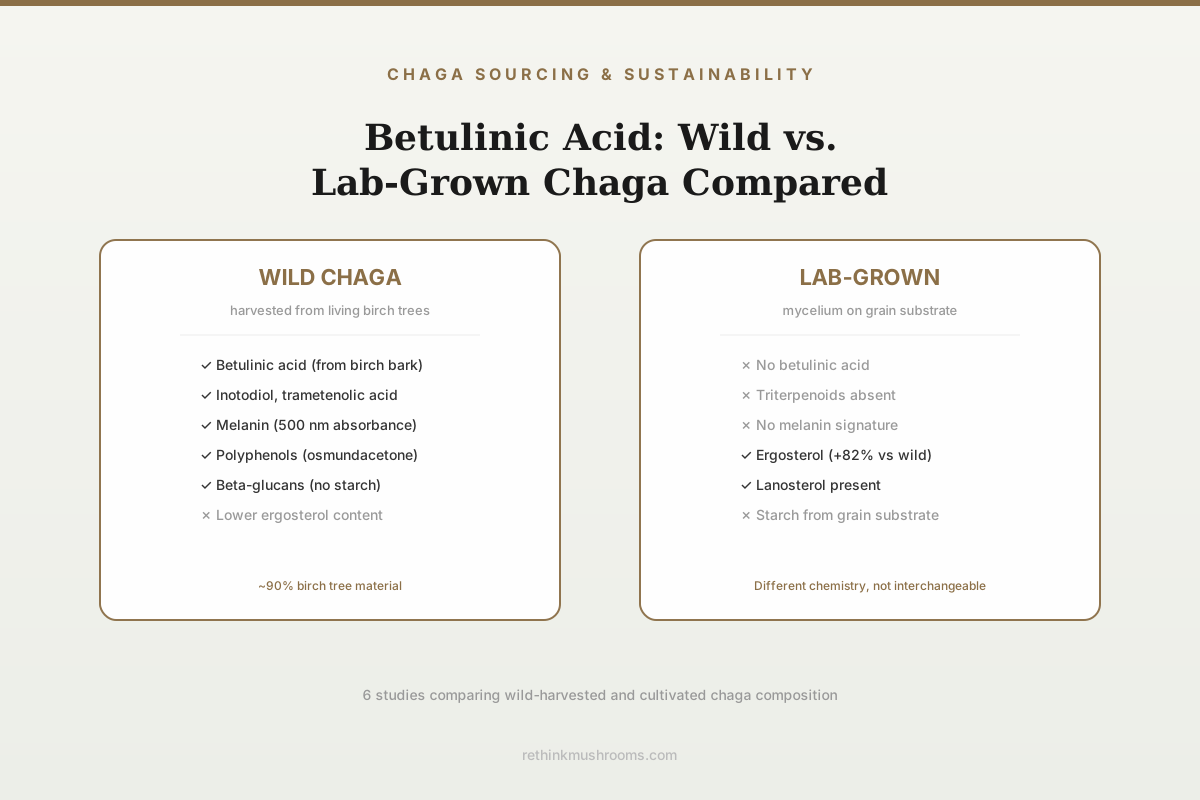
Lab-grown chaga mycelium on grain substrates contains zero or trace betulinic acid. This compound originates from birch trees, not from Inonotus obliquus itself.
Windsor et al., IJMS, 2025
~90% Birch Wood
composition of wild chaga conk
Inotodiol Present
only in wild chaga canker
Starch-Rich
grain substrate detected in cultivated products
Windsor et al., IJMS, 2025
 View as image ↗
Betulinic acid is one of chaga's most cited bioactive compounds, investigated for anti-cancer, anti-inflammatory, and antiviral properties. There is a fundamental problem with this narrative: betulinic acid does not come from chaga. It comes from birch trees. Wild-harvested Inonotus obliquus sclerotia (conks) contain betulinic acid because the conk is roughly 90% birch wood material, a pathological growth response by the tree to fungal infection.[1] Windsor et al. (2025) used six complementary analytical techniques to compare wild chaga canker against commercial supplements containing mycelium-on-grain products. The differences were stark: wild chaga contained triterpenoids (inotodiol, trametenolic acid) and melanin-based polyphenols, while fermented grain products were starch-rich with absent or undetectable levels of these compounds.[2]
For the broader question of wild vs. cultivated chaga, see wild vs. cultivated chaga: does it matter?. For why the birch tree relationship matters, see why wild chaga is more potent: the birch tree connection.
Key Takeaways
- Betulinic acid in wild chaga originates from birch tree bark (Betula spp.), not from Inonotus obliquus fungal biosynthesis (Ern et al., 2024)
- Wild chaga conks are approximately 90% woody birch material; lab-grown mycelium on grain contains none of this birch-derived chemistry (Fordjour et al., 2023)
- Multi-analytical comparison found wild chaga canker contained inotodiol and trametenolic acid triterpenoids; fermented grain products lacked these compounds entirely (Windsor et al., 2025)
- NMR fingerprinting and LC-QToF-MS metabolomics revealed "stark compositional deviations" between wildcrafted chaga canker, I. obliquus mycelium, and fermented grain products (Windsor et al., 2025)
- Iodine-starch assays confirmed starch-rich composition in grain-grown products and its absence in authentic wild chaga canker (Windsor et al., 2025)
- Chaga extract (wild-harvested) reduced oxidative DNA fragmentation by over 40% in human lymphocytes compared to H2O2-treated controls (Park et al., 2004)
Where Betulinic Acid Actually Comes From
Betulinic acid is a pentacyclic triterpene derived from betulin, a compound abundant in birch bark. When I. obliquus infects a living birch tree, the tree responds by producing a dense, melanin-rich mass (the sclerotium or conk) that incorporates both fungal tissue and host tree material. This conk, which takes 3-5 years to mature before harvest, is primarily composed of birch-derived compounds, including betulin and its derivative betulinic acid.[1]
Ern et al. (2024) reviewed the therapeutic properties of I. obliquus and noted that betulinic acid is present in wild-harvested sclerotia because it originates from the Betula spp. host tree. Whole genome analysis of I. obliquus suggests the fungus possesses biosynthetic enzymes that could theoretically produce betulin and betulinic acid. In practice, these compounds are present only in trace amounts or entirely absent in cultivated and fermented grain products.[1]
Fordjour et al. (2023) emphasized that wild chaga consists of roughly 90% woody plant material. The bioactive profile that has built chaga's reputation, including betulinic acid, melanin, and certain polyphenols, is inseparable from the birch tree relationship. A lab can cultivate the mycelium of I. obliquus, but it cannot replicate the canker or sclerotium itself.[3]
The 2025 Comparative Analysis
Windsor et al. (2025) conducted the most comprehensive analytical comparison of wild chaga versus commercial supplements. Using HPTLC, LC-ELSD, LC-PDA/DAD, LC-QToF-MS, NMR spectroscopy, UV-Vis spectrophotometry, and iodine-starch assays, they evaluated key markers including triterpenoids, polysaccharides, and melanin.[2]
Wild chaga canker contained:
- Triterpenoids: inotodiol, trametenolic acid
- Phenolics: osmundacetone and other polyphenols
- Melanin (detected via UV absorbance at 500 nm)
- Beta-glucans (no starch)[2]
Fermented grain products contained:
- High starch content (confirmed by iodine-starch assay)
- Absent or undetectable triterpenoids
- No melanin absorbance signature
- Polysaccharides primarily from the grain substrate rather than fungal origin[2]
NMR fingerprinting and LC-QToF-MS metabolomics demonstrated what the authors called "stark compositional deviations" between wildcrafted chaga canker, I. obliquus mycelium, and fermented grain products. The three forms are chemically distinct materials despite being sold under the same "chaga" label.[2]
The iodine-starch assay provides a simple authenticity test: wild chaga canker contains no starch and produces a negative result. Grain-grown products test positive for starch because the mycelium grows on rice or oat substrates and the final product includes substantial quantities of undigested grain. This is not a minor contaminant. In some products, grain-derived carbohydrates constitute the majority of the material.[2]
What Cultivated Chaga Does Contain
Cultivated mycelium is not bioactively inert. It produces a different set of compounds than wild canker.
Ern et al. (2024) noted that cultivated I. obliquus mycelium expresses sterol derivatives including ergosterol and lanosterol (linked to antifungal, antiviral, and anti-inflammatory effects) and inotodiol, with these sterols making up a substantial fraction of total sterol content. Cultivated mycelium reportedly contains 82% more ergosterol than wild conks.[1]
The trade-off is clear: wild chaga provides birch-derived compounds (betulinic acid, betulin, melanin), while cultivated mycelium provides fungal-derived sterols (ergosterol, lanosterol) but lacks the birch chemistry entirely. These are complementary profiles, not interchangeable ones.
Extraction Methods Affect What You Get
Even with authentic wild chaga, what ends up in the final extract depends on how it is processed. Lazić et al. (2024) compared green extraction technologies on I. obliquus from Serbia and Mongolia. Subcritical water extraction (SWE) at 200 degrees C produced higher yields of total polysaccharides and glucans. Microwave-assisted extraction with 50% ethanol yielded the highest total phenol content, with chlorogenic acid as the dominant phenolic compound.[4]
Different extraction solvents target different compound classes. Water extracts pull polysaccharides and some phenolics. Ethanol extracts access triterpenoids and less polar compounds, including betulinic acid. A "chaga extract" label without extraction method disclosure tells the consumer nothing about which bioactive compounds are present.[4]
Bioactivity of Wild Chaga Extracts
The bioactivity most commonly attributed to wild chaga extracts is antioxidant and DNA-protective.
Park et al. (2004) tested aqueous chaga extracts for protection against oxidative DNA damage in human lymphocytes using the comet assay. Cells pretreated with chaga extract at concentrations of 10-500 microg/mL showed over 40% reduction in DNA fragmentation compared to H2O2-treated positive controls. The protection was dose-dependent.[5]
Lee et al. (2007) isolated novel antioxidant polyphenols from I. obliquus, including inonoblins A, B, and C along with known phelligridins. These compounds exhibited scavenging activity against ABTS radical cation and DPPH radical. These polyphenols are distinct from betulinic acid and represent a separate class of wild chaga bioactives.[6]
Whether these effects are attributable to betulinic acid specifically, to the polyphenol fraction, to melanin, or to the combination remains unresolved. Wild chaga is a complex mixture of hundreds of compounds from both fungal and tree origin. Isolating the contribution of any single compound is methodologically difficult. For sustainability concerns with wild harvesting, see chaga sustainability crisis and sustainable chaga harvesting.
What This Means for Supplements
The practical implications are straightforward:
If betulinic acid is the target compound, only wild-harvested chaga from birch trees will contain it. Grain-grown mycelium products labeled "chaga" do not provide betulinic acid regardless of dose.
If general immunomodulation is the goal, cultivated mycelium may still offer value through ergosterol, lanosterol, and fungal polysaccharides, though the evidence base is thinner than for wild chaga.
If antioxidant protection is desired, extraction method matters as much as source. Ethanol extracts access different compounds than water extracts, and the polyphenol profile varies by preparation.
The label "chaga" without further specification is insufficient for informed use. Source (wild vs. cultivated), substrate (birch vs. grain), and extraction method all determine the chemical profile of the final product.
The Bottom Line
Betulinic acid in chaga comes from birch trees, not from the Inonotus obliquus fungus. Wild-harvested chaga canker, which is approximately 90% birch wood, contains betulinic acid, inotodiol, trametenolic acid, and melanin. Lab-grown mycelium on grain substrates lacks all of these compounds but contains more ergosterol. A 2025 multi-analytical study confirmed "stark compositional deviations" between wild canker and commercial grain-grown supplements. The compounds that built chaga's reputation are inseparable from the birch tree relationship, and no cultivation method has replicated them.
Frequently Asked Questions
Sources & References
- 1RTHM-01886·Ern, Phoebe Tee Yon et al. (2024). “Chaga Therapeutic Properties: What This 2024 Review Actually Shows.” Mycology.Study breakdown →PubMed →↩
- 2RTHM-02209·Windsor, Coleton et al. (2025). “What This 2025 Chaga Supplement Authentication Study Actually Found.” International journal of molecular sciences.Study breakdown →PubMed →↩
- 3RTHM-01694·Fordjour, Eric et al. (2023). “Chaga mushroom: a super-fungus with countless facets and untapped potential..” Frontiers in pharmacology.Study breakdown →PubMed →↩
- 4RTHM-00888·Lazić, Vesna et al. (2024). “The Effect of Green Extraction Technologies on the Chemical Composition of Medicinal Chaga Mushroom Extracts..” Journal of fungi (Basel.Study breakdown →PubMed →↩
- 5RTHM-00076·Park, Yoo Kyoung et al. (2004). “Chaga mushroom extract inhibits oxidative DNA damage in human lymphocytes as assessed by comet assay..” BioFactors (Oxford.Study breakdown →PubMed →↩
- 6RTHM-00118·Lee, In-Kyoung et al. (2007). “New antioxidant polyphenols from the medicinal mushroom Inonotus obliquus..” Bioorganic & medicinal chemistry letters.Study breakdown →PubMed →↩