Chaga Sourcing and Sustainability
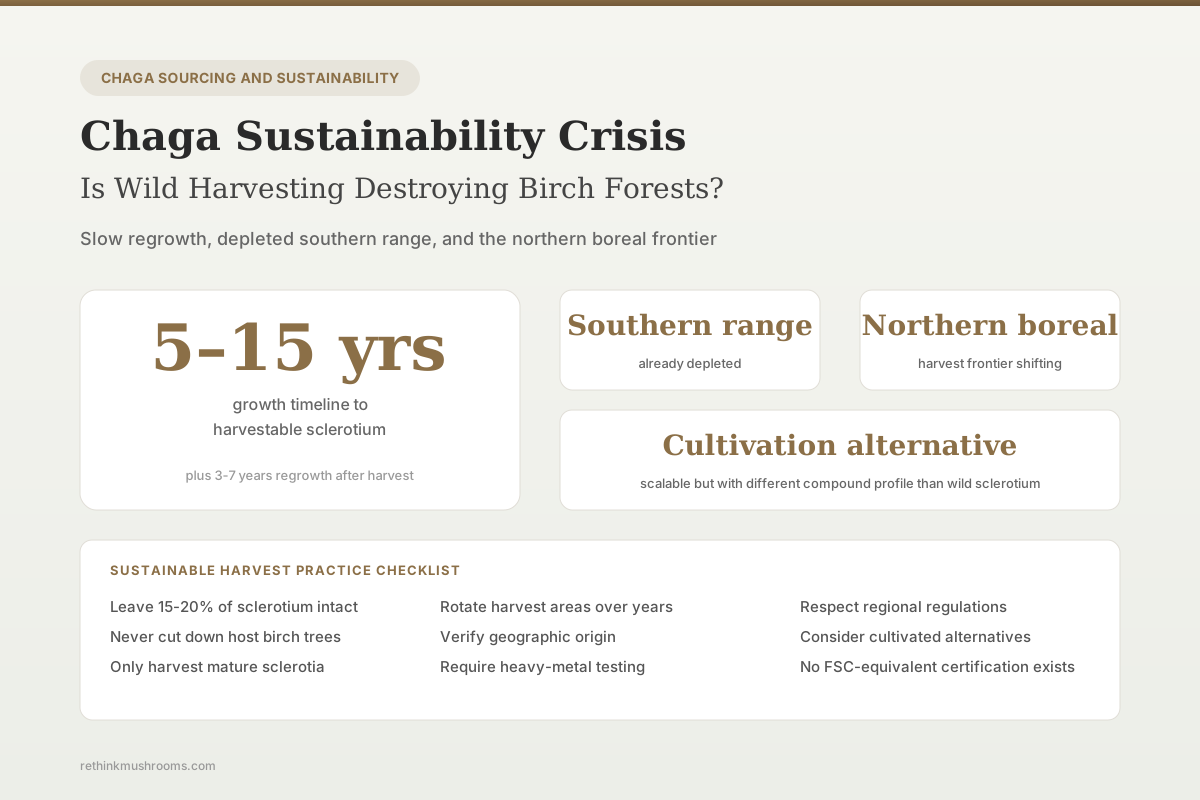
3–7 years Regrowth after harvest
Chaga sclerotia grow slowly on living birch trees over years to decades. After harvest, the same sclerotium takes 3-7 years or longer to regrow meaningfully, if it regrows at all. Combined with growing commercial demand, this has depleted wild populations in the southern range and pushed harvesting north to boreal Canada, Alaska, and Siberia, where depletion is inevitable without sustainable practices.
Burmasova et al., Biomolecules, 2019
Depleted southern range
wild chaga has become rare in the southern part of its range across North America and Eurasia
Northern boreal harvest
most commercial chaga now comes from northern Canada, Russia, and Alaska
Cultivation alternative
mycelium-based cultivation produces chaga biomass at scale but with different compound profiles than wild sclerotium
Burmasova et al., Biomolecules, 2019
 View as image ↗
Chaga (Inonotus obliquus) is a slow-growing parasitic fungus that forms its characteristic sclerotium (the black canker) on living birch trees over years to decades. Commercial demand has expanded sharply since Western interest in chaga accelerated in the early 2000s, with North American, European, and Asian markets all expanding. The pressure on wild populations is real: chaga is now scarce in the southern part of its historical range, commercial harvesting has moved north into boreal Canada, Alaska, Russia, and Finland, and cultivation alternatives, while scalable, do not fully replicate the compound profile of wild sclerotium. The research literature largely focuses on chaga's medicinal properties rather than its ecology, making sustainability a question answered more from ethnobotanical and forestry observation than from peer-reviewed quantitative studies.[1] For the related compound-profile sibling, see chaga bioactive compounds: betulinic acid, melanin, and polysaccharides and how birch trees contribute to chaga's chemistry.
Key Takeaways
- Wild chaga grows slowly on living birch trees, typically 5–15 years from spore colonisation to a harvestable sclerotium; after harvest, regrowth on the same site is slow and often incomplete, with the parent tree eventually dying from continued infection
- Chaga has become depleted in the southern part of its range (southern Canada, northern US, central and southern Europe, Japan) where tree populations are smaller and harvest pressure has been continuous for longer
- Commercial harvesting has shifted north into boreal Canada, Alaska, Russia, and Siberia where wild populations remain larger but are showing local depletion around accessible roads, waterways, and population centres
- Sustainable wild harvest practices include leaving 15-20% of each sclerotium intact to support regrowth, not cutting down host trees to access high sclerotia, harvesting only mature sclerotia (avoiding small developing ones), and rotating harvest areas over multiple-year cycles
- Cultivated chaga (mycelium grown on grain or liquid culture) is commercially available and scalable, but its triterpenoid, phenolic, and melanin profile differs measurably from wild sclerotium (Burmasova 2019 documented structural differences in melanin from wild vs cultivated sources)
- No formal certification scheme equivalent to FSC forestry or MSC fisheries exists for chaga; consumers rely on supplier transparency, geographic source verification, and regional regulations that vary substantially between jurisdictions
The Biology of Chaga Growth
Chaga is a parasitic polypore that colonises living birch trees (Betula species) through wounds in the bark. After spore germination, the fungus grows through the inner bark and cambium over years, eventually forming the external sclerotium that is the visible and harvestable structure. The sclerotium is not a reproductive structure (reproductive fruiting bodies form only after the host tree dies and fall), but a dense mass of sterile mycelium mixed with birch wood fragments and melanin-rich pigment.
Growth rates depend on host tree health, age, climate, and local microclimate. Typical estimates from forestry and ethnobotanical observation place the timeline from initial infection to a harvestable sclerotium at 5-15 years, with some slower sites requiring longer. Once a sclerotium is fully removed, any remaining infected wood can produce a new sclerotium, but this regrowth is itself slow, 3-7 years or more for a second harvest of comparable size, and often the host tree declines or dies before a second harvest is possible. A single chaga-bearing tree therefore has a finite harvest yield over its lifetime.
Ecological Role and the Host Tree Relationship
Chaga is a slow parasite; the infection progresses over decades and eventually contributes to tree death, but does not kill quickly. During the years when the chaga sclerotium is present, the host birch continues photosynthesising, growing, and contributing to forest ecology. The relationship between chaga and birch is not symbiotic in the mutualistic sense, but the long coexistence means that chaga populations are tied to birch forest health at the landscape level.
Birch forests across the boreal range face multiple pressures: climate change-driven shifts in species distribution, commercial logging, agricultural clearance, and increasing fire frequency in some regions. Chaga depends on mature birch trees with enough wound entry points and enough age for multi-year colonisation. Young managed birch plantations do not generally support chaga populations. Old-growth and mature mixed boreal forests are the primary chaga habitat.
The implication for sustainability is that chaga sustainability is not just a harvesting question; it is a forestry question. Sustainable chaga requires sustainable birch forests. Any disruption to boreal forest integrity (from logging, fire, climate shifts) affects the underlying chaga resource independently of harvest pressure.
The Southern Range Depletion
Wild chaga has become rare in the southern part of its historical range. In southern Canada, northern United States (particularly the Great Lakes region and New England), central and southern Europe, and parts of Japan, wild chaga populations that were historically present have been substantially depleted. Contributing factors include:
Cumulative commercial harvest: These regions have been accessible to commercial collectors for decades, and the slow regrowth rate has not kept pace with removal.
Tree cutting for access: Some harvest practices involve cutting down entire birch trees to access sclerotia too high to reach safely. This removes both the immediate chaga and the host tree, preventing any regrowth.
Forestry pressure: Birch forests in these regions face development, logging, and agricultural pressure independent of chaga harvesting, reducing the underlying host population.
Climate and disease pressure on birch: Some southern birch populations face pressure from bronze birch borer, forest tent caterpillar, and climate-related stressors that reduce tree health independently of chaga.
The Northern Boreal Shift
Commercial chaga harvesting has shifted north into boreal Canada, Alaska, Russia, and Siberia, where wild populations remain abundant at the landscape scale. These regions contain vast birch-dominated or mixed boreal forests with long coexistence between chaga and birch. The shift is visible in commercial chaga product labelling: "wild-harvested Siberian chaga" and "Alaskan wild chaga" are now common product descriptors, where a decade or two ago "Canadian wild chaga" or "Northeast US wild chaga" were more common.
The northern shift does not eliminate the sustainability concern; it postpones it. Accessible northern regions, such as areas near roads, waterways, and population centres, are already showing local depletion as commercial harvesters work outward from access points. Remote boreal interiors remain largely unharvested because the cost of access exceeds the commercial value at current prices. As prices rise or as accessible populations are depleted further, the harvest frontier will move into these interiors as well.
What Sustainable Wild Harvest Actually Looks Like
Sustainable wild chaga harvest is feasible but requires specific practices that are not always followed by commercial harvesters. The published harvest guidance across ethnobotanical and forestry sources converges on the following:
Leave a portion of each sclerotium: Removing 80-85% of the sclerotium while leaving 15-20% on the tree can support regrowth, though this varies by site conditions.
Harvest only mature sclerotia: Small developing sclerotia have not yet produced the compound profile associated with mature chaga and should be left to mature.
Do not cut down host trees: Chaga too high to reach safely should be left. Cutting the tree destroys the forest resource and the regrowth potential.
Rotate harvest areas: A single area should not be harvested repeatedly. Multi-year rotation allows local populations to recover.
Respect regional regulations: Some jurisdictions restrict wild chaga harvest or require permits. Alaska, British Columbia, and parts of Russia have local regulations at varying enforcement levels.
Source-verify for consumers: Purchase from suppliers who identify geographic origin specifically and can document their harvest practices.
Very few commercial chaga products meet all of these standards. Consumer verification is limited, and most commercial chaga is sold without substantive information on harvest practices beyond general marketing language.
The Cultivation Alternative
Cultivated chaga is commercially available at scale. Two main approaches exist:
Mycelium on grain: I. obliquus mycelium is grown on sterilised grain (rice, millet) in controlled conditions. The resulting biomass contains the mycelium plus the grain substrate. Quality varies by producer; some products contain 20-40% starch from the grain substrate rather than pure mycelium.
Liquid culture: Mycelium is grown in submerged liquid fermentation, producing biomass and culture broth. The dry matter of culture broth (DMCB) is the fraction tested in many research studies (Sun et al., 2008 used DMCB for antidiabetic activity in alloxan mice at 500 and 1000 mg/kg).[2]
The compound profile of cultivated chaga differs from wild sclerotium. Burmasova et al. (2019) directly compared melanin from wild sclerotium to melanin from cultivated mycelium and documented structural differences: particle size, surface charge, antioxidant activity, and elemental composition all differed, with wild sclerotium melanin showing allomelanin character and cultivated mycelium melanin showing features closer to eumelanin.[1] Triterpenoid content is also generally lower in cultivated material because the characteristic chaga triterpenoids (inotodiol, trametenolic acid, betulin derivatives) partly derive from host birch metabolites that are absent in cultivation.
Cultivated chaga is therefore a different product from wild chaga, not a direct substitute. It may be better suited for applications that depend on polysaccharide content (which cultivates well) and less suited for applications depending on triterpenoid or wild-sclerotium-specific melanin content.
Certification and Consumer Verification
No formal certification scheme analogous to Forest Stewardship Council (FSC) for timber, Marine Stewardship Council (MSC) for fisheries, or Rainforest Alliance for agriculture exists specifically for chaga. Consumers attempting to buy sustainably sourced chaga have limited tools:
Organic certification: Some chaga products are certified organic under USDA, EU, or Canadian organic standards. Organic certification addresses chemical inputs and contamination but does not directly address sustainable harvest practices in wild-foraged products.
Geographic source transparency: Suppliers who specify the exact region (rather than "Siberian" or "North American") and can describe their harvest practices provide more information, though this is voluntary and not verified by third parties.
Third-party heavy metal testing: Independent laboratory testing for lead, cadmium, mercury, and arsenic is available from some suppliers. This addresses contamination (particularly relevant because chaga melanin binds heavy metals) but does not address sustainability.
Cultivated versus wild labelling: Clear labelling of cultivated versus wild origin allows consumers to make informed choices. Cultivated chaga has a different sustainability profile (no wild resource depletion, but other agricultural inputs) and different compound profile.
What the Reviews Note About Sustainability
The primary chaga medical reviews (Fordjour 2023; Ern 2024; Szychowski 2021) focus on medicinal properties and largely do not address sustainability in depth.[3][4][5] Glamočlija et al. (2015) noted variability in chaga compound profiles across geographic sources, implicitly raising sustainability questions about source consistency as wild populations are depleted from any given region.[6]
The gap in the research literature, specifically quantitative ecological assessment of chaga population dynamics under harvest pressure, is substantial. Published ecological studies of commercially harvested fungi are dominated by other species (matsutake, morels, truffles), with chaga receiving comparatively little attention despite the economic scale of the current market.
What the Evidence Supports and What It Does Not
| Question | Evidence | Confidence |
|---|---|---|
| Has wild chaga been depleted in its southern range? | Yes, documented in ethnobotanical and commercial sources | Moderate |
| Is boreal chaga being harvested at current scales? | Yes, major commercial harvest is concentrated in boreal Canada, Russia, Alaska | High |
| Are current harvest practices sustainable at the landscape level? | Unknown: no quantitative ecological study | None |
| Does cultivated chaga have the same compound profile as wild? | No: documented differences in melanin, triterpenoids, and polysaccharides | Moderate |
| Is there a certification scheme for sustainable chaga? | No | High |
| Does consumer purchasing meaningfully affect wild chaga sustainability? | Plausible but unquantified | Low |
The Bottom Line
Wild chaga (Inonotus obliquus) grows slowly on living birch trees, with 5-15 year cycles from initial infection to harvestable sclerotium and 3-7 year or longer regrowth after harvest. Commercial demand has depleted wild populations in the southern range of both North America and Eurasia, pushing harvesting north into boreal Canada, Russia, Alaska, and Siberia where local depletion is beginning around access points. Cultivated chaga is scalable but has measurably different compound profiles: Burmasova et al. (2019) documented structural differences between wild sclerotium and cultivated mycelium melanin, and triterpenoid content is generally lower in cultivated material because key compounds derive from host birch metabolites. No formal certification scheme exists for sustainable chaga; consumers rely on supplier transparency, geographic source verification, and voluntary standards. The research literature on chaga ecology and harvest sustainability is limited, leaving many important questions (regeneration rates, population dynamics under pressure, landscape-level impact) unanswered.
Frequently Asked Questions
Sources & References
- 1RTHM-00545·Burmasova, Marina A et al. (2019). “Melanins of Inonotus Obliquus: Bifidogenic and Antioxidant Properties..” Biomolecules.Study breakdown →PubMed →↩
- 2RTHM-00145·Sun, Jun-En et al. (2008). “Antihyperglycemic and antilipidperoxidative effects of dry matter of culture broth of Inonotus obliquus in submerged culture on normal and alloxan-diabetes mice..” Journal of ethnopharmacology.Study breakdown →PubMed →↩
- 3RTHM-01694·Fordjour, Eric et al. (2023). “Chaga mushroom: a super-fungus with countless facets and untapped potential..” Frontiers in pharmacology.Study breakdown →PubMed →↩
- 4RTHM-01886·Ern, Phoebe Tee Yon et al. (2024). “Chaga Therapeutic Properties: What This 2024 Review Actually Shows.” Mycology.Study breakdown →PubMed →↩
- 5RTHM-00722·Szychowski, Konrad A et al. (2021). “Inonotus obliquus - from folk medicine to clinical use..” Journal of traditional and complementary medicine.Study breakdown →PubMed →↩
- 6RTHM-00373·Glamočlija, Jasmina et al. (2015). “Chemical characterization and biological activity of Chaga (Inonotus obliquus), a medicinal "mushroom"..” Journal of ethnopharmacology.Study breakdown →PubMed →↩