Chaga Foundations
3 compound classes
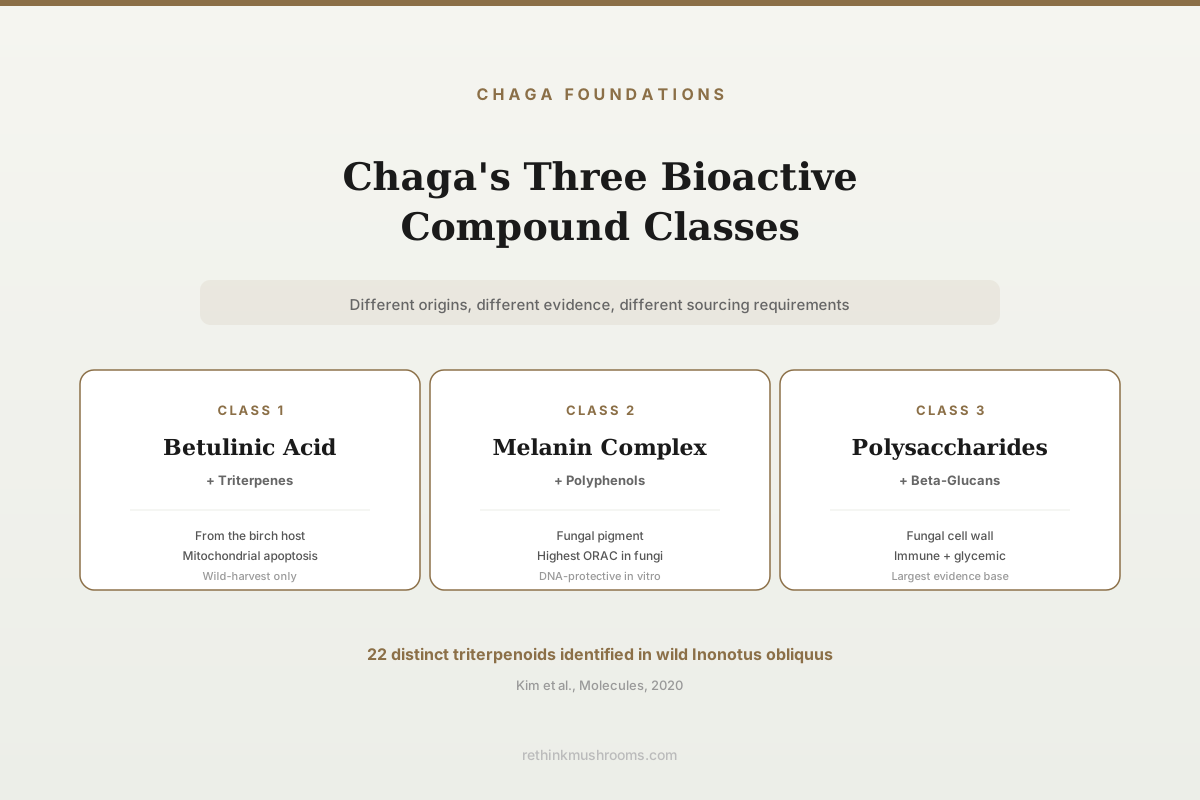
Chaga's pharmacology is driven by three distinct chemistries: birch-derived triterpenes, fungal melanin, and fungal polysaccharides. Each has different evidence and different sourcing requirements.
Ern et al., Mycology, 2024
Betulinic Acid
from the birch host, not the fungus
Melanin Complex
the highest ORAC among edible fungi
Beta-Glucans
immune and glycemic signaling
Ern et al., Mycology, 2024
 View as image ↗
When researchers talk about chaga bioactive compounds, they are not describing a single molecule. They are describing a chemistry problem. Inonotus obliquus produces hundreds of secondary metabolites, absorbs compounds from its birch host, and concentrates a pigment complex whose structure is still being mapped. Three classes do the heaviest lifting in the published literature: betulinic acid and related triterpenes, the melanin-polyphenol complex, and polysaccharides dominated by beta-glucans. Each has a different origin, a different evidence profile, and a different set of sourcing rules. Ern et al. (2024) reviewed the therapeutic properties of I. obliquus and identified these three families as the primary contributors to chaga's anti-cancer, antioxidant, antidiabetic, and immunomodulatory activity.[1]
This article is a map of those three compound classes. For the broader context of what chaga is as an organism, see what is chaga mushroom and why chaga isn't technically a mushroom. For the biological reason chaga concentrates these compounds in the first place, see Inonotus obliquus: the antioxidant-dense birch parasite.
Key Takeaways
- Betulinic acid in chaga is birch-derived, not fungal, and only wild-harvested chaga growing on Betula species contains meaningful amounts (Ern et al., 2024)
- Chaga polyphenol and polysaccharide extracts reduced oxidative DNA damage in human lymphocytes at concentrations as low as 10 microg/mL in the comet assay (Park et al., 2004)
- I. obliquus polysaccharides lowered fasting blood glucose in streptozotocin-induced diabetic rats and improved insulin signaling through PI3K-Akt pathway activation (Diao et al., 2014; Wang et al., 2017)
- A 2025 comparative analysis of commercial chaga supplements found wide variation in beta-glucan content and frequent species misidentification across 19 products tested (Windsor et al., 2025)
- Chaga triterpenoid composition shifts dramatically between wild sclerotia and cultured mycelium, with 22 distinct triterpenoids identified and differential anti-proliferative activity across cancer cell lines (Kim et al., 2020)
- Green extraction methods such as subcritical water and ultrasound change the ratio of polysaccharides to polyphenols recovered from the same starting material (Lazic et al., 2024)
The Three Compound Classes, Briefly
Before going deep on any single class, a framing point: chaga's three major compound families come from three different biological sources, and this matters for anyone trying to interpret the research.
Betulinic acid and the pentacyclic triterpenes originate from the birch host. The fungus absorbs betulin from the bark and converts a portion of it to betulinic acid as it grows into the wood. Cultivated chaga grown on grain or liquid media has none of it.
The melanin-polyphenol complex is the black pigment that gives the sclerotium its charcoal appearance. It is fungal in origin, produced by the mycelium as a defense against ultraviolet radiation and oxidative stress in cold northern climates. It is what drives chaga's exceptionally high antioxidant activity in chemical assays.
Polysaccharides, especially beta-glucans, are built by the fungal cell wall. These are the most extensively studied compounds for immune modulation and glycemic effects, and they are present in both wild and cultivated material, though the structures differ.
Fordjour et al. (2023) framed chaga as a "super-fungus with untapped potential" precisely because these three classes act through distinct mechanisms and could, in principle, complement one another.[2]
Betulinic Acid: the Birch-Derived Triterpene
Betulinic acid is a pentacyclic triterpene. It was isolated from birch bark long before anyone thought to look for it in chaga, and its presence in chaga is a consequence of the fungus living inside a birch tree for 10 to 20 years.
Where It Actually Comes From
The confusion is common. Betulinic acid is often described as "a chaga compound." It is more accurate to call it a birch compound that chaga biotransforms. Wild chaga sclerotia growing on Betula species accumulate betulinic acid at concentrations that vary with tree age, latitude, and the specific Betula species. Chaga grown by submerged liquid fermentation on a non-birch substrate produces essentially no betulinic acid. This sourcing distinction is the single most important thing a consumer can know about chaga products. For the full wild-versus-lab-grown comparison, see betulinic acid: wild harvest vs. lab-grown chaga.
Kim et al. (2020) quantified 22 distinct triterpenoids in I. obliquus and tested their anti-proliferative activity across cancer cell lines.[3] Betulinic acid was present but was not the only active triterpene. Inotodiol, lanostane-type triterpenes, and related compounds also showed cytotoxic activity at varying potencies. This is worth keeping in mind whenever betulinic acid is discussed as if it were the sole active ingredient.
What the Research Shows
Betulinic acid's mechanism in cancer cells is well-characterized. It permeabilizes the outer mitochondrial membrane, releases cytochrome c, activates caspase-9, and triggers downstream caspases 3 and 7, the intrinsic apoptosis pathway. The mechanism is p53-independent, which matters because p53 is mutated in most advanced human cancers and most conventional chemotherapies depend on it. For the step-by-step pathway analysis, see betulinic acid anti-cancer mechanisms. For the full span of cancer and antiviral evidence, see betulinic acid from chaga: anti-cancer and antiviral research.
Outside of cancer, betulinic acid and its derivatives have documented anti-inflammatory, antiviral, and hepatoprotective activity in preclinical models. The anti-inflammatory data is covered separately in betulinic acid from chaga: the birch anti-inflammatory.
What Is Not Yet Known
No human clinical trial has tested betulinic acid from chaga for any indication. All of the anti-cancer and anti-inflammatory evidence comes from cell culture and rodent studies. Bioavailability of orally administered betulinic acid is poor, which is a core reason the pharmaceutical industry has pursued derivatives rather than the native compound. A chaga tea contains betulinic acid, but the dose that actually reaches systemic circulation after oral ingestion has not been characterized in humans.
The Melanin-Polyphenol Complex: Chaga's Defining Pigment
Chaga's black color is not cosmetic. The melanin-polyphenol complex is a high-molecular-weight polymer of phenolic subunits, and it is one of the most concentrated antioxidant systems found in any edible fungus.
What the Complex Actually Is
Chemically, chaga melanin is a heteropolymer. Lee et al. (2007) isolated three new antioxidant polyphenols from I. obliquus and characterized their radical-scavenging activity, which exceeded that of several reference antioxidants at equivalent concentrations.[4] Glamoclija et al. (2015) performed a full chemical characterization of chaga from wild European sources and documented phenolic, flavonoid, and melanin content alongside the associated biological activities.[5] Szychowski et al. (2021), in their folk-medicine-to-clinical-use review, identified the melanin-polyphenol complex as the chemical basis of chaga's reputation as a "health tonic" across centuries of Eastern European and Siberian use.[6]
Antioxidant and DNA-Protective Activity
The antioxidant activity of chaga extracts in chemical assays is genuinely high, high enough that chaga is routinely cited as having one of the highest ORAC values of any edible fungus or plant-derived material. This is covered in detail in chaga antioxidants: the highest ORAC in the mushroom kingdom.
The biologically more meaningful evidence is Park et al. (2004), which tested chaga extract against hydrogen-peroxide-induced DNA damage in human lymphocytes using the comet assay.[7] At concentrations of 10 to 500 microg/mL, the extract reduced oxidative DNA fragmentation by over 40%. Comet assay damage correlates with cancer risk in long-term human cohorts, which makes this a more translationally relevant endpoint than a chemical radical-scavenging measurement.
The ORAC Caveat
A high ORAC value does not automatically translate to a clinical benefit. The FDA removed the ORAC database from its website in 2012 in part because marketers were using chemical antioxidant assay values to imply human health effects that had not been demonstrated. Chaga's melanin-polyphenol antioxidant capacity is real and high in vitro. The extent to which it is preserved after extraction, digestion, and absorption, and the extent to which circulating antioxidant activity matters clinically, remains an open question. Honest interpretation requires holding both facts at once.
Polysaccharides and Beta-Glucans: the Most-Studied Class
The polysaccharide fraction is where chaga has the most published human and animal data. These are high-molecular-weight sugar polymers built by the fungal cell wall.
Structure and Immune Signaling
Chaga beta-glucans contain 1,3 and 1,6 glycosidic linkages that are recognized by pattern-recognition receptors on innate immune cells: Dectin-1 on macrophages and neutrophils, Complement Receptor 3, and TLR2. When these receptors engage fungal beta-glucans, they trigger cytokine release, phagocytic activation, and cross-talk with adaptive immunity. For the immune-signaling cascade in detail, see chaga beta-glucans and immune cell activation.
Duru et al. (2019) reviewed the preclinical pharmacology of I. obliquus and identified polysaccharides as the primary drivers of immunomodulation across the published literature, with consistent activity across multiple rodent models.[8]
Antidiabetic Activity
The polysaccharide data in diabetes models is unusually consistent. Diao et al. (2014) administered I. obliquus polysaccharides to streptozotocin-induced diabetic rats and documented reductions in fasting blood glucose, improvements in oral glucose tolerance, and partial restoration of pancreatic islet morphology.[9] Liu et al. (2018) structurally characterized two distinct polysaccharides from chaga and tied hypoglycemic activity to specific molecular weights and linkage patterns.[10]
The mechanism involves AMPK activation in skeletal muscle and liver, improved PI3K-Akt insulin signaling, and antioxidant protection of pancreatic beta cells against streptozotocin-induced damage. For the AMPK pathway specifically, see chaga AMPK activation and insulin sensitivity.
Antiviral Polysaccharides
Polysaccharide bioactivity is not limited to immune signaling and glycemic effects. Tian et al. (2017) isolated an I. obliquus polysaccharide with broad-spectrum antiviral activity against multiple feline viruses, demonstrating direct antiviral activity at sub-cytotoxic concentrations.[11] Earlier work by Pan et al. (2013) showed chaga polysaccharides block herpes simplex virus entry by interfering with viral-induced membrane fusion, independent of any effect on the host immune system.
The Translation Problem
Almost all of the polysaccharide evidence is preclinical. The single biggest gap in the chaga literature is a shortage of well-powered randomized controlled trials in humans with diabetes, immune dysfunction, or any other indication where the rodent data is strong. Szychowski et al. (2021) made this point directly: chaga has been used in folk medicine for centuries and has a large preclinical evidence base, but the translational step is mostly missing.[6]
Other Triterpenoids Worth Knowing
Betulinic acid gets most of the attention, but Kim et al. (2020) identified 22 different triterpenoids in I. obliquus, and several of them have independent biological activity.[3]
Inotodiol is a lanostane-type triterpene found almost exclusively in chaga. Preclinical data suggests anti-allergic and anti-tumor activity, with a mechanism distinct from betulinic acid's mitochondrial apoptosis pathway. Unlike betulinic acid, inotodiol appears to be fungal-derived. It is present in both wild and some cultivated chaga preparations, though concentrations vary dramatically.
Trametenolic acid and ergosterol peroxide are present at lower concentrations but have documented activity in cancer cell lines and in immunomodulation assays.
Lanostane triterpenes as a class contribute to the cytotoxic activity documented in Kim's panel of cancer cell lines. The implication is that attributing chaga's anti-cancer activity to betulinic acid alone overstates what a single molecule explains.
Why Sourcing and Extraction Change What You Actually Get
The research on chaga bioactive compounds would be more straightforward if every chaga sample had the same composition. It does not.
Wild vs. Cultivated
Wild sclerotia from Betula trees contain betulinic acid, inotodiol, a mature melanin-polyphenol complex, and fungal beta-glucans. Cultivated mycelium from submerged liquid fermentation contains beta-glucans and some triterpenoids, but no meaningful betulinic acid and a different, less-developed pigment complex. The products are not interchangeable.
Windsor et al. (2025) analyzed commercial chaga dietary supplements using multiple complementary analytical techniques and found wide variation in beta-glucan content, polyphenol content, and species authenticity across 19 tested products.[12] Some products labeled as chaga contained substantial non-chaga mycelium. Others had beta-glucan content consistent with wild sclerotia. The label alone was unreliable.
Extraction Chemistry
Lazic et al. (2024) tested how different "green" extraction technologies (subcritical water, ultrasound, microwave-assisted, and conventional hot water) changed the chemical composition of the final chaga extract from a single starting material.[13] The ratios of polysaccharides, polyphenols, and triterpenoids recovered differed substantially between methods. An extract optimized for polysaccharide yield captured a minority of the polyphenol fraction, and vice versa.
The practical consequence is that when a research paper reports "chaga extract at 200 mg/kg," the exact compound exposure depends entirely on the extraction. Readers of the chaga literature should pay attention to whether the authors used ethanol, water, hot water, or a sequential extraction, because the pharmacological consequence changes.
What the Evidence Looks Like Honestly
The three compound classes each have a different evidence profile.
Betulinic acid has strong mechanistic data in cell culture, consistent activity in rodent cancer models, and zero human clinical trials in chaga-sourced material. The bioavailability problem is real and unresolved.
The melanin-polyphenol complex has impressive antioxidant assay data, at least one solid human-cell-based study on oxidative DNA protection, and weak translation to any human clinical endpoint. The ORAC numbers are real; what they mean for human health is contested.
Polysaccharides have the most consistent preclinical evidence across immune, glycemic, and antiviral models, and the least human trial data given the size of the preclinical base. This is the compound class most likely to matter clinically if chaga is ever formally tested, and it is also the class where a well-designed phase 2 trial would change the field.
Fordjour et al. (2023) used the phrase "untapped potential" deliberately.[2] The compounds are characterized. The mechanisms are mapped. The human trials are mostly absent. That is the accurate summary of the evidence landscape as of 2026.
For historical context on how chaga went from Siberian folk medicine to the subject of modern natural-product chemistry, see chaga in traditional medicine: from 12th century Europe to modern research.
The Bottom Line
Chaga's pharmacology is driven by three compound classes with three different biological origins: birch-derived betulinic acid, fungal melanin-polyphenol complex, and fungal polysaccharides. The preclinical evidence is substantial across all three; the human clinical evidence is thin. Sourcing and extraction method change which compounds reach the consumer, which is why wild-harvested whole-sclerotium material and cultivated liquid-fermentation mycelium are not pharmacologically equivalent.
Frequently Asked Questions
Sources & References
- 1RTHM-01886·Ern, Phoebe Tee Yon et al. (2024). “Chaga Therapeutic Properties: What This 2024 Review Actually Shows.” Mycology.Study breakdown →PubMed →↩
- 2RTHM-01694·Fordjour, Eric et al. (2023). “Chaga mushroom: a super-fungus with countless facets and untapped potential..” Frontiers in pharmacology.Study breakdown →PubMed →↩
- 3RTHM-01218·Kim, Jaecheol et al. (2020). “Composition of Triterpenoids in Inonotus obliquus and Their Anti-Proliferative Activity on Cancer Cell Lines..” Molecules (Basel.Study breakdown →PubMed →↩
- 4RTHM-00118·Lee, In-Kyoung et al. (2007). “New antioxidant polyphenols from the medicinal mushroom Inonotus obliquus..” Bioorganic & medicinal chemistry letters.Study breakdown →PubMed →↩
- 5RTHM-00373·Glamočlija, Jasmina et al. (2015). “Chemical characterization and biological activity of Chaga (Inonotus obliquus), a medicinal "mushroom"..” Journal of ethnopharmacology.Study breakdown →PubMed →↩
- 6RTHM-00722·Szychowski, Konrad A et al. (2021). “Inonotus obliquus - from folk medicine to clinical use..” Journal of traditional and complementary medicine.Study breakdown →PubMed →↩
- 7RTHM-00076·Park, Yoo Kyoung et al. (2004). “Chaga mushroom extract inhibits oxidative DNA damage in human lymphocytes as assessed by comet assay..” BioFactors (Oxford.Study breakdown →PubMed →↩
- 8RTHM-00553·Duru, Kingsley C et al. (2019). “The pharmacological potential and possible molecular mechanisms of action of Inonotus obliquus from preclinical studies..” Phytotherapy research : PTR.Study breakdown →PubMed →↩
- 9RTHM-00319·Diao, Bao-Zhong et al. (2014). “Protective Effect of Polysaccharides from Inonotus obliquus on Streptozotocin-Induced Diabetic Symptoms and Their Potential Mechanisms in Rats..” Evidence-based complementary and alternative medicine : eCAM.Study breakdown →PubMed →↩
- 10RTHM-00520·Liu, Ping et al. (2018). “Structure Characterization and Hypoglycaemic Activities of Two Polysaccharides from Inonotus obliquus..” Molecules (Basel.Study breakdown →PubMed →↩
- 11RTHM-00492·Tian, Jin et al. (2017). “Identification of Inonotus obliquus polysaccharide with broad-spectrum antiviral activity against multi-feline viruses..” International journal of biological macromolecules.Study breakdown →PubMed →↩
- 12RTHM-02209·Windsor, Coleton et al. (2025). “What This 2025 Chaga Supplement Authentication Study Actually Found.” International journal of molecular sciences.Study breakdown →PubMed →↩
- 13RTHM-00888·Lazić, Vesna et al. (2024). “The Effect of Green Extraction Technologies on the Chemical Composition of Medicinal Chaga Mushroom Extracts..” Journal of fungi (Basel.Study breakdown →PubMed →↩