Chaga (Inonotus obliquus)
3 Materials Sold As Chaga
A 2025 multi-technique analysis separated products sold as chaga into three compositionally distinct materials: wildcrafted sclerotium, cultured Inonotus obliquus mycelium, and mycelium grown on fermented grain. They are not chemically interchangeable, and most published research was done on the first one.
Windsor et al., International Journal of Molecular Sciences, 2025
14.2 g/100 g
oxalate measured in the chaga powder of a patient who developed end-stage renal disease (Lee 2020)
4–30×
more betulinic acid in alder-grown conks than birch-grown conks, the reverse of the standard label claim (Drenkhan 2022)
0 human trials
test any of chaga's five main claimed benefits; the only human data on chaga is three kidney-injury case reports
Windsor et al., International Journal of Molecular Sciences, 2025
 View as image ↗
Most people who take chaga mushroom are not taking a mushroom. The charred, black growth on birch trees is a sterile sclerotium, a hardened mass of fungal tissue fused with degraded wood. No gills, no cap, no spores. The fungus does form a true fruiting body, but it develops hidden beneath the bark and is almost never seen. That distinction matters more than most supplement labels admit, because what is chaga mushroom, in both biology and chemistry, depends heavily on where it grew and what was actually put in the bottle.
Inonotus obliquus has been used in Russia, Siberia and northern Europe for centuries, most often brewed as a tea for gastrointestinal complaints and general vitality.[1] Modern chemistry has confirmed that the sclerotium contains a genuinely unusual array of bioactive compounds, and preclinical research has found anti-inflammatory, antioxidant, immune-modulating, anti-cancer, antiviral and blood-sugar-lowering activity across cell and animal models.[9] Nearly all of that evidence is preclinical. There is also a safety issue involving the kidneys that most chaga content ignores entirely, and it is the only part of the chaga story that has been documented in living human beings. Both belong in this article.
Key Takeaways
- Chaga is a sterile sclerotium, not a fruiting body: a hardened mass of fungal hyphae fused with degraded wood, growing on the outside of a living tree. The true fruiting body forms hidden beneath the bark and is almost never observed (Fordjour 2023)
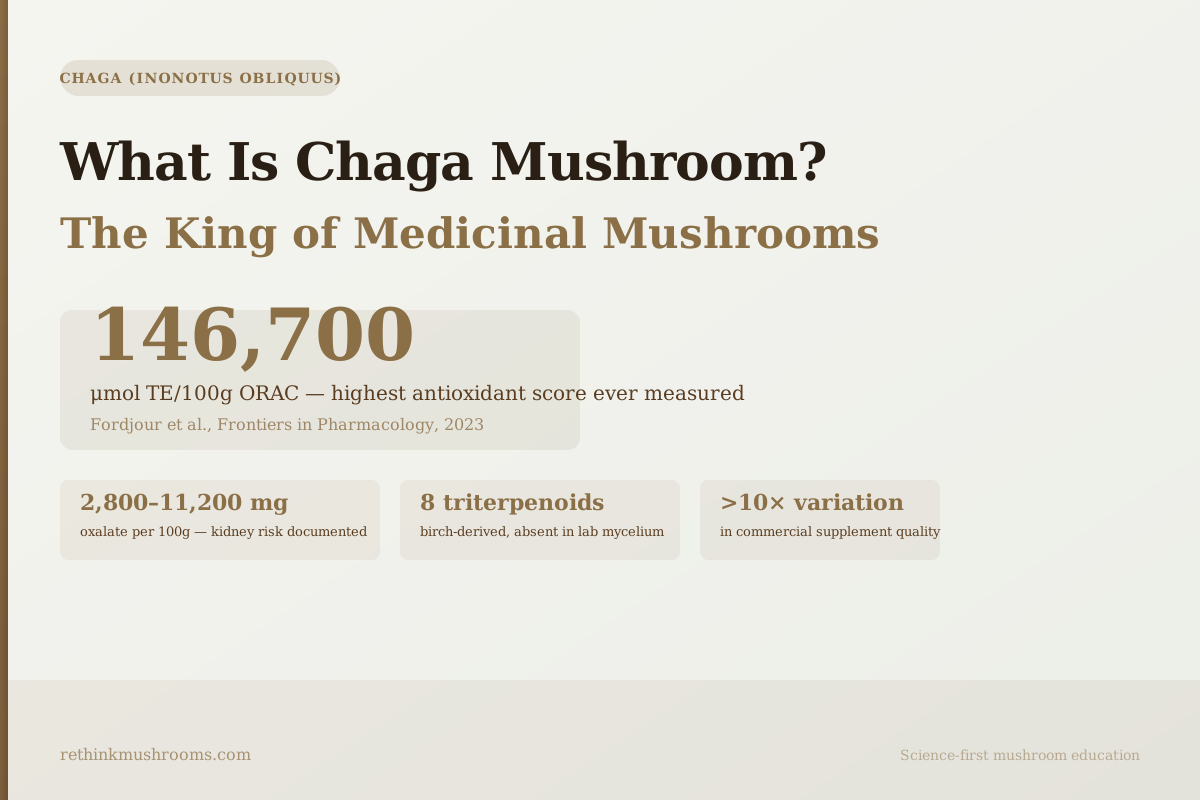
- The famous "146,700 ORAC" figure is not from a scientific paper. It traces to a single unpublished 2011 Brunswick Laboratories test report on one manufacturer's aqueous extract, and the USDA withdrew its ORAC database entirely in 2012 for exactly this kind of marketing use
- Chaga's antioxidant activity is nonetheless real and better documented than the ORAC number: aqueous extract cut hydrogen-peroxide-induced DNA fragmentation in human lymphocytes by over 40% (Park 2004), and the responsible polyphenols have been isolated and named (Lee 2007)
- The "birch-grown only" label claim does not survive measurement. Conks from grey alder contained 474–635 µg/g betulinic acid versus 20–132 µg/g in birch conks, with inotodiol and lanosterol showing no meaningful host difference (Drenkhan 2022)
- A 2025 multi-technique analysis found that wildcrafted chaga sclerotium, cultured I. obliquus mycelium, and mycelium-on-fermented-grain products are compositionally distinct, separable by melanin absorbance, iodine-starch response and triterpenoid profile (Windsor 2025)
- Three published case reports document oxalate nephropathy from sustained chaga use, including one progression to end-stage renal disease in a patient whose retained powder measured 14.2 g oxalate per 100 g (Kikuchi 2014; Lee 2020; Kwon 2022)
- No human clinical trial has tested chaga for any of its claimed benefits. The five pharmacological activities most often cited all stop at cell culture or rodent models (Duru 2019; Szychowski 2021)
Not a Mushroom: What Chaga Actually Is, and Why It Matters
The word "mushroom" usually refers to a fruiting body, the reproductive structure a fungus grows to release spores. Chaga is not that. Inonotus obliquus does produce a true fruiting body, but it forms hidden beneath the outer layer of infected bark. It is thin, papery, and almost never seen because it typically develops only as the host tree is dying.[2]
What is harvested and sold as chaga is the sterile conk, or sclerotium: a compact, irregular mass of hardened fungal tissue that erupts through the bark on the outside of the tree, built up over years or decades. Its outer layer is a dense black melanin crust; the interior is orange-brown and softer. It is not pure fungus. It is a composite of fungal hyphae and the degraded wood the fungus has been digesting, and the fungal fraction is the minority component. A frequently repeated figure puts the mycelial share at roughly ten percent, based on microscopic estimation, but the precise composition of the conk has never been well characterised, and no analytical paper establishes that ratio.[2]
This taxonomy has direct commercial consequences, because the market sells more than one material under the name. Windsor et al. analysed commercial chaga supplements in 2025 using high-performance thin-layer chromatography, liquid chromatography with mass spectrometry, NMR fingerprinting, UV-visible spectrophotometry and iodine-starch assays, and found that wildcrafted chaga canker, I. obliquus mycelium, and mycelium grown on fermented grain show stark compositional deviations from one another.[12] Whole canker carried triterpenoids such as inotodiol and trametenolic acid plus phenolics like osmundacetone, and its melanin absorbance at 500 nm distinguished it from fermented-grain products. Iodine-starch assays confirmed that fermented grain products are starch-rich and that authentic canker contains no starch at all.
The biology answers a question buyers often don't know to ask: is the "chaga" in this product the thing scientists have studied, or a different material carrying the same name?
For a complete explanation of the sclerotium biology and its implications for supplement selection, see Why Chaga Isn't Technically a Mushroom: The Sclerotium Explained.
Where Chaga Grows, and What the Host Tree Actually Changes
Chaga grows in cold northern forests: Siberia, Russia, Scandinavia, northern China, Canada, and the northeastern United States. Birch (Betula spp.) is the predominant host, and birch is the tree the entire marketing category is built around. It also colonises alder, elm, hornbeam and beech.[1]
The standard claim is that birch is the source of chaga's value, on the reasoning that birch bark is rich in betulin and betulinic acid, pentacyclic triterpenes studied in their own right for anti-inflammatory and anti-proliferative activity, and that I. obliquus absorbs and transforms these as it parasitises the tree. That story is intuitive. It is also the one claim in this article that has been directly tested against a comparison host, and the test did not go the way the story predicts.
Drenkhan et al. sampled sterile conks in Estonia from grey alder (Alnus incana), black alder (Alnus glutinosa) and silver birch (Betula pendula) and quantified their bioactive compounds. Betulinic acid was significantly higher in the alder conks: 474–635 µg/g, against 20–132 µg/g in the birch conks. Betulin was present in conks from both hosts in the same reported range of 111–159 µg/g. Inotodiol was essentially unchanged between hosts, at 7,455–8,961 µg/g in alder and 7,881–9,057 µg/g in birch, and lanosterol showed no significant host difference. Birch conks did come out ahead on total polyphenols, flavonols and glucans.[14]
Alder vs Birch, Measured
The Host Tree Does Not Do What the Label Says It Does
“Birch-grown” is the most common quality claim on a chaga label, and the reasoning behind it is that birch bark supplies betulin and betulinic acid. One study has actually measured conks from alder and from birch side by side. For betulinic acid the result runs the other way.
Significantly higher in alder conks (p < 0.05) — the reverse of the marketing premise
Detected in conks from both hosts across the same reported range
Described by the authors as "quite similar" between the two hosts
No significant host effect detected
The one class where birch conks genuinely came out ahead
Read it this way: host tree does change chaga’s chemistry, but not in the direction the label implies. Alder conks carried roughly four to thirty times more betulinic acid than birch conks in this dataset, while inotodiol and lanosterol barely moved. Birch conks won on polyphenols, flavonols and glucans. This is a single study from one country, so it settles the marketing claim rather than the biology — but the marketing claim is what most buyers are paying a premium for.
Source: Drenkhan et al. (2022), “Comparative Analyses of Bioactive Compounds in Inonotus obliquus Conks Growing on Alnus and Betula,” Biomolecules 12(9), PMID 36139017 (RTHM-01509).
Host tree therefore does change chaga's chemistry, but not in the direction the label implies, and not uniformly across compound classes. This is one study from one country, so it is better read as settling a marketing claim than as settling the biology. But the marketing claim is what most buyers are paying a premium for.
Label Claims
“Only birch-grown chaga contains the active compounds”
The claim
“Chaga's betulin and betulinic acid come from the birch host, so chaga grown on any other tree, or cultured without a tree, lacks the compounds that make it work.”
A plausible inference from birch bark chemistry, repeated across supplement marketing and consumer guides until it hardened into a fact.
What research shows
MisleadingThe only study to measure conks from different hosts side by side found significantly more betulinic acid in alder conks (474–635 µg/g) than birch conks (20–132 µg/g), with betulin present in both and inotodiol and lanosterol showing no meaningful difference.
Host tree does matter, just not this way: birch conks were richer in polyphenols, flavonols and glucans. And the real product-identity problem is not which tree the conk grew on but whether the material in the bottle is conk at all, versus mycelium grown on fermented grain.
Drenkhan et al. (2022), Biomolecules 12(9); Windsor et al. (2025), Int. J. Molecular Sciences 26(7)
Chaga is a parasite. It infects trees over years or decades and eventually kills them, which is why wild chaga is found on living and recently dead hosts. Traditional harvesters generally took only a portion of a conk to allow continued growth. Sustainable harvesting is now an active concern in commercial supply chains, where wild stocks in parts of Russia and Eastern Europe have been meaningfully depleted by demand.
The Compound Classes Inside Chaga
Glamočlija et al. published a chemical characterisation of chaga in 2015, testing aqueous and ethanolic extracts of I. obliquus from Finland, Russia and Thailand for organic acids, phenolic compounds, antioxidant activity, antimicrobial and anti-quorum-sensing activity, and cytotoxicity against MCF-7, NCI-H460, HeLa and HepG2 tumour cells alongside non-tumour primary liver cells.[4] Their single most consequential finding is one that consumer coverage almost never carries: oxalic acid was the main organic acid in chaga, present in the greatest amount in the aqueous extract from Russia. Gallic, protocatechuic and p-hydroxybenzoic acids were detected in all samples. That result is the chemical bridge between the benefits section of this article and the safety section, and the two are not separable.
Combined with the reviews by Duru (2019), Szychowski (2021), Fordjour (2023) and Ern (2024), a consistent picture of four compound classes emerges.[9][1][2][3]
Polysaccharides, including beta-glucans. Long-chain sugars forming part of the fungal cell wall. The beta-glucan structure relevant to immune activation is glucose chains linked through β-1,3 bonds with β-1,6 side branches, the same architecture found in other immunologically studied mushrooms such as turkey tail and reishi. Beta-glucans bind dectin-1, a receptor on macrophages and dendritic cells, and that binding activates the cell. Polysaccharides are water-soluble, so hot-water extraction captures them effectively, which is why the traditional Siberian practice of prolonged hot-water brewing would have extracted this class well.
Melanin. Chaga's black exterior is a melanin polymer. Burmasova et al. isolated melanin fractions from I. obliquus aqueous extracts in 2019 and characterised them by spectrophotometry, electron paramagnetic resonance and dynamic light scattering, finding that redox potential, particle size and zeta potential differed between fractions.[6] The melanin from microwave aqueous extract had an antioxidant activity of 0.67 ± 0.06 mg/g expressed as ascorbic acid equivalent, and a redox potential of −5.51 ± 2.22 mV. It also showed a bifidogenic effect, increasing the growth of Bifidobacterium bifidum 1 by 1.4 times relative to ascorbic acid over 24 hours of culture. Melanin is a real and distinctive part of chaga's chemistry; note that Burmasova measured antioxidant capacity and prebiotic effect, not the share of any ORAC score.
Triterpenes and sterols. Fat-soluble compounds, structurally related to steroids, that require alcohol extraction to concentrate. Kim et al. quantified the triterpenoid composition of I. obliquus in 2020, extracting the inner and outer parts of the conk with 80% methanol and fractionating on Diaion HP-20 resin. Inotodiol and trametenolic acid were the major triterpenoids in both parts: inotodiol at 153.9 ± 15.4 mg/g in the inner fraction and 194.1 ± 11.5 mg/g in the outer, trametenolic acid at 94.5 ± 9.15 mg/g and 106.3 ± 8.23 mg/g respectively. Triterpenoid content was significantly higher in the outer part, and the outer-part fraction was also significantly more anti-proliferative against AGS gastric, MCF-7 breast and PC3 prostate cancer cells than the inner-part fraction.[7] Because triterpenes are poorly captured by hot water alone, dual extraction (hot water for polysaccharides, alcohol for triterpenes) is the standard approach for full-spectrum products.
Polyphenols. Lee et al. isolated three new compounds from the methanolic extract in 2007, naming them inonoblins A, B and C, alongside the known phelligridins D, E and G. All six showed significant scavenging activity against the ABTS radical cation and the DPPH radical, and moderate activity against the superoxide radical anion.[5] These polyphenols contribute to chaga's antioxidant profile independently of melanin.
Kim et al. (2020) · Molecules 25(18)
- Population
- Inner and outer parts of Inonotus obliquus sclerotium; HT-29, AGS, MCF-7 and PC3 human cancer cell lines
- Intervention
- 80% methanol extraction, Diaion HP-20 triterpenoid fractionation, HPLC and LC-ESI-MS quantification, MTT anti-proliferative assay
- Comparator
- Inner-part triterpenoid fraction vs outer-part triterpenoid fraction
- Finding
- Inotodiol and trametenolic acid were the dominant triterpenoids in both parts (inotodiol 153.9 ± 15.4 mg/g inner, 194.1 ± 11.5 mg/g outer). The outer part was significantly richer in triterpenoids and significantly more anti-proliferative against AGS, MCF-7 and PC3.
narrow-scope This is a compositional and cell-viability study on conk fractions. It does not compare wild sclerotium against cultured mycelium, it does not isolate betulin or betulinic acid, and MTT anti-proliferation in a dish is not an anti-cancer result in an organism.
These classes work through different mechanisms and require different extraction conditions. A product that extracts only one of them, or that is built from a substrate the research was never done on, is a different product from the one the papers describe.
The Antioxidant Story, and Where "146,700 ORAC" Actually Came From
The single most repeated chaga statistic is an ORAC score of 146,700 μmol TE per 100 grams, usually presented as the highest antioxidant value ever recorded for any food. It is worth being precise about what that number is, because it is not a research finding.
The figure traces to a Brunswick Laboratories ORAC test report dated June 2011, run on one aqueous chaga extract sample supplied by a single manufacturer. It is a commercial contract-laboratory certificate of analysis: unpublished, unreplicated, and measured on an extract rather than on the raw sclerotium the number is usually attached to. A PubMed search for ORAC measurements in Inonotus obliquus returns exactly one primary paper, Liao et al. (2020) in the International Journal of Medicinal Mushrooms (22(10):979-990, PMID 33426827), which compares a chaga water extract against a water-extraction/alcohol-precipitation extract and reports that the higher-polysaccharide preparation scored higher. It offers no absolute figure for ranking chaga against other foods. Separately, the USDA Nutrient Data Laboratory withdrew its ORAC database from public release in 2012, stating that the values were routinely misused by manufacturers and that there is no evidence the benefits of polyphenol-rich foods can be attributed to their antioxidant properties as measured this way.
Where the Number Came From
Tracing “146,700 ORAC” Back to Its Source
The most quoted chaga statistic and the best chaga antioxidant evidence are not the same thing, and they do not come from the same place. Reading down this list, the strength of the source goes up while the size of the claim it can carry goes down.
- 01146,700 μmol TE/100 gCommercial test report
Brunswick Laboratories test report, June 2011
A contract-lab certificate of analysis run on one aqueous chaga extract sample from one supplier. Never published, never replicated, and measured on an extract rather than on the raw sclerotium that the number is usually attached to.
Supports: this specific extract sample scored this value on this assay, on this day.
- 02ORAC database withdrawnRegulator withdrawal
USDA Nutrient Data Laboratory, 2012
The USDA removed its ORAC database from public release, citing routine misuse of the values by food and supplement manufacturers, and stating there is no evidence that the benefits of polyphenol-rich foods can be attributed to their antioxidant properties as measured this way.
Supports: ORAC values are not a validated basis for a health claim about any food.
- 03One primary paperPeer-reviewed, single paper
Liao et al. (2020), Int J Med Mushrooms
The only PubMed-indexed primary study that measures ORAC in Inonotus obliquus. It compares a water extract against a water-extraction/alcohol-precipitation extract and finds the higher-polysaccharide preparation scores higher. No absolute figure is offered for ranking against other foods.
Supports: chaga ORAC varies with how the extract is made. Nothing about "highest of any food."
- 04>40% less DNA damagePeer-reviewed, replicated
Park et al. (2004), comet assay in human lymphocytes
Aqueous chaga extract at 10-500 μg/mL cut hydrogen-peroxide-induced DNA fragmentation by more than 40% in human white blood cells. Lee et al. (2007) separately isolated the polyphenols responsible (inonoblins A-C, phelligridins D, E, G) and confirmed ABTS and DPPH scavenging.
Supports: chaga has real, mechanistically characterised antioxidant activity in human cells.
Read it this way: the honest version of the chaga antioxidant story does not need the marketing number. Chaga measurably protects human DNA from oxidative damage in cell culture, and the compounds doing it have been isolated and named. That is a stronger claim than a single unpublished assay result, and it is the one the literature actually supports.
Sources: Brunswick Laboratories ORAC test report (June 2011, commercial certificate of analysis, unpublished); USDA Nutrient Data Laboratory ORAC database withdrawal notice (2012); Liao et al. (2020), International Journal of Medicinal Mushrooms 22(10):979-990, PMID 33426827; Park et al. (2004), BioFactors 21(1-4):109-12, PMID 15630179; Lee et al. (2007), Bioorganic & Medicinal Chemistry Letters 17(24):6678-81, PMID 17980585.
None of that makes chaga's antioxidant activity fictional. It makes the marketing number the weakest available evidence for it. The stronger evidence sits at the cellular level. Park et al. pretreated human lymphocytes with aqueous chaga extract at 10, 50, 100 and 500 μg/mL for one hour, then exposed them to 100 μM hydrogen peroxide and measured DNA fragmentation by single-cell gel electrophoresis. Pretreated cells showed over 40% less DNA fragmentation than the hydrogen-peroxide-only control.[8] That is a measurable protective effect on human DNA, in human cells, against a defined oxidative insult, with the responsible polyphenol chemistry independently isolated by Lee et al. three years later.[5]
For a full analysis of the antioxidant data, including the ecological explanation for why a birch parasite in Siberian winters evolved such extreme antioxidant defences, see Inonotus obliquus: Why This Birch-Tree Parasite Is the Most Antioxidant-Dense Mushroom. For the ORAC metric specifically, see Chaga ORAC Score: Marketing Hype vs. Actual Antioxidant Science.
What the Preclinical Research Has Found, Across Five Areas
The pharmacological literature on chaga is broad. Duru et al. published a review of mechanisms in 2019 whose title states its own scope precisely: the pharmacological potential and possible molecular mechanisms of action of Inonotus obliquus from preclinical studies.[9] Fordjour et al. extended the synthesis in 2023, and Ern et al. reviewed the therapeutic properties in 2024.[2][3]
Anti-inflammatory activity. Kim et al. tested a 70% ethanol extract of I. obliquus in lipopolysaccharide-stimulated RAW 264.7 macrophages and found it inhibited nitric oxide production and the expression of inducible nitric oxide synthase and cyclooxygenase-2, acting through IκBα, Akt and c-Jun N-terminal kinase signalling.[15] NF-κB is a transcription factor that switches on inflammatory genes; COX-2 is the enzyme producing the prostaglandins responsible for local inflammation, pain and fever, and the same enzyme NSAIDs like ibuprofen target. These are real, mechanistically characterised effects in cultured cells. They have not been reproduced in a human trial at any dose.
Antioxidant defence. Beyond direct radical scavenging, chaga extracts have been reported to increase superoxide dismutase activity, the body's primary enzymatic antioxidant, which converts superoxide radicals into hydrogen peroxide for downstream neutralisation. Duru et al. identified reactive-oxygen-species scavenging as one of chaga's more consistent preclinical effects across the literature they reviewed.[9]
Anti-cancer activity (preclinical only). Multiple chaga compounds trigger apoptosis in cancer cell lines, and Kim et al.'s outer-conk triterpenoid fraction was significantly anti-proliferative against AGS, MCF-7 and PC3 cells.[7] The most translationally interesting result is Arata et al.'s, because they used a realistic dose. Mice with Lewis lung carcinoma received aqueous chaga extract at 6 mg/kg/day for three weeks, a dose the authors matched to daily chaga infusion intake in Japan. Tumour-bearing mice showed 60% tumour reduction, and metastatic mice had 25% fewer nodules than controls, with increased tumour agglomeration and inhibited vascularisation.[17] This is compelling rodent data. It is still rodent data. For the full anti-cancer evidence analysis, see Chaga and Cancer: What the Research Shows.
Antiviral activity. Pan et al. found that aqueous I. obliquus extract prevented herpes simplex virus entry by inhibiting virus-induced membrane fusion, with a 50% inhibitory concentration of 3.82 μg/mL in the plaque reduction assay, 50% cytotoxic concentration above 1 mg/mL, and a selectivity index above 80 in Vero cells — a mechanism distinct from nucleoside-analogue antiherpetics.[16] Tian et al. later showed that I. obliquus polysaccharide blocked viral binding across feline calicivirus, feline herpesvirus 1, feline influenza H3N2 and H5N6, feline panleukopenia virus and feline infectious peritonitis virus in vitro.[19] No human antiviral trial has been conducted.
Blood-sugar lowering. Sun et al. gave alloxan-diabetic mice the dry matter of I. obliquus submerged culture broth at 500 and 1,000 mg/kg for 21 days. Blood glucose fell 11.90% and 15.79% by day 7, and 30.07% and 31.30% by three weeks, alongside reduced free fatty acids, total cholesterol, triglycerides and LDL-cholesterol, and increased HDL-cholesterol, insulin and hepatic glycogen.[18] Worth noting: this material was culture broth from cultivated mycelium, not wild sclerotium. Human evidence for this application does not exist.
How Far Each Claim Actually Travels
Five Benefits, Zero Human Trials, Three Human Harms
Each row is a claim chaga is commonly sold on, matched to the strongest study design that has ever tested it and the single best result from that study. The rightmost column is the one that matters most, and it reads the same way all the way down.
Highest evidence level reached: Cell culture.
Kim et al. (2007), Journal of Medicinal Food
70% ethanol extract suppressed LPS-induced nitric oxide, iNOS and COX-2 in RAW 264.7 macrophages via NF-κB, Akt and MAPK signalling
Highest evidence level reached: Human cells, ex vivo.
Park et al. (2004), BioFactors
Aqueous extract at 10–500 µg/mL cut hydrogen-peroxide-induced DNA fragmentation by over 40% in human lymphocytes (comet assay)
Highest evidence level reached: Animal model.
Arata et al. (2016), Heliyon
6 mg/kg/day aqueous extract for 3 weeks in mouse Lewis lung carcinoma: 60% tumour reduction, 25% fewer metastatic nodules
Highest evidence level reached: Cell culture.
Pan et al. (2013), Int. J. Medicinal Mushrooms
Aqueous extract blocked HSV-1 entry by inhibiting virus-induced membrane fusion; IC50 3.82 µg/mL, selectivity index > 80 in Vero cells
Highest evidence level reached: Animal model.
Sun et al. (2008), Journal of Ethnopharmacology
Culture-broth dry matter at 500 and 1000 mg/kg for 21 days in alloxan-diabetic mice: blood glucose down 30.07% and 31.30%
Highest evidence level reached: Human case report.
Kikuchi 2014; Lee 2020; Kwon 2022
Three published case reports of oxalate nephropathy, one progressing to end-stage renal disease and one fully recovering
Read it this way: the benefit rows and the harm row are not the same kind of evidence, and the asymmetry runs the opposite way to intuition. Everything chaga is sold for stops at a mouse or a petri dish. The only place chaga has been observed doing anything in a living human being is three nephrology case reports. That does not mean the benefits are false or that the risk is common — it means the honest answer to “does chaga work in people” is that nobody has run the study.
Sources: Kim et al. (2007), Journal of Medicinal Food 10(1):80-9, PMID 17472471; Park et al. (2004), BioFactors 21(1-4):109-12, PMID 15630179; Arata et al. (2016), Heliyon 2(5):e00111, PMID 27441282; Pan et al. (2013), International Journal of Medicinal Mushrooms 15(1):29-38, PMID 23510282; Tian et al. (2017), International Journal of Biological Macromolecules 95:160-167, PMID 27865960; Sun et al. (2008), Journal of Ethnopharmacology 118(1):7-13, PMID 18434051; Kikuchi et al. (2014), Clinical Nephrology 81(6):440-4; Lee et al. (2020), Journal of Korean Medical Science 35(19):e122; Kwon et al. (2022), Medicine 101(10):e28997.
Szychowski et al. put the interpretive problem plainly at the end of their 2021 review: various authors have proposed molecular mechanisms, chaga fits the definition of a functional food, and it has a potentially positive effect on health beyond basic nutrition — however, studies meeting evidence-based medicine criteria are needed.[1] That is the accurate summary. The research points in consistent, interesting directions. It does not constitute evidence of efficacy in humans at supplement doses. Both things are true simultaneously.
For the immune modulation evidence specifically, see Chaga and the Immune System: How It Modulates Immunity.
The Safety Conversation Most Chaga Articles Skip
There is a specific, documented safety concern with chaga that most consumer-facing coverage omits: the kidneys. It is also, notably, the only part of the chaga literature with human data in it.
Chaga is unusually high in oxalate. Glamočlija et al. identified oxalic acid as the main organic acid in chaga extracts, with the highest content in the aqueous Russian extract — that is, in exactly the hot-water preparation the traditional use is built on.[4] The one direct measurement of a consumed product comes from Lee et al., who assayed the chaga powder retained by their patient and found 14.2 g of oxalate per 100 g. For context, that is an order of magnitude above the oxalate content of foods conventionally treated as high-oxalate, such as spinach.
Oxalate at high concentrations forms crystals that deposit in kidney tissue, a condition called oxalate nephropathy. The crystals cause progressive tubular injury and, at sufficient exposure, kidney failure.
Three cases are on the record, and they differ in almost every dimension except mechanism:
Kikuchi et al. reported the first, in 2014: a 72-year-old Japanese woman who had taken 4–5 teaspoons of chaga powder daily for six months following a liver cancer diagnosis and left-lobe hepatectomy. Renal function declined, haemodialysis was initiated, and biopsy showed diffuse tubular atrophy and interstitial fibrosis with oxalate crystals in the tubular lumina and urinary sediment.[10]
Lee et al. reported the most severe outcome, in 2020: a 49-year-old Korean man with end-stage renal disease, whose biopsy showed chronic tubulointerstitial nephritis with oxalate crystal deposits and whose drug history revealed long-term chaga powder use for intractable atopic dermatitis. His estimated daily oxalate intake was roughly twice usual dietary intake for four years and five times usual intake in the final year.[11]
Kwon et al. reported the third, in 2022: a 69-year-old man taking 10–15 g of chaga powder daily plus 500 mg of vitamin C — itself an oxalate precursor — for three months, who developed acute kidney injury presenting as nephrotic syndrome. Biopsy showed focal acute tubular injury with calcium oxalate crystal deposition, and electron microscopy showed podocyte foot-process effacement consistent with minimal change disease. Treated with haemodialysis and high-dose steroids, his kidney function recovered within a month.[13]
Kidney Risk
CriticalChaga's oxalate load can cause kidney injury at doses people consider ordinary
Concern
Oxalic acid is the main organic acid in chaga, and the one product ever measured after an injury contained 14.2 g oxalate per 100 g. Three published case reports document oxalate nephropathy from sustained use at 4–5 teaspoons to 10–15 g of powder per day, over durations from three months to roughly five years. One patient progressed to end-stage renal disease.
What the research says
Three case reports cannot establish an incidence rate or a safe threshold, in either direction. No toxicology study and no human trial has tested chaga for renal safety at any dose. Traditional tea infusion delivers a substantially smaller oxalate load than concentrated powder or extract, but the difference has not been quantified in a published comparison.
Particularly relevant for: Anyone with reduced kidney function, a history of kidney stones, or a diet already high in oxalate. Vitamin C supplementation compounds the exposure, because ascorbate is metabolised to oxalate — one of the three cases involved exactly this combination.
What to do
This article is not medical advice. If you take chaga regularly, particularly as powder or concentrated extract, discuss it with a physician and have kidney function checked; oxalate nephropathy is typically silent until function is measurably lost.
Glamočlija et al. (2015), J Ethnopharmacol 162:323-32; Kikuchi et al. (2014), Clin Nephrol 81(6):440-4; Lee et al. (2020), J Korean Med Sci 35(19):e122; Kwon et al. (2022), Medicine 101(10):e28997
None of the reporting described obviously reckless doses. The risk appears dose- and duration-dependent, and is likely amplified in people with pre-existing kidney conditions, reduced kidney function, or diets already high in oxalate. It is worth stating the limits of this evidence honestly in both directions: three case reports establish that the mechanism is real and that the harm can be severe, and they establish nothing about how often it happens. For the full safety analysis, see Can You Take Chaga Long-Term? Safety Considerations.
What a 2025 Supplement Study Found About Product Quality
The gap between "chaga" on a label and chaga in the bottle is the practical problem that follows from everything above.
Windsor et al. analysed commercial chaga dietary supplements in 2025, using high-performance thin-layer chromatography, liquid chromatography with evaporative light scattering and photodiode array detection, LC-quadrupole time-of-flight mass spectrometry, NMR spectroscopy, UV-visible spectrophotometry and iodine-starch assays, specifically to differentiate wildcrafted chaga canker from North American supplements containing mycelium-on-fermented-grain material.[12] Whole canker contained triterpenoids (inotodiol, trametenolic acid) and phenolics such as osmundacetone, and its melanin absorbance at 500 nm separated it from fermented-grain products. Beta-glucan quantification and iodine-starch assays confirmed a starch-rich composition in the fermented grain products and the absence of starch in authentic canker. NMR fingerprinting and LC-QToF-MS metabolomics showed stark compositional deviations between wildcrafted canker, I. obliquus mycelium and fermented grain products.
The consequence is not abstract. Nearly all of the preclinical research described in this article was performed on wild sclerotium or on extracts of it. A starch-rich fermented-grain product with a different metabolomic fingerprint and no detectable chaga melanin is not the material those studies tested, whatever the label says. Extrapolating the research across that gap is unsound.
- Cell and biochemical studiescompleted
Extensive. Anti-inflammatory signalling (Kim 2007), antioxidant activity in human lymphocytes (Park 2004), polyphenol isolation (Lee 2007), triterpenoid anti-proliferation (Kim 2020), antiviral entry blockade (Pan 2013).
- Animal modelscompleted
Substantial. Tumour suppression at an infusion-equivalent dose in mice (Arata 2016), glucose and lipid improvement in diabetic mice (Sun 2008), colitis models, liver-protection models.
- Human case reportscurrent
Three, and all three are adverse events: oxalate nephropathy from sustained consumption (Kikuchi 2014; Lee 2020; Kwon 2022). No published human case series reports a benefit.
- Small human trialsmissing
None published for any indication.
- Large randomised trialsmissing
None.
- Meta-analysis of human trialsmissing
Not possible — there are no human efficacy trials to pool.
Chaga's evidence base is deep in cells and animals and empty in humans, with the single exception of three kidney-injury case reports. That is an unusual shape: for most supplements the human data is thin on both benefit and harm, whereas for chaga the only human observations that exist are of harm.
Duru et al. (2019), Phytother Res; Szychowski et al. (2021), J Trad Complement Med; Ern et al. (2024); Kikuchi 2014; Lee 2020; Kwon 2022
Chaga's History: From Siberian Tea to Global Supplement
Chaga's use as a medicine predates modern pharmacology by centuries. Ern et al. date therapeutic use to the sixteenth century, with folk-medicine records describing application to gastrointestinal cancer, diabetes, bacterial infection and liver disease.[3] Szychowski et al. record the traditional use as centred on gastrointestinal complaints.[1] Fordjour et al.'s ethnobotanical survey documents a wider range of traditional practice than the medicinal framing suggests, including pipe-smoking rituals and divination, alongside the medicinal uses that later attracted laboratory attention.[2]
The preparation was overwhelmingly a tea brewed from dried, powdered conk, and that detail matters twice over. It is why the polysaccharide fraction dominates the traditional pharmacology (water extracts it well, and it is what the traditional preparation would have delivered), and it is why the modern shift to concentrated powders and extracts changed the oxalate exposure without anyone deciding to.
Much of the laboratory work from the 1990s onward was explicitly testing whether the folk claims had biochemical validity. The honest verdict from the reviews is that for anti-inflammatory, antioxidant and some anti-cancer applications the preclinical data is consistent with traditional use, while for general vitality claims the connection is untestable, because "vitality" is not a preclinical endpoint. The traditional uses that attracted rigorous research are the ones where cell biology offered a plausible mechanism to test.
Where Chaga Fits Among Medicinal Mushrooms
Chaga belongs to a broader category of fungi studied for pharmacological activity, alongside reishi, lion's mane, turkey tail and cordyceps. Within that group it occupies a distinctive position: an unusual melanin-and-polyphenol antioxidant chemistry, a triterpenoid profile dominated by inotodiol and trametenolic acid, and the most pronounced oxalate safety concern of any of them.
Where it sits relative to the others depends on the application. Lion's mane has human trial data on cognitive endpoints that chaga lacks entirely. Turkey tail's polysaccharide extract PSK has been used as a cancer adjunct in Japan on the basis of clinical trial evidence; chaga has no equivalent regulatory recognition anywhere. Reishi has more human trial data on immune function. On chemical antioxidant assays chaga scores very highly, though as discussed above, that is the weakest of the available evidence types rather than the strongest.
None of this places chaga above or below the others in a simple hierarchy. Each species has different compound classes, different evidence depth, and different safety profiles. Chaga's distinguishing features are its melanin chemistry, the host-dependence of its triterpenoids, the product-identity problem in its supply chain, and a kidney safety issue that deserves honest attention.
For a cross-species view of the cancer research, see Medicinal Mushrooms in Cancer Treatment: A Complete Guide.
The Bottom Line
Chaga (Inonotus obliquus) is a sterile sclerotium rather than a mushroom, and three compositionally distinct materials — wildcrafted canker, cultured mycelium, and mycelium on fermented grain — are sold under its name. Its chemistry is genuinely distinctive: a melanin polymer, polyphenols including the inonoblins, and a triterpenoid fraction dominated by inotodiol and trametenolic acid. Two of the most repeated claims about it do not survive checking. The "146,700 ORAC" figure comes from an unpublished 2011 commercial test report, not a study, and the "birch-grown only" claim is contradicted by the one paper that measured alder and birch conks side by side. What is well supported is preclinical: over 40% less oxidative DNA damage in human lymphocytes, NF-κB and COX-2 suppression in macrophages, 60% tumour reduction in mice at an infusion-equivalent dose. No human clinical trial has tested chaga for anything. The only human data that exists is three case reports of oxalate nephropathy, one of which progressed to end-stage renal disease. This article is not medical advice; anyone taking chaga regularly, particularly with reduced kidney function or vitamin C supplementation, should discuss it with a physician.
Frequently Asked Questions
Sources & References
- 1RTHM-00722·Szychowski, Konrad A et al. (2021). “Inonotus obliquus - from folk medicine to clinical use..” Journal of traditional and complementary medicine.Study breakdown →PubMed →↩
- 2RTHM-01694·Fordjour, Eric et al. (2023). “Chaga mushroom: a super-fungus with countless facets and untapped potential..” Frontiers in pharmacology.Study breakdown →PubMed →↩
- 3RTHM-01886·Ern, Phoebe Tee Yon et al. (2024). “Chaga Therapeutic Properties: What This 2024 Review Actually Shows.” Mycology.Study breakdown →PubMed →↩
- 4RTHM-00373·Glamočlija, Jasmina et al. (2015). “Chemical characterization and biological activity of Chaga (Inonotus obliquus), a medicinal "mushroom"..” Journal of ethnopharmacology.Study breakdown →PubMed →↩
- 5RTHM-00118·Lee, In-Kyoung et al. (2007). “New antioxidant polyphenols from the medicinal mushroom Inonotus obliquus..” Bioorganic & medicinal chemistry letters.Study breakdown →PubMed →↩
- 6RTHM-00545·Burmasova, Marina A et al. (2019). “Melanins of Inonotus Obliquus: Bifidogenic and Antioxidant Properties..” Biomolecules.Study breakdown →PubMed →↩
- 7RTHM-01218·Kim, Jaecheol et al. (2020). “Composition of Triterpenoids in Inonotus obliquus and Their Anti-Proliferative Activity on Cancer Cell Lines..” Molecules (Basel.Study breakdown →PubMed →↩
- 8RTHM-00076·Park, Yoo Kyoung et al. (2004). “Chaga mushroom extract inhibits oxidative DNA damage in human lymphocytes as assessed by comet assay..” BioFactors (Oxford.Study breakdown →PubMed →↩
- 9RTHM-00553·Duru, Kingsley C et al. (2019). “The pharmacological potential and possible molecular mechanisms of action of Inonotus obliquus from preclinical studies..” Phytotherapy research : PTR.Study breakdown →PubMed →↩
- 10RTHM-00329·Kikuchi, Yuko et al. (2014). “Chaga mushroom-induced oxalate nephropathy..” Clinical nephrology.Study breakdown →PubMed →↩
- 11RTHM-00630·Lee, Sua et al. (2020). “Development of End Stage Renal Disease after Long-Term Ingestion of Chaga Mushroom: Case Report and Review of Literature..” Journal of Korean medical science.Study breakdown →PubMed →↩
- 12RTHM-02209·Windsor, Coleton et al. (2025). “What This 2025 Chaga Supplement Authentication Study Actually Found.” International journal of molecular sciences.Study breakdown →PubMed →↩
- 13RTHM-00775·Kwon, Ohyun et al. (2022). “Chaga mushroom-induced oxalate nephropathy that clinically manifested as nephrotic syndrome: A case report..” Medicine.Study breakdown →PubMed →↩
- 14RTHM-01509·Drenkhan, Rein et al. (2022). “Comparative Analyses of Bioactive Compounds in Inonotus obliquus Conks Growing on Alnus and Betula..” Biomolecules.Study breakdown →PubMed →↩
- 15RTHM-00117·Kim, Ho-Gyoung et al. (2007). “Ethanol extract of Inonotus obliquus inhibits lipopolysaccharide-induced inflammation in RAW 264.7 macrophage cells..” Journal of medicinal food.Study breakdown →PubMed →↩
- 16RTHM-00300·Pan, Hong-Hui et al. (2013). “Aqueous extract from a Chaga medicinal mushroom, Inonotus obliquus (higher Basidiomycetes), prevents herpes simplex virus entry through inhibition of viral-induced membrane fusion..” International journal of medicinal mushrooms.Study breakdown →PubMed →↩
- 17RTHM-00416·Arata, Satoru et al. (2016). “Continuous intake of the Chaga mushroom (Inonotus obliquus) aqueous extract suppresses cancer progression and maintains body temperature in mice..” Heliyon.Study breakdown →PubMed →↩
- 18RTHM-00145·Sun, Jun-En et al. (2008). “Antihyperglycemic and antilipidperoxidative effects of dry matter of culture broth of Inonotus obliquus in submerged culture on normal and alloxan-diabetes mice..” Journal of ethnopharmacology.Study breakdown →PubMed →↩
- 19RTHM-00492·Tian, Jin et al. (2017). “Identification of Inonotus obliquus polysaccharide with broad-spectrum antiviral activity against multi-feline viruses..” International journal of biological macromolecules.Study breakdown →PubMed →↩