Chaga Foundation & Science
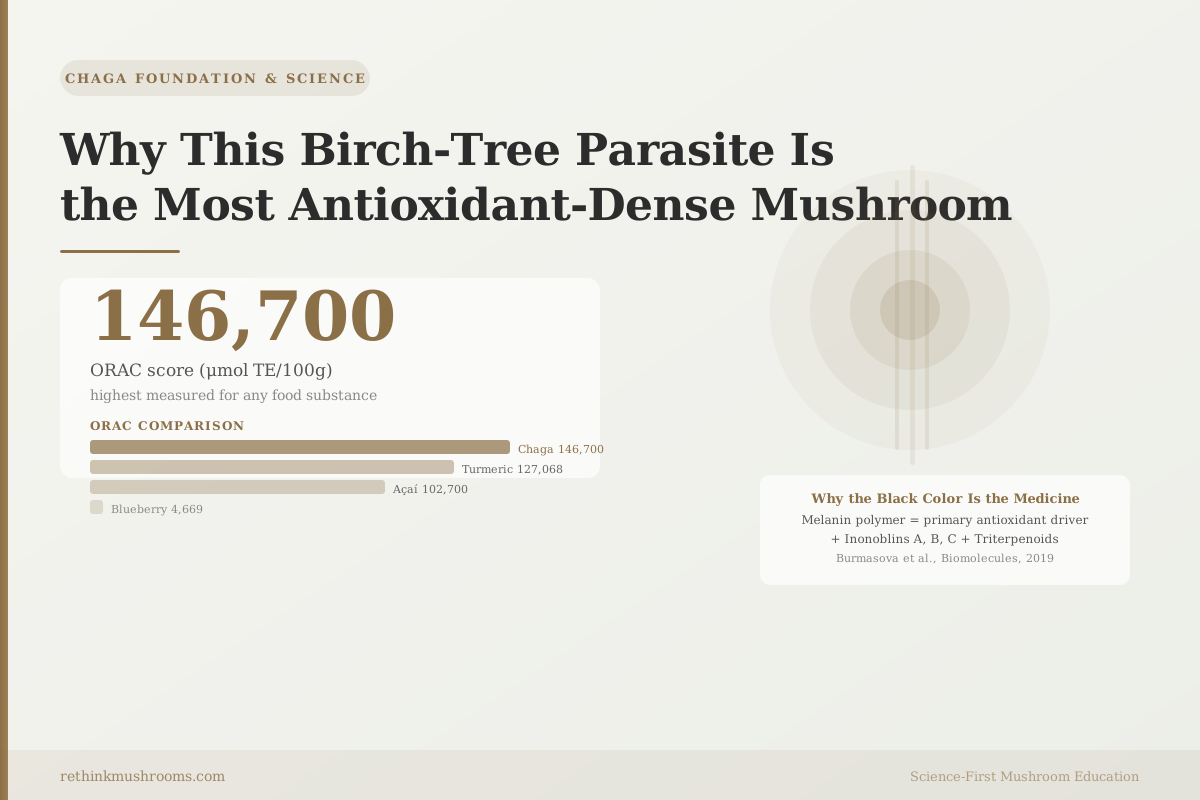
146,700 μmol TE/100g ORAC
Chaga's ORAC antioxidant score is the highest measured for any food substance. Blueberries score 4,669. Açaí scores 102,700. The gap isn't nutritional variation — it reflects the biology of a fungus evolved to survive extreme oxidative stress in Siberian winters.
Glamočlija et al., Journal of Ethnopharmacology, 2015
Melanin
the black outer layer of chaga is the primary antioxidant compound class
2800-11200 mg
oxalate per 100g — among the highest of any organism (Kikuchi et al., 2014)
Wild only
birch-derived betulin and betulinic acid are absent in cultivated mycelium products
Glamočlija et al., Journal of Ethnopharmacology, 2015
 View as image ↗
The number is 146,700. That's chaga's ORAC score in micromoles of Trolox equivalents per 100 grams — the standard unit for measuring antioxidant capacity in food. For comparison: blueberries score 4,669. Açaí berries score 102,700. Turmeric scores 127,068.
Chaga (Inonotus obliquus) sits at the top of every measured food by a meaningful margin. But what competitors and most health sources miss is the question that makes this number interesting: why does a fungus growing on birch trees in Siberia need this much antioxidant protection? The answer is found in its biology, not its supplement potential.
This article is one of three in the Chaga Introduction cluster. For the full overview of chaga's research and uses, start with What Is Chaga Mushroom? The King of Medicinal Mushrooms. For the biology of what chaga actually is, see Why Chaga Isn't Technically a Mushroom: The Sclerotium Explained.
Key Takeaways
- Chaga's ORAC antioxidant score of 146,700 μmol TE/100g is the highest measured for any food substance, roughly 31 times that of blueberries
- The primary driver of this score is melanin, the same polymer that makes chaga's exterior black; a 2019 study confirmed chaga melanins show strong antioxidant activity and bifidogenic effects
- Park and colleagues (2004) found chaga extract significantly reduced hydrogen-peroxide-induced DNA strand breaks in human lymphocytes — direct evidence of in vitro antioxidant protection at a cellular level
- Lee and colleagues (2007) identified three novel polyphenol compounds from chaga (inonoblins A, B, C) with significant radical-scavenging activity, separate from the melanin fraction
- Chaga contains 2800-11200 mg of oxalate per 100g, among the highest concentrations in any organism; multiple case reports document kidney failure from high-dose long-term consumption
- Processing method determines antioxidant yield: a 2024 study found green extraction methods (ultrasonic, microwave) preserved polyphenol and beta-glucan content better than conventional hot water
The Number: 146,700 and What It Means in Context
The ORAC (Oxygen Radical Absorbance Capacity) method measures a substance's ability to neutralize free radicals in a standardized assay. It's an in vitro test, not a measure of what happens in a human body. The USDA, which once published an ORAC database, withdrew it in 2012 with a note that in vitro values don't reliably predict in vivo antioxidant activity because absorption, metabolism, and cellular delivery all intervene.
So the 146,700 number should be understood for what it is: a measure of raw antioxidant capacity in a controlled lab setting, not a guarantee of equivalent effects in a human body. What it tells you is that chaga contains an unusually high concentration of antioxidant-capable compounds. Why they're there, and which ones are doing the most work, is the more important question.
For comparative context, the ORAC ranking of commonly cited antioxidant foods looks like this:
| Food | ORAC Score (μmol TE/100g) |
|---|---|
| Chaga mushroom | 146,700 |
| Turmeric | 127,068 |
| Açaí berry | 102,700 |
| Raw cacao | 80,933 |
| Blueberry | 4,669 |
The gap between chaga and blueberries isn't a rounding error. It's a 31-fold difference. That kind of gap requires a biological explanation, not just nutritional variation.
Why a Birch Parasite Needs Extreme Antioxidant Defenses
Inonotus obliquus is not found in warm climates. It grows in the boreal forests of Russia, Siberia, Canada, and northern Europe, almost exclusively on birch trees, and in harsh conditions. The sclerotium (the black mass that consumers buy, not a true mushroom fruiting body) grows on the exterior of infected birch trees, exposed to UV radiation, extreme cold, and the oxidative byproducts of wood decomposition.
The sclerotium is actively involved in the chemical war between the fungus and the birch tree. The host tree produces defensive compounds; the fungus produces counter-defenses. The result is a concentration of bioactive protective compounds in the sclerotium that exceeds what any tame cultivated mushroom needs to produce.
This ecological pressure is the evolutionary explanation for chaga's antioxidant density. It didn't evolve a high ORAC score to benefit human health. It evolved it to survive. Humans are incidental beneficiaries.
The birch relationship also explains something most supplement buyers don't know: chaga grown without birch trees (mycelium grown in grain-based lab substrates) lacks the birch-derived triterpenoids, specifically betulin and betulinic acid, that are often cited as among chaga's most interesting compounds. Wild-harvested sclerotium and lab-cultivated mycelium are not the same product in terms of compound profile.
The Black Layer That Is the Antioxidant: Chaga Melanin
The most visually distinctive feature of chaga is its black, charred-looking exterior. Most sources describe this as a surface characteristic. It is actually the compound class most responsible for chaga's extreme antioxidant score.
Burmasova and colleagues demonstrated in a 2019 study published in Biomolecules that chaga melanins show strong antioxidant activity by multiple assay methods, as well as bifidogenic effects (supporting beneficial gut bacteria growth). The melanin fraction, not the polysaccharide fraction, drives chaga's exceptional radical-scavenging capacity.[3]
Chaga melanin is a complex polymer built from oxidized polyphenols. It is not the same compound as melanin in human skin (eumelanin), though both are darkly pigmented. Chaga's melanin accumulates in the outer layer of the sclerotium as a defense against UV radiation and oxidative attack from the host tree.
The practical implication: the black color of chaga is a reasonable proxy for melanin content. Products that are pale, tan, or yellowish, typical of mycelium grown without birch bark exposure, contain significantly less melanin and correspondingly lower antioxidant capacity. Hot water extraction can hydrolyze some melanin polymers into more bioavailable fragments; harsh processing may degrade them.
Park and colleagues, in a 2004 study published in BioFactors, provided cellular-level evidence of chaga's antioxidant activity. Chaga extract significantly reduced hydrogen peroxide-induced DNA strand breaks in human lymphocytes, measured by comet assay. This study established that chaga's antioxidant compounds can protect DNA from oxidative damage in human cells under laboratory conditions.[1]
Three More Antioxidant Compound Classes
Melanin accounts for a large share of chaga's ORAC score, but it operates alongside three other compound classes.
Polyphenols. Lee and colleagues, in a 2007 paper in Bioorganic and Medicinal Chemistry Letters, isolated three previously undescribed polyphenol compounds from chaga, which they named inonoblins A, B, and C. All three showed significant DPPH radical-scavenging activity. Critically, this activity was distinct from the melanin fraction, meaning chaga's polyphenols contribute independently to its antioxidant capacity.[2]
Sterols and triterpenoids. Glamočlija and colleagues, in a 2015 characterization study, identified sterols including inotodiol and lanosterol, alongside triterpenoids, in chaga's compound profile. Their antioxidant capacity measurements confirmed chaga's high total phenolic content and correlated phenol concentration with radical-scavenging activity.[5]
Anti-inflammatory overlap. Debnath and colleagues' 2013 study demonstrated that chaga extract inhibited LPS-induced nitric oxide production in addition to showing strong DPPH and ABTS radical-scavenging activity, with total phenol content correlating with both antioxidant and anti-inflammatory effects.[4] The antioxidant and anti-inflammatory profiles overlap: compounds that scavenge free radicals often also suppress inflammatory signaling pathways that generate them.
From Lab to Supplement: How Processing Determines What You Get
The antioxidant compounds in chaga have different solubility profiles. Polysaccharides and some polyphenols are water-soluble; triterpenes and sterols are alcohol-soluble. A product made by hot water extraction alone will be missing most of the triterpene fraction. An alcohol extract alone will be missing polysaccharides. Neither captures the full antioxidant profile.
Lazić and colleagues, in a 2024 study, compared conventional hot water extraction to green extraction methods (ultrasonic-assisted and microwave-assisted) for chaga. The green methods preserved both polyphenol content and beta-glucan integrity significantly better than conventional hot water processing. Antioxidant yield from the same starting material varied substantially by extraction method.[6]
Windsor and colleagues' 2025 comparative analysis of commercial chaga supplements found massive variation between products in beta-glucan content and antioxidant activity. Wild-harvested sclerotium products consistently outperformed mycelium-based products. Several commercial products showed evidence of mislabeling.[7]
The conclusion from the processing research: the 146,700 ORAC score belongs to the raw sclerotium. What ends up in a capsule is a function of the extraction method, the source material (wild sclerotium vs. mycelium), and what the manufacturer chose to optimize for. These variables aren't visible from the label.
For how to evaluate extraction methods in mushroom supplements generally, see Dual Extraction: Why It Matters for Full-Spectrum Mushroom Products.
The Safety Counterpoint: Oxalate Content No One Mentions
Chaga contains between 2800 and 11200 milligrams of oxalate per 100 grams. This is among the highest oxalate concentration documented in any organism. Spinach, which is well-known for its oxalate content, contains roughly 970 mg per 100g. Chaga contains 3-11 times more.
Oxalates bind calcium and, in high concentrations, can form calcium oxalate crystals in the kidneys. This causes kidney damage that is dose-dependent and potentially irreversible.
Kikuchi and colleagues published a 2014 case report in Clinical Nephrology of oxalate nephropathy in a patient who had been consuming large amounts of chaga powder. The analysis confirmed chaga's oxalate content as the cause.[9]
Kwon and colleagues published a 2022 case report in Medicine of chaga-induced oxalate nephropathy presenting as nephrotic syndrome, with kidney biopsy confirming calcium oxalate crystal deposition. The patient had been consuming chaga tea daily.[8]
For anyone interested in the safety data in more depth, Can You Take Chaga Long-Term? Safety Considerations covers the kidney risk data and the populations most at risk (those with existing kidney disease, hyperoxaluria, or high-dose consumption patterns).
The antioxidant story and the safety story are not contradictory. Chaga contains genuine, unusually high concentrations of antioxidant compounds. It also contains genuinely high concentrations of oxalates. Both things are true, and honest reporting requires presenting both.
The Bottom Line
Chaga's ORAC antioxidant score of 146,700 μmol TE/100g is the highest measured for any food substance, driven primarily by its melanin polymer (the black exterior layer), polyphenols including the novel inonoblins A/B/C identified in 2007, and birch-derived triterpenoids. The ecological explanation is compelling: a fungus evolved to survive Siberian winters under extreme UV and oxidative stress accumulates extraordinary antioxidant reserves. Lab-cultivated mycelium lacks the birch-derived compounds and melanin of wild sclerotium, making source material the key quality variable. Chaga also contains 2800-11200 mg oxalate per 100g, with documented kidney failure cases from high-dose consumption — the antioxidant density and the safety risk are both real.
Frequently Asked Questions
Sources & References
- 1. Source details for this reference are not yet available.
- 2. Source details for this reference are not yet available.
- 3. Source details for this reference are not yet available.
- 4. Source details for this reference are not yet available.
- 5. Source details for this reference are not yet available.
- 6. Source details for this reference are not yet available.
- 7. Source details for this reference are not yet available.
- 8. Source details for this reference are not yet available.
- 9. Source details for this reference are not yet available.