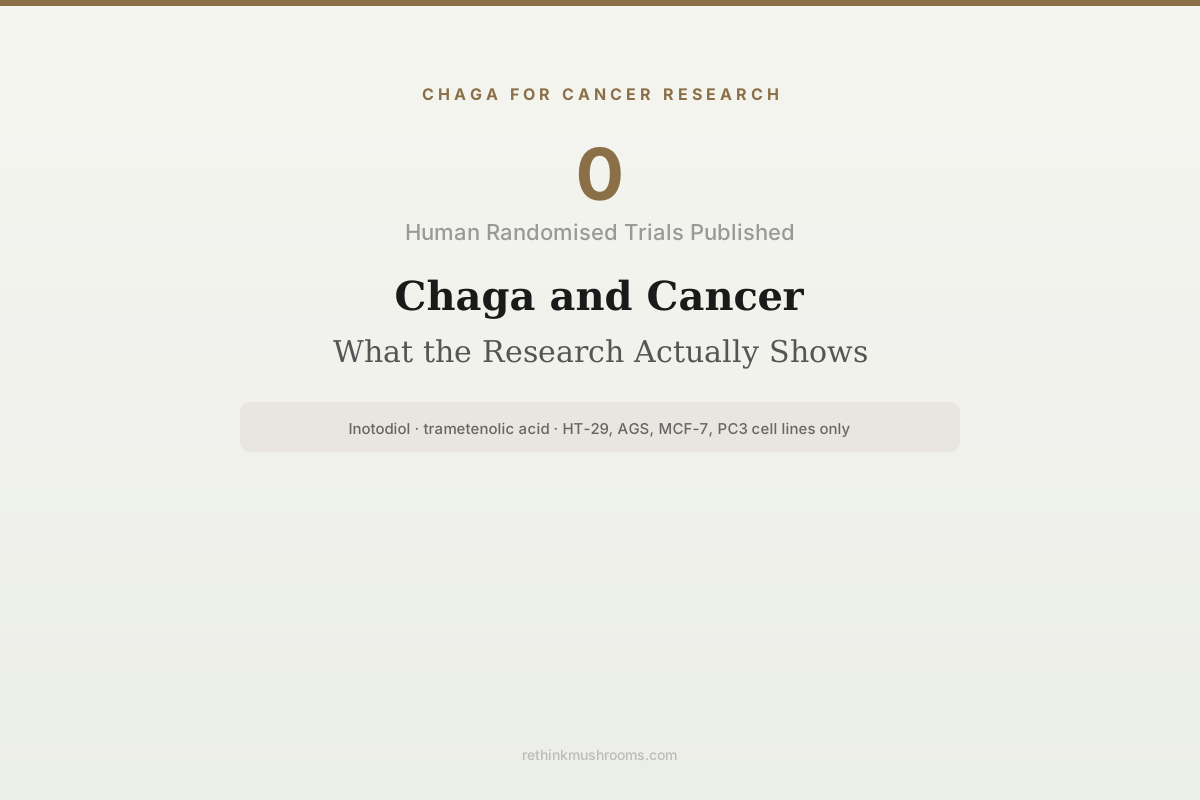
Chaga for Cancer Research
0 Human RCTs
Every published anti-cancer finding for chaga (Inonotus obliquus) comes from cell or animal models. No randomised controlled trial in humans has tested chaga as a cancer therapy, adjuvant, or preventive.
Ern et al., Mycology, 2024
194 mg/g
inotodiol content in the outer part of wildcrafted chaga triterpenoid fraction
HT-29, AGS, MCF-7, PC3
cancer cell lines showing anti-proliferative activity in chaga triterpenoid fractions
16th century
documented folk use for gastrointestinal cancer, long before modern oncology
Ern et al., Mycology, 2024
 View as image ↗
Chaga (Inonotus obliquus) has been used in Russian, Scandinavian, and East Asian folk medicine for gastrointestinal cancer since at least the sixteenth century.[1] Modern research has identified multiple bioactive compound classes (triterpenoids including inotodiol and trametenolic acid, polyphenols including inonoblins and phelligridins, β-glucans, and betulin derivatives transferred from its birch host) that show anti-proliferative, pro-apoptotic, antioxidant, and immunomodulatory activity in cell and animal models.[2] What has not been published is any randomised controlled trial of chaga in human cancer patients as a treatment, adjuvant, or preventive. The evidence base for benefit is entirely preclinical, while the evidence for harm from long-term use includes three published case reports of kidney failure.[3] Anyone evaluating chaga for cancer must reconcile this asymmetry honestly. For the safety side specifically, see can you take chaga long-term? safety considerations.
Key Takeaways
- Inotodiol (153.9–194.1 mg/g) and trametenolic acid (94.5–106.3 mg/g) are the major triterpenoids in chaga, and their triterpenoid fractions showed anti-proliferative activity against HT-29 (colon), AGS (gastric), MCF-7 (breast), and PC3 (prostate) cancer cell lines (Kim et al., 2020)
- The outer part of chaga contains higher triterpenoid concentrations and stronger anti-proliferative activity than the inner part (Kim et al., 2020)
- Novel polyphenols inonoblins A, B, C and phelligridins D, E, G isolated from chaga showed antioxidant activity against ABTS, DPPH, and superoxide radicals (Lee et al., 2007)
- Ethanol extract of chaga inhibited NF-κB activation and suppressed LPS-induced iNOS, COX-2, TNF-α, IL-1β, and IL-6 in RAW 264.7 macrophages, mechanistically relevant to inflammation-driven cancer (Kim et al., 2007)
- Orally administered aqueous chaga extract attenuated DSS-induced colitis in mice by reducing iNOS, MPO, and pro-inflammatory cytokines, with implications for inflammation-associated colorectal carcinogenesis (Mishra et al., 2012)
- No published randomised controlled trial has tested chaga as a cancer therapy, adjuvant, or preventive in humans (Ern et al., 2024; Fordjour et al., 2023)
The Evidentiary Asymmetry
Two statements are simultaneously true about chaga and cancer: (1) the preclinical evidence for anti-cancer activity is extensive, spanning triterpenoid-mediated cell cycle arrest, polyphenol antioxidant activity, NF-κB inhibition in inflammation-driven models, and polysaccharide immunomodulation; (2) the human clinical evidence for cancer benefit is zero. Not "weak," not "preliminary," not "emerging." Zero randomised controlled trials have been published testing chaga as a cancer therapy, as an adjuvant to chemotherapy or radiotherapy, or as a cancer preventive in any population at any dose.
Ern et al. (2024) reviewed the therapeutic properties of I. obliquus and explicitly acknowledged that "modern research provides scientific evidence of the therapeutic properties" while noting that the evidence comes from in vitro and animal studies, with clinical data limited to case reports of adverse effects.[1] Fordjour et al. (2023) similarly summarised the preclinical evidence in depth while identifying the complete absence of clinical trial data as the central gap.[2] Any claim that chaga "treats cancer" that references human outcomes is unsupported by published trials. Any claim that chaga "shows anti-cancer activity" in cell or animal models is well supported. The difference matters.
The Triterpenoid Evidence: Kim 2020
Kim et al. (2020) determined the composition of triterpenoids in Inonotus obliquus extracts and evaluated their anti-proliferative activity against four cancer cell lines: HT-29 (colon adenocarcinoma), AGS (gastric adenocarcinoma), MCF-7 (hormone-responsive breast adenocarcinoma), and PC3 (hormone-independent prostate cancer).[4] The inner and outer parts of chaga were extracted separately with 80% methanol for 24 hours, the extract was fractionated by Diaion HP-20 resin to obtain the triterpenoid fraction, and composition was analysed by HPLC and LC-ESI-MS. Anti-proliferative activity was measured by MTT assay.
Inotodiol and trametenolic acid were the major triterpenoids in both inner and outer parts. Inotodiol content in the triterpenoid fractions was 153.9 ± 15.4 mg/g (inner) and 194.1 ± 11.5 mg/g (outer). Trametenolic acid content was 94.5 ± 9.15 mg/g (inner) and 106.3 ± 8.23 mg/g (outer). Triterpenoid content and anti-proliferative activity against AGS, MCF-7, and PC3 were significantly higher in the outer part than the inner part. This is mechanistically consistent with a compound-concentration-dependent response and provides a quantitative reference point for standardising chaga extracts aimed at the triterpenoid content rather than at whole-mushroom mass. For the inotodiol-specific picture, see inotodiol and cancer: chaga's lesser-known anti-cancer compound.
The caveats matter. MTT assays measure cell viability in high-concentration in vitro conditions; anti-proliferative activity in a 2D cell culture does not translate mechanistically to tumour regression in a human patient. The absorption, distribution, metabolism, and excretion of these triterpenoids in humans after oral dosing has not been characterised. Whether oral chaga delivers inotodiol and trametenolic acid to tumour tissue at pharmacologically active concentrations is unknown.
The Polyphenol Evidence: Lee 2007
Lee et al. (2007) isolated three novel antioxidant polyphenols from the methanolic extract of I. obliquus fruiting body: inonoblins A, B, and C, along with the known compounds phelligridins D, E, and G.[5] Structures were established by extensive spectroscopic analyses. All six compounds showed scavenging activity against ABTS radical cation and DPPH radical and moderate activity against superoxide radical anion.
The cancer-relevant framing is that oxidative stress contributes to carcinogenesis, and mushroom polyphenols with documented free-radical scavenging activity are mechanistically relevant to cancer prevention research. What Lee's study does not demonstrate is that these compounds reach tumour tissue in humans or that antioxidant activity at the chemical level translates to cancer outcomes in a clinical population. Chaga's antioxidant profile is well-documented; its clinical translation for cancer is not.
The Inflammation-Cancer Axis: Kim 2007 and Mishra 2012
Chronic inflammation is an established driver of carcinogenesis in multiple tissues, particularly gastrointestinal cancers where inflammatory bowel disease meaningfully elevates colorectal cancer risk. Two chaga studies provide mechanistic data relevant to this inflammation-cancer axis.
Kim et al. (2007) demonstrated that ethanol extract of I. obliquus inhibited lipopolysaccharide-induced iNOS, COX-2, TNF-α, IL-1β, and IL-6 expression in RAW 264.7 macrophages through suppression of NF-κB activation.[6] NF-κB is a master transcription factor for inflammatory gene expression and a validated oncogenic signalling node in colorectal, gastric, and hepatocellular cancers. COX-2 overexpression drives prostaglandin-mediated tumour promotion in multiple tissues. Inhibiting both reduces a mechanistically plausible cancer-promoting pathway.
Mishra et al. (2012) extended the finding in vivo. Orally administered aqueous extract of I. obliquus to female C57BL/6 mice in a DSS-induced colitis model suppressed oedema, mucosal damage, crypt loss, iNOS expression, neutrophil infiltration (measured by myeloperoxidase), and the mRNA expression of TNF-α, IL-1β, IL-6, and IFN-γ.[7] This establishes that the macrophage-level anti-inflammatory signal translates to tissue-level attenuation in an animal model. The colitis-to-colorectal-cancer inferential bridge is standard in preclinical research but requires human trial confirmation to support a cancer prevention claim. For the specific colorectal pathway, see chaga for cancer prevention: epidemiological and preclinical data.
Why the Preclinical Data Are Not a Substitute for Trials
Cancer is a heterogeneous family of diseases driven by specific genetic and epigenetic lesions that vary by tissue, stage, and molecular subtype. Cell line anti-proliferative activity establishes that a compound has cytotoxic or cytostatic effects on dividing cells at the concentrations tested; it does not establish that the compound (a) reaches equivalent concentrations at the tumour site in a patient, (b) selectively affects tumour cells over healthy proliferating cells, (c) combines favourably with existing oncology therapy, or (d) improves any patient-centred outcome (overall survival, progression-free survival, quality of life).
The Torkelson et al. (2012) turkey tail phase 1 trial in breast cancer patients demonstrates what a minimal human safety-and-signal study looks like: dose escalation (3, 6, 9 g/day), structured adverse event tracking, and immunological endpoints measured across the intervention. No equivalent study has been published for chaga. Until one is, the translation from preclinical promise to clinical utility remains unbridged. For the turkey tail comparator, see chaga vs. turkey tail for immune support: which is stronger?.
The Safety Counterweight: What Cancer Patients Need to Know
Cancer patients often consider chaga as complementary therapy, sometimes without disclosing use to their oncology team. Two categories of published safety data are directly relevant to this population.
First, three case reports document kidney failure from long-term chaga use through oxalate nephropathy. Kwon et al. (2022) reported a case in a 69-year-old man who consumed 10–15 grams of chaga mushroom powder daily for three months alongside 500 mg of vitamin C, developing acute kidney injury with nephrotic syndrome presentation.[3] Pathology showed focal acute tubular injury and calcium oxalate crystal deposition. The kidney function recovered only after active dialysis and high-dose steroid treatment over one month. Two prior published cases (Kikuchi et al., 2014; Lee et al., 2020) documented similar oxalate nephropathy in long-term chaga users, one of whom progressed to end-stage renal disease requiring transplant.
Second, chaga contains a novel tripeptide (Trp-Gly-Cys) with platelet aggregation inhibitory activity documented in vitro and in ICR mice. Hyun et al. (2006) isolated this peptide from I. obliquus ASI 74006 mycelia and measured 81.2% platelet aggregation inhibition for the ethanol extract itself.[8] Cancer patients are frequently on anticoagulants (for tumour-associated thrombosis prophylaxis or atrial fibrillation), antiplatelet drugs, or are scheduled for surgery. A mechanistically plausible antiplatelet effect from chaga could augment bleeding risk in these contexts, though no published case report has documented a chaga-anticoagulant bleeding event.
The Review Evidence: What Comprehensive Syntheses Actually Say
Fordjour et al. (2023) published a comprehensive review of chaga's ethnobotany, mycochemistry, pharmacology, and traditional applications, synthesising dozens of preclinical studies across anti-inflammatory, antioxidant, anticancer, anti-diabetic, and immunomodulatory domains.[2] The anti-cancer section covered triterpenoid-mediated apoptosis pathways, polysaccharide immunomodulation, and inflammation-cancer axis modulation. The review acknowledged that the published kidney toxicity case reports represent the only clinical-level human data and that no controlled cancer trial exists.
Ern et al. (2024) reviewed the therapeutic properties of I. obliquus across anti-inflammatory, antioxidant, anticancer, anti-diabetic, anti-obesity, hepatoprotective, renoprotective, anti-fatigue, antibacterial, and antiviral domains.[1] For the anti-cancer domain, the review covered polysaccharide, triterpenoid, and polyphenol mechanisms while framing the evidence as entirely preclinical. The sixteenth-century folk medicine reference traced traditional chaga use for gastrointestinal cancer in Russian and Scandinavian populations, a historical observation rather than a clinical trial.
Both reviews converge on the same conclusion: chaga has broad preclinical evidence for anti-cancer activity, no human trial data, and documented renal toxicity risk from long-term high-dose use. For comprehensive reviews to reach this conclusion independently is meaningful; it is not marketing consensus, it is scientific consensus. For the betulinic acid side of the picture, see betulinic acid from chaga: anti-cancer mechanisms.
What the Evidence Supports and What It Does Not
| Question | Evidence | Confidence |
|---|---|---|
| Does chaga show anti-proliferative activity against cancer cell lines? | Yes: HT-29, AGS, MCF-7, PC3 anti-proliferative activity from triterpenoid fractions (Kim et al., 2020) | Moderate (in vitro) |
| Does chaga contain known anti-cancer compounds? | Yes: inotodiol, trametenolic acid, inonoblins, phelligridins, betulin derivatives | High (chemical) |
| Does chaga modulate inflammation-cancer pathways? | Yes: NF-κB, COX-2, iNOS inhibition in macrophage and colitis models (Kim et al., 2007; Mishra et al., 2012) | Moderate |
| Has chaga been tested as a cancer therapy in humans? | No randomised controlled trial published (Fordjour et al., 2023; Ern et al., 2024) | None |
| Is chaga safe for cancer patients? | Three case reports of kidney failure from long-term use; antiplatelet activity complicates anticoagulant and surgical contexts | Low to moderate safety concern |
| Do traditional use records support efficacy? | Sixteenth-century folk use for GI cancer is documented but does not substitute for controlled evidence | Very low |
The Bottom Line
Every published chaga anti-cancer finding comes from cell or animal models (Kim et al., 2020; Mishra et al., 2012; Kim et al., 2007). No randomised controlled trial has tested chaga as a cancer therapy, adjuvant, or preventive in humans (Fordjour et al., 2023; Ern et al., 2024). Inotodiol (up to 194 mg/g in outer chaga), trametenolic acid, inonoblins, and phelligridins establish the chemical basis for anti-proliferative and antioxidant activity. Three case reports document kidney failure from long-term use (Kwon et al., 2022 and prior). Cancer patients face a meaningful safety consideration alongside the unverified efficacy claim.
Frequently Asked Questions
Sources & References
- 1RTHM-01886·Ern, Phoebe Tee Yon et al. (2024). “Chaga Therapeutic Properties: What This 2024 Review Actually Shows.” Mycology.Study breakdown →PubMed →↩
- 2RTHM-01694·Fordjour, Eric et al. (2023). “Chaga mushroom: a super-fungus with countless facets and untapped potential..” Frontiers in pharmacology.Study breakdown →PubMed →↩
- 3RTHM-00775·Kwon, Ohyun et al. (2022). “Chaga mushroom-induced oxalate nephropathy that clinically manifested as nephrotic syndrome: A case report..” Medicine.Study breakdown →PubMed →↩
- 4RTHM-01218·Kim, Jaecheol et al. (2020). “Composition of Triterpenoids in Inonotus obliquus and Their Anti-Proliferative Activity on Cancer Cell Lines..” Molecules (Basel.Study breakdown →PubMed →↩
- 5RTHM-00118·Lee, In-Kyoung et al. (2007). “New antioxidant polyphenols from the medicinal mushroom Inonotus obliquus..” Bioorganic & medicinal chemistry letters.Study breakdown →PubMed →↩
- 6RTHM-00117·Kim, Ho-Gyoung et al. (2007). “Ethanol extract of Inonotus obliquus inhibits lipopolysaccharide-induced inflammation in RAW 264.7 macrophage cells..” Journal of medicinal food.Study breakdown →PubMed →↩
- 7RTHM-00258·Mishra, Siddhartha Kumar et al. (2012). “Orally administered aqueous extract of Inonotus obliquus ameliorates acute inflammation in dextran sulfate sodium (DSS)-induced colitis in mice..” Journal of ethnopharmacology.Study breakdown →PubMed →↩
- 8RTHM-00100·Hyun, Kwang Wook et al. (2006). “Isolation and characterization of a novel platelet aggregation inhibitory peptide from the medicinal mushroom, Inonotus obliquus..” Peptides.Study breakdown →PubMed →↩