Chaga & Cancer Research
DHFR inhibitor: same target as methotrexate
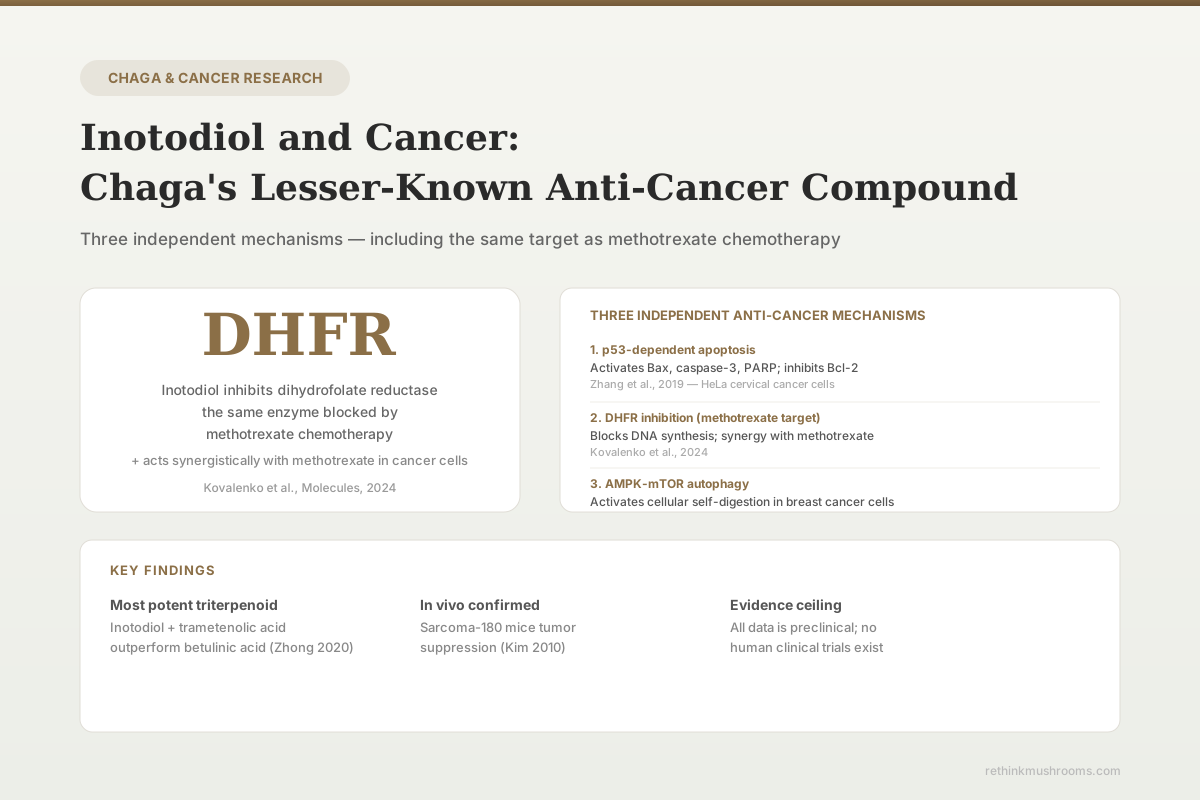
Inotodiol inhibits dihydrofolate reductase, the same enzyme blocked by methotrexate chemotherapy, and Chaga triterpenoids act synergistically with the standard breast-cancer drugs cisplatin and trastuzumab, documented in Wang et al. (2024).
Wang et al., Biomolecules, 2024
p53 pathway
Zhang 2019: inotodiol activates the p53 pathway and caspase-3 and inhibits migration and invasion in HeLa cells
AMPK-mTOR
Lee 2021: Chaga extract induces autophagy in breast cancer cells via a second distinct pathway
Dominant triterpenoids
Kim 2020: inotodiol and trametenolic acid are the most abundant triterpenoids in Chaga and drive its anti-proliferative activity
Wang et al., Biomolecules, 2024
 View as image ↗
Betulinic acid gets most of the coverage when people write about Chaga's anti-cancer compounds. But inotodiol, a lanostane-type triterpenoid present in Chaga alongside betulinic acid, may be equally important. Research across multiple studies shows that inotodiol acts on cancer cells through at least three independent mechanisms, including one that shares a target with methotrexate chemotherapy. Inotodiol receives far less consumer attention than betulinic acid despite a comparable body of anti-cancer research. This article synthesizes the published evidence on what inotodiol does, how it does it, and what the evidence actually supports.
For the broader overview of Chaga's cancer research, see chaga and cancer: what the research shows. For how inotodiol fits within Chaga's full bioactive compound profile, this article focuses on the cancer-specific mechanisms.
Key Takeaways
- Inotodiol is a lanostane-type triterpenoid in Chaga (Inonotus obliquus) whose anti-cancer activity was documented by Chung et al. (2010), who tested Chaga subfractions in both human cancer cell lines and in Sarcoma-180-bearing mice
- Zhang et al. (2019) identified a primary mechanism: inotodiol triggers apoptosis in cancer cells via the p53-dependent pathway, activating caspase-3 and inhibiting cell migration and invasion in HeLa cells
- Wang et al. (2024) found Chaga triterpenoids including inotodiol inhibit dihydrofolate reductase (DHFR) — the same enzyme targeted by methotrexate chemotherapy — and act synergistically with the standard breast-cancer drugs cisplatin and trastuzumab
- Lee et al. (2021) identified a second independent mechanism: Chaga extract induces autophagy in breast cancer cells by activating AMPK and inhibiting mTOR phosphorylation
- Kim et al. (2020) found inotodiol and trametenolic acid are the dominant triterpenoids in Chaga, driving anti-proliferative activity against colon, stomach, breast, and prostate cancer cell lines
- All evidence is preclinical (in vitro and animal models); no human clinical trials have tested inotodiol or Chaga extracts for cancer treatment
What Inotodiol Is, and How It Sits Among Chaga's Triterpenoids
Inotodiol is a lanostane-type triterpenoid. A triterpenoid is a large organic molecule built from six isoprene units, producing a complex ring structure. Lanostane-type triterpenoids share a specific four-ring backbone configuration (the lanostane skeleton) that distinguishes them from other triterpenoid classes. In plain terms: inotodiol belongs to the same chemical family as many bioactive plant and fungal compounds, with a specific architecture that allows it to interact with proteins inside cancer cells.
Chaga mushroom (Inonotus obliquus) is unusually rich in triterpenoids compared to most fungi, partly because it grows parasitically on birch trees and incorporates compounds from the birch wood. The triterpenoid fraction of Chaga includes betulinic acid (derived from betulin, which comes from birch bark), inotodiol, trametenolic acid, lanosterol, and several others.
Kim and colleagues (2020) profiled the triterpenoid composition of Chaga's inner and outer parts and tested the fraction's anti-proliferative activity against cancer cell lines.[3] They found that inotodiol and trametenolic acid were the dominant triterpenoids in both parts of the mushroom, and that the triterpenoid-rich fraction inhibited proliferation across colon (HT-29), stomach (AGS), breast (MCF-7), and prostate (PC3) cancer cell lines. The parts of the mushroom with higher triterpenoid content showed stronger anti-proliferative activity. Notably, the compounds present in the greatest abundance were inotodiol and trametenolic acid — not the more famous betulinic acid.
For a detailed look at betulinic acid's own anti-cancer mechanisms, including how they differ from inotodiol, see betulinic acid from Chaga: anti-cancer mechanisms.
Chung 2010: The Study That Tested Chaga's Pure Compounds Against Tumors
An early paper establishing Chaga's isolated compounds as anti-cancer agents came from Chung and colleagues in 2010.[1] Their study separated pure compound subfractions from Chaga, including inotodiol, and tested each separately against human cancer cell lines and in an in vivo mouse model.
The isolated compounds — 3-beta-hydroxy-lanosta-8,24-dien-21-al, inotodiol, and lanosterol — showed cytotoxic activity against a panel of human carcinoma cell lines (lung A549, stomach AGS, breast MCF-7, and cervical HeLa). But the study went further and tested the most active subfractions in mice bearing Sarcoma-180 tumors. In those mice, the most active subfraction significantly reduced tumor volume in vivo (by roughly 24% and 34% at two doses), not just in cell culture.
The in vivo result matters because cell culture results frequently fail to translate to living organisms. A compound that kills cancer cells in a dish can be metabolized, diluted, or blocked from reaching tumor tissue in a living system. Chung's in vivo data showed the anti-tumor effect survived this more demanding test.
This 2010 paper moved Chaga's key compounds from "present in the mushroom" to "isolated subfractions with documented anti-cancer activity in both cells and animals."
The Molecular Mechanism: How Inotodiol Triggers Cancer Cell Death
Zhang and colleagues (2019) conducted the most detailed mechanistic study on inotodiol's cancer-cell-killing pathway.[2] They used HeLa cells, the most widely studied human cancer cell line (derived from cervical cancer), and exposed them to inotodiol at various concentrations.
The results mapped a p53-dependent apoptosis pathway. Apoptosis is programmed cell death: a cellular self-destruction sequence that cancer cells typically evade. P53 is a tumor suppressor protein sometimes called the "guardian of the genome." When p53 activates, it initiates a cascade of molecular events that lead to cell death. Many cancers survive by mutating or disabling p53; compounds that restore or activate p53 signaling can overcome this survival strategy. Zhang's team confirmed p53's central role by silencing it with small interfering RNA, which blunted inotodiol's effect.
In HeLa cells, concentrations of inotodiol above roughly 25 μM significantly inhibited growth and induced apoptosis, accompanied by activation of caspase-3 (the executioner enzyme of the apoptosis cascade) through the p53 pathway.
In plain terms: inotodiol switched the molecular signaling in cancer cells from "survive" to "die" by activating the tumor suppressor pathway that cancer cells normally bypass.
The same study also showed inotodiol inhibited both cell migration and invasion in a dose-dependent manner.[2] Cancer's lethality comes largely from metastasis, the spread of cancer cells to secondary sites in the body. Compounds that inhibit migration and invasion target the metastatic capacity of cancer cells, not just their immediate proliferation. This aspect of Zhang's finding positions inotodiol as potentially relevant to cancer spread, not only primary tumor growth.
The 2024 Discovery: Inotodiol Inhibits the Same Target as Methotrexate
One of the most newsworthy recent findings in Chaga cancer research came from Wang and colleagues in 2024.[4] Their study digested Chaga water extract in vitro to mimic how its components are processed and absorbed when consumed, then tested the extract against HER2-positive and triple-negative breast cancer cell lines. Four bioactive triterpenoids — inotodiol, trametenolic acid, 3-hydroxy-lanosta-8,24-dien-21-al, and betulin — were identified as the main active components, and dihydrofolate reductase (DHFR) was identified as their crucial target.
Dihydrofolate reductase is the enzyme that converts dihydrofolate to tetrahydrofolate, a step essential for DNA synthesis. Without DHFR, cells cannot replicate their DNA. Cancer cells, which divide rapidly, are particularly dependent on DHFR activity. Methotrexate, one of the most widely used chemotherapy drugs for leukemia, lymphoma, breast cancer, and other cancers, works primarily by blocking DHFR.
The Wang finding has two significant implications. First, it provides a mechanistic explanation for part of Chaga's anti-cancer activity through an entirely different pathway from the p53 apoptosis pathway identified by Zhang. Second, the Chaga triterpenoids acted synergistically — not merely additively — with two conventional breast-cancer drugs, cisplatin and trastuzumab, in SK-BR-3 cells, while also blocking HER2 and HER1 activation. Synergy means the combined effect exceeds the sum of what each agent produces alone.
This finding must be framed carefully. Synergy in a cell-culture model does not establish that Chaga is an effective complement to chemotherapy in humans. It establishes that, in controlled laboratory conditions, Chaga's triterpenoids inhibit a validated cancer drug target — DHFR, the same enzyme methotrexate blocks — and can enhance the activity of standard chemotherapy drugs. The clinical question of whether a person undergoing chemotherapy would benefit from Chaga, and at what dose, and without adverse interactions, requires human trial data that does not yet exist.
A Second Independent Mechanism: AMPK-mTOR Autophagy
Lee and colleagues (2021) documented a third mechanism by which Chaga-active compounds affect cancer cells.[6] Working with breast cancer cells, they showed that Chaga extract activated AMPK (AMP-activated protein kinase) and inhibited phosphorylation of mTOR (mechanistic target of rapamycin), and slowed tumor growth in a 4T1 breast tumor mouse model.
AMPK is a cellular energy sensor that, when activated, triggers autophagy. Autophagy (from the Greek for "self-eating") is a process by which a cell digests its own damaged components. In cancer cells, autophagy can serve as an anti-cancer mechanism: it can force malignant cells into death through self-digestion when they are already under stress. mTOR normally suppresses autophagy; when Chaga inhibits mTOR phosphorylation, autophagy is disinhibited and proceeds.
This is a completely distinct molecular pathway from both the p53-dependent apoptosis identified by Zhang and the DHFR inhibition identified by Wang. Apoptosis is a specific cell death program; autophagy is a different cell death and stress response pathway; DHFR inhibition prevents DNA synthesis directly. Lee's team used chromatography and mass spectrometry to identify the triterpenoid constituents of the extract responsible for its cytotoxic effect.
The relevance of having multiple independent mechanisms is that cancer cells can become resistant to any single mechanism. A compound acting through three different pathways is theoretically less vulnerable to resistance than one acting through only one.
Three Independent Pathways
How Inotodiol Acts Against Cancer Cells
Across separate lab studies, inotodiol (and the chaga triterpenoid fraction it belongs to) has been shown to hit cancer cells through three unrelated molecular routes. Because the routes are independent, a cancer cell that becomes resistant to one is not automatically resistant to the others.
Apoptosis
p53-dependent programmed cell death
Inotodiol activates the p53 tumor-suppressor pathway in HeLa cells — switching on caspase-3 and inhibiting migration and invasion — driving cancer cells into apoptosis. [2]
DNA synthesis block
DHFR inhibition
Chaga triterpenoids including inotodiol inhibit dihydrofolate reductase (DHFR) — the same enzyme methotrexate targets — and act synergistically with cisplatin and trastuzumab in breast cancer cells. [4]
Autophagy
AMPK activation, mTOR inhibition
In breast cancer models, chaga extract activates AMPK and suppresses mTOR phosphorylation, disinhibiting autophagy — a distinct self-digestion route to cancer-cell death. [6]
Every pathway shown is established only in cell-culture and animal models. No human trial has tested inotodiol or chaga for cancer, and the in-vitro concentrations that kill cancer cells may not be reachable through oral supplementation. This map explains documented laboratory mechanisms — it is not evidence that chaga treats cancer in people.
Mechanism synthesis; pathways from refs [2][4][6] (see references)
Which Cancer Types Have Been Tested
Chaga's anti-cancer research covers a range of cancer types, though with variable mechanistic depth. Raal and colleagues (2024) characterized the chemical content of Chaga grown on different birch species and tested cytotoxicity across multiple cancer cell lines, finding that cytotoxic activity varied by cancer type.[5]
The cancer types tested across the full body of Chaga inotodiol research include: cervical cancer (HeLa cells, Zhang 2019); lung, stomach, breast, and cervical carcinoma lines (A549, AGS, MCF-7, HeLa; Chung 2010); colon, stomach, breast, and prostate lines in the Kim 2020 triterpenoid profiling (HT-29, AGS, MCF-7, PC3); breast cancer cells (Lee 2021); and multiple cancer cell lines in the Raal 2024 comprehensive study.
The observation of compound- and cancer-type specificity from Raal 2024 is important for interpreting this research. Inotodiol does not appear to be uniformly potent against all cancer types. Some cancer cell lines show high sensitivity; others show lower sensitivity. This pattern is biologically expected, as different cancers have different metabolic dependencies, mutation profiles, and p53 status; this means the evidence cannot be generalized to "Chaga works against cancer" without specifying which cancer type and which evidence base applies.
For a comprehensive review of the preclinical evidence across all Chaga-tested cancer types, see chaga and tumor growth inhibition: preclinical evidence.
The Adjunct Hypothesis: Inotodiol and Minimally Invasive Cancer Therapies
Plehn and colleagues (2023) published a review positioning Chaga triterpenoids as potential adjuncts to minimally invasive cancer therapies, specifically cryoablation, radiofrequency ablation, and microwave ablation.[7] These are image-guided procedures that destroy tumor tissue through extreme cold or heat without requiring open surgery.
The hypothesis: Chaga triterpenoids' immunostimulatory effects might amplify the immune response triggered by ablation, which releases tumor antigens into the bloodstream. Ablation alone can trigger a local immune response; compounds that enhance this response might extend the anti-tumor effect beyond the treated site. Inotodiol's dual role (direct cytotoxicity plus immune effects) makes it a plausible candidate for this type of synergy.
This review is hypothesis-generating, not evidence-establishing. No clinical trial has tested Chaga triterpenoids alongside ablation procedures. The mechanism is plausible from the available preclinical data, and the review deserves attention as a novel framing of where Chaga research might go, but it does not constitute evidence that this approach works in humans.
The comprehensive review of Chaga's pharmacological mechanisms by Duru and colleagues (2019) provides the broader mechanistic framework for how Chaga compounds interact with cancer and immune pathways, positioning Chaga as a multi-target natural medicine where triterpenoids drive direct cytotoxicity and polysaccharides drive immune activation.[8]
What the Evidence Does and Doesn't Establish
Every finding described in this article comes from in vitro (cell culture) or animal research. This is not a minor caveat; it is the most important context for interpreting inotodiol's anti-cancer evidence.
- Cell-culture studiescompleted
HeLa, MCF-7, A549, AGS, HT-29, PC3, SK-BR-3, 4T1 and other cancer lines
- Animal studiescurrent
Chung 2010: Sarcoma-180 mice; Lee 2021: 4T1 breast tumor mice
- Human case reportsmissing
None for inotodiol or Chaga as cancer treatment
- Small clinical trialsmissing
None conducted
- Large randomized trialsmissing
None conducted
- Meta-analysesmissing
No human trial data to pool
Inotodiol's anti-cancer evidence spans cell-culture and mouse studies. No human clinical trial has tested it. The gap between animal models and human treatment is where the large majority of promising cancer compounds fail.
Synthesis of Chung 2010, Zhang 2019, Kim 2020, Wang 2024, Lee 2021, Plehn 2023, Duru 2019, and Géry 2018
Cell culture results are the earliest stage of drug development. The vast majority of compounds that show compelling cancer-cell-killing activity in laboratory dishes do not survive the translation to human biology. Absorption, metabolism, blood-brain barrier penetration, and the dramatically more complex immune environment of a living human all affect whether a compound reaches its target tissue at effective concentrations.
In vivo animal results (Chung 2010, Sarcoma-180 mice; Lee 2021, 4T1 mice) are stronger evidence, but mouse models of cancer are not reliable predictors of human outcomes. Dozens of compounds have extended survival in mouse cancer models and failed in human trials.
The questions that remain unanswered for inotodiol: What concentrations of inotodiol are achievable in human blood and tissues after consuming Chaga? Do these achievable concentrations match the concentrations that showed anti-cancer effects in cell culture? What is the elimination half-life? What are the safety boundaries at higher doses? Does Chaga consumption meaningfully alter tumor biology in humans?
No published human clinical trial has addressed any of these questions for inotodiol specifically or for Chaga's anti-cancer effects generally. Even studies that frame Chaga as a "future potential medicinal fungus in oncology" — such as Géry and colleagues (2018), who compared Chaga extract cytotoxicity against human lung adenocarcinoma cells (A549) and normal bronchial epithelial cells (BEAS-2B) — remain at the cell-culture stage.[9]
Safety
ModerateChaga is not a cancer treatment — and carries its own risks
Concern
Every anti-cancer finding for inotodiol comes from cell and animal studies. No human trial has shown that Chaga treats, prevents, or safely complements cancer therapy. Separately, Chaga is high in oxalates, and heavy or prolonged use has caused oxalate nephropathy (kidney injury) in documented case reports.
What the research says
Treat inotodiol's anti-cancer research as early-stage mechanism science, not clinical guidance. Because inotodiol and methotrexate share the DHFR (folate-pathway) target, combining Chaga with methotrexate or similar drugs is a theoretical interaction that has not been studied in people.
Particularly relevant for: People with cancer, kidney disease, or on chemotherapy
What to do
Discuss any Chaga use with your oncologist or physician before starting, especially during active treatment.
Chaga-induced oxalate nephropathy case reports (2014; 2022) and the preclinical-only anti-cancer evidence base
For readers interested in where the mushroom cancer research stands across species, the evidence for mushroom-based cancer adjuncts provides the cross-species overview.
The Bottom Line
Inotodiol is a Chaga triterpenoid with documented anti-cancer activity through at least three independent mechanisms: p53-dependent apoptosis (Zhang 2019), DHFR inhibition — the target shared with methotrexate chemotherapy, plus synergy with the conventional breast-cancer drugs cisplatin and trastuzumab (Wang 2024) — and AMPK-mTOR autophagy induction (Lee 2021). Kim 2020 identified inotodiol and trametenolic acid as the dominant, anti-proliferative triterpenoids in Chaga. All evidence is preclinical; no human clinical trial has tested inotodiol for cancer treatment, and the gap between these cell culture findings and clinically actionable conclusions remains substantial.
Frequently Asked Questions
Sources & References
- 1RTHM-00178·Chung, Mi Ja et al. (2010). “Anticancer activity of subfractions containing pure compounds of Chaga mushroom (Inonotus obliquus) extract in human cancer cells and in Balbc/c mice bearing Sarcoma-180 cells..” Nutrition research and practice.Study breakdown →PubMed →↩
- 2RTHM-01154·Zhang, Sun-Dong et al. (2019). “Inotodiol inhibits cells migration and invasion and induces apoptosis via p53-dependent pathway in HeLa cells..” Phytomedicine : international journal of phytotherapy and phytopharmacology.Study breakdown →PubMed →↩
- 3RTHM-01218·Kim, Jaecheol et al. (2020). “Composition of Triterpenoids in Inonotus obliquus and Their Anti-Proliferative Activity on Cancer Cell Lines..” Molecules (Basel.Study breakdown →PubMed →↩
- 4RTHM-02012·Wang, Junbiao et al. (2024). “Chaga Mushroom Triterpenoids Inhibit Dihydrofolate Reductase and Act Synergistically with Conventional Therapies in Breast Cancer..” Biomolecules.Study breakdown →PubMed →↩
- 5RTHM-01972·Raal, Ain et al. (2024). “Chemical Content and Cytotoxic Activity on Various Cancer Cell Lines of Chaga (Inonotus obliquus) Growing on Betula pendula and Betula pubescens..” Pharmaceuticals (Basel.Study breakdown →PubMed →↩
- 6RTHM-01380·Lee, Min-Gu et al. (2021). “Chaga mushroom extract induces autophagy via the AMPK-mTOR signaling pathway in breast cancer cells..” Journal of ethnopharmacology.Study breakdown →PubMed →↩
- 7RTHM-01768·Plehn, Selina et al. (2023). “Chaga mushroom triterpenoids as adjuncts to minimally invasive cancer therapies: A review..” Current research in toxicology.Study breakdown →PubMed →↩
- 8RTHM-00553·Duru, Kingsley C et al. (2019). “The pharmacological potential and possible molecular mechanisms of action of Inonotus obliquus from preclinical studies..” Phytotherapy research : PTR.Study breakdown →PubMed →↩
- 9RTHM-00958·Géry, Antoine et al. (2018). “Chaga ( Inonotus obliquus), a Future Potential Medicinal Fungus in Oncology? A Chemical Study and a Comparison of the Cytotoxicity Against Human Lung Adenocarcinoma Cells (A549) and Human Bronchial Epithelial Cells (BEAS-2B)..” Integrative cancer therapies.Study breakdown →PubMed →↩