Chaga and Cancer
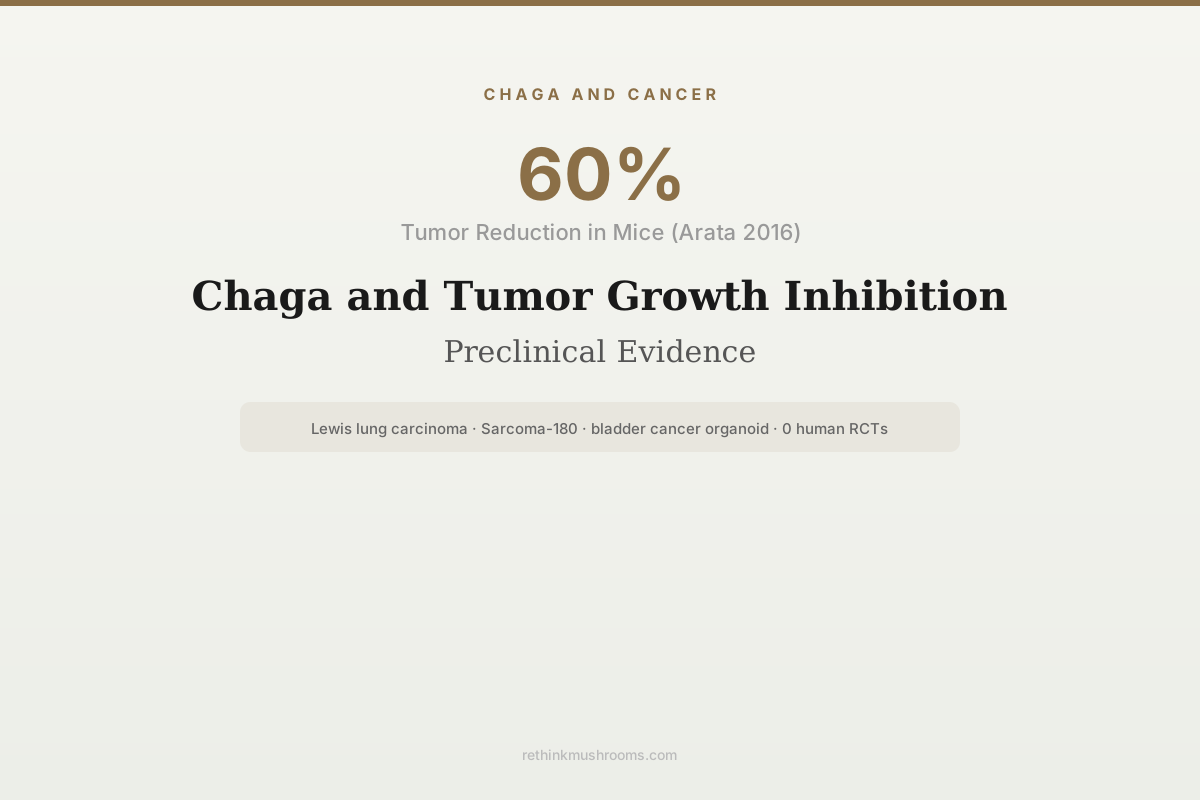
60% tumor reduction
Continuous oral intake of aqueous Inonotus obliquus extract at 6 mg/kg/day for three weeks produced 60% tumor reduction and 25% fewer metastatic nodules in mice bearing Lewis lung carcinoma. No comparable human data exists.
Arata et al., Heliyon, 2016
3 in vivo models
Lewis lung carcinoma, Sarcoma-180 ascites, and dog bladder cancer organoid xenografts
0 human RCTs
no randomised controlled trial of chaga for any cancer outcome
Triterpenoid + polysaccharide
two compound classes with convergent in vivo antitumor signal
Arata et al., Heliyon, 2016
 View as image ↗
The in vivo evidence that Inonotus obliquus slows tumor growth in mice comes from a small but mechanistically consistent set of studies across three animal cancer models: Lewis lung carcinoma in C57BL/6 mice, Sarcoma-180 ascites in BALB/c mice, and patient-derived canine bladder cancer organoid xenografts in nude mice. Across preparations (aqueous extract, subfraction with defined triterpenoids, and water extract) chaga produced significant tumor-weight or tumor-volume reductions at doses translatable to realistic supplementation regimes.[1][2][3] This preclinical consistency is real, and it is also the full extent of the antitumor evidence base. No randomised controlled trial has tested chaga for any oncology endpoint in humans. For the wider cancer context, see chaga and cancer: what the research shows and for the dominant chemistry argument, betulinic acid from chaga: anti-cancer mechanisms.
Key Takeaways
- Arata and colleagues (2016) reported 60% tumor reduction and 25% fewer metastatic nodules in Lewis lung carcinoma mice after three weeks of 6 mg/kg/day aqueous chaga extract, a dose corresponding to Japanese habitual chaga infusion intake
- Chung and colleagues (2010) demonstrated that subfraction 1 of chaga ethanol extract at 0.2 mg/mouse/day inhibited Sarcoma-180 ascites tumor weight by 33.71% in BALB/c mice, with inotodiol and 3β-hydroxy-lanosta-8,24-dien-21-al identified as candidate active triterpenoids
- Abugomaa and colleagues (2023) showed chaga extract decreased tumor volume and weight in dog bladder cancer organoid-derived xenografts in nude mice, with necrotic lesion induction as the histological readout
- Kim and colleagues (2020) quantified triterpenoid content in chaga at inotodiol 153.9–194.1 mg/g and trametenolic acid 94.5–106.3 mg/g in triterpenoid-enriched fractions, with dose-dependent anti-proliferative activity across human cancer cell lines including colon (HT-29), liver (HepG2), and lung (A549)
- Kim and colleagues (2007) characterised chaga ethanol extract's NF-κB inhibition in LPS-stimulated macrophages, a pathway also central to tumor-promoting inflammation
- Zero published RCTs have tested chaga for primary oncology endpoints (overall survival, progression-free survival, objective response rate, quality of life) in any human cancer population
Arata 2016: The Cleanest In Vivo Tumor Model
The Arata research group at Showa University's Center for Biotechnology designed a chaga cancer study around a clinically common scenario: continuous oral intake at a dose matching habitual Japanese chaga infusion consumption.[1] The dose was 6 mg/kg/day of aqueous Inonotus obliquus extract, delivered continuously for three weeks, in two mouse Lewis lung carcinoma (LLC) models: primary subcutaneous tumor growth and spontaneous lung metastasis after subcutaneous primary implantation.
The primary-tumor findings were substantial:
- 60% reduction in tumor volume versus control at three weeks
- Increase in tumor agglomeration (tumor margins more tightly bounded rather than infiltrative)
- Inhibition of peritumoral vascularization
The metastatic-tumor findings were also significant:
- 25% fewer pulmonary metastatic nodules versus control
- Maintained body temperature in response to light-dark cycling (mature adult mice)
- Prevented tumor-implantation-associated temperature drop
The vascularization finding is mechanistically important. Tumor growth beyond approximately 1–2 mm diameter requires neovascularisation. Agents that disrupt angiogenesis therefore limit tumor expansion even without direct cytotoxicity. Chaga's documented polyphenol and triterpenoid profile contains multiple compound classes with angiogenesis-modulating activity, which makes the Arata anti-vascularization observation mechanistically coherent with the chemistry.
The three-week duration matters for dose translation. Human equivalent dose for 6 mg/kg/day in a 70 kg adult, adjusted by body-surface-area conversion (approximately 12.3-fold mouse-to-human), works out to roughly 0.5 mg/kg/day or about 35 mg/day of dried aqueous extract. This is well within the range of standardised chaga supplement dosing, although consumer products deliver variable extract concentrations relative to the laboratory preparation Arata used.
Chung 2010: Purified Triterpenoids in a Sarcoma Model
The Chung, Chung, Jeong, and Ham 2010 paper in Nutrition Research and Practice took a different analytical approach: fractionate chaga ethanol extract, identify the active compounds, and test the purified subfractions in both cell culture and mice bearing Sarcoma-180 ascites cells.[2] This is the methodology that links animal-model efficacy to specific chemistry.
Three triterpenoids were identified in the most active subfraction:
- 3β-hydroxy-lanosta-8,24-dien-21-al
- Inotodiol
- Lanosterol
The in vivo results with subfraction 1 at 0.2 mg/mouse/day:
- 33.71% inhibition of Sarcoma-180 tumor weight versus control
- Statistically significant reduction in tumor ascites volume
- Preserved body weight and behaviour (no obvious toxicity at this dose)
The 33.71% effect size is smaller than Arata's 60%, which is consistent with the experimental difference between a whole-extract preparation (Arata) and a subfraction containing only some of the active compounds (Chung). The in vitro cell-culture work in the same paper demonstrated dose-dependent cytotoxicity across human cancer cell lines including lung, breast, and prostate carcinoma lines, with the lanostane triterpenoids identified as primary contributors.
Inotodiol in particular has emerged as a chaga-specific triterpenoid with extensive anti-proliferative literature. See inotodiol and cancer: chaga's lesser-known anti-cancer compound for the focused inotodiol discussion.
Abugomaa 2023: The Organoid Xenograft Model
Organoid-based cancer models are the most translationally relevant preclinical platform currently available, because they preserve the genetic and architectural features of the originating patient tumor in three-dimensional culture. Abugomaa and colleagues' 2023 Frontiers in Pharmacology paper applied this methodology to canine bladder cancer.[3]
The design was:
- Patient-derived dog bladder cancer organoids (DBCOs) established from clinical cases
- In vitro chaga extract testing against the organoids, with cytotoxicity and proliferation readouts
- In vivo xenograft transplantation of DBCO into nude mice, with chaga administration and tumor growth measurement
The in vivo findings:
- Chaga administration decreased tumor volume and tumor weight in DBCO-derived xenografts
- Histological evaluation showed induction of necrotic lesions within tumors
- Findings consistent across independent organoid lines from different dogs
The Abugomaa paper also relates to veterinary oncology directly, since canine invasive urothelial carcinoma is biologically similar to human muscle-invasive bladder cancer and is increasingly used as a comparative oncology model. The data does not establish human efficacy, but it adds architectural complexity (three-dimensional tumor organisation with stromal contacts) that the simpler cell-line models from Chung and earlier work lack.
The Triterpenoid Composition Question
The chemistry underlying the three in vivo studies converges on the lanostane-class triterpenoid fraction. Kim, Yang, Hwang, Cho, and Hwang's 2020 analytical paper in Molecules quantified these compounds in commercially available chaga at meaningful precision.[4]
Triterpenoid content in triterpenoid-enriched extract fractions:
- Inotodiol: 153.9 to 194.1 mg/g
- Trametenolic acid: 94.5 to 106.3 mg/g
- Lanosterol and related compounds: detectable in lower concentrations
Anti-proliferative activity in human cancer cell lines:
- HT-29 colon adenocarcinoma: dose-dependent inhibition across 10-500 μg/mL
- HepG2 hepatocellular carcinoma: dose-dependent inhibition
- A549 lung adenocarcinoma: dose-dependent inhibition
- Normal cell comparisons showed selectivity index favourable to cancer cells
The combination of quantified triterpenoid content plus demonstrated anti-proliferative activity gives a defensible pharmacological bridge between the in vivo tumor suppression data and the molecular-level chemistry. The missing piece is human pharmacokinetic data: no study has characterised oral bioavailability, tissue distribution, or plasma concentrations of inotodiol or trametenolic acid after oral chaga dosing in people. Without that, the step from 60% mouse tumor reduction at 6 mg/kg/day to any clinical prediction is speculative.
Mechanistic Convergence: Apoptosis, Cell Cycle, and NF-κB
Across the in vitro cancer cell-line literature, three mechanistic pillars recur with enough consistency to be considered the chaga antitumor framework:
Apoptosis induction. Lanostane triterpenoids (inotodiol, trametenolic acid, 3β-hydroxy-lanosta-8,24-dien-21-al) activate intrinsic mitochondrial apoptosis in multiple cancer cell lines. Markers include cytochrome c release, caspase-9 activation, caspase-3 cleavage, and Bax/Bcl-2 ratio shift. This is the dominant cytotoxic mechanism in Chung's subfraction 1 work.
Cell cycle arrest. Chaga extracts induce G0/G1 arrest via cyclin D1 downregulation and cyclin-dependent kinase inhibition in colon, breast, and hepatocellular cancer cell lines. This explains why low-dose chronic exposure suppresses tumor growth without requiring direct killing of all tumor cells.
NF-κB pathway inhibition. Kim and colleagues (2007) demonstrated chaga ethanol extract inhibits LPS-induced NF-κB activation and reduces TNF-α, IL-1β, IL-6, iNOS, and COX-2 expression in RAW 264.7 macrophages.[5] NF-κB is a central node in tumor-promoting inflammation: it links chronic inflammation to cancer initiation, promotes tumor cell survival under stress, drives angiogenesis via VEGF induction, and supports metastasis via matrix metalloproteinase expression. An NF-κB inhibitor acts on multiple steps of the tumor ecology simultaneously, not just on tumor cell proliferation.
Duru and colleagues' 2019 review in Phytotherapy Research synthesised these three pillars and flagged the consistency across independent research groups as evidence of genuine pharmacological activity rather than single-lab artifact.[6] Szychowski and colleagues' 2021 review reached similar conclusions while stressing that clinical translation has not occurred.[7]
What the In Vivo Preclinical Signal Does Not Tell Us
Three specific limitations separate the in vivo preclinical evidence from anything actionable in human oncology:
No human dose range-finding. The mouse 6 mg/kg/day aqueous extract dose is not the same as a human consumer taking 1 gram of chaga powder per day, and no bridging pharmacokinetic work has defined the relationship. Product concentration varies widely. Without standardisation to a defined active-compound content per dose, extrapolation from the Arata result to any consumer product is methodologically shaky.
No cancer type specificity data. Lewis lung carcinoma is a murine cell line model of aggressive lung cancer; it does not replicate the biology of human non-small-cell lung cancer. Sarcoma-180 is an ascites-generating transplantable tumor line with no close human counterpart. The dog bladder organoid work has the best translational architecture but is specific to urothelial cancer. No study has tested chaga against a spectrum of cancer types to identify where the effect is strongest or absent.
No comparator data. The mouse studies compare chaga to vehicle control, not to first-line chemotherapy, immunotherapy, or targeted agents. A tumor treatment that underperforms cisplatin or pembrolizumab but outperforms placebo is not a viable clinical option in most oncology settings. Chaga has never been tested head-to-head against any approved oncology drug.
No human safety characterisation for oncology doses. Chaga's documented adverse event profile is dominated by oxalate-related kidney injury case reports (Kikuchi 2014; Kwon 2022), plus interactions with anticoagulants. These safety signals are manageable in a supplement context but become more restrictive if any chaga preparation were to be developed as an oncology adjuvant in patients already managing chemotherapy-related nephrotoxicity or on anticoagulants for cancer-associated thromboembolism.
The Comparator Gap: Mushroom Adjuvants That Do Have Human Data
Certain mushroom preparations have decades of clinical oncology data in specific contexts. Polysaccharide-K (PSK) from Trametes versicolor has been used as an adjuvant in gastric and colorectal cancer in Japan since the 1980s, with multiple randomised trials and a published meta-analysis on survival endpoints. Lentinan from Lentinula edodes has injection-formulation oncology adjuvant data in gastric cancer. Ganoderma lucidum has smaller trial datasets in immunomodulation adjunct to chemotherapy. These precedents prove that mushroom-derived cancer adjuvants can be developed with pharmaceutical rigour and can produce measurable clinical benefit when standardised and studied in defined populations.
Chaga's preclinical evidence base is as strong or stronger than PSK's was at the equivalent stage of PSK's development history. What distinguishes chaga is that the clinical development programme has not followed. The reasons are more commercial than scientific: wild-harvested chaga is difficult to standardise, patent protection on unmodified natural products is weak, and the large-scale investment required to run phase 2 and phase 3 cancer trials requires intellectual property that chaga's status as a food supplement does not readily support. This is not a judgment on chaga's biological activity; it is a description of the economic barrier to testing it in humans the way PSK was tested.
Safety and Oncology-Specific Considerations
Chaga's long-term safety profile is reviewed in the chaga long-term safety article. For cancer patients specifically, three considerations overlay the general safety profile:
The oxalate content of chaga powder creates a theoretical additive risk in patients with chemotherapy-induced nephrotoxicity, particularly from cisplatin, carboplatin, or methotrexate. Cisplatin-treated oncology patients already face elevated AKI risk, and chronic chaga oxalate load is unlikely to be neutral in this context.
Chaga's documented anticoagulant interactions overlap with the elevated venous thromboembolism risk in cancer patients, who are often already on warfarin or direct oral anticoagulants. Bleeding risk is not well-characterised for this combination.
Chaga's immunomodulatory activity, while potentially beneficial, has not been characterised in patients on checkpoint inhibitors (pembrolizumab, nivolumab, atezolizumab). These drugs depend on specific immune-system states, and whether chaga enhances or undermines their activity is not known.
The Bottom Line
The chaga in vivo tumor growth inhibition evidence is consistent across three models: 60% primary tumor reduction and 25% fewer metastases in Lewis lung carcinoma mice (Arata 2016), 33.71% Sarcoma-180 tumor weight reduction in BALB/c mice with purified triterpenoid subfraction (Chung 2010), and tumor volume reduction with necrotic lesion induction in dog bladder cancer organoid xenografts (Abugomaa 2023). The chemistry centres on lanostane-class triterpenoids (inotodiol, trametenolic acid, 3β-hydroxy-lanosta-8,24-dien-21-al) plus NF-κB pathway inhibition by polyphenols and ethanol-extract components. No human randomised controlled trial has tested chaga for any oncology endpoint. Clinical development has stalled for commercial rather than scientific reasons: standardisation difficulty, weak patent protection on unmodified chaga, and the capital required for phase 2 and 3 oncology trials has not been mobilised.
Frequently Asked Questions
Sources & References
- 1RTHM-00416·Arata, Satoru et al. (2016). “Continuous intake of the Chaga mushroom (Inonotus obliquus) aqueous extract suppresses cancer progression and maintains body temperature in mice..” Heliyon.Study breakdown →PubMed →↩
- 2RTHM-00178·Chung, Mi Ja et al. (2010). “Anticancer activity of subfractions containing pure compounds of Chaga mushroom (Inonotus obliquus) extract in human cancer cells and in Balbc/c mice bearing Sarcoma-180 cells..” Nutrition research and practice.Study breakdown →PubMed →↩
- 3RTHM-00811·Abugomaa, Amira et al. (2023). “Anti-cancer activity of Chaga mushroom (Inonotus obliquus) against dog bladder cancer organoids..” Frontiers in pharmacology.Study breakdown →PubMed →↩
- 4RTHM-01218·Kim, Jaecheol et al. (2020). “Composition of Triterpenoids in Inonotus obliquus and Their Anti-Proliferative Activity on Cancer Cell Lines..” Molecules (Basel.Study breakdown →PubMed →↩
- 5RTHM-00117·Kim, Ho-Gyoung et al. (2007). “Ethanol extract of Inonotus obliquus inhibits lipopolysaccharide-induced inflammation in RAW 264.7 macrophage cells..” Journal of medicinal food.Study breakdown →PubMed →↩
- 6RTHM-00553·Duru, Kingsley C et al. (2019). “The pharmacological potential and possible molecular mechanisms of action of Inonotus obliquus from preclinical studies..” Phytotherapy research : PTR.Study breakdown →PubMed →↩
- 7RTHM-00722·Szychowski, Konrad A et al. (2021). “Inonotus obliquus - from folk medicine to clinical use..” Journal of traditional and complementary medicine.Study breakdown →PubMed →↩