Chaga Cancer Research
9+ cancer types
Betulinic acid has demonstrated anti-cancer activity against melanoma, neuroblastoma, glioblastoma, leukemia, and multiple carcinoma types in preclinical models.
Ern et al., Mycology, 2024
Intrinsic Pathway
mitochondrial membrane permeabilization
p53-Independent
bypasses most common drug resistance
40%+ DNA Protection
chaga reduced oxidative DNA damage
Ern et al., Mycology, 2024
 View as image ↗
Betulinic acid, a pentacyclic triterpene found in wild-harvested chaga (Inonotus obliquus), kills cancer cells through a specific molecular pathway that has been mapped in detail across multiple tumor types. The compound directly targets mitochondria, triggering a cascade of enzymatic events that result in programmed cell death. What makes betulinic acid unusual among anti-cancer compounds is its independence from p53, the tumor suppressor protein mutated in over half of all human cancers. Ern et al. (2024) reviewed the anti-cancer evidence for I. obliquus, identifying betulinic acid as a primary contributor alongside polysaccharides, polyphenols, and other triterpenoids.[1]
Before examining the mechanisms, an essential clarification: betulinic acid comes from birch bark, not from the I. obliquus fungus. Only wild-harvested chaga from birch trees contains it. For the sourcing distinction, see betulinic acid: wild vs. lab-grown chaga. For betulinic acid's antiviral research, see betulinic acid from chaga: cancer and antiviral research.
Key Takeaways
- Betulinic acid directly permeabilizes outer mitochondrial membranes, triggering intrinsic apoptosis via caspase-9, then caspases 3 and 7, with PARP cleavage completing cell death (Ern et al., 2024)
- The mechanism is p53-independent, meaning it can trigger apoptosis in cancers that have lost p53 function and resist conventional chemotherapy (Fordjour et al., 2023)
- Preclinical anti-cancer activity spans melanoma, neuroblastoma, glioblastoma, medulloblastoma, Ewing sarcoma, leukemia, breast, lung, and colorectal carcinomas (Ern et al., 2024)
- Chaga extracts contain additional anti-cancer compounds beyond betulinic acid: polysaccharides with immunomodulatory effects, inotodiol, and polyphenols with antioxidant activity (Fordjour et al., 2023)
- Wild chaga extract reduced oxidative DNA fragmentation by over 40% in human lymphocytes at 10-500 microg/mL concentrations (Park et al., 2004)
- No human clinical trial has tested betulinic acid from chaga for cancer treatment; all evidence is from cell lines and animal models
The Apoptosis Pathway: Step by Step
Most anti-cancer drugs trigger cell death through pathways that require functional p53 protein. When p53 is mutated (as it is in the majority of advanced cancers), these drugs lose effectiveness. Betulinic acid bypasses this limitation by targeting mitochondria directly.[1]
Mitochondrial Membrane Permeabilization
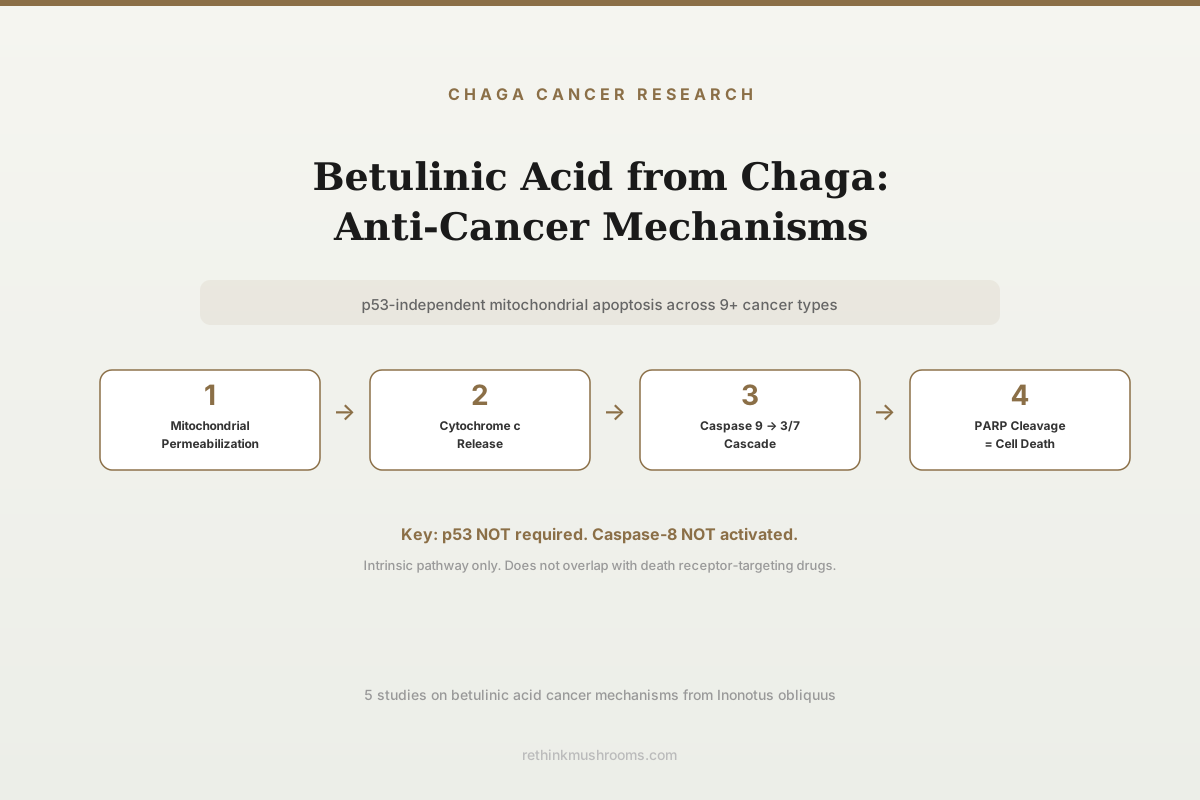
The first and most critical step. Betulinic acid interacts with the outer mitochondrial membrane, disrupting its integrity and creating pores. This permeabilization is the point of no return. Once the mitochondrial membrane is breached, the cell is committed to death regardless of its p53 status, drug resistance mechanisms, or other survival signals.[1]
Cytochrome c Release and Caspase Cascade
Mitochondrial membrane permeabilization releases cytochrome c into the cytoplasm. Cytochrome c binds Apaf-1 (apoptotic protease activating factor-1), forming the apoptosome complex. The apoptosome activates caspase-9 (the initiator caspase), which then cleaves and activates executioner caspases 3 and 7.[1]
PARP Cleavage
Activated caspases 3 and 7 cleave PARP (poly(ADP-ribose) polymerase) from its 116 kDa active form to an 85 kDa inactive fragment. PARP normally repairs single-strand DNA breaks. Its inactivation ensures that the cell cannot repair DNA damage, making the apoptotic process irreversible.[1]
Extrinsic Pathway Exclusion
Caspase-8, the initiator caspase of the extrinsic (death receptor) apoptosis pathway, remains inactive during betulinic acid-induced cell death. This confirms that the compound works exclusively through the intrinsic mitochondrial pathway, not through death receptors like Fas or TRAIL receptors. This pathway-specific activity means betulinic acid's mechanism does not overlap with most receptor-targeting cancer drugs, making it theoretically combinable.[1]
Cancer Types Responding to Betulinic Acid
Ern et al. (2024) compiled the preclinical evidence across cancer types:[1]
Solid tumors: Melanoma (the original discovery target), neuroblastoma, glioblastoma, medulloblastoma, Ewing sarcoma, breast carcinoma, lung carcinoma, colorectal carcinoma.
Hematological malignancies: Leukemia cell lines.
The melanoma data is the most mature. The landmark 1995 study in Nature Medicine showed complete tumor growth inhibition in athymic mice carrying human melanomas, with no apparent systemic toxicity. This finding launched two decades of follow-up research across other cancer types.
Selectivity varies by context. Early reports emphasized betulinic acid's selectivity for cancer cells over normal cells. Subsequent research has shown this selectivity is concentration-dependent and not absolute across all cell types. At high concentrations, normal cell toxicity can occur. The therapeutic window between cancer cell killing and normal cell toxicity varies by the specific tumor type and experimental conditions.[1]
Beyond Betulinic Acid: Chaga's Multi-Compound Anti-Cancer Profile
Betulinic acid is not the only anti-cancer compound in wild chaga. Fordjour et al. (2023) reviewed the full spectrum of chaga-derived anti-cancer mechanisms:[2]
Polysaccharides from I. obliquus modulate the immune system, enhancing natural killer cell activity and macrophage-mediated tumor clearance. These polysaccharides are fungal-derived (unlike betulinic acid) and are present in both wild and cultivated forms.
Inotodiol, a triterpenoid unique to I. obliquus, has shown cytotoxic activity against several cancer cell lines. Unlike betulinic acid, inotodiol is produced by the fungus itself, though it is found in higher concentrations in wild canker than in cultivated mycelium.[2]
Polyphenols, including inonoblins and phelligridins isolated by Lee et al. (2007), provide antioxidant activity that may contribute to cancer prevention through reduction of oxidative DNA damage.[3]
For specific inotodiol cancer research, see inotodiol and cancer: chaga's lesser-known compound. For the broader chaga cancer evidence, see chaga and cancer: what the research shows.
DNA Protection: A Prevention Angle
Beyond direct cytotoxicity against existing cancer cells, chaga extracts may protect against cancer initiation by preventing DNA damage.
Park et al. (2004) pretreated human lymphocytes with aqueous chaga extracts at concentrations of 10, 50, 100, and 500 microg/mL for 1 hour, then exposed them to 100 micromolar H2O2 as an oxidative stress. Using the comet assay, cells pretreated with chaga showed over 40% reduction in DNA fragmentation compared to H2O2-treated controls without pretreatment. The effect was dose-dependent.[4]
This is an aqueous extract, which would capture polysaccharides and water-soluble polyphenols but not betulinic acid (which is poorly water-soluble). The DNA protective effect likely comes from the polyphenol and polysaccharide fractions rather than betulinic acid. This distinction matters: it means chaga's cancer-prevention potential involves different compounds than its cancer-cell-killing activity.
The Translation Gap
The molecular mechanism is clear. The preclinical evidence is consistent. The clinical evidence is absent.
No human trial has tested betulinic acid from chaga for any cancer type. The one betulinic acid derivative to reach human trials (bevirimat, for HIV, not cancer) was synthetic and its development was discontinued. The bioavailability barrier is substantial: betulinic acid is poorly water-soluble, and the concentrations that kill cancer cells in vitro may not be achievable through oral supplementation.[2]
Windsor et al. (2025) added a product quality concern. Many commercial chaga supplements are grain-grown mycelium that contains no betulinic acid. Even consumers specifically seeking this compound may not be receiving it.[5]
The mechanistic data warrants continued research, not clinical conclusions. For the preclinical tumor growth data, see chaga and tumor growth inhibition. For epidemiological context, see chaga for cancer prevention.
The Bottom Line
Betulinic acid from wild chaga kills cancer cells through a well-defined mitochondrial apoptosis pathway: membrane permeabilization, cytochrome c release, caspase cascade activation, and PARP cleavage. This mechanism works independently of p53 and has shown preclinical activity against at least 9 cancer types. Wild chaga also contains polysaccharides, inotodiol, and polyphenols that contribute anti-cancer effects through separate pathways. All evidence is preclinical. The compound's poor bioavailability, birch-tree origin (absent in cultivated chaga), and complete lack of human cancer trials define the current state of the field.
Frequently Asked Questions
Sources & References
- 1RTHM-01886·Ern, Phoebe Tee Yon et al. (2024). “Chaga Therapeutic Properties: What This 2024 Review Actually Shows.” Mycology.Study breakdown →PubMed →↩
- 2RTHM-01694·Fordjour, Eric et al. (2023). “Chaga mushroom: a super-fungus with countless facets and untapped potential..” Frontiers in pharmacology.Study breakdown →PubMed →↩
- 3RTHM-00118·Lee, In-Kyoung et al. (2007). “New antioxidant polyphenols from the medicinal mushroom Inonotus obliquus..” Bioorganic & medicinal chemistry letters.Study breakdown →PubMed →↩
- 4RTHM-00076·Park, Yoo Kyoung et al. (2004). “Chaga mushroom extract inhibits oxidative DNA damage in human lymphocytes as assessed by comet assay..” BioFactors (Oxford.Study breakdown →PubMed →↩
- 5RTHM-02209·Windsor, Coleton et al. (2025). “What This 2025 Chaga Supplement Authentication Study Actually Found.” International journal of molecular sciences.Study breakdown →PubMed →↩