Chaga Bioactive Compounds
100% tumor inhibition
In athymic mice carrying human melanomas, betulinic acid completely inhibited tumor growth without systemic toxicity in early preclinical research.
Pisha et al., Nature Medicine, 1995
Mitochondrial Pathway
triggers intrinsic apoptosis in cancer cells
p53-Independent
works regardless of tumor suppressor status
Anti-HIV Activity
disrupts viral fusion and assembly
Pisha et al., Nature Medicine, 1995
 View as image ↗
Betulinic acid is a pentacyclic triterpene found in wild-harvested chaga (Inonotus obliquus) that has attracted research attention for two primary biological activities: selective cytotoxicity against cancer cells and anti-HIV properties. The compound was first identified as a melanoma-specific cytotoxic agent in 1995 when Pisha et al. reported in Nature Medicine that betulinic acid completely inhibited tumor growth in athymic mice carrying human melanomas without systemic toxicity. Subsequent research expanded the list of susceptible cancers to include neuroblastoma, glioblastoma, leukemia, and several carcinomas. Ern et al. (2024) reviewed betulinic acid's anti-cancer and antiviral properties in the context of chaga's broader therapeutic profile, confirming it as one of the key bioactive compounds responsible for the mushroom's traditional use against cancer.[1]
A critical caveat: betulinic acid originates from birch bark, not from the I. obliquus fungus itself. Only wild-harvested chaga from birch trees contains this compound. For the sourcing distinction, see betulinic acid: wild vs. lab-grown chaga. For chaga's other bioactive compounds, see inotodiol: chaga's other important bioactive compound.
Key Takeaways
- Betulinic acid triggers cancer cell death through the intrinsic (mitochondrial) apoptosis pathway, directly permeabilizing mitochondrial membranes and activating the caspase cascade (Ern et al., 2024)
- The compound induces apoptosis regardless of p53 tumor suppressor status, making it potentially relevant for cancers with p53 mutations (Fordjour et al., 2023)
- Anti-cancer activity has been documented against melanoma, neuroblastoma, glioblastoma, medulloblastoma, Ewing tumor, leukemia, and several carcinoma types in preclinical models (Ern et al., 2024)
- Betulinic acid derivatives show anti-HIV-1 activity by disrupting viral fusion (via gp41 interaction) and inhibiting viral assembly and budding (Fordjour et al., 2023)
- Chaga extract reduced oxidative DNA fragmentation by over 40% in human lymphocytes, though this effect may involve compounds beyond betulinic acid (Park et al., 2004)
- All evidence is preclinical; no human clinical trials have tested betulinic acid from chaga for cancer or HIV treatment
Anti-Cancer Mechanism: Mitochondrial Apoptosis
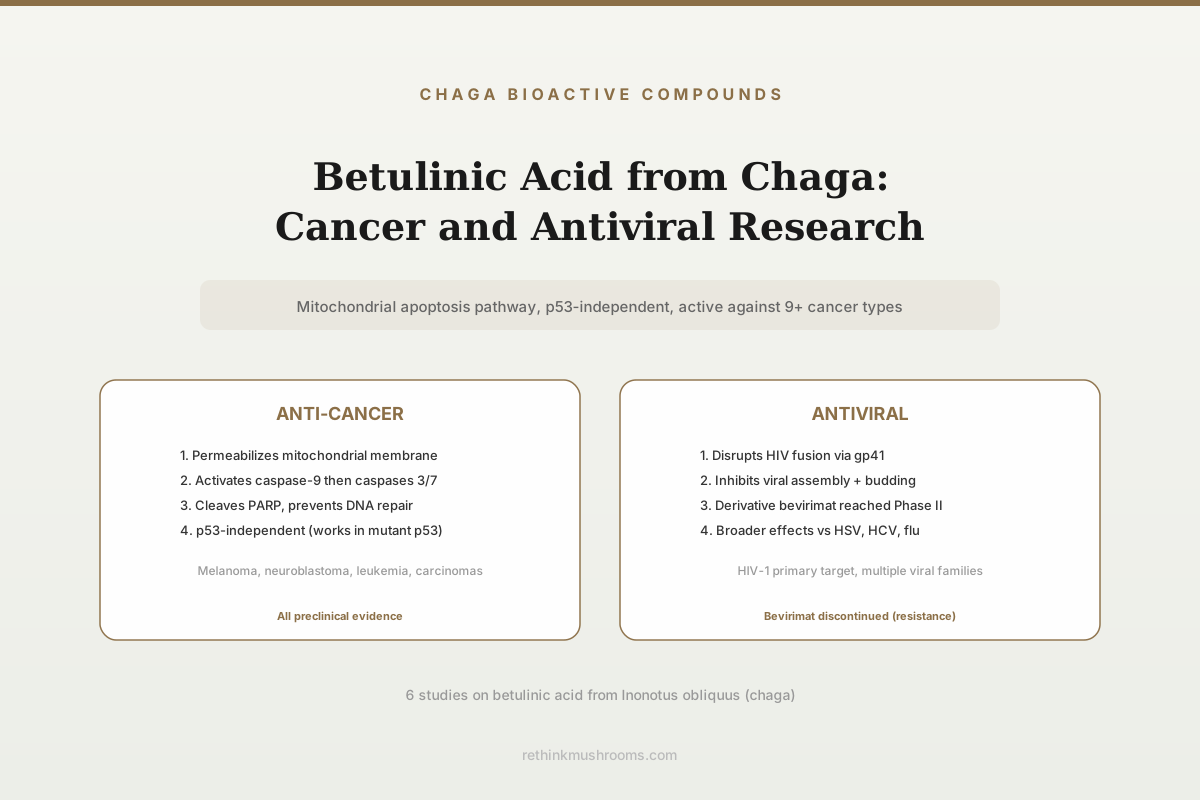
Betulinic acid kills cancer cells through the intrinsic (mitochondrial) apoptosis pathway. This mechanism has been characterized through multiple cell line studies and reviewed comprehensively by Ern et al. (2024) in the context of chaga's therapeutic properties.[1]
The sequence of events:
Step 1: Mitochondrial membrane permeabilization. Betulinic acid directly triggers permeabilization of the outer mitochondrial membrane. This is the commitment point for cell death and cannot be reversed once initiated.
Step 2: Caspase cascade activation. Cytochrome c released from damaged mitochondria activates caspase-9, which then activates executioner caspases 3 and 7. Caspase-8 (the extrinsic pathway caspase) remains inactive, confirming that betulinic acid works exclusively through the intrinsic pathway.
Step 3: PARP cleavage. Activated caspases cleave poly(ADP-ribose) polymerase (PARP) to its 85 kDa form, preventing DNA repair and completing the apoptotic process.[1]
Two properties make this mechanism distinctive. First, betulinic acid induces apoptosis irrespective of p53 status. Since p53 mutations are present in over 50% of human cancers and often confer resistance to conventional chemotherapy, a p53-independent apoptotic trigger has theoretical value.[2] Second, early studies reported selective cytotoxicity: betulinic acid killed cancer cells while leaving normal cells relatively unaffected, though subsequent research has shown this selectivity varies by cell type and concentration.[1]
Intrinsic Pathway, No p53 Needed
How Betulinic Acid Triggers Cancer-Cell Apoptosis
In lab studies, betulinic acid drives cell death down a single route — the mitochondrial (intrinsic) pathway. It hits the mitochondria first, then rides the caspase cascade to the end. The death-receptor (extrinsic) branch that many drugs use stays switched off, and the whole sequence runs whether or not the cell’s p53 brake is working — the safeguard most conventional chemotherapy depends on.
Mitochondrial membrane permeabilized
Betulinic acid directly permeabilizes the outer mitochondrial membrane (MOMP). This is the commitment point — once it fires, cell death cannot be reversed. [1]
Caspase-9 activated by released cytochrome c
Cytochrome c leaking from the damaged mitochondria activates initiator caspase-9, which in turn switches on the executioner caspases 3 and 7. [1]
PARP cleaved, DNA repair blocked
The executioner caspases cleave poly(ADP-ribose) polymerase (PARP) to its 85 kDa form, shutting down DNA repair and completing programmed cell death. [1]
Every step shown is established only in cell-culture and animal models. No human trial has tested betulinic acid from chaga for cancer, and the in-vitro concentrations that kill cancer cells may not be reachable through oral supplementation. This map explains a documented laboratory mechanism — it is not evidence that chaga treats cancer in people.
Mechanism synthesis; steps from refs [1][2] (see references)
Cancer Types Studied
The original 1995 discovery identified betulinic acid as a melanoma-specific agent. Subsequent preclinical work expanded the range of responsive cancer types substantially.
Ern et al. (2024) cataloged anti-cancer activity against: melanoma, neuroblastoma, glioblastoma, medulloblastoma, Ewing sarcoma, leukemia, breast carcinoma, lung carcinoma, and colorectal carcinoma. The activity varies by cancer type and experimental conditions.[1]
Fordjour et al. (2023) reviewed additional chaga-derived anti-cancer mechanisms beyond betulinic acid alone. I. obliquus extracts have demonstrated anti-tumor activity through multiple pathways: direct cytotoxicity, anti-angiogenic effects (preventing tumors from forming new blood vessels), and immunomodulation (enhancing the body's own anti-tumor immune response). Not all of these effects are attributable to betulinic acid. Chaga contains polysaccharides, polyphenols, and other triterpenoids (inotodiol, lanosterol) that contribute to its anti-cancer profile.[2]
For how chaga's melanin compounds contribute to bioactivity, see chaga melanin: the unique pigment. For birch tree-derived chemistry, see how birch trees contribute to chaga's chemistry.
Antiviral Properties: HIV and Beyond
Betulinic acid's antiviral activity, particularly against HIV-1, represents its second major area of preclinical investigation.
Fordjour et al. (2023) reviewed the anti-HIV mechanisms of betulinic acid and its synthetic derivatives. Two distinct antiviral mechanisms have been identified:
Fusion inhibition. Certain betulinic acid analogs disrupt viral fusion to the host cell in a post-binding step through interaction with the viral glycoprotein gp41. This prevents HIV from entering target cells even after initial attachment.[2]
Assembly and budding inhibition. Other derivatives disrupt the assembly and budding of HIV-1 particles, preventing the virus from producing new infectious copies. Bevirimat (PA-457), a betulinic acid derivative, reached Phase II clinical trials for HIV treatment before development was discontinued due to resistance issues in certain viral strains.[2]
Ern et al. (2024) also documented broader antiviral effects of chaga extracts against herpes simplex virus (HSV), hepatitis C virus (HCV), and influenza, though these effects may involve polysaccharides and polyphenols in addition to betulinic acid.[1]
DNA Protection and Antioxidant Effects
Park et al. (2004) tested aqueous chaga mushroom extracts for protection against oxidative DNA damage in human lymphocytes. Using the comet assay, cells pretreated with chaga extract (10-500 microg/mL) showed over 40% reduction in DNA fragmentation compared to H2O2-treated controls. The protection was dose-dependent and occurred at concentrations achievable with supplementation.[3]
Lee et al. (2007) isolated the specific antioxidant compounds responsible: inonoblins A, B, and C, along with known phelligridins D, E, and G. These polyphenols exhibited scavenging activity against ABTS radical cation, DPPH radical, and superoxide radical anion. These are distinct from betulinic acid, demonstrating that chaga's antioxidant protection involves its polyphenol fraction, not its triterpene content.[4]
The Bioavailability Problem
A persistent challenge for betulinic acid as a therapeutic agent is poor oral bioavailability. Betulinic acid is poorly water-soluble, which limits absorption from the gastrointestinal tract. Lazić et al. (2024) showed that extraction method dramatically affects which compounds are recovered from chaga material: water extracts pull polysaccharides and some phenolics, while ethanol-based extractions access triterpenoids including betulinic acid more effectively.[5]
Even with ethanol extraction, the amount of bioavailable betulinic acid delivered through chaga consumption is low compared to the doses used in cancer cell line studies. The in vitro concentrations that kill cancer cells may not be achievable through oral supplementation. This is the central unsolved problem for translating chaga's preclinical anti-cancer promise into clinical reality.
Windsor et al. (2025) added another layer to this problem. Their multi-analytical comparison showed that many commercial "chaga" supplements are grain-grown mycelium products that contain no betulinic acid at all. Even consumers seeking betulinic acid specifically may not be getting it if their product is not authentic wild-harvested chaga canker.[6]
Where the Evidence Stands
Betulinic acid's anti-cancer mechanism is well-characterized at the molecular level: mitochondrial membrane permeabilization, caspase cascade activation, p53-independent apoptosis. The anti-HIV mechanism is similarly defined: fusion inhibition via gp41 and assembly/budding disruption. Both are supported by extensive cell line and animal model data.
No human clinical trial has tested betulinic acid from chaga for cancer treatment. The one betulinic acid derivative that reached human trials (bevirimat for HIV) was synthetic, not chaga-derived, and development was discontinued. The bioavailability constraints of natural betulinic acid from chaga make direct translation from cell studies to clinical outcomes uncertain. For the broader chaga therapeutic picture, see chaga melanin vs. human melanin.
- Cell-line studiescompleted
Mitochondrial apoptosis, caspase cascade, and p53-independent cell death characterized across melanoma, leukemia, glioblastoma, and carcinoma lines.
- Animal modelscurrent
Tumor growth inhibited in mouse melanoma xenografts; broader anti-tumor and antiviral effects documented for chaga extracts in rodents.
- Human case reportsmissing
No published clinical case reports of betulinic acid from chaga treating cancer.
- Small human trialsmissing
None. Poor oral bioavailability leaves it unclear whether cell-killing concentrations are reachable in people.
- Large randomized trialsmissing
None.
- Meta-analysesmissing
None.
The molecular mechanism is well-characterized and animal data are supportive, but the evidence stops at preclinical models. No human has been shown to benefit, and the bioavailability gap is unresolved.
Ern et al., 2024; Fordjour et al., 2023
Medical Safety
CriticalChaga is not a cancer or HIV treatment
Concern
Betulinic acid's anti-cancer and anti-HIV activity has only been shown in cell cultures and animals. Using chaga in place of, or to delay, evidence-based cancer or HIV care can be dangerous.
What the research says
Treat chaga as a food or supplement with unproven disease-treatment value, not a therapy. There are no established doses for these uses and no human efficacy data.
Particularly relevant for: Anyone with a cancer or HIV diagnosis, and anyone on chemotherapy, antivirals, or immunosuppressants
What to do
Talk to your oncologist or physician before adding chaga, especially alongside prescribed treatment. This article is educational and is not medical advice.
Ern et al., 2024; Fordjour et al., 2023
The Bottom Line
Betulinic acid from wild chaga triggers cancer cell death through the mitochondrial apoptosis pathway, activating caspases 3, 7, and 9 while bypassing the p53 dependency that limits many conventional therapies. Anti-HIV activity involves disruption of viral fusion and assembly. All evidence is preclinical. Poor oral bioavailability, the birch-tree origin of betulinic acid (absent in cultivated chaga), and the lack of human clinical trials represent the gaps between laboratory promise and clinical application.
Frequently Asked Questions
Sources & References
- 1RTHM-01886·Ern, Phoebe Tee Yon et al. (2024). “Chaga Therapeutic Properties: What This 2024 Review Actually Shows.” Mycology.Study breakdown →PubMed →↩
- 2RTHM-01694·Fordjour, Eric et al. (2023). “Chaga mushroom: a super-fungus with countless facets and untapped potential..” Frontiers in pharmacology.Study breakdown →PubMed →↩
- 3RTHM-00076·Park, Yoo Kyoung et al. (2004). “Chaga mushroom extract inhibits oxidative DNA damage in human lymphocytes as assessed by comet assay..” BioFactors (Oxford.Study breakdown →PubMed →↩
- 4RTHM-00118·Lee, In-Kyoung et al. (2007). “New antioxidant polyphenols from the medicinal mushroom Inonotus obliquus..” Bioorganic & medicinal chemistry letters.Study breakdown →PubMed →↩
- 5RTHM-00888·Lazić, Vesna et al. (2024). “The Effect of Green Extraction Technologies on the Chemical Composition of Medicinal Chaga Mushroom Extracts..” Journal of fungi (Basel.Study breakdown →PubMed →↩
- 6RTHM-02209·Windsor, Coleton et al. (2025). “What This 2025 Chaga Supplement Authentication Study Actually Found.” International journal of molecular sciences.Study breakdown →PubMed →↩