Chaga Bioactive Compounds
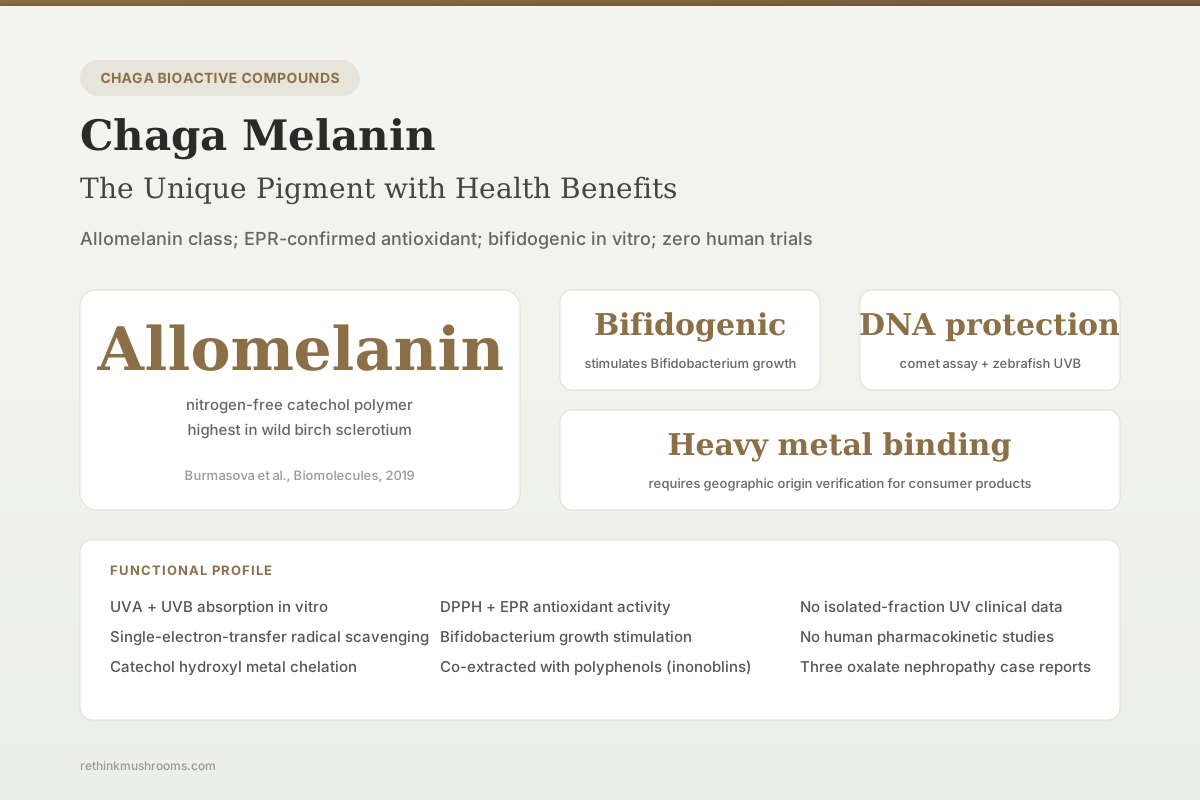
Allomelanin Rare Fungal Pigment
Wild chaga sclerotium contains exceptionally high concentrations of allomelanin, a nitrogen-free phenolic polymer with documented antioxidant, bifidogenic, and genoprotective activity in preclinical models. The pigment that makes chaga black is also a central driver of chaga's traditional antioxidant reputation. All current evidence for chaga melanin's health effects is preclinical.
Burmasova et al., Biomolecules, 2019
EPR-confirmed radicals
stable free-radical character of chaga melanin documented by electron paramagnetic resonance (Burmasova 2019)
Bifidogenic
chaga melanin stimulates Bifidobacterium growth in the intestine, a gut-microbiota-specific effect
0 human trials
no randomised clinical trial has tested chaga melanin for any human health outcome
Burmasova et al., Biomolecules, 2019
 View as image ↗
Chaga (Inonotus obliquus) produces one of the most melanin-rich sclerotia in the fungal kingdom. The jet-black outer layer of the canker that identifies chaga on a birch trunk is primarily melanin, and the pigment drives much of what chaga does functionally: broad antioxidant capacity, UV absorption, metal binding, and a documented bifidogenic effect on gut microbiota that distinguishes chaga melanin from all human melanins. Structurally, chaga melanin is classified as an allomelanin, a nitrogen-free phenolic polymer that differs from both the DHN-melanins of many other fungi and the tyrosine-derived eumelanins of human skin.[1] For the dedicated human-versus-fungal comparison sibling, see chaga melanin vs. human melanin: structure, function, and photoprotection and for the broader compound landscape see chaga bioactive compounds: betulinic acid, melanin, and polysaccharides.[2]
Key Takeaways
- Burmasova et al. (2019) applied spectrophotometry, EPR spectroscopy, and dynamic light scattering to chaga melanins and documented free-radical scavenging, antioxidant activity, and bifidogenic effects (stimulation of Bifidobacterium growth in vitro)
- Wild chaga sclerotium melanin is classified as an allomelanin (nitrogen-free, derived from catechol-type phenolic precursors), while melanin from cultivated chaga mycelium showed features closer to eumelanin-like polymers with different redox and particle-size characteristics
- Glamočlija et al. (2015) performed chemical characterisation of chaga from multiple geographic sources and confirmed melanin as a major contributor to total antioxidant capacity alongside phenolic acids, flavonoids, and triterpenoids
- Park et al. (2004) showed that chaga mushroom extract inhibited oxidative DNA damage in human lymphocytes in a comet assay, with melanin and polyphenol fractions plausibly contributing to the DNA-protective effect
- Eid et al. (2021) documented that chaga polysaccharide (likely co-purified with residual melanin) reduced UVB-induced DNA damage in zebrafish embryos and upregulated DNA repair genes including XRCC5, XRCC6, RAD51, and GADD45
- No randomised clinical trial has tested chaga melanin, alone or in combination, for any human health outcome including antioxidant activity, gut microbiome modulation, skin photoprotection, or disease prevention
What Makes Chaga Melanin Different
Chaga's melanin is unusual on two axes: concentration and structural class. The wild sclerotium accumulates melanin at concentrations considerably higher than most fungal tissues, producing the jet-black outer appearance characteristic of the canker. Structurally, wild chaga melanin lacks the nitrogen-containing indole units that characterise human eumelanin and many animal melanins. Instead, it is built predominantly from catechol-type phenolic monomers cross-linked through oxidative coupling, producing a nitrogen-free polymer class known as allomelanin.[1]
The allomelanin classification matters because different melanin classes show different reactivity patterns in biological assays. Nitrogen-containing eumelanins form more extensive π-conjugation across indole units and show characteristic EPR signatures. Allomelanins have different redox behaviour, different particle-size distributions, and different metal-binding profiles. Burmasova 2019 documented measurable differences in all these parameters between wild sclerotium and cultivated mycelium chaga melanin, supporting the view that source matters for functional activity.
Chaga melanin derives part of its precursor material from the birch host. Betulin and other phenolic compounds translocate from the Betula tree into the developing sclerotium. For the birch contribution sibling, see how birch trees contribute to chaga's chemistry. The host-derived phenolic input influences monomer identity and therefore the detailed structure of the resulting melanin polymer.
The Antioxidant Core Function
Chaga melanin's best-documented activity is antioxidant. Burmasova et al. (2019) measured free-radical scavenging using EPR and DPPH assays and quantified redox potential across sclerotium and mycelium-derived fractions. Wild sclerotium melanin showed higher antioxidant activity per unit mass than mycelium melanin, consistent with the different monomer composition and higher degree of oxidative cross-linking.[1]
The mechanism is single-electron transfer characteristic of conjugated phenolic polymers. Free radicals encountering melanin abstract electrons and are quenched, while the melanin polymer absorbs the radical equivalent into its extended π-system. Stable radical character is visible by EPR even in the resting state. This reactivity profile produces the broad-spectrum scavenging capacity that characterises all melanins across their evolutionary range.
At the chaga-extract level, Lee et al. (2007) characterised individual antioxidant polyphenols (inonoblins A–C and phelligridins D, E, G) that act alongside melanin in the crude extract.[3] Glamočlija et al. (2015) quantified total antioxidant capacity across multiple chaga samples and attributed a major share of the activity to melanin and phenolic fractions combined.[4]
The Bifidogenic Effect: Gut-Microbiota-Specific
The bifidogenic effect is one functional domain where chaga melanin's activity has no parallel in human melanin biology. Burmasova et al. (2019) documented that chaga melanin fractions stimulated Bifidobacterium growth in in vitro culture. Bifidobacteria are commensal Gram-positive bacteria that dominate the infant gut and persist as a significant fraction of healthy adult colonic flora. Reduced Bifidobacterium abundance is associated with inflammatory bowel disease, colorectal cancer, and other intestinal pathology.
The mechanistic basis for chaga melanin's bifidogenic effect is not fully characterised. Possible mechanisms include providing oligomeric phenolic substrates that Bifidobacterium can utilise; modulating intestinal pH or redox conditions in ways that favour Bifidobacterium over competitors; and direct binding of inhibitory metabolites from other microbial species. None of these has been isolated as the sole operative mechanism in the chaga melanin case, and clinical translation to measurable shifts in human gut microbiota composition has not been tested.
This effect is relevant to the broader chaga story because polysaccharide fractions of chaga also show microbiome-modulating activity (Zhang et al., 2023 for DSS colitis microbiota shifts). The combined melanin-plus-polysaccharide effect on gut microbiota may exceed what either would produce alone.
DNA Protection and Genotoxicity Reduction
Chaga's ability to protect DNA from oxidative damage has been demonstrated across three models, with melanin and phenolic fractions as probable contributors.
Park et al. (2004) used the comet assay to test chaga mushroom extract against hydrogen peroxide–induced oxidative DNA damage in human lymphocytes.[5] Chaga pretreatment reduced comet tail moment, indicating decreased DNA strand breaks under oxidative stress. The extract used contained melanin and polyphenol fractions; the DNA-protective effect could not be isolated to melanin specifically but is consistent with melanin's antioxidant activity contributing.
Eid et al. (2021) extended the DNA-protection evidence to UVB-induced damage in zebrafish embryos using chaga polysaccharide at 2.5 mg/mL.[6] DNA repair gene expression was upregulated (XRCC5, XRCC6, RAD51, GADD45) and apoptosis drivers (p53, BAX) were downregulated. Polysaccharide fractions typically co-purify with residual melanin unless explicitly separated; the observed effect probably reflects combined action.
Yun et al. (2011) documented UV-exposed hairless mice showing reduced skin thickening and wrinkle formation after I. obliquus treatment, with MMP-1 and MMP-9 inhibition in fibroblasts.[7] These in vivo skin effects reinforce the DNA-protective story at the tissue level.
Metal Binding and Heavy Metal Context
Allomelanin and eumelanin alike bind transition metals through catechol or indole hydroxyl groups. Chaga melanin is no exception. The binding is polydentate and strong for iron, copper, lead, cadmium, and mercury, and underlies one practical concern: chaga sclerotia concentrate heavy metals from their environment. Wild-harvested chaga from industrially contaminated regions can carry elevated lead, cadmium, or mercury, which are bound to melanin and can be released during extraction or digestion.
This creates a dual-edged sword for chaga melanin as a dietary component. On the protective side, melanin-bound metals do not generate as much Fenton-reaction ROS as free metal ions, contributing to antioxidant activity indirectly. On the harm side, oral intake of heavy-metal-loaded chaga can deliver toxic metals to the consumer. Geographic origin of chaga matters substantially: material harvested from relatively uncontaminated boreal forests shows much lower heavy metal loads than material from urban or industrial periphery regions.
Photoprotective Preclinical Evidence
Chaga melanin's UV-absorption profile across UVB and UVA plus its radical-scavenging capacity make it a plausible photoprotective compound. Preclinical evidence supports this at the extract level.
Lin et al. (2023) documented chaga polysaccharide effects in a UVB-induced HaCaT keratinocyte photoaging model: reduced senescence markers (p16, p21, p53), activated Nrf2/HO-1 pathway, restored autophagy.[8] The polysaccharide fraction used here may have contained residual melanin; complete separation of these fractions is not typically performed in photoprotection studies.
Yun et al. (2011) documented in vivo photoprotection in hairless mice. No study has tested isolated chaga melanin in a validated clinical SPF test; in vitro absorbance-based SPF estimates (SPF >30 at 10 mg/mL in aqueous or ethanolic extract) do not meet ISO 24444 clinical SPF standards.
For the dedicated UV sibling, see chaga and UV damage: photoprotective properties.
Review-Level Integration
Fordjour et al. (2023) and Ern et al. (2024) both identify melanin as among chaga's most distinctive components and catalogue the antioxidant, bifidogenic, and photoprotective effects documented across the preclinical literature.[9][10] Both reviews flag melanin's clinical translation as unfinished: no human trial has specifically tested chaga melanin for any health outcome.
Practical next-step trials would include oral dosing pharmacokinetic studies of chaga melanin fractions (to characterise what reaches systemic circulation versus stays in the gut lumen), microbiome composition changes in healthy adult volunteers consuming standardised chaga melanin, and topical photoprotection trials using ISO-validated methodology. None of these has been registered at ClinicalTrials.gov or comparable registries.
What the Evidence Supports and What It Does Not
| Question | Evidence | Confidence |
|---|---|---|
| Is chaga melanin a distinct allomelanin class? | Yes: Burmasova 2019 structural classification | High |
| Does chaga melanin scavenge free radicals? | Yes by EPR and DPPH assays (Burmasova 2019) | High (in vitro) |
| Does chaga melanin stimulate Bifidobacterium in vitro? | Yes (Burmasova 2019) | Moderate |
| Does chaga melanin protect DNA from oxidative damage? | Indirect evidence from mixed extracts (Park 2004; Eid 2021) | Low to moderate |
| Does chaga melanin protect skin from UV in animal models? | Yes at the mixed-extract level (Lin 2023; Yun 2011) | Moderate |
| Is chaga melanin effective in humans for any outcome? | Not tested; no published RCT | None |
| Is chaga melanin safe for long-term oral use? | Compounded by heavy-metal binding concern; three oxalate nephropathy case reports | Precautionary |
Safety: Heavy Metals, Oxalates, and the Long-Term Question
Three case reports (Kikuchi 2014; Kwon 2020; Lee 2022) document chaga-induced oxalate nephropathy from long-term high-dose oral use. These describe the chaga preparation as a whole rather than isolated melanin, but melanin is the dominant component of wild sclerotium. The oxalate load in chaga is partly bound or co-eluted with melanin during aqueous extraction.
Heavy metal concerns are specific to chaga melanin because the melanin polymer is the primary binding surface for environmental contaminants. Geographic origin verification and third-party testing of chaga products for lead, cadmium, mercury, and arsenic is the most important quality criterion for consumers. Some commercial chaga products carry elevated heavy metal content that would not be considered acceptable in a regulated food or supplement context in jurisdictions with active contaminant testing.
The Bottom Line
Chaga melanin is a distinct allomelanin polymer concentrated in the sclerotium of Inonotus obliquus with documented antioxidant (Burmasova 2019), bifidogenic (Burmasova 2019), and DNA-protective (Park 2004; Eid 2021) activity in preclinical models. UV-exposure studies of mixed chaga extracts show photoprotective effects consistent with melanin contribution (Lin 2023; Yun 2011). Chemical characterisation (Glamočlija 2015; Lee 2007) places melanin alongside polyphenols, polysaccharides, and triterpenoids as the compounds driving chaga's bioactivity. No randomised clinical trial has tested isolated chaga melanin for any human health outcome. Safety considerations include heavy-metal binding (making geographic source critical), three published oxalate nephropathy case reports from long-term use, and unknown drug interactions.
Frequently Asked Questions
Sources & References
- 1RTHM-00545·Burmasova, Marina A et al. (2019). “Melanins of Inonotus Obliquus: Bifidogenic and Antioxidant Properties..” Biomolecules.Study breakdown →PubMed →↩
- 2RTHM-01694·Fordjour, Eric et al. (2023). “Chaga mushroom: a super-fungus with countless facets and untapped potential..” Frontiers in pharmacology.Study breakdown →PubMed →↩
- 3RTHM-00118·Lee, In-Kyoung et al. (2007). “New antioxidant polyphenols from the medicinal mushroom Inonotus obliquus..” Bioorganic & medicinal chemistry letters.Study breakdown →PubMed →↩
- 4RTHM-00373·Glamočlija, Jasmina et al. (2015). “Chemical characterization and biological activity of Chaga (Inonotus obliquus), a medicinal "mushroom"..” Journal of ethnopharmacology.Study breakdown →PubMed →↩
- 5RTHM-00076·Park, Yoo Kyoung et al. (2004). “Chaga mushroom extract inhibits oxidative DNA damage in human lymphocytes as assessed by comet assay..” BioFactors (Oxford.Study breakdown →PubMed →↩
- 6RTHM-00683·Eid, Jehane Ibrahim et al. (2021). “Chaga mushroom (Inonotus obliquus) polysaccharides exhibit genoprotective effects in UVB-exposed embryonic zebrafish (Danio rerio) through coordinated expression of DNA repair genes..” Heliyon.Study breakdown →PubMed →↩
- 7RTHM-00241·Yun, Jong Seok et al. (2011). “Inonotus obliquus protects against oxidative stress-induced apoptosis and premature senescence..” Molecules and cells.Study breakdown →PubMed →↩
- 8RTHM-00840·Lin, Jun et al. (2023). “Chaga Medicinal Mushroom, Inonotus obliquus (Agaricomycetes), Polysaccharides Alleviate Photoaging by Regulating Nrf2 Pathway and Autophagy..” International journal of medicinal mushrooms.Study breakdown →PubMed →↩
- 9RTHM-01886·Ern, Phoebe Tee Yon et al. (2024). “Chaga Therapeutic Properties: What This 2024 Review Actually Shows.” Mycology.Study breakdown →PubMed →↩
- 10RTHM-00722·Szychowski, Konrad A et al. (2021). “Inonotus obliquus - from folk medicine to clinical use..” Journal of traditional and complementary medicine.Study breakdown →PubMed →↩