Chaga Bioactive Compounds
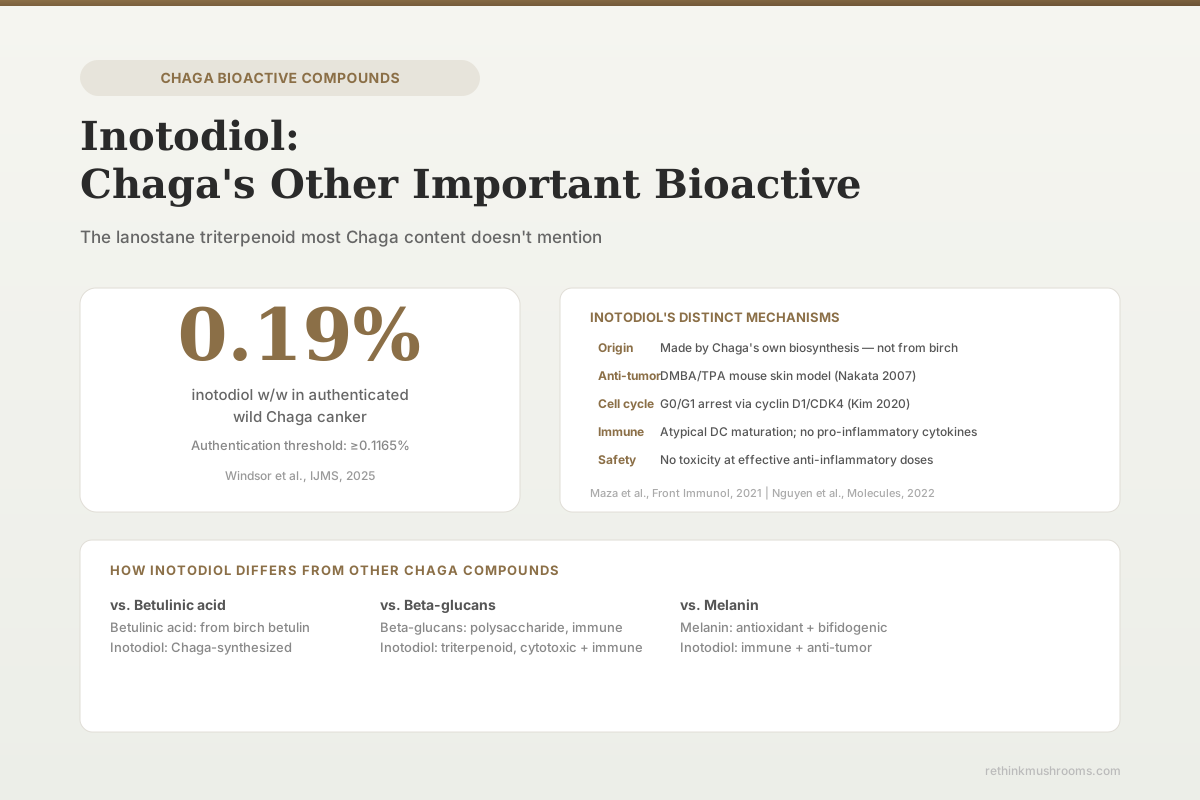
0.19% inotodiol content in authenticated wild Chaga
Windsor and colleagues measured inotodiol in wild Chaga canker at 0.19% w/w by dry weight in 2025 — the most abundant triterpenoid in the profile, and roughly 1.6 times a previously recommended authentication threshold of 0.1165%. Most commercial products do not specify inotodiol content, leaving consumers with no way to verify potency.
Windsor et al., International Journal of Molecular Sciences, 2025
Lanostane triterpenoid
inotodiol's compound class: the same triterpenoid family as ganoderic acids from reishi but with a distinct structure and mechanism; it is produced by Chaga's own metabolic machinery, not sourced from the birch host
Atypical DC maturation
Maza 2021 found purified inotodiol matures dendritic cells without triggering pro-inflammatory cytokines, working through PI3K rather than the usual NF-kB route — an immunomodulatory profile distinct from standard immune activators
G0/G1 arrest
the cancer cell cycle halt documented for the four main Chaga triterpenoids together, inotodiol among them: cyclin D1, CDK4, cyclin E and phosphorylated Rb are downregulated, stopping cell division at the earliest checkpoint (Wang et al., Biomolecules, 2024)
Windsor et al., International Journal of Molecular Sciences, 2025
 View as image ↗
Most Chaga coverage focuses on two compound categories: beta-glucans (polysaccharides responsible for immune activation) and betulinic acid (the triterpenoid derived from birch bark compounds that Chaga converts). Both are real and well-studied. Neither is the whole story.
Inotodiol is a lanostane-class triterpenoid that Chaga produces through its own biosynthetic machinery, distinct from the betulinic acid pathway. It has documented anti-tumor promotion, cancer cell cycle effects, anti-allergic, and immunomodulatory activities in preclinical models. It is the most abundant triterpenoid in authenticated wild Chaga at 0.19% w/w dry weight, and its measurement is now used as an authentication marker for genuine Chaga products.[1]
For context on how Chaga's full compound profile fits together, see what are beta-glucans: the most important compound in medicinal mushrooms. For the betulinic acid side of Chaga's chemistry, see betulinic acid from Chaga: anti-cancer and antiviral research.
Key Takeaways
- Inotodiol is a lanostane triterpenoid found in Chaga (Inonotus obliquus), produced by the mushroom's own metabolic machinery rather than derived from its birch host, which distinguishes it from betulinic acid, which originates from birch-derived betulin
- Nakata and colleagues documented purified inotodiol's anti-tumor promoting activity in a DMBA/TPA two-stage mouse skin carcinogenesis model in 2007, while also characterizing two novel related compounds, inonotsuoxides A and B (Nakata et al., Bioorganic & Medicinal Chemistry, 2007)
- The four main Chaga triterpenoids together — inotodiol, trametenolic acid, 3-hydroxy-lanosta-8,24-dien-21-al and betulin — halted breast cancer cell division at G0/G1 by downregulating cyclin D1, CDK4, cyclin E and phosphorylated Rb, with dihydrofolate reductase identified as their shared target (Wang et al., Biomolecules, 2024)
- Tested on its own, purified inotodiol produces a different cell cycle signature: cyclin E down and p27 up in cervical cancer cells (Zhao et al., APJCP, 2014), and beta-catenin with its targets c-Myc and cyclin D1 down in tumor-bearing rats (Zhang et al., Biomedicine & Pharmacotherapy, 2018)
- Maza and colleagues found in 2021 that inotodiol induces an atypical maturation profile in dendritic cells: surface markers MHC-I, MHC-II, CD86 and CD40 increase while TNF-alpha and IL-12p40 are NOT triggered, and the effect runs through PI3K rather than NF-kB (Maza et al., Frontiers in Immunology, 2021)
- Nguyen and colleagues confirmed inotodiol's safety in repeated-dose oral studies in mice — no mortality or organ abnormalities — while showing anti-allergic activity through mast cell inhibition in a food allergy model (Nguyen et al., Molecules, 2022)
- Windsor and colleagues measured inotodiol at 0.19% w/w in authenticated wild Chaga canker, confirming it exceeds a previously recommended authentication minimum of 0.1165%; most commercial Chaga supplements do not specify inotodiol content (Windsor et al., IJMS, 2025)
- No human clinical trial has tested inotodiol for any condition, and its oral bioavailability in people has not been characterised
The Compound Most Chaga Articles Don't Mention
Comprehensive reviews of Chaga's chemistry, including Fordjour and colleagues' 2023 overview and Ern and colleagues' 2024 review, consistently identify three bioactive layers: betulinic acid (triterpenoid, birch-derived), polysaccharides/beta-glucans (immunomodulatory), and melanin (antioxidant/pigment).[8][9]
Inotodiol is the fourth layer that these systematic reviews cover but popular content omits entirely. This matters because inotodiol has a distinct origin and a distinct mechanism from the other three compound classes.
For the broader context of this compound class in medicinal mushrooms, see lanostane triterpenes in medicinal mushrooms and mushroom triterpenes: the bitter compounds with powerful effects.
Origin: Made by Chaga, Not Sourced from Birch
The difference between inotodiol and betulinic acid in terms of origin is worth understanding before the biological effects.
Betulinic acid in Chaga originates from betulin, a pentacyclic triterpenoid that makes up a large fraction of birch outer bark by dry weight. Chaga absorbs betulin and converts a portion to betulinic acid. The compound is essentially a modified form of a birch-specific molecule.
Inotodiol is different. It is a product of Chaga's own terpenoid biosynthesis pathway, assembled from mevalonate-pathway precursors the same way animals make cholesterol and plants make terpene-based secondary metabolites. It does not depend on the birch host for its precursors in the way betulinic acid does.
Two Different Origins
Where Chaga’s Two Headline Triterpenoids Actually Come From
Both compounds are found in the same mushroom, and popular articles usually treat them as interchangeable “chaga triterpenoids.” They are not. One is a birch molecule that chaga edits. The other chaga builds from scratch. The routes diverge at the very first step.
Borrowed from the host
Betulinic acid
Birch outer bark → Betulin absorbed → Chaga converts it
Chaga takes a birch-made molecule and modifies it. Remove the birch and you remove the starting material.
Built by the fungus
Inotodiol
Mevalonate precursors → Chaga's own enzymes → Lanostane skeleton
Chaga assembles this one itself, the same general way animals build cholesterol. No birch molecule is required.
This diagram describes where the molecules come from, not how well either one works. Origin says nothing about potency — it explains why substrate and growing method can shift one compound’s content more than the other’s.
Pathway background from chaga chemistry reviews [8][9]; triterpenoid co-occurrence from refs [1][3]
This distinction has a practical consequence. Cultivated Chaga grown on substrates other than birch may have substantially different betulinic acid content, because the birch precursor is absent. Inotodiol, being independently synthesised, is not tied to the host species in the same way — though it is worth being clear that no study has directly compared inotodiol yields across birch and non-birch substrates, so this is a reasonable inference from biosynthesis rather than a measured result.
What has been measured is where inotodiol sits within the mushroom. Kim and colleagues extracted the inner and outer parts of Chaga separately in 2020 and found inotodiol and trametenolic acid to be the major triterpenoids in both, with the outer part significantly richer: inotodiol reached 194.1 ± 11.5 mg/g in the triterpenoid fraction from the outer part versus 153.9 ± 15.4 mg/g from the inner part.[3]
For how birch trees specifically shape Chaga's broader compound profile, see how birch trees contribute to Chaga's chemistry.
A Problem With How Inotodiol Evidence Gets Reported
Before going through the findings, one distinction determines how much any of them is worth.
Some studies test purified inotodiol. Others test a triterpenoid fraction in which inotodiol is the most abundant of several active compounds. Others test a whole Chaga extract containing everything the mushroom makes. All three routinely get reported as "inotodiol research," and they support very different claims.
A whole-extract result showing cancer cells dying tells you the extract did something. It does not tell you inotodiol did it — betulinic acid, ergosterol peroxide, the polysaccharides and the phenolics were all in the dish too. Only the purified-compound studies can carry a claim about the molecule itself.
Read The Methods, Not The Headline
What Was Actually In The Tube
Most claims that “inotodiol does X” come from studies that tested a chaga extract containing inotodiol, not inotodiol on its own. Those are different claims. This sorts every study cited in this article by what the researchers actually put on the cells or into the animal.
Purified inotodiol
Attributable to the compoundThe molecule was isolated before testing, so the result belongs to inotodiol itself.
| Study | Model | Reported finding |
|---|---|---|
| Nakata 2007 [2] | Mouse skin, in vivo | Inhibited tumor promotion |
| Zhao 2014 [11] | HeLa cells, in vitro | Cyclin E down, p27 up, apoptosis |
| Zhang 2018 [12] | Rat tumors, in vivo | Beta-catenin, c-Myc, cyclin D1 down |
| Maza 2021 [6] | Mouse DCs + in vivo | Atypical DC maturation |
| Nguyen 2022 [7] | Mice, in vivo | No toxicity; mast cell inhibition |
Triterpenoid fraction
Shared with other triterpenoidsInotodiol was the most abundant compound present, but trametenolic acid and others were in the tube too.
| Study | Model | Reported finding |
|---|---|---|
| Kim 2020 [3] | 4 cancer cell lines | Anti-proliferative; composition measured |
| Wang 2024 [10] | Breast cancer lines | G0/G1 arrest; DHFR inhibition |
| Baek 2018 [5] | 4 lung cancer lines | Apoptosis via caspase-3 |
Whole chaga extract
Cannot be assigned to one compoundEverything chaga contains was present. A positive result says the extract did something, not which molecule did it.
| Study | Model | Reported finding |
|---|---|---|
| Gery 2018 [4] | A549 vs BEAS-2B | Selective cytotoxicity to cancer cells |
No row in this table is a human study. Every finding listed is from cell culture or an animal model, and the tiers rank what a result can be attributed to, not how strong the evidence is for people. Inotodiol has never been tested in a human clinical trial.
Sorted from the methods sections of refs [2][3][4][5][6][7][10][11][12]
This is not a pedantic distinction. It is the difference between "inotodiol arrests the cell cycle via cyclin D1 and CDK4" — which no purified-inotodiol study has shown — and "the four main Chaga triterpenoids together arrest the cell cycle via cyclin D1 and CDK4," which is what the evidence actually says.
Anti-Tumor Promotion: What the DMBA/TPA Model Shows
The foundational study of inotodiol's anti-cancer activity was published by Nakata and colleagues in 2007, using a two-stage mouse skin carcinogenesis model — and importantly, it tested the purified compound.[2]
Nakata et al. (2007) · Bioorganic & Medicinal Chemistry
- Population
- Mouse skin, two-stage carcinogenesis model
- Intervention
- Purified inotodiol isolated from Inonotus obliquus sclerotia
- Comparator
- DMBA/TPA treated controls
- Finding
- Inotodiol, the most abundant triterpene in the sclerotia, showed potent anti-tumor promoting activity in the in vivo carcinogenesis test. The same work determined the structures of two previously unknown lanostane triterpenoids, inonotsuoxides A and B.
preliminary An in vivo result on the purified compound, which is unusual for inotodiol — but a chemoprevention model in mice, not a cancer treatment result, and now nearly two decades old without direct replication.
Nakata T, et al. Bioorg Med Chem. 2007;15(1):257-64.
Subsequent work extended the picture, though with the caveat established above. Baek and colleagues used bioactivity-guided fractionation of Chaga in 2018 to identify cytotoxic constituents that induce apoptosis in human lung adenocarcinoma cells, testing four cell lines with different p53 status.[5] They isolated eight triterpenoids, including a previously undescribed lanostane they named chagabusone A, and found that three of the eight drove most of the cytotoxicity through caspase-3 activation. The potency was modest: IC50 values ran from 75.1 to 227.4 μM, concentrations far above anything plausibly reached in human blood from drinking Chaga tea.
Géry and colleagues provided a useful selectivity result in 2018. A Chaga aqueous extract was significantly more cytotoxic to lung cancer cells (A549) than to bronchial epithelial cells (BEAS-2B), at both 48 hours (P = 0.025) and 72 hours (P = 0.004).[4] Differential toxicity — killing cancer cells more readily than normal cells — is the property that matters most for any potential cancer application. This was a whole aqueous extract, however, and the study did not attribute the selectivity to any individual compound. The same work quantified inotodiol across geographic sources and found Canadian Chaga richest in it, while French Chaga carried more betulin and betulinic acid.
The Cell Cycle Arrest Mechanism
The mechanism connecting Chaga triterpenoids to cancer cell death runs through the cell cycle.
Wang and colleagues supplied the clearest account of this in 2024. They digested a Chaga water extract in vitro first, to mimic what actually survives consumption as a beverage, then tested it on HER2-positive and triple-negative breast cancer lines.[10] Four triterpenoids — inotodiol, trametenolic acid, 3-hydroxy-lanosta-8,24-dien-21-al and betulin — were identified as the main bioactive components. Together they reduced cell viability and blocked the cell cycle at G0/G1, downregulating cyclin D1, CDK4, cyclin E and phosphorylated retinoblastoma protein. The team identified dihydrofolate reductase, the same enzyme the chemotherapy drug methotrexate targets, as the crucial shared target, and found the components acted synergistically with cisplatin and with trastuzumab.
Wang et al. (2024) · Biomolecules
- Population
- HER2-positive and triple-negative breast cancer cell lines
- Intervention
- In vitro digested Chaga water extract; four triterpenoids incl. inotodiol
- Comparator
- Untreated cells; combination arms with cisplatin and trastuzumab
- Finding
- Cell viability fell and the cycle blocked at G0/G1 with cyclin D1, CDK4, cyclin E and phosphorylated Rb all downregulated. Dihydrofolate reductase was identified as the crucial target, and the components acted synergistically with cisplatin and trastuzumab.
narrow-scope A well-designed cell study — the in vitro digestion step makes it more relevant to actual consumption than most — but the effects belong to the four triterpenoids collectively, not to inotodiol alone, and no animal or human work followed.
Wang J, et al. Biomolecules. 2024;14(11):1454.
Purified inotodiol on its own produces a related but distinguishable signature. Zhao and colleagues treated cervical cancer (HeLa) cells with the isolated compound in 2014 and saw dose-dependent growth inhibition alongside apoptosis, with cyclin E and bcl-2 falling while p27 and bax rose.[11] Note what is absent: no cyclin D1 or CDK4 change was reported. That combination belongs to the mixed-triterpenoid studies.
The one place purified inotodiol and cyclin D1 do meet is in living animals. Zhang and colleagues gave inotodiol to rats carrying chemically induced breast tumours on a background of streptozotocin-induced diabetes.[12] Inotodiol lowered blood glucose, reduced the proliferation marker PCNA in tumour tissue, and downregulated beta-catenin along with its downstream targets c-Myc and cyclin D1, with apoptosis increasing. Here cyclin D1 falls as a consequence of beta-catenin suppression — a different route to the same protein than the direct cell cycle blockade the triterpenoid mixture produces.
Two independent in vivo results for a purified mushroom compound is more than most bioactives have. It is still two rodent studies.
Inotodiol's Distinctive Immune Mechanism
The most unusual finding in inotodiol research is the 2021 Frontiers in Immunology study by Maza and colleagues on dendritic cell maturation — and it used the purified compound.[6]
Inotodiol split the package. Dendritic cells raised their surface maturation markers — MHC-I, MHC-II, CD86 and CD40 — without altering production of cytokines including TNF-alpha and IL-12p40. T cells primed by those dendritic cells proliferated and produced IL-2, without producing IL-12p40 or IFN-gamma. The effect was not confined to a dish: injecting inotodiol into mice matured splenic dendritic cells, raised IL-2, and drove proliferation of adoptively transferred CD8+ T cells.
The signalling route explains why the two halves came apart. The maturation depended on PI3K — the inhibitor wortmannin abolished both Akt phosphorylation and the rise in CD86 and MHC-II. But inotodiol never triggered the NF-kB machinery that normally carries the inflammatory half of the signal: it failed to induce IkB kinase phosphorylation or IkB-alpha degradation, and an IkB kinase inhibitor did not block the CD86 increase.
Maza et al. (2021) · Frontiers in Immunology
- Population
- Mouse bone marrow-derived dendritic cells, plus in vivo mouse experiments
- Intervention
- Purified inotodiol
- Comparator
- Untreated cells; wortmannin and IkB kinase inhibitor arms
- Finding
- MHC-I, MHC-II, CD86 and CD40 rose without changes in TNF-alpha or IL-12p40. Primed T cells produced IL-2 but not IFN-gamma. Maturation was PI3K-dependent and NF-kB-independent.
positive A mechanistically thorough study on the purified compound with both cell and in vivo components. Still entirely in mice, with no evidence yet that oral Chaga achieves the concentrations used.
Maza PAMA, et al. Front Immunol. 2021;12:650841.
This immunomodulatory fingerprint is genuinely distinct from standard immune activation. It suggests inotodiol can prime T cell responses without the systemic inflammation that usually accompanies immune activation. Whether that translates into therapeutic utility in any specific context is unknown — but the mechanism separates inotodiol from both simple immunostimulants and simple anti-inflammatory compounds.
Safety Profile in Preclinical Studies
Nguyen and colleagues assessed inotodiol's safety in mice in 2022, preparing both a crude form (INO20) and a pure form (INO95) from Chaga extract and giving them once daily by mouth for repeated-dose toxicity evaluation.[7] Repeated administration produced no mortality and no organ abnormalities.
The efficacy half of that study is more specific than "anti-inflammatory" suggests. The model was food allergy, and both preparations reduced diarrhoea symptoms while lowering MCPT-1, a mast cell protease used as a readout of mast cell activation. The authors framed the result as anti-allergic activity achieved by inhibiting mast cell function — a narrower and better-defined claim than general inflammation control.
Safety
ModeratePreclinical safety data does not transfer to human use
Concern
Inotodiol's safety record consists of repeated-dose toxicity work in mice. No human pharmacokinetic study, no human toxicology study, and no human clinical trial of inotodiol exists for any condition. The oral bioavailability of lanostane triterpenoids from consumed Chaga has not been characterised in people, so the relationship between concentrations that work in a dish and concentrations achievable in a human bloodstream is unknown.
What the research says
Treat inotodiol content as a marker of Chaga authenticity rather than a dosing target, and treat every mechanism described in this article as laboratory biology rather than a demonstrated human effect.
Particularly relevant for: Anyone considering Chaga for a health condition, and especially anyone undergoing cancer treatment or taking immunosuppressive, anticoagulant or antidiabetic medication
What to do
Talk to your oncologist or prescriber before adding Chaga to any treatment regimen. Chaga also carries a separate, well-documented oxalate load concern relevant to kidney health, independent of its triterpenoid content.
Nguyen TMN, et al. Molecules. 2022;27(15):4704; absence of human trial data as of 2026
This article describes preclinical research. It is not medical advice, and nothing here should be used to diagnose, treat, or make decisions about a health condition.
- Cell studiescompleted
Multiple, across cervical, breast, lung, colon, gastric and prostate cancer lines, plus dendritic cell work
- Animal studiescompleted
Mouse skin carcinogenesis, rat breast tumours, mouse food allergy, mouse immune experiments
- Case reportsmissing
None for inotodiol specifically
- Small human trialsmissing
None. No human has been given purified inotodiol in a published trial
- Large RCTsmissing
None
- Meta-analysesmissing
None possible without trials
Inotodiol has an unusually solid preclinical base for a mushroom compound — including two in vivo studies using the purified molecule — and a complete absence of human data. Every benefit described anywhere in this article stops at the animal stage.
Refs [2][4][5][6][7][10][11][12]; no registered human trials of inotodiol as of 2026
What to Look for in Chaga Supplements: The 0.19% Benchmark
The Windsor 2025 analysis of commercial Chaga products supplies a practical quality benchmark.[1] Using LC-DAD quantification, wild Chaga canker — the sclerotium, the hardened black growth harvested from birch trees — contained inotodiol at 0.19% w/w on average, making it the most abundant triterpenoid ahead of trametenolic acid, 3-hydroxy-lanosta-8,24-dien-21-al and lanosterol.
Authenticated Wild Canker
The Triterpenoid Profile Behind The 0.19% Number
Inotodiol is not just present in genuine wild chaga — it is the most abundant triterpenoid there, which is exactly what makes it usable as an authentication marker. These are LC-DAD measurements of wildcrafted canker.
Marker compound
Inotodiol leads the profile
At 0.19% w/w it is roughly twice the next-highest triterpenoid and about 1.6× the authentication threshold. [1]
What it separates
Canker vs grain products
Iodine-starch assays found starch-rich composition in mycelium-on-grain products and none in authentic canker. [1]
Read the funding
Authors sell chaga
Five of six authors work for Nammex, which sells authenticated chaga; the sixth works for its testing lab. Declared in the paper. [1]
These are compositional measurements, not health claims. A product hitting 0.19% inotodiol is evidence that it is genuine wild chaga canker — it is not evidence that the product does anything for you.
LC-DAD quantification, Windsor 2025 [1]; threshold origin ref [3]
One attribution detail is worth stating precisely, because it is widely garbled. The 0.1165% w/w figure is not Windsor's invention. Their paper describes it as a previously recommended authentication threshold, traceable to Kim and colleagues' 2020 compositional work.[3] What Windsor's team contributed was confirmation that authenticated wildcrafted canker comfortably exceeds it, alongside a broader analytical framework — HPTLC, LC-QToF-MS, NMR fingerprinting, UV-Vis and iodine-starch assays — for separating genuine canker from mycelium-on-grain products. The iodine-starch test is the bluntest of these: fermented grain products are starch-rich, authentic canker contains none.
Most commercial Chaga supplements do not disclose inotodiol content, which makes direct verification difficult. Products that undergo comprehensive analytical testing will specify it, and a Certificate of Analysis listing inotodiol alongside beta-glucan content is a meaningful quality indicator.
Read that literature with its funding in view. The Windsor study was produced by Nammex — five of its six authors are employed by the company, which sells authenticated Chaga and has a commercial interest in standards that distinguish canker from grain-based products, with the sixth author at the third-party lab Nammex uses. The paper declares all of this openly, and the analytical work stands on its methods. But a quality threshold published by a company that sells product meeting that threshold deserves to be read as what it is.
For how Chaga supplement quality compares between wild, cultivated, and commercial extract forms more broadly, see chaga melanin: the unique pigment with health benefits and chaga melanin vs. human melanin: structure, function, and photoprotection.
For a comparison of how inotodiol's lanostane triterpenoid mechanism compares to ganoderic acids in reishi, see ganoderic acids from reishi: a complete guide.
The Bottom Line
Inotodiol is a lanostane triterpenoid produced by Chaga's own biosynthesis rather than derived from birch compounds, distinguishing it from betulinic acid. Purified inotodiol was characterised in vivo by Nakata and colleagues in 2007 as an anti-tumor promoter in a DMBA/TPA mouse skin model, and by Zhang and colleagues in 2018 as suppressing breast tumour proliferation in rats via beta-catenin downregulation. Wang and colleagues showed in 2024 that Chaga's four main triterpenoids together — inotodiol among them — arrest breast cancer cells at G0/G1 by downregulating cyclin D1, CDK4, cyclin E and phosphorylated Rb, targeting dihydrofolate reductase and acting synergistically with cisplatin and trastuzumab. Tested alone, inotodiol instead lowers cyclin E and raises p27 (Zhao et al., 2014). Géry and colleagues showed a Chaga aqueous extract was selectively cytotoxic to lung cancer cells over normal bronchial cells in 2018. Maza and colleagues' 2021 study documented inotodiol's atypical dendritic cell maturation — surface markers MHC-I, MHC-II, CD86 and CD40 up without TNF-alpha or IL-12p40 — running through PI3K rather than NF-kB. Safety was supported by repeated-dose mouse studies that also showed anti-allergic mast cell inhibition (Nguyen et al., 2022). Windsor and colleagues measured 0.19% w/w in wild canker in 2025, confirming it exceeds a previously recommended 0.1165% authentication threshold that originates with Kim 2020. No human clinical trial of inotodiol exists.
Frequently Asked Questions
Sources & References
- 1RTHM-02209·Windsor, Coleton et al. (2025). “What This 2025 Chaga Supplement Authentication Study Actually Found.” International journal of molecular sciences.Study breakdown →PubMed →↩
- 2RTHM-00225·Nakata, Tomoko et al. (2007). “Structure determination of inonotsuoxides A and B and in vivo anti-tumor promoting activity of inotodiol from the sclerotia of Inonotus obliquus..” Bioorganic & medicinal chemistry.Study breakdown →PubMed →↩
- 3RTHM-01218·Kim, Jaecheol et al. (2020). “Composition of Triterpenoids in Inonotus obliquus and Their Anti-Proliferative Activity on Cancer Cell Lines..” Molecules (Basel.Study breakdown →PubMed →↩
- 4RTHM-00958·Géry, Antoine et al. (2018). “Chaga ( Inonotus obliquus), a Future Potential Medicinal Fungus in Oncology? A Chemical Study and a Comparison of the Cytotoxicity Against Human Lung Adenocarcinoma Cells (A549) and Human Bronchial Epithelial Cells (BEAS-2B)..” Integrative cancer therapies.Study breakdown →PubMed →↩
- 5RTHM-00940·Baek, Jiwon et al. (2018). “Bioactivity-based analysis and chemical characterization of cytotoxic constituents from Chaga mushroom (Inonotus obliquus) that induce apoptosis in human lung adenocarcinoma cells..” Journal of ethnopharmacology.Study breakdown →PubMed →↩
- 6RTHM-01402·Maza, Perry Ayn Mayson A et al. (2021). “Inotodiol From Inonotus obliquus Chaga Mushroom Induces Atypical Maturation in Dendritic Cells..” Frontiers in immunology.Study breakdown →PubMed →↩
- 7RTHM-01592·Nguyen, Thi Minh Nguyet et al. (2022). “Evaluation of Toxicity and Efficacy of Inotodiol as an Anti-Inflammatory Agent Using Animal Model..” Molecules (Basel.Study breakdown →PubMed →↩
- 8RTHM-01694·Fordjour, Eric et al. (2023). “Chaga mushroom: a super-fungus with countless facets and untapped potential..” Frontiers in pharmacology.Study breakdown →PubMed →↩
- 9RTHM-01886·Ern, Phoebe Tee Yon et al. (2024). “Chaga Therapeutic Properties: What This 2024 Review Actually Shows.” Mycology.Study breakdown →PubMed →↩
- 10RTHM-02012·Wang, Junbiao et al. (2024). “Chaga Mushroom Triterpenoids Inhibit Dihydrofolate Reductase and Act Synergistically with Conventional Therapies in Breast Cancer..” Biomolecules.Study breakdown →PubMed →↩
- 11RTHM-02375·Zhao, Li-Wei et al. (2014). “Purified inotodiol slowed growth and triggered self-destruction in cervical cancer cells.” Asian Pacific journal of cancer prevention : APJCP.Study breakdown →PubMed →↩
- 12RTHM-02376·Zhang, Xin et al. (2018). “Inotodiol slowed breast tumor growth in diabetic rats by shutting down beta-catenin signaling.” Biomedicine & pharmacotherapy.Study breakdown →PubMed →↩