Mushroom Triterpenes and Ganoderic Acids
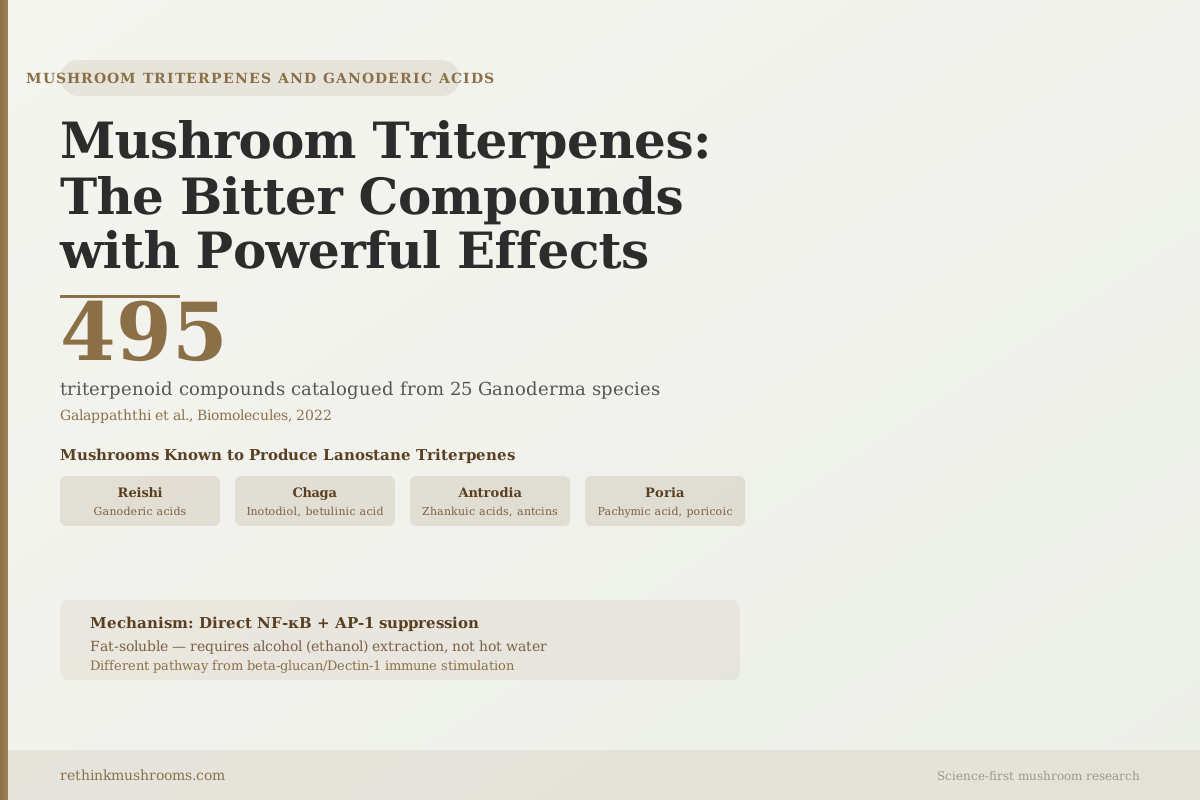
495 triterpenoid compounds
A 2022 review catalogued 495 distinct triterpenoid compounds from 25 Ganoderma species alone, classified into 7 structural subclasses. Reishi is not one compound. It's a biochemical library.
Galappaththi et al., Biomolecules, 2022
7 structural subclasses
of triterpenoids identified in Ganoderma species, ranging from C31 to C24 carbon skeletons plus rearranged variants (Galappaththi et al., 2022)
NF-κB suppressed directly
by isolated Ganoderma triterpenes in vitro, a mechanism distinct from the beta-glucan immune-stimulation pathway (Dudhgaonkar et al., 2009)
Chaga and Antrodia
also produce lanostane-type triterpenes with anti-inflammatory and anticancer preclinical evidence, not only reishi
Galappaththi et al., Biomolecules, 2022
 View as image ↗
Traditional Chinese medicine practitioners used reishi mushroom for 2,000 years and paid specific attention to its taste. Bitter was good. Bitterness was treated as a sign of potency, and highly bitter specimens were more prized. Now we know why: the compounds responsible for that bitterness are mushroom triterpenes, and they are biologically active in ways that are distinct from the polysaccharides most people associate with mushroom supplementation. This article covers what mushroom triterpenes are, why they taste bitter, what species produce them, and what the current evidence says about their biological effects. For the broader context of bioactive compounds in medicinal mushrooms, see the guide to what beta-glucans are and why they matter.
Key Takeaways
- Mushroom triterpenes are C30 steroid-like compounds found predominantly in reishi, chaga, antrodia, and poria; they are fat-soluble and require alcohol extraction, not hot water
- 495 distinct triterpenoid compounds have been catalogued from 25 Ganoderma species alone, organized into 7 structural subclasses based on carbon skeleton length and oxidation state (Galappaththi et al., Biomolecules, 2022)
- Triterpenes suppress inflammation through a direct mechanism: they inhibit NF-κB and AP-1 inside cells; this is different from the Dectin-1/immune cell stimulation pathway used by beta-glucans (Dudhgaonkar et al., International Immunopharmacology, 2009)
- The first systematic review and meta-analysis of Ganoderma triterpene anti-inflammatory evidence was registered with PROSPERO and published in January 2026, marking the field's first formal synthesis of preclinical data
- Chaga (Inonotus obliquus) and Antrodia camphorata produce lanostane-type triterpenes with similar structural scaffolds to ganoderic acids, showing that this compound class extends well beyond reishi
- Most evidence for mushroom triterpenes comes from preclinical studies (cell culture and animal models); human clinical trial data is limited; the 2026 meta-analysis explicitly calls for clinical translation
What Mushroom Triterpenes Are (The Definition Behind the Name)
The word "terpene" describes a large family of natural compounds built from a 5-carbon building block called isoprene. Monoterpenes are two isoprene units; sesquiterpenes are three; diterpenes are four; triterpenes are six isoprene units linked together, making a C30 compound. They are not the same as the simple aromatic terpenes associated with cannabis or essential oils, which are mostly C10 or C15 structures.
Mushroom triterpenes are C30 compounds with a steroid-like ring structure. Most of the triterpenes in medicinal mushrooms share a four-ring molecular scaffold called the lanostane framework, which is the same structural class that the body uses as a precursor to cholesterol. The lanostane core can be modified by additional chemical reactions (oxidation, hydroxylation, cyclization, glycosylation) to produce hundreds of structurally distinct variants, which is how one fungal species can generate such an extraordinary number of related but different compounds.
They are fat-soluble. This is not a minor pharmacological detail: it means they will not dissolve in hot water. Reishi tea does not contain meaningful amounts of triterpenes. The extraction method determines what you get.
Paterson's 2006 landmark review described Ganoderma lucidum as a "therapeutic biofactory" for its capacity to produce over 140 distinct triterpenoids alongside polysaccharides, nucleosides, and sterols.[1] That number has since grown substantially. Galappaththi and colleagues published a 2022 systematic review cataloguing 495 distinct triterpenoid compounds from 25 Ganoderma species, organized into 7 structural subclasses based on carbon skeleton length (C31 through C24) and arrangement.[2] The C30 lanostane type predominates, but the structural diversity across those 495 compounds is the result of decades of enzymatic modifications acting on the same basic scaffold.
Why Reishi Tastes Bitter: The Evolutionary Reason
Humans detect bitterness through a family of taste receptors called TAS2Rs. We have 25 variants of these receptors, more than for any other taste, which is thought to reflect the evolutionary importance of detecting potentially toxic compounds. Many plant alkaloids that are toxic at high doses are bitter. The bitterness is a warning signal.
Mushroom triterpenes trigger TAS2R receptors. The characteristic bitter taste of reishi is a direct result of this receptor activation. In low-quality or mycelium-on-grain products, where triterpene content is negligible, the bitterness is absent or minimal. Practitioners of traditional Chinese medicine used bitterness as a proxy for quality long before analytical chemistry could explain the connection.
The evolutionary purpose of triterpene production in mushrooms is not fully settled, but the most plausible explanation involves chemical defense. Mushrooms produce these bitter compounds partly to deter insects and other invertebrates from consuming them. The same class of compounds that interact with human bitter taste receptors at non-toxic concentrations may function as a deterrent or toxin at higher doses for smaller organisms. Environmental stress (substrate composition, competing fungal species, temperature variation) also regulates which triterpenes are expressed and at what concentrations, suggesting an adaptive role in ecological competition.
This evolutionary context has a practical implication: mushrooms grown in stable, low-stress conditions may produce fewer triterpenes than those cultivated on challenging substrates or with deliberate environmental variation. It is one reason that growing conditions affect the chemical profile of the final product.
How Triterpenes Fight Inflammation: A Mechanism Beta-Glucans Don't Use
When people discuss medicinal mushrooms and inflammation, they usually mean the beta-glucan pathway: polysaccharides bind to Dectin-1 receptors on immune cells, triggering cytokine release and activating immune responses. That is an indirect mechanism. Beta-glucans stimulate the immune system; the immune system then handles the inflammatory state.
Triterpenes use a different approach. They act more like steroid-related compounds, directly entering cells and interacting with molecular targets inside them.
Dudhgaonkar and colleagues demonstrated in 2009 that isolated triterpenes from Ganoderma lucidum suppress NF-κB and AP-1 activity in cell culture.[4] NF-κB is a molecular switch inside cells: when it is activated, it triggers the expression of dozens of pro-inflammatory genes. AP-1 is another molecular switch with similar inflammatory gene-activating effects. Triterpenes suppress both. The mechanism does not require immune cell activation or cytokine relay. It is a direct action at the gene-expression level inside affected cells.
A 2025 review by Ren and colleagues synthesizing Ganoderma lucidum bioactives explicitly distinguished this: triterpenoids activate steroid hormone receptor pathways and directly inhibit NF-κB, while polysaccharides act via Dectin-1 and TLR pattern-recognition receptors on immune cell surfaces.[5] Two different compound classes. Two different mechanisms. Two different cellular targets.
Wang and colleagues' 2024 five-year synthesis of ganoderic acid research documented the breadth of this activity: ganoderic acids show anti-inflammatory, anti-cancer, hepatoprotective, neuroprotective, antioxidant, anti-aging, and radiation-protective effects in preclinical models, with ganoderic acid A's network of molecular targets identified by pharmacology analysis as including MAPK3, TNF, caspase-3, PPARgamma, and beta-catenin.[3]
The liver protection angle is particularly well-represented in the research. Several ganoderic acids have been shown to reduce liver enzyme markers, protect hepatocytes from oxidative damage, and reduce lipid accumulation in preclinical liver injury models. A 2025 synthesis by Ren and colleagues reviewing Ganoderma lucidum bioactives noted that triterpenoids have demonstrated hepatoprotective activity through pathways including NF-κB suppression, Nrf2 antioxidant activation, and lipid metabolism regulation, making hepatoprotection one of the mechanistically best-documented areas for triterpenes specifically.[5]
Anti-cancer effects, specifically the preclinical anti-proliferative and anti-angiogenic data, are also covered in the 2024 Wang review. Ganoderic acids have been studied for activity against liver cancer (HCC), prostate cancer, breast cancer, and gastric cancer cell lines in vitro. These findings are preclinical, meaning they are derived from cancer cells in culture and animal models, not from clinical trials in humans. The 2026 meta-analysis explicitly flags the limited clinical translation as the primary gap in the field.
The most rigorous current synthesis is a 2026 systematic review and meta-analysis of Ganoderma triterpene anti-inflammatory evidence, registered prospectively with PROSPERO (CRD42024510982) and covering the PubMed, Medline, and Embase literature from 2003 through 2025.[6] The meta-analysis confirmed consistently potent anti-inflammatory activity across included studies and explicitly called for clinical translation research and human trial data. It is the first formal meta-analysis on this topic, and competitors cannot yet have incorporated it.
The honest assessment: the vast majority of the evidence is preclinical. Cell-culture and animal studies support a coherent mechanistic picture. Human clinical trials on mushroom triterpenes specifically are limited. The 2026 meta-analysis flags this as the key gap in the evidence base.
Not Just Reishi: Chaga and Antrodia Produce Lanostane Triterpenes Too
The triterpene story is often told as if it is unique to reishi. It is not. The lanostane structural scaffold appears across several medicinal mushroom genera.
Chaga (Inonotus obliquus) produces its own lanostane-type triterpenes. Kim and colleagues characterized the triterpenoid profile of Chaga in 2020 and documented that lanostane-type compounds including inotodiol and betulinic acid show anti-proliferative activity against multiple cancer cell lines in vitro.[7] Chaga's characteristic dark exterior and medical history in Eastern European traditional medicine are partly attributable to its triterpene content alongside its betulin-rich outer layer from the birch bark it colonizes.
A 2024 review by Ern and colleagues covering Chaga's therapeutic evidence confirmed that triterpenes, including betulinic acid, inotodiol, and lanosterol, are among the key bioactive compound classes alongside polysaccharides, with documented anti-cancer, antioxidant, and anti-inflammatory preclinical evidence.[8]
Antrodia camphorata, the Taiwanese medicinal mushroom, also produces lanostane-type triterpenes called zhankuic acids. Shen and colleagues demonstrated in 2004 that zhankuic acids isolated from Antrodia fruiting bodies show potent anti-inflammatory activity in vitro.[9] The mechanism aligns with what Dudhgaonkar later documented for Ganoderma: direct suppression of pro-inflammatory signaling at the cell level.
The structural commonality across these species is the lanostane four-ring carbon framework. Different species have evolved different oxidation and glycosylation patterns on that shared scaffold, producing compounds with overlapping but not identical activity profiles. The full taxonomy of lanostane triterpenes across mushroom genera is covered in lanostane triterpenes in medicinal mushrooms.
Why Alcohol Extraction Matters: Triterpenes Are Fat-Soluble
Understanding what triterpenes are chemically leads directly to the most important practical point: they dissolve in fat and alcohol, not in water.
Polysaccharides (including beta-glucans) dissolve in hot water. That is why hot water tea, decoctions, and hot-water extracts are the traditional preparation method for mushroom immune applications, and why modern hot-water extract powders are rich in beta-glucans. The hot water releases and captures the water-soluble fraction.
Triterpenes stay behind. They will not dissolve into hot water. A reishi tea contains essentially no ganoderic acids. A hot-water-only reishi extract, regardless of its polysaccharide content, has negligible triterpene content.
Capturing both compound classes requires two extraction steps: hot water for the polysaccharide fraction, alcohol (typically ethanol) for the triterpene fraction. This is called dual extraction or double extraction. Ren and colleagues' 2025 review of Ganoderma lucidum bioactives confirmed this extraction requirement, noting that triterpenoids and polysaccharides require different solvents and that obtaining both necessitates separate processes.[5]
Not all mushroom supplement products use dual extraction. Products sold as "hot water extract" or "standardized polysaccharide powder" that do not specify an alcohol extraction step are unlikely to contain meaningful triterpene concentrations. The detailed breakdown of how different extraction methods affect what a product contains is covered in double-extraction mushroom tinctures: why alcohol + water captures more compounds.
The difference between triterpene and beta-glucan mechanisms, extraction requirements, solubility, and bioavailability profiles is covered fully in how triterpenes differ from polysaccharides in mechanism. For the specific ganoderic acid variants from reishi and what each has been studied for, see ganoderic acids from reishi: a complete guide.
The Bottom Line
Mushroom triterpenes are C30 steroid-like compounds found in reishi, chaga, antrodia, and other medicinal species. Their bitter taste reflects interaction with human TAS2R bitter taste receptors, which corresponds to their ecological role as chemical defenses against insects and competitors. Mechanistically, triterpenes suppress inflammatory gene expression by directly inhibiting NF-κB and AP-1, a different pathway from the beta-glucan/Dectin-1/immune stimulation mechanism. The evidence base is largely preclinical; a 2026 meta-analysis confirmed consistent anti-inflammatory activity in preclinical models and calls for clinical translation. Because triterpenes are fat-soluble, hot-water extracts and teas contain none of them: alcohol extraction is required.
Frequently Asked Questions
Sources & References
- 1. Source details for this reference are not yet available.
- 2. Source details for this reference are not yet available.
- 3. Source details for this reference are not yet available.
- 4. Source details for this reference are not yet available.
- 5. Source details for this reference are not yet available.
- 6. Source details for this reference are not yet available.
- 7. Source details for this reference are not yet available.
- 8. Source details for this reference are not yet available.
- 9. Source details for this reference are not yet available.