Mushroom Triterpenes and Ganoderic Acids
495 distinct triterpene compounds from 25 Ganoderma species
A 2022 review catalogued 495 distinct triterpenoid compounds described from 25 Ganoderma species in the literature published between 1984 and 2022 — the most comprehensive inventory available.
Galappaththi et al., Biomolecules, 2022
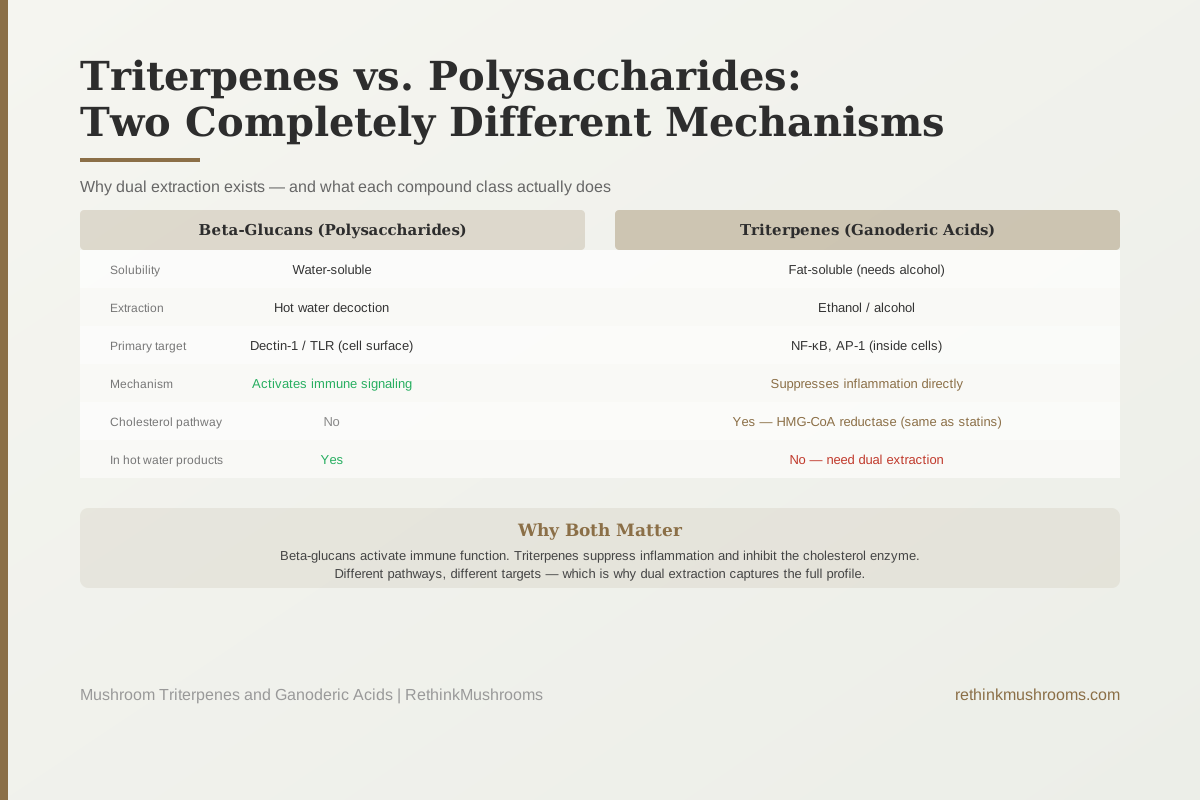
fat-soluble
triterpenes need alcohol extraction, not hot water
Dectin-1 pathway
how beta-glucans signal immune cells
NF-κB suppression
how triterpenes act inside cells on inflammation
Galappaththi et al., Biomolecules, 2022
 View as image ↗
If you have ever wondered why dual-extract mushroom products exist, or why hot water reishi tea might not deliver the same effects as an alcohol extract, the answer lies in a fundamental chemical difference between two compound classes that medicinal mushrooms contain: beta-glucans (polysaccharides) and triterpenes.
They dissolve in different things, they reach different parts of the body, they bind to different molecular targets, and they produce different effects. Neither is simply "better." They do different things, and understanding that difference is what the word "dual extraction" actually means.
There is also a popular claim in this space — that reishi triterpenes lower cholesterol by blocking the same enzyme statins block — that does not survive contact with the underlying studies. We work through it below, because getting the mechanism right matters more than making the mushroom sound impressive.
For the broader context on mushroom bioactive compounds, see What Are Beta-Glucans? The Most Important Compound in Medicinal Mushrooms.
Key Takeaways
- Beta-glucans are water-soluble long-chain sugars that signal through pattern-recognition receptors (Dectin-1 and Toll-like receptors) on immune cells; triterpenes are fat-soluble steroid-like compounds small enough to enter cells, where they act on the transcription factors that switch inflammation on
- Dudhgaonkar and colleagues (2009) showed directly that a Ganoderma lucidum triterpene extract suppressed NF-κB and AP-1 DNA-binding activity in LPS-stimulated macrophages, reducing TNF-α, IL-6, nitric oxide and PGE₂ — the clearest demonstration that the triterpene mechanism is transcriptional, not receptor-signaling
- Hot water extraction captures beta-glucans but not triterpenes; alcohol extraction captures triterpenes; dual extraction (water + alcohol) is required to obtain both compound classes from one product
- The widely repeated claim that reishi triterpenes inhibit HMG-CoA reductase "like a statin" is not supported by the study usually cited for it. Rahman and colleagues (2018) tested a hot water extract — the polysaccharide-rich fraction, not the triterpene fraction — and never measured HMG-CoA reductase at all
- Where lipid effects have been tested head-to-head, triterpenes did not stand apart: Li and colleagues (2021) found Ganoderma triterpenoids and polysaccharides both reduced cholesterol and aortic plaque in rabbits. A 2015 Cochrane review of human RCTs found no significant effect on total or LDL cholesterol
- Absorption is structure-specific, and the direction is often reported backwards: in a Caco-2 model of 14 Antrodia triterpenoids, the ergostane-type compounds crossed readily by passive diffusion while the lanostane-type compounds — the class reishi's ganoderic acids belong to — barely crossed at all (Wang et al., 2015)
- A 2026 systematic review and meta-analysis (PROSPERO CRD42024510982) pooled 23 preclinical studies and confirmed significant anti-inflammatory effects for Ganoderma triterpenes — while noting that clinical trials were excluded because the human literature does not yet exist
Two Completely Different Chemical Classes
Beta-glucans and triterpenes look nothing alike at the molecular level, and that structural difference explains everything else.
Beta-glucans are polysaccharides: long chains of glucose (sugar) units linked in a specific three-dimensional pattern. Think of them as long, branching sugar necklaces. They are water-soluble, which is why hot water extraction captures them. Medicinal mushrooms characteristically produce high-molecular-weight beta-glucans,[12] and molecules of that size do not slip across cell membranes. Instead, they work by being recognized from outside the cell.
Triterpenes are steroid-like compounds built from 30 carbon atoms arranged in a specific ring structure. The class found in medicinal mushrooms typically uses the lanostane scaffold, a four-ring carbon skeleton related to lanosterol (the precursor from which the body builds cholesterol). Galappaththi and colleagues catalogued 495 distinct triterpenoid compounds described from 25 Ganoderma species across the literature published between 1984 and 2022, noting that triterpenes serve as the primary constituents among more than 600 chemical compounds identified from Ganoderma.[2] Triterpenes are fat-soluble, dissolving in fats and alcohol rather than water. They are also small: ganoderic acid A, the most abundant of the ganoderic acids, has the formula C₃₀H₄₄O₇,[19] putting it near 500 daltons — roughly the size of a typical small-molecule drug, and small enough to cross membranes.
Beta-Glucans vs. Triterpenes: Side-by-Side Comparison
| Property | Beta-Glucans (Polysaccharides) | Triterpenes |
|---|---|---|
| Chemical class | Long-chain sugar polymer | C30 steroid-like lipid |
| Solubility | Water-soluble | Fat-soluble |
| Extraction method | Hot water (decoction) | Alcohol (ethanol) |
| Molecular size | High molecular weight | Small (~500 daltons) |
| Primary target | Dectin-1 and TLR receptors (cell surface) | NF-κB, AP-1 (inside cells) |
| Key mechanism | Activates immune response signaling | Suppresses inflammatory transcription |
| Lipid/cholesterol effects | Yes, in animal models | Yes, in animal models — not clearly greater |
| Cross cell membranes | No (too large) | Yes (fat-soluble) |
| Found in Reishi? | Yes, in both fruiting body and mycelium | Yes, primarily in fruiting body |
| Hot water product? | Yes | No |
This table explains dual extraction: you need hot water to capture the immune-active beta-glucans, and you need alcohol to capture the inflammation-suppressing triterpenes. A product made with only one extraction method necessarily misses half of what the mushroom contains.
Note the lipid row carefully. It is the one place where the popular framing and the evidence diverge, and we deal with it in detail below.
How Beta-Glucans Work: Signaling from the Outside
Beta-glucans from mushrooms are recognized by innate immune cells through a receptor called Dectin-1 and through a family of receptors called Toll-like receptors. Neutrophils, macrophages and dendritic cells all express receptors capable of recognizing beta-glucan in its various forms, and Dectin-1 is the best-characterized of them — the receptor whose translation of recognition into intracellular signaling is understood in the most detail.[10]
Structural work confirms this is genuine molecular recognition rather than a loose association. Brown and colleagues solved crystal structures of Dectin-1, including one in which a short natural beta-glucan is trapped in the crystal lattice, and showed that the extracellular domain is a C-type lectin-like domain that binds fungal beta-glucans and forms higher-order complexes with them.[11]
These receptors are pattern-recognition receptors: they evolved to detect highly conserved microbial molecular patterns such as beta-glucan, mannan and lipopolysaccharide. When beta-glucan binds Dectin-1 on a macrophage or dendritic cell, the cell's immunomodulating activity is augmented, and it in turn activates adaptive immune cells — B and T lymphocytes, natural killer cells — by secreting cytokines including IL-4, IL-6 and TNF-α.[12]
One important nuance: in whole mushroom material, the receptor signal is not always purely glucan-driven. Zhang and colleagues found that the macrophage-activating potential of water-soluble extracts from 13 edible mushrooms was predominantly attributable to TLR2 and TLR4 agonists derived from colonizing bacteria, while the Dectin-1-dependent activity tracked water-insoluble beta-glucans — and that co-stimulation with both produced a synergistic enhancement of cytokine production.[13] That finding is a useful caution against reading every immune result from a crude mushroom extract as a pure beta-glucan effect.
The defining characteristic of this mechanism remains: beta-glucans work by binding receptors on the outside of cells. The beta-glucan molecule does not itself enter the cell to act. It is a signal. The immune cell does the work in response.
How Triterpenes Work: Acting Inside the Cell
Triterpenes operate differently. Because they are small and fat-soluble, they can cross cell membranes. Once inside, they act on the molecular machinery that controls inflammation.
Dudhgaonkar and colleagues demonstrated this directly in 2009, testing a triterpene extract from Ganoderma lucidum in LPS-stimulated RAW264.7 macrophages.[1] The extract markedly suppressed secretion of TNF-α, IL-6, nitric oxide and prostaglandin E₂, and down-regulated the enzymes iNOS and COX-2. Critically, they traced the effect to its source: decreased NF-κB DNA-binding activity, suppressed phosphorylation of the p65 subunit, inhibited AP-1 DNA-binding activity, and down-regulated the AP-1 subunit c-Jun. The same extract also inhibited TNF-α and IL-6 production in endotoxemic mice.
This is a genuinely different mode of action from beta-glucan immune stimulation. Beta-glucans activate immune signaling from the cell surface; triterpenes can dampen the transcriptional program driving inflammation from inside. These are complementary effects on different parts of the system, not opposing ones.
Pozzobon et al. (2026) · Pharmaceuticals
- Population
- 23 preclinical studies selected from over 3,000 screened records (2003–2025), using macrophages, human PBMCs, and mice, rats and chickens
- Intervention
- Ganoderma lucidum triterpene extracts or isolated triterpene compounds
- Comparator
- Untreated and vehicle controls within each included study
- Finding
- All included studies reported significant anti-inflammatory effects via reduced TNF-α, IL-1β and IL-6, primarily through downregulation of MAPK and TLR-4/NF-κB signaling. Pooled in vitro data showed significant reductions in nitric oxide (−3.29; 95% CI −5.21 to −1.37; p = 0.0008) and IL-6 (−3.51; 95% CI −4.73 to −2.29).
preliminary Registered on PROSPERO (CRD42024510982) with SYRCLE risk-of-bias assessment — methodologically careful work. But clinical trials were excluded by design, because the human trial literature on isolated Ganoderma triterpenes does not yet exist. The authors explicitly call bioavailability and long-term toxicity data 'notably absent'.
Pozzobon et al., Pharmaceuticals, 2026 (RTHM-02241)
A 2025 review by Ren and colleagues in Food Science & Nutrition provides the wider frame: it summarizes the primary bioactive components of G. lucidum — polysaccharides, triterpenoids, peptides and proteins, and sterols — and notes that where the antitumor mechanism was once attributed solely to host immune activation, it is now understood to extend beyond immune modulation to include induction of cell differentiation and inhibition of angiogenesis. The same review is candid that few G. lucidum compounds have been clinically validated as superior to existing therapies.[4]
That angiogenesis strand has direct experimental support. Stanley and colleagues showed in 2005 that a G. lucidum extract inhibited capillary morphogenesis in human aortic endothelial cells and down-regulated secretion of VEGF and TGF-β1 from PC-3 prostate cancer cells — by inhibiting constitutively active AP-1, through modulation of Erk1/2 and Akt.[9] Worth noting precisely: this study used a G. lucidum extract and did not isolate the effect to the triterpene fraction. What makes it mechanistically interesting here is the convergence on AP-1 — the same transcription factor Dudhgaonkar's purified triterpenes suppressed.
The Cholesterol Claim: Where the Popular Story Breaks Down
Search for reishi and cholesterol and you will repeatedly find a specific claim: that reishi triterpenes inhibit HMG-CoA reductase, the enzyme statin drugs block, and that this is a mechanism unique to the triterpene class. The structural story is appealing — lanostane triterpenes share their four-ring skeleton with lanosterol, a cholesterol precursor, so a shape-based interaction sounds plausible.
Plausible is not the same as demonstrated. We went to the studies usually cited for this claim, and they do not say it.
Claim Audit
Do reishi triterpenes work like a statin?
The claim
“Reishi triterpenes inhibit HMG-CoA reductase — the same enzyme statins block — making cholesterol-lowering a mechanism unique to the triterpene class, not shared by beta-glucans.”
Widely attributed to Rahman et al. (2018), a study on the antioxidative and hypocholesterolemic effects of Ganoderma lucidum in cardiovascular disease.
What research shows
UnsupportedRahman et al. (2018) tested a hot water extract and five solvent-partitioned fractions — the hot water extract is the polysaccharide-rich preparation, not the triterpene fraction. The study measured DPPH radical scavenging, total phenolics, lipid peroxidation, LDL oxidation, and antioxidant enzyme activity in rats, and found the hot water extract at 200 mg/kg lowered plasma total cholesterol, triacylglycerol and LDL while raising HDL. It never assayed HMG-CoA reductase.
The closest genuine finding in this literature comes from a different mushroom: Peng et al. (2017) found Antrodia cinnamomea extract decreased HMG-CoA reductase in high-fat-diet mice — but as downregulation of expression via AMPK and SREBP signaling, not direct enzyme inhibition, and in Antrodia rather than Ganoderma. Meanwhile Li et al. (2021) tested Ganoderma triterpenoids and polysaccharides side by side in high-fat-diet rabbits and found both lowered total cholesterol, triglycerides and LDL and both reduced aortic plaque area — which is the opposite of a triterpene-exclusive mechanism.
Rahman et al., Int J Med Mushrooms, 2018 (RTHM-00997); Peng et al., Am J Chin Med, 2017 (RTHM-00905); Li et al., NMCD, 2021 (RTHM-01387)
So what is true about mushrooms and lipids? Something real, but weaker and less specific than the statin analogy suggests.
Rahman and colleagues did find that a G. lucidum hot water extract at 200 mg/kg body weight lowered plasma total cholesterol, triacylglycerol and LDL cholesterol and raised HDL cholesterol in rats, alongside measurable antioxidant activity.[6] Li and colleagues found that both Ganoderma triterpenoids and polysaccharides, given to high-fat-diet rabbits for four months, significantly lowered triglycerides, total cholesterol and LDL-C and significantly reduced aortic plaque area — with mechanisms running through NF-κB p65 and LOX-1 in endothelial cells and Notch1/DLL4 in macrophages.[15] A 2023 systematic review and meta-analysis of 49 animal studies found G. lucidum consumption associated with meaningfully lower TG, TC, LDL-C and VLDL and higher HDL-C.[16]
The nearest thing to a genuine HMG-CoA reductase finding in the medicinal mushroom literature comes from a different fungus. Peng and colleagues fed Antrodia cinnamomea extract to high-fat-diet mice and found it restored body weight gain, body fat, free fatty acids, triacylglycerol, total cholesterol and the LDL-C/HDL-C ratio, while increasing phosphorylated AMPK and decreasing SREBP, fatty acid synthase and HMG-CoA reductase — the extract being rich in triterpenes, most abundantly antcin K.[18] Read precisely, that is downregulation of the enzyme through AMPK/SREBP signaling, in Antrodia, in mice — not direct inhibition of the enzyme by a ganoderic acid, which is what the statin analogy implies.
Every one of those results is preclinical. When the same question was asked of human randomized controlled trials, the answer changed.
- Cell and in vitro workcompleted
Ganoderma extracts reduce ROS and NF-κB p65/LOX-1 signaling in ox-LDL-stimulated endothelial cells (Li 2021). No study cited for the statin claim assayed HMG-CoA reductase in Ganoderma.
- Animal studiescompleted
Rats: hot water extract at 200 mg/kg lowered TC, TG and LDL and raised HDL (Rahman 2018). Rabbits: triterpenoids and polysaccharides both lowered lipids and plaque area (Li 2021).
- Meta-analysis of animal studiescompleted
49 animal studies pooled; significant reductions in TG, TC, LDL-C and VLDL, increase in HDL-C (Aref 2023).
- Human randomized trialscurrent
Five trials, 398 participants; the three analysable trials used 1.4–3 g/day for 12–16 weeks, all in people with type 2 diabetes. Risk of bias low in one trial, unclear in four (Klupp 2015).
- Large confirmatory RCTsmissing
No adequately powered trial has tested an isolated or standardized Ganoderma triterpene preparation for lipid outcomes in humans.
The animal evidence is broad and consistent. The human evidence is small, largely restricted to type 2 diabetes, and negative: the Cochrane review found no statistically or clinically significant reduction in total cholesterol (−0.07 mmol/L; 95% CI −0.57 to 0.42) or LDL cholesterol (0.02 mmol/L; 95% CI −0.41 to 0.45), and concluded the evidence does not support using G. lucidum for cardiovascular risk factors in this population.
Klupp et al., Cochrane Database Syst Rev, 2015 (RTHM-00699); Aref et al., J Res Med Sci, 2023 (RTHM-01656); Li et al., NMCD, 2021 (RTHM-01387); Rahman et al., 2018 (RTHM-00997)
The 2015 Cochrane review is the most important document here, and the one most often left out of supplement marketing. Klupp and colleagues identified five randomized or controlled trials totalling 398 participants; the three from which data could be analysed compared 1.4 to 3 g/day of G. lucidum against placebo over 12 to 16 weeks, in participants who all had type 2 diabetes. They found no statistically or clinically significant reduction in HbA1c, total cholesterol, LDL cholesterol or BMI, and concluded that the evidence "does not support the use of G lucidum for treatment of cardiovascular risk factors in people with type 2 diabetes mellitus."[17]
Cardiovascular
CriticalReishi is not a statin substitute
Concern
Because the 'blocks the same enzyme as statins' framing is so widespread, some readers conclude a reishi extract can stand in for prescribed lipid-lowering therapy. The evidence does not support that, and stopping a statin on this basis carries real cardiovascular risk.
What the research says
The HMG-CoA reductase mechanism has not been demonstrated for Ganoderma triterpenes in the studies commonly cited for it, and the human trial evidence for Ganoderma on cholesterol is null. Statin therapy is prescribed on the basis of large outcome trials that have no equivalent in the mushroom literature.
Particularly relevant for: Anyone taking prescribed lipid-lowering or antihypertensive medication, and anyone with diagnosed cardiovascular disease or type 2 diabetes.
What to do
Do not modify or discontinue prescribed medication based on supplement mechanism claims. Discuss any mushroom extract with the clinician managing your lipids, particularly alongside anticoagulants, where Ganoderma warrants specific caution.
Klupp et al., Cochrane Database Syst Rev, 2015 (RTHM-00699); Rahman et al., 2018 (RTHM-00997)
This article is educational and is not medical advice. Nothing here is a recommendation to treat, prevent or manage any medical condition.
Claim Audit · “Reishi Triterpenes Block The Statin Enzyme”
Walking one popular mechanism claim back through its own sources
The claim: reishi triterpenes inhibit HMG-CoA reductase like a statin, a mechanism beta-glucans cannot reproduce. Below is what each study cited in support actually tested and actually measured.
None of this means reishi does nothing to lipids — the animal evidence is broad and consistent. It means the specific mechanistic story, that a ganoderic acid blocks HMG-CoA reductase the way a statin does and that beta-glucans cannot touch lipids, is not what these studies show. Educational information only; not medical advice, and not a basis for changing prescribed therapy.
Sources: Rahman et al. (2018); Peng et al. (2017); Li et al. (2021); Aref et al. (2023); Klupp et al. (2015)
View as image ↗Extraction: Why Hot Water Reishi Tea Delivers Minimal Triterpenes
Hot water dissolves polar, water-soluble molecules well. Triterpenes are neither polar nor water-soluble. When you make reishi tea with hot water, you extract primarily the polysaccharides. The ganoderic acids and other triterpenes largely stay in the mushroom material.
Physical structure compounds the problem in some preparations. Wang and colleagues documented in 2017 that the hard, indissolvable sporoderm (outer wall) of Ganoderma lucidum spores hinders the release of the bioactive components inside, and developed a combined chemical and physical method — ultrasonication plus refrigeration — to break it. They evaluated their method specifically by measuring the dissolution of the triterpenoids held within.[7] In other words: even where triterpenes are present, they can be physically locked away from any solvent until the wall is breached.
For a dual-extract product, the typical process involves a hot water extraction step (capturing polysaccharides) followed by an alcohol extraction step (capturing triterpenes), with the two extracts then combined. This is the standard route to obtaining both compound classes from the same mushroom material.
Products labeled "hot water extract" or "aqueous extract" will deliver beta-glucans but minimal triterpenes. Products labeled "ethanol extract" or "alcohol extract" may deliver triterpenes but reduced polysaccharides. "Dual extract" or "full spectrum extract" indicates both extraction methods were used.
For more on extraction methods and what they deliver, see Double-Extraction Mushroom Tinctures: Why Alcohol + Water Captures More Compounds and Hot Water Extract vs. Dual Extract vs. Raw Powder: Which Delivers More Beta-Glucans?.
Bioavailability: Absorption Depends on the Exact Triterpene
Even when triterpenes are successfully extracted, oral absorption is not guaranteed — and here the commonly repeated version of the evidence is frequently stated backwards.
Wang and colleagues used a Caco-2 human intestinal cell monolayer model to measure bidirectional transport of 14 representative triterpenoids from Antrodia cinnamomea, monitored by a validated LC/MS/MS method.[8] The result split cleanly along structural lines. The ergostane-type compounds — antcins A, B, C, H and K — were absorbed by passive transcellular diffusion and showed high permeability values (above 2.5 × 10⁻⁵ cm/s). The lanostane-type compounds — dehydroeburicoic acid, eburicoic acid, dehydrosulphurenic acid and 15α-acetyldehydrosulphurenic acid — could "hardly pass through" the monolayer and exhibited poor permeability. Transport behaviour matched the compounds' pharmacokinetics in rats.
That distinction matters directly for reishi, because ganoderic acids are lanostane-type triterpenes. This study was conducted in Antrodia, not Ganoderma, so it does not measure ganoderic acid absorption. But it establishes that "triterpene" is far too coarse a category for predicting absorption, and that the structural subclass reishi's headline compounds belong to was the poorly-absorbed one in this model. The 2026 meta-analysis reaches the same conclusion from a different direction, naming bioavailability as one of the notable absences in the current literature.[5]
A common practical suggestion is to take fat-soluble extracts with a fat-containing meal. That is reasonable general pharmacology for lipophilic compounds, but it is worth being clear that it was not what these studies tested — Wang's compounds crossed by passive transcellular diffusion in a cell model with no dietary fat involved, and no trial has demonstrated that food timing improves ganoderic acid absorption in humans.
Beta-glucan uptake follows a different route entirely, and it has been mapped in detail. Wang and colleagues (2024) tracked fluorescently labelled lentinan after oral administration and showed it accumulates in Peyer's patches — organized immune tissue in the small intestine — with M cells acting as the main cells transporting it there. Dectin-1 then mediates uptake of the lentinan by mononuclear phagocytes within the Peyer's patches, which proliferate and differentiate in response.[14] A large polysaccharide does not need to be absorbed into circulation the way a small molecule does; it needs to reach the right immune tissue, and there is a dedicated transport system that takes it there.
Mechanism Map · Two Routes Through The Body
One stops at the membrane. The other goes through it.
The difference between a beta-glucan and a triterpene is not a difference of potency — it is a difference of destination. Follow each from the gut to its molecular target.
Sources: Dudhgaonkar et al. (2009); Wang et al. (2015); Goodridge et al. (2009); Brown et al. (2007); Wang et al. (2024)
View as image ↗Why Both Compound Classes Matter
The fact that beta-glucans and triterpenes work through different mechanisms is not a reason to prefer one. It is the reason both belong in a comprehensive medicinal mushroom product.
A product delivering only beta-glucans (hot water extract) engages immune signaling through Dectin-1 and Toll-like receptors. A product delivering only triterpenes (alcohol extract) brings the transcriptional anti-inflammatory activity demonstrated by Dudhgaonkar and pooled by the 2026 meta-analysis. A dual extract carries both.
The breadth of the triterpene side is worth appreciating. Wang and colleagues' 2024 review of the previous five years of ganoderic acid research summarized activity across anti-cancer, anti-inflammatory, radiation protection, anti-aging, liver protection, anti-microbial and neuroprotective domains.[3] Sui and colleagues' 2025 in-depth review of ganoderic acid A specifically found it acting through NF-κB, JAK/STAT, TLR4, Nrf2, PI3K/AKT, mTOR, MAPK and Notch signaling, with network pharmacology and molecular docking analyses converging on MAPK3, TNF, caspase-3, PPARγ and β-catenin as key targets — while also reporting that ganoderic acid A has low bioavailability despite high absorption and elimination rates.[19]
That last detail is the honest summary of this whole topic. The triterpene mechanism is real, well-characterized at the molecular level, and genuinely distinct from what beta-glucans do. What it does not yet have is the human clinical evidence to match — and no amount of mechanistic elegance substitutes for that.
For a deeper look at the specific ganoderic acids from Reishi, see Ganoderic Acids from Reishi: A Complete Guide. For the broader class of mushroom triterpenes across species, see Mushroom Triterpenes: The Bitter Compounds with Powerful Effects.
The Bottom Line
Beta-glucans and triterpenes are the two primary active compound classes in medicinal mushrooms and they work through fundamentally different mechanisms. Beta-glucans are high-molecular-weight water-soluble polysaccharides that bind pattern-recognition receptors on immune cells (Dectin-1, TLRs) to activate immune signaling, and reach gut immune tissue via M-cell transport into Peyer's patches rather than by conventional absorption. Triterpenes are small fat-soluble steroid-like compounds that cross cell membranes and suppress inflammatory transcription factors including NF-κB and AP-1, demonstrated directly in Ganoderma triterpene extracts and pooled across 23 preclinical studies in a 2026 meta-analysis. Hot water extraction captures beta-glucans; alcohol extraction captures triterpenes; dual extraction is required for both. The frequently repeated claim that reishi triterpenes inhibit HMG-CoA reductase like a statin is not supported by the study usually cited for it, and human randomized trials reviewed by Cochrane in 2015 found no significant effect of G. lucidum on cholesterol. Absorption is structure-specific: in a Caco-2 model, ergostane-type triterpenoids crossed readily while lanostane-type compounds — the class ganoderic acids belong to — barely crossed at all.
Frequently Asked Questions
Sources & References
- 1RTHM-00152·Dudhgaonkar, Shailesh et al. (2009). “Suppression of the inflammatory response by triterpenes isolated from the mushroom Ganoderma lucidum..” International immunopharmacology.Study breakdown →PubMed →↩
- 2RTHM-01519·Galappaththi, Mahesh C A et al. (2022). “A Review of Ganoderma Triterpenoids and Their Bioactivities..” Biomolecules.Study breakdown →PubMed →↩
- 3RTHM-02014·Wang, Siyi et al. (2024). “Research Progress on the Biological Activity of Ganoderic Acids in Ganoderma lucidum over the Last Five Years..” Life (Basel.Study breakdown →PubMed →↩
- 4RTHM-02166·Ren, Sizhu et al. (2025). “A Review of Bioactive Components and Pharmacological Effects of Ganoderma lucidum..” Food science & nutrition.Study breakdown →PubMed →↩
- 5RTHM-02241·Pozzobon, Rafaela Guedes et al. (2026). “Anti-Inflammatory Potential of Ganoderma lucidum Triterpenes: A Systematic Review and Meta-Analysis of Preclinical Evidence..” Pharmaceuticals (Basel.Study breakdown →PubMed →↩
- 6RTHM-00997·Rahman, Mohammad Azizur et al. (2018). “Evaluation of the Antioxidative and Hypo-cholesterolemic Effects of Lingzhi or Reishi Medicinal Mushroom, Ganoderma lucidum (Agaricomycetes), in Ameliorating Cardiovascular Disease..” International journal of medicinal mushrooms.Study breakdown →PubMed →↩
- 7RTHM-00496·Wang, Jiajia et al. (2017). “Breaking the sporoderm of Ganoderma lucidum spores by combining chemical reaction with physical actuation..” Natural product research.Study breakdown →PubMed →↩
- 8RTHM-00409·Wang, Qi et al. (2015). “Intestinal Absorption of Ergostane and Lanostane Triterpenoids from Antrodia cinnamomea Using Caco-2 Cell Monolayer Model..” Natural products and bioprospecting.Study breakdown →PubMed →↩
- 9RTHM-00087·Stanley, Gwenaelle et al. (2005). “Ganoderma lucidum suppresses angiogenesis through the inhibition of secretion of VEGF and TGF-beta1 from prostate cancer cells..” Biochemical and biophysical research communications.Study breakdown →PubMed →↩
- 10RTHM-00154·Goodridge, Helen S et al. (2009). “Beta-glucan recognition by the innate immune system..” Immunological reviews.Study breakdown →PubMed →↩
- 11RTHM-00111·Brown, James et al. (2007). “Structure of the fungal beta-glucan-binding immune receptor dectin-1: implications for function..” Protein science : a publication of the Protein Society.Study breakdown →PubMed →↩
- 12RTHM-00333·Lee, Dong Hee et al. (2014). “Innate immunity induced by fungal β-glucans via dectin-1 signaling pathway..” International journal of medicinal mushrooms.Study breakdown →PubMed →↩
- 13RTHM-01152·Zhang, Jin et al. (2019). “Macrophage activation by edible mushrooms is due to the collaborative interaction of toll-like receptor agonists and dectin-1b activating beta glucans derived from colonizing microorganisms..” Food & function.Study breakdown →PubMed →↩
- 14RTHM-02013·Wang, Kaiping et al. (2024). “Insights into oral lentinan immunomodulation: Dectin-1-mediated lymphatic transport from Peyer's patch M cells to mononuclear phagocytes..” Carbohydrate polymers.Study breakdown →PubMed →↩
- 15RTHM-01387·Li, Yanhong et al. (2021). “Ganoderma lucidum triterpenoids and polysaccharides attenuate atherosclerotic plaque in high-fat diet rabbits..” Nutrition.Study breakdown →PubMed →↩
- 16RTHM-01656·Aref, Maryam et al. (2023). “Effect of Ganoderma lucidum on serum lipid profiles: A systematic review and meta-analysis on animal studies..” Journal of research in medical sciences : the official journal of Isfahan University of Medical Sciences.Study breakdown →PubMed →↩
- 17RTHM-00380·Klupp, Nerida L et al. (2015). “Ganoderma lucidum mushroom for the treatment of cardiovascular risk factors..” The Cochrane database of systematic reviews.Study breakdown →PubMed →↩
- 18RTHM-00487·Peng, Chiung-Huei et al. (2017). “Antrodia cinnamomea Prevents Obesity, Dyslipidemia, and the Derived Fatty Liver via Regulating AMPK and SREBP Signaling..” The American journal of Chinese medicine.Study breakdown →PubMed →↩
- 19RTHM-02188·Sui, Qi et al. (2025). “Ganoderic acid A: an in-depth review of pharmacological effects and molecular docking analysis..” Journal of ethnopharmacology.Study breakdown →PubMed →↩