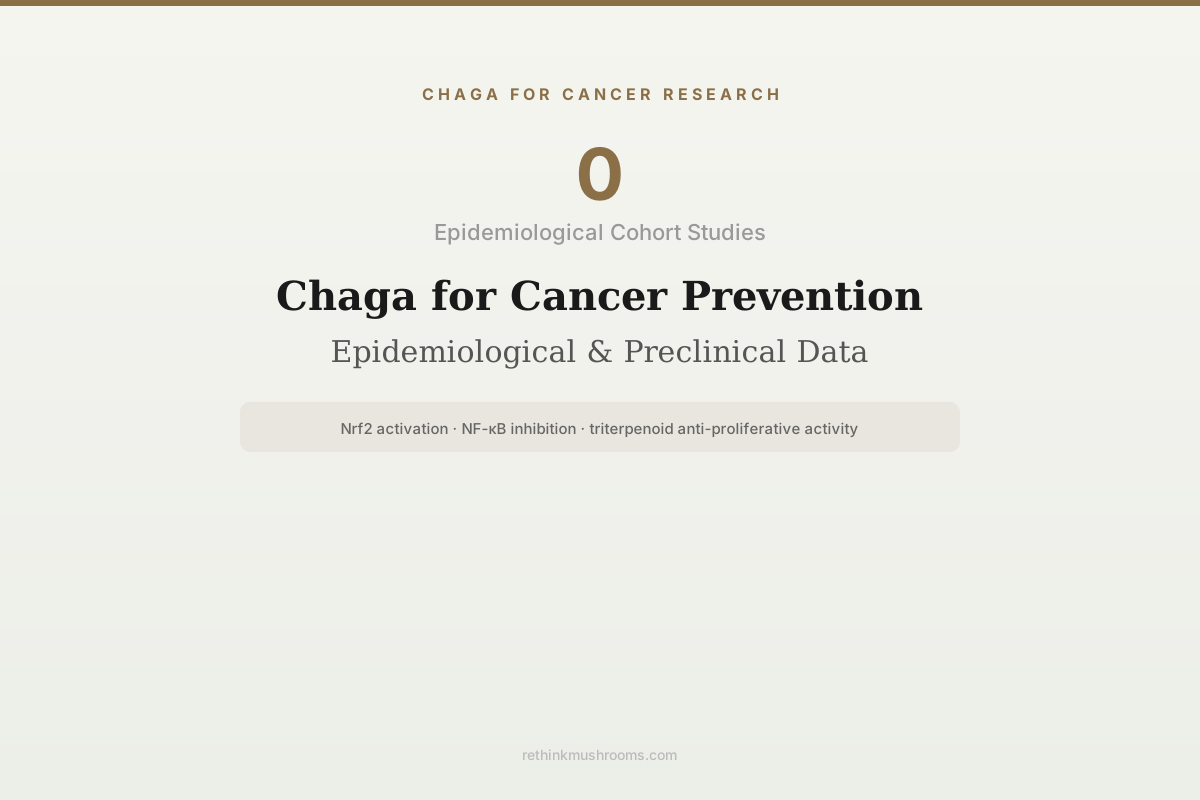
Chaga for Cancer Research
0 Epidemiological Studies
No published epidemiological study has measured chaga mushroom intake and subsequent cancer incidence in any population. The cancer prevention claim for chaga rests on preclinical chemoprevention markers (Nrf2 activation, NF-κB inhibition, triterpenoid anti-proliferative activity) and traditional folk use rather than on population-level outcome data.
Ern et al., Mycology, 2024
Nrf2 / HO-1 ↑
master chemoprevention pathway activated by chaga polysaccharide (Xu et al., 2019)
NF-κB ↓
inflammation-cancer axis suppressed by chaga extract (Kim et al., 2007)
16th century
traditional use for gastrointestinal cancer documented in folk medicine literature
Ern et al., Mycology, 2024
 View as image ↗
Cancer prevention evidence has a specific hierarchy: epidemiological cohort studies linking exposure to incidence over years or decades sit at the top, followed by randomised controlled prevention trials, then preclinical carcinogenesis model data (DMBA-induced mammary tumours, azoxymethane-induced colon carcinogenesis, DEN-induced hepatocellular carcinoma), then mechanistic cell and biochemical data on chemoprevention markers. For chaga (Inonotus obliquus), the population-level epidemiological and clinical trial levels of this hierarchy are empty, while the preclinical and mechanistic levels have substantive data.[1][2] The honest cancer prevention discussion for chaga acknowledges both the mechanistic promise and the population-level evidence absence. For the broader cancer research context, see chaga and cancer: what the research shows.
Key Takeaways
- No published epidemiological cohort study has measured chaga mushroom intake in a defined population and tracked subsequent cancer incidence
- Inonotus obliquus polysaccharide upregulates Nrf2 and heme oxygenase-1 (the master chemoprevention pathway) while downregulating TLR2, TLR4, and NF-κB phosphorylation in rodent liver injury (Xu et al., 2019)
- Chaga ethanol extract inhibits NF-κB activation and suppresses iNOS, COX-2, TNF-α, IL-1β, and IL-6 in LPS-stimulated macrophages, addressing the inflammation-cancer axis mechanistically (Kim et al., 2007)
- Oral aqueous chaga extract attenuated DSS-induced colitis in mice, reducing inflammatory mediators that contribute to colitis-associated colorectal carcinogenesis (Mishra et al., 2012)
- Chaga triterpenoid fractions (inotodiol 153.9–194.1 mg/g; trametenolic acid 94.5–106.3 mg/g) showed anti-proliferative activity against HT-29 (colon), AGS (gastric), MCF-7 (breast), and PC3 (prostate) cancer cell lines (Kim et al., 2020)
- Comprehensive reviews (Fordjour et al., 2023; Ern et al., 2024) identify chemopreventive activity among chaga's documented preclinical properties while flagging the absence of prevention trial data
- Three case reports of chaga-induced oxalate nephropathy complicate any chronic preventive use recommendation (Kikuchi 2014; Lee 2020; Kwon 2022)
The Epidemiological Evidence Gap
Cancer prevention research depends on long-term cohort studies that measure exposure in a defined population and track incidence over years to decades. For dietary and supplement exposures, this requires food frequency questionnaires, supplement use surveys, or biomarker-confirmed intake measurements across thousands of participants over sufficient follow-up to capture cancer events. Classic examples include the Nurses' Health Study, the Health Professionals Follow-Up Study, the European Prospective Investigation into Cancer and Nutrition (EPIC), and the Women's Health Initiative.
No such study has measured chaga intake as an exposure variable. This is not simply a gap in reporting; it reflects the reality that chaga has historically been a regional folk medicine product (Russia, Scandinavia, East Asia) consumed in dietary patterns that large Western cohort studies did not capture, and its modern commercial popularity in North America and Europe is too recent to have accumulated the follow-up time required for cancer endpoint tracking. The absence of data is not evidence of absent effect; it is evidence that the empirical question has not been asked at population scale.
Fordjour et al. (2023) and Ern et al. (2024) both comprehensive reviews of I. obliquus therapeutic properties acknowledge that epidemiological cancer data are absent.[1][2] The sixteenth-century folk medicine record identifies chaga use for gastrointestinal cancer in Russian and Scandinavian populations, but this is historical ethnobotanical documentation rather than controlled epidemiological measurement.
Preclinical Chemoprevention: The Mechanism Framework
Chemoprevention mechanisms are categorised into three phases of carcinogenesis: initiation (DNA damage from mutagens, carcinogens, and reactive oxygen species), promotion (expansion of initiated cell populations through sustained inflammation and proliferative signalling), and progression (acquisition of invasive and metastatic properties). Chemopreventive agents target one or more phases through specific molecular mechanisms.
Initiation-phase chemoprevention involves reducing carcinogen activation (Phase I enzyme modulation) or enhancing carcinogen detoxification (Phase II enzyme induction, Nrf2 pathway activation), plus reducing oxidative DNA damage through antioxidant activity.
Promotion-phase chemoprevention involves reducing chronic inflammation through NF-κB inhibition, cytokine suppression, and prostaglandin pathway modulation, plus modulating cell proliferation through cell cycle or survival signalling interference.
Progression-phase chemoprevention involves inhibiting angiogenesis (VEGF signalling), cell invasion (matrix metalloproteinases), and metastasis establishment in distant tissues.
Chaga's preclinical evidence spans initiation and promotion phase mechanisms with documented effects at the cellular and animal levels.
Initiation Phase: Nrf2 Activation and Antioxidant Enzyme Induction
The Nrf2-Keap1-ARE pathway is the master regulator of Phase II detoxification enzyme expression (glutathione S-transferases, UDP-glucuronosyltransferases, NAD(P)H:quinone oxidoreductase 1, heme oxygenase-1) and endogenous antioxidant enzyme expression (superoxide dismutase, catalase, glutathione peroxidase). Nrf2 activators are an established class of chemopreventive agents, with sulforaphane (from broccoli sprouts) as the best-characterised dietary example.
Xu et al. (2019) demonstrated that Inonotus obliquus polysaccharide upregulates Nrf2 and heme oxygenase-1 expression in mouse liver, with concurrent downregulation of TLR2/TLR4 and reduced NF-κB phosphorylation.[3] This is the textbook chemoprevention mechanism: Phase II antioxidant response activation combined with inflammatory signalling suppression.
The antioxidant enzyme activity extension is consistent across chaga studies. Sun et al. (2008) documented increased catalase, SOD, and GPx activity in diabetic mouse liver with chaga culture broth. Diao et al. (2014) extended this to streptozotocin-induced diabetic rats. Hong et al. (2015) showed glutathione content preservation and MDA reduction in primary rat hepatocytes exposed to oxidative stress. Debnath et al. (2013) added antioxidant enzyme induction in H2O2-stimulated mouse liver. The convergent preclinical pattern is chaga-mediated enhancement of the cellular antioxidant defence system across multiple tissues and injury types.
Promotion Phase: NF-κB Inhibition and Inflammation-Cancer Axis
Chronic inflammation is an established driver of carcinogenesis in multiple tissues. Inflammatory bowel disease substantially elevates colorectal cancer risk; chronic hepatitis raises hepatocellular carcinoma risk; Helicobacter pylori gastritis elevates gastric cancer risk; pancreatitis raises pancreatic cancer risk. NF-κB is the transcription factor linking chronic inflammation to carcinogenic signalling, and NF-κB inhibitors are chemopreventive in multiple models.
Kim et al. (2007) demonstrated that ethanol extract of I. obliquus inhibited LPS-induced NF-κB activation in RAW 264.7 macrophages, reducing iNOS, COX-2, TNF-α, IL-1β, and IL-6 expression.[4] COX-2 is particularly relevant to chemoprevention: selective COX-2 inhibition is chemopreventive in colorectal carcinogenesis, and non-selective COX inhibition by aspirin reduces colorectal cancer incidence in long-term prospective cohorts.
Mishra et al. (2012) extended the signal to intestinal mucosa. Oral aqueous I. obliquus extract in DSS-induced colitis mice suppressed oedema, mucosal damage, crypt loss, iNOS, myeloperoxidase, and the mRNA expression of TNF-α, IL-1β, IL-6, and IFN-γ.[5] The colitis-to-colorectal-cancer inferential bridge is standard in preclinical chemoprevention research. Whether chronic chaga administration would reduce colitis-associated colorectal cancer incidence (using azoxymethane-DSS or IL-10 knockout models, for example) has not been specifically tested, which would be the natural extension of the Mishra 2012 finding into a cancer-outcome model.
Anti-Proliferative Triterpenoid Evidence
Kim et al. (2020) quantified chaga triterpenoid content and tested anti-proliferative activity against four cancer cell lines: HT-29 (colon), AGS (gastric), MCF-7 (breast), PC3 (prostate).[6] Inotodiol content was 153.9–194.1 mg/g in triterpenoid fractions (inner vs. outer canker), and trametenolic acid was 94.5–106.3 mg/g. Triterpenoid content was significantly higher in the outer part, which also produced stronger anti-proliferative activity against AGS, MCF-7, and PC3 cell lines.
For cancer prevention specifically, anti-proliferative activity in cell culture is one mechanistic strand but is not equivalent to chemoprevention. Chemoprevention targets intervene during the normal-to-preneoplastic-to-neoplastic transition, not only during established tumour cell proliferation. The Kim 2020 data establish that chaga triterpenoids have cytotoxic or cytostatic effects on transformed cells; whether those same compounds suppress the early initiating events in normal epithelial tissues is a different question that has not been addressed in the published chaga literature.
The Traditional Use Question
Chaga has documented folk medicine use for cancer in Russian and Scandinavian populations since at least the sixteenth century, with gastrointestinal cancers being the most frequently cited traditional indication.[1][2] Traditional use evidence occupies an awkward position in modern evidence hierarchies: it represents centuries of population observation but without the controls, standardisation, and outcome measurement required for epidemiological inference.
The strongest argument traditional use can make for cancer prevention is a plausibility argument: populations with sustained chaga consumption over generations, if chaga were causing significant harm or accumulating no benefit, might be expected to abandon it. The fact that chaga persisted in folk medicine across multiple cultures suggests, at minimum, that users perceived benefit exceeding perceived harm. This is not equivalent to evidence of cancer prevention effect, but it establishes a reasonable rationale for prospective research.
The Kwon 2022, Kikuchi 2014, and Lee 2020 oxalate nephropathy case reports complicate the traditional use argument because they identify a real harm signal (albeit rare) that was not captured by generations of folk use observation. This is consistent with the general pattern in traditional medicine validation: some traditional claims survive rigorous testing, and some discover previously unrecognised harms. For the safety picture, see chaga and oxalates: the kidney stone risk explained.
What the Review Literature Concludes
Fordjour et al. (2023) and Ern et al. (2024) both review chaga's preclinical cancer prevention evidence and reach the same structural conclusion: the preclinical mechanistic data (Nrf2 activation, NF-κB inhibition, antioxidant enzyme induction, anti-proliferative triterpenoid activity) are consistent with chemoprevention mechanisms, but no epidemiological study or randomised controlled prevention trial has tested chaga in humans.[1][2] The reviews call for clinical translation without specifying the trial design required.
A reasonable next step would be a phase 1 tolerability and biomarker study in populations at elevated cancer risk (for example, long-term smokers for lung cancer, or Barrett's oesophagus patients for oesophageal adenocarcinoma), measuring urinary 8-OHdG (oxidative DNA damage), serum high-sensitivity CRP (inflammation), and Nrf2 pathway targets (NQO1, HO-1) as intermediate biomarkers. No such study has been registered for chaga specifically.
What the Evidence Supports and What It Does Not
| Question | Evidence | Confidence |
|---|---|---|
| Is there epidemiological evidence for chaga cancer prevention? | No: no cohort study has measured chaga intake and cancer incidence | None |
| Does chaga activate Nrf2 (master chemoprevention pathway)? | Yes in mouse liver injury model (Xu et al., 2019) | Moderate (preclinical) |
| Does chaga inhibit inflammation-cancer axis signalling? | Yes: NF-κB inhibition, COX-2 suppression, cytokine reduction (Kim et al., 2007; Mishra et al., 2012) | Moderate (preclinical) |
| Does chaga show anti-proliferative activity against cancer cell lines? | Yes: HT-29, AGS, MCF-7, PC3 (Kim et al., 2020) | Moderate (in vitro) |
| Has chaga been tested in a cancer prevention clinical trial? | No randomised controlled trial published | None |
| Does traditional use support cancer prevention? | Historical ethnobotanical documentation, not controlled evidence | Very low |
| Is chronic chaga use safe for cancer prevention? | Unquantified: three case reports of oxalate nephropathy complicate chronic high-dose use | Precautionary |
The Bottom Line
No epidemiological cohort study has measured chaga intake and cancer incidence. The preclinical chemoprevention evidence is substantive and mechanistically coherent: Nrf2/HO-1 activation (Xu et al., 2019), NF-κB inhibition and cytokine suppression (Kim et al., 2007), antioxidant enzyme induction (Sun et al., 2008; Diao et al., 2014; Hong et al., 2015; Debnath et al., 2013), colitis attenuation (Mishra et al., 2012), and triterpenoid anti-proliferative activity against colon, gastric, breast, and prostate cancer cell lines (Kim et al., 2020). Traditional use for gastrointestinal cancer is documented from the sixteenth century. No randomised controlled prevention trial has tested chaga in humans, and three case reports of oxalate nephropathy complicate any chronic preventive use recommendation (Kikuchi 2014; Lee 2020; Kwon 2022).
Frequently Asked Questions
Sources & References
- 1RTHM-01694·Fordjour, Eric et al. (2023). “Chaga mushroom: a super-fungus with countless facets and untapped potential..” Frontiers in pharmacology.Study breakdown →PubMed →↩
- 2RTHM-01886·Ern, Phoebe Tee Yon et al. (2024). “Chaga Therapeutic Properties: What This 2024 Review Actually Shows.” Mycology.Study breakdown →PubMed →↩
- 3RTHM-00601·Xu, Lu et al. (2019). “The polysaccharide from Inonotus obliquus protects mice from Toxoplasma gondii-induced liver injury..” International journal of biological macromolecules.Study breakdown →PubMed →↩
- 4RTHM-00117·Kim, Ho-Gyoung et al. (2007). “Ethanol extract of Inonotus obliquus inhibits lipopolysaccharide-induced inflammation in RAW 264.7 macrophage cells..” Journal of medicinal food.Study breakdown →PubMed →↩
- 5RTHM-00258·Mishra, Siddhartha Kumar et al. (2012). “Orally administered aqueous extract of Inonotus obliquus ameliorates acute inflammation in dextran sulfate sodium (DSS)-induced colitis in mice..” Journal of ethnopharmacology.Study breakdown →PubMed →↩
- 6RTHM-01218·Kim, Jaecheol et al. (2020). “Composition of Triterpenoids in Inonotus obliquus and Their Anti-Proliferative Activity on Cancer Cell Lines..” Molecules (Basel.Study breakdown →PubMed →↩