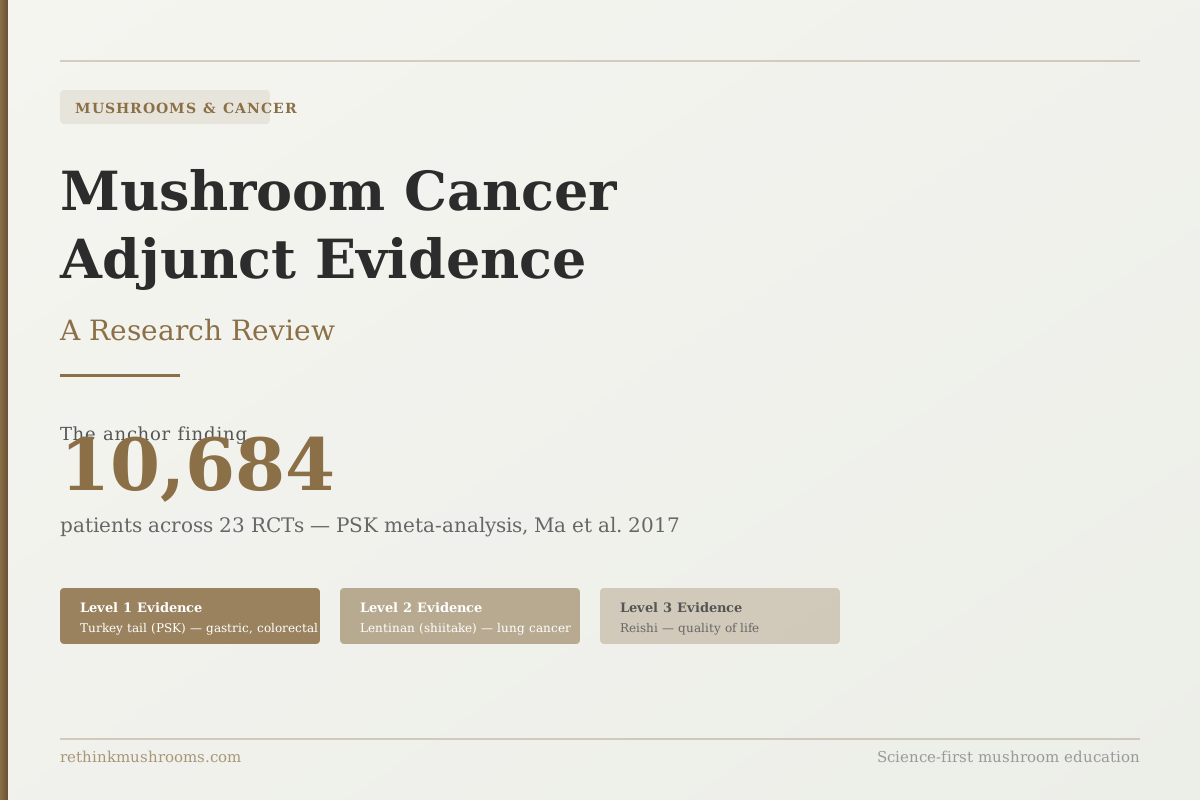
Mushrooms & Cancer
10,684 patients
PSK combined with chemotherapy significantly improved five-year overall survival across 23 randomized controlled trials, the strongest clinical case for any mushroom compound in oncology.
Ma et al., Oncotarget, 2017
23 RCTs
analyzed in the PSK network meta-analysis
Level 1
evidence grade for turkey tail per Narayanan 2023
35+ years
lentinan licensed as a prescription anticancer drug in Japan
Ma et al., Oncotarget, 2017
 View as image ↗
The most important number in mushroom cancer research is 10,684. That is how many patients were enrolled across 23 randomized controlled trials in a 2017 network meta-analysis of PSK, a polysaccharide extract derived from turkey tail mushroom. The finding: patients who received PSK alongside chemotherapy had significantly better five-year overall survival than those on chemotherapy alone.[1]
That study, by Ma and colleagues in Oncotarget, is the anchor evidence in this field. It does not prove that mushrooms cure cancer. What it shows is more specific: a defined extract from a specific mushroom species, used alongside standard treatment, produced measurable survival improvements across thousands of patients in multiple controlled trials. That is a fundamentally different kind of evidence than a lab study showing mushroom compounds kill cancer cells in a dish.
This article maps the clinical evidence for mushroom cancer adjuncts, organized from the strongest study designs to the weakest. For the broader clinical guide, see Medicinal Mushrooms in Cancer Treatment: A Complete Guide.
Key Takeaways
- A 2017 network meta-analysis of 23 RCTs and 10,684 patients found PSK (turkey tail) plus chemotherapy significantly improved five-year overall survival in gastric and colorectal cancer, without increasing side effects (Ma et al., 2017)
- A 2023 systematic review by Narayanan et al. assigned PSK the highest evidence grade (Level 1) for gastric and colorectal cancer, the only mushroom compound to reach this tier
- Lentinan, derived from shiitake mushroom, has been a government-approved prescription anticancer drug in Japan since 1985, used as IV adjuvant therapy for lung cancer (Rony et al., 2018)
- A 2021 systematic review of fungal beta-glucans across multiple cancer types confirmed improved immune function and reduced chemotherapy side effects, with PSK identified as having the strongest human evidence (Chen et al., 2021)
- Reishi shows meaningful quality-of-life benefit in a well-designed RCT for cancer patients on endocrine therapy, but at a lower evidence grade than PSK or lentinan (Dan et al., 2023)
- Most PSK trial data comes from Japan, where it is a licensed prescription drug. No large Phase 3 US trials have been completed, which limits direct extrapolation to Western clinical settings
Why Evidence Quality Determines What You Can Conclude
Not all mushroom studies carry the same weight. A cell-line study showing that reishi extract kills breast cancer cells in a laboratory dish is genuinely interesting science. But it tells you almost nothing about what happens when a person takes reishi. Cells in a dish respond to concentrations of compounds that no supplement could realistically deliver, in an environment stripped of every immune and metabolic variable that shapes how biology works in an actual person.
The clinical evidence hierarchy runs from strongest to weakest: meta-analyses of multiple randomized controlled trials, then individual RCTs, then cohort studies, then animal studies, then cell-line studies. When you see supplement marketing claim "clinically proven" benefits, the question that matters is always: which level of evidence, and how similar is the tested product to what is actually being sold?
The 2021 systematic review by Chen and colleagues examined fungal beta-glucan adjuvant use across multiple cancer types and found meaningful evidence for improved immune function and quality of life, but also noted significant variation in trial designs, dosing, and mushroom preparations across studies, which makes drawing universal conclusions difficult.[4] That heterogeneity is the defining challenge in this research area. Some compounds have cleared the highest evidential bars. Most have not.
The Strongest Mushroom Cancer Adjunct Evidence: The PSK Meta-Analysis
The anchor study in this field is a 2017 network meta-analysis by Ma and colleagues, published in Oncotarget.[1] They analyzed 23 randomized controlled trials enrolling 10,684 patients with gastric or colorectal cancer. The compound tested was PSK, also known as polysaccharide-K or Krestin, extracted from Trametes versicolor (turkey tail mushroom) and given alongside standard chemotherapy.
The results were statistically significant and clinically meaningful. PSK combined with chemotherapy was associated with significantly improved five-year overall survival and seven-year disease-free survival compared to chemotherapy alone. Critically, adding PSK did not increase adverse effects. This was not a single pilot study: it was 23 separate controlled trials synthesized together using a network analysis method specifically designed to capture effect sizes that any individual trial would miss.
There are important caveats to hold alongside that finding. Nearly all 23 trials were conducted in Japan, where PSK has been a licensed prescription anticancer drug since the 1970s. Japanese oncology trials follow rigorous methodological standards, but patient populations, chemotherapy protocols, and staging conventions differ from current Western practice. No large Phase 3 US trials of PSK have been completed.
The findings are genuine and substantial. Ten thousand patients across 23 controlled trials, showing consistent survival benefit without added toxicity, is the most powerful clinical case for any mushroom compound in oncology. They also apply to a specific compound form, in specific patient populations, on regimens that differ from what most Western patients receive today.
How 2023 Systematic Reviews Grade Each Mushroom Compound
Two independent systematic reviews published in 2023 assessed the full clinical evidence base for medicinal mushrooms in oncology, arriving at largely consistent conclusions.
Narayanan and colleagues produced the most comprehensive systematic review of clinical mushroom oncology studies to date.[2] Their evidence grading:
Turkey tail (PSK/Krestin): Level 1 evidence for gastric and colorectal cancer. Multiple high-quality RCTs support survival benefit as a chemotherapy adjuvant. This is the highest designation in the grading framework, and no other mushroom compound reached it.
Shiitake (lentinan): Level 2 evidence for lung cancer. Lentinan has been a government-approved prescription drug in Japan since 1985. The evidence base is meaningful but narrower in scope than PSK, built on IV administration rather than oral supplementation.
Reishi (Ganoderma lucidum): Lower overall evidence grade, but with a well-designed RCT demonstrating significant quality-of-life benefit, particularly cancer-related fatigue and depression in breast cancer patients on endocrine therapy. The data supports QoL benefit; survival benefit has not been demonstrated in well-controlled human trials.
Dan and colleagues, publishing a scoping review in Integrative Cancer Therapies the same year, examined clinical evidence across gastric, breast, and colorectal cancer specifically.[3] They confirmed PSK has the strongest survival evidence for gastric and colorectal cancer, while noting that evidence quality across the broader field remains limited by trial heterogeneity. The honest summary from both 2023 reviews: PSK sits in a different evidence category from every other mushroom compound, and the gap is not small.
Lentinan: 35 Years of Prescription Drug Data From Japan
Lentinan is derived from shiitake (Lentinus edodes) and has been used as an IV adjuvant drug in Japan since 1985. It is not a supplement. It is a pharmaceutical-grade polysaccharide extract administered intravenously alongside chemotherapy, prescribed by oncologists for specific cancer types.
Rony and colleagues published a systematic review of 12 years of clinical lentinan use in China for lung cancer.[5] Across multiple clinical studies, patients receiving lentinan alongside chemotherapy showed improved immune function markers (higher NK cell counts and lymphocyte activity) and better quality of life scores compared to chemotherapy alone. Narayanan 2023 assigns lentinan Level 2 evidence, one tier below PSK.[2]
The critical distinction is administration route. Lentinan's evidence was built with intravenous delivery, which bypasses the digestion and absorption variables that affect oral supplements. The compound binds to Dectin-1 receptors on macrophages and dendritic cells, triggering a cascade of immune activation. Whether oral shiitake products deliver enough lentinan to produce comparable immune effects is a separate question, and one that clinical data does not currently answer.
When a compound has been a government-licensed prescription oncology drug for over 35 years, its basic safety and clinical utility are not contested at the institutional level. The open question for consumers is whether oral shiitake products are pharmacologically comparable to the IV lentinan that built this evidence base.
Beta-Glucans Across Cancer Types: What the Systematic Review Confirms
PSK and lentinan are both beta-glucans, long-chain polysaccharides that activate immune receptors and set off immune responses. The question of whether beta-glucans as a broader class consistently benefit cancer patients was examined in a 2021 systematic review by Chen and colleagues in Phytotherapy Research.[4]
Their review covered fungal beta-glucan adjuvant use across multiple cancer types, examining both human trials and the proposed cellular mechanisms. The primary findings: beta-glucan supplementation was associated with improved immune function markers, reduced chemotherapy side effects including nausea, fatigue, and infection rates, and improved quality of life scores. PSK and PSP, both from turkey tail, were identified as having the strongest human evidence within this broader category.
The review also surfaces the persistent methodological challenge: different studies used different species, extraction methods, doses, and administration routes, making direct study comparisons and precise dose-response conclusions difficult. What the review does confirm is a consistent directional signal. Across cancer types and study designs, fungal beta-glucan supplementation tends to support immune function and treatment tolerability. How large the effect is, and for which specific patients, remains clearly established only in the PSK gastric and colorectal trial context.
For a deeper look at how mushroom compounds activate the immune system at the cellular level, see How Mushrooms Support Cancer Patients: Mechanisms and Evidence.
The Breast Cancer Evidence: Population Data and Species-Specific Findings
The evidence for medicinal mushrooms in breast cancer is less consolidated than for gastric and colorectal cancer. The strongest signals come from population-level observational data and species-specific mechanistic research, not from large clinical trials.
Chen and colleagues published a 2014 meta-analysis of observational studies examining dietary mushroom intake and breast cancer risk.[7] Higher mushroom consumption was associated with reduced breast cancer risk across the pooled studies. The proposed mechanism is aromatase inhibition: compounds found in several mushroom species reduce estrogen synthesis, a relevant pathway in hormone-receptor-positive breast cancer. This is population-level dietary data, not a clinical trial, and causal interpretation requires the standard epidemiological caution.
Rop and colleagues published a 2020 review mapping evidence from cell lines, animal models, and clinical trials for mushroom extracts in breast cancer specifically.[6] Their evidence map: turkey tail shows anti-aromatase activity and immune activation in preclinical work, with supporting data from a US Phase 1 trial. Reishi shows anti-proliferative effects in cell lines and meaningful fatigue reduction in a clinical RCT. Maitake D-fraction activates NK cells in laboratory and animal models.
The honest tier for breast cancer: no mushroom compound has produced survival trial evidence for breast cancer equivalent to what PSK has produced for gastric and colorectal cancer. Cell-line and animal data are genuinely interesting. Clinical evidence is promising but limited. For quality-of-life outcomes, reishi has solid RCT support across cancer types, including breast cancer patients on endocrine therapy.
What the Evidence Does and Doesn't Support
The most common misreading of this research is extrapolating PSK's survival data in gastric and colorectal cancer into a general claim that mushrooms treat cancer, or assuming that whole-mushroom consumer supplements deliver the same effects as pharmaceutical-grade PSK extracts.
Neither follows from the data.
PSK's survival evidence comes from a specific pharmaceutical compound, standardized and administered at defined doses, in specific patient populations, alongside specific chemotherapy regimens, predominantly in Japanese oncology settings. The compound's composition is standardized in ways that commercial mushroom supplements are typically not. No clinical trial has demonstrated that an over-the-counter turkey tail capsule replicates PSK's pharmacological effects.
The Narayanan 2023 systematic review is explicit on this point: evidence grades apply to the specific compounds and forms studied, not to mushroom species broadly.[2] The gap between PSK as a licensed Japanese pharmaceutical and a powdered mushroom capsule is not trivial.
What the evidence genuinely supports, taken on its own terms: PSK as a chemotherapy adjuvant improves survival outcomes in gastric and colorectal cancer across multiple large RCTs. Lentinan as an IV drug improves immune function and quality of life in lung cancer. Reishi extracts reduce cancer-related fatigue in well-designed clinical trials. Population data suggests habitual mushroom consumption may modestly reduce breast cancer risk. These are real findings from real studies in real patients. They also mean something more specific than the phrase "mushrooms fight cancer" implies.
For the regulatory context behind why US companies cannot make cancer claims about mushroom supplements despite this evidence, see FDA and Mushroom Supplements: How DSHEA Shapes What Companies Can Say.
For a species-by-species breakdown of the clinical evidence, see Medicinal Mushrooms as Cancer Adjuncts: A Cross-Species Evidence Overview. For what oncologists actually recommend during treatment, see Mushroom Supplements During Cancer Treatment: What Oncologists Say.
The Bottom Line
PSK, derived from turkey tail, sits at Level 1 evidence for gastric and colorectal cancer, supported by 23 RCTs and 10,684 patients in a 2017 meta-analysis. Lentinan from shiitake has over 35 years as a prescription drug in Japan for lung cancer. Reishi has quality-of-life RCT data across cancer types. The consistent limitation throughout the research: evidence applies to pharmaceutical-grade extracts studied in Japanese oncology settings, and the forms used in clinical trials differ substantially from most consumer supplements available today.
Frequently Asked Questions
Sources & References
- 1RTHM-00895·Ma, Yan et al. (2017). “Can polysaccharide K improve therapeutic efficacy and safety in gastrointestinal cancer? a systematic review and network meta-analysis..” Oncotarget.Study breakdown →PubMed →↩
- 2RTHM-01760·Narayanan, Santhosshi et al. (2023). “Medicinal Mushroom Supplements in Cancer: A Systematic Review of Clinical Studies..” Current oncology reports.Study breakdown →PubMed →↩
- 3RTHM-01682·Dan, Amit et al. (2023). “Therapeutic Effects of Medicinal Mushrooms on Gastric, Breast, and Colorectal Cancer: A Scoping Review..” Cureus.Study breakdown →PubMed →↩
- 4. Source details for this reference are not yet available.
- 5. Source details for this reference are not yet available.
- 6. Source details for this reference are not yet available.
- 7. Source details for this reference are not yet available.