Mushrooms & Cancer
10,684 patients
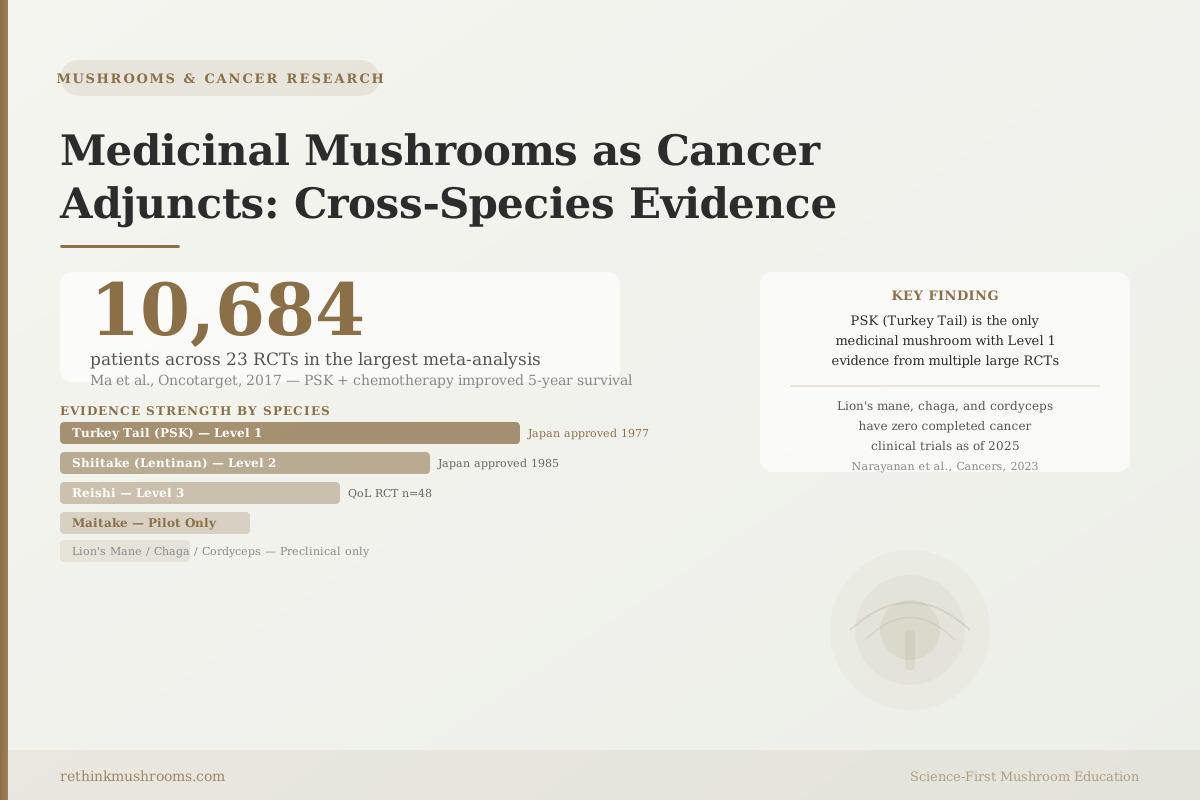
A 2017 network meta-analysis of 23 RCTs covering 10,684 patients found PSK — a compound derived from turkey tail mushroom — significantly improved overall survival when added to chemotherapy for gastrointestinal cancers.
Ma et al., Oncotarget, 2017
3 species
have pharmaceutical-grade approval in Japan: PSK (turkey tail), lentinan (shiitake), schizophyllan
8,009 patients
across eight randomized trials of PSK after gastric cancer surgery; pooled hazard ratio 0.88 for overall survival
Zero trials
lion's mane, cordyceps, and chaga have no cancer-specific clinical trials in humans
Ma et al., Oncotarget, 2017
 View as image ↗
The phrase "medicinal mushrooms for cancer" encompasses an enormous range of claims. At one end: PSK, a compound from turkey tail mushroom, is a prescription drug in Japan, used as an adjuvant to chemotherapy for decades, with a 2017 meta-analysis of 23 randomized controlled trials and 10,684 patients showing improved survival.[1] At the other end: lion's mane mushroom has no cancer-specific clinical trials in humans at all.
Everything in between requires care. These are adjunct therapies, meaning add-on treatments used alongside conventional cancer care, not replacements for it. The evidence for each species is different in type, quality, and cancer type specificity. This article maps that spectrum honestly, and flags where popular summaries have invented precision that the underlying literature does not contain.
For the full overview of how medicinal mushrooms fit into cancer care, including the Japan pharmaceutical approval context and safety considerations, see Medicinal Mushrooms in Cancer Treatment: A Complete Guide.
Key Takeaways
- PSK (polysaccharide-K from turkey tail) has the strongest clinical evidence of any mushroom compound: a 2017 network meta-analysis of 23 RCTs in 10,684 patients showed significantly improved 1–5 year overall survival and 1–7 year disease-free survival when added to chemotherapy for gastrointestinal cancers
- Two earlier meta-analyses of centrally randomized trials support this independently: 8,009 patients in gastric cancer (hazard ratio 0.88) and 1,094 patients in colorectal cancer (survival risk ratio 0.71)
- Lentinan, from shiitake, is an approved injectable cancer adjuvant in Japan; a review of 38 randomized trials in 3,117 Chinese lung cancer patients found overall response rates rose from 43.3% with chemotherapy alone to 56.9% with lentinan added — a response-rate and quality-of-life finding, not a survival finding
- Reishi's best cancer trial is a randomized pilot study in 48 breast cancer patients on endocrine therapy, showing significant improvement in physical well-being and fatigue. It was not double-blind and had no survival endpoint
- Maitake's only substantial human cancer trial found immune effects that ran in both directions — some parameters rose, others were depressed, with non-monotonic dose-response curves. Its authors warned that botanical agents may depress as well as enhance immune function
- Lion's mane, chaga, and cordyceps have no human clinical trials for cancer outcomes; available evidence is from cell lines and animal models
- The widely repeated claim that a 2023 systematic review graded PSK "Level 1", lentinan "Level 2" and reishi "Level 3" does not appear in that review. What it actually concluded is that the evidence remains inconclusive for recommending routine mushroom use in cancer care
The Evidence Spectrum: Not All Medicinal Mushrooms Are Interchangeable
The most important fact about medicinal mushrooms and cancer is also the least known: the evidence differs radically between species. Not by a little, and not in a way that careful supplementation can paper over. The gap between the best-studied and least-studied species in this article runs from more than ten thousand cancer patients down to none at all.
Human Evidence Volume
How Many People Have Actually Been Studied, by Species
Patients enrolled in human cancer trials, per species. Bars use a logarithmic scale — each full step is roughly ten times more people, not ten more.
Turkey tail Trametes versicolor
10,684 patients
PSK · 23 randomised trials, network meta-analysis
Significant gains in 1-5 year overall survival and 1-7 year disease-free survival, with no increase in side effects.
Shiitake Lentinus edodes
3,117 patients
Lentinan · 38 randomised trials, pooled analysis
Overall response rate rose from 43.3% with chemotherapy alone to 56.9% with lentinan added. Survival was not the reported endpoint.
Reishi Ganoderma lucidum
48 patients
Spore powder · Single randomised pilot trial
Significant improvement in physical well-being and the fatigue subscale over four weeks. No survival endpoint, and not a double-blind trial.
Maitake Grifola frondosa
34 patients
D-fraction · Single phase I/II dose escalation
Primary endpoints were safety and tolerability. Immune effects were real but ran in both directions depending on dose.
Lion's mane, chaga, cordyceps H. erinaceus, I. obliquus, Cordyceps spp.
zero patients
Various · No human cancer-outcome trials
Cancer evidence for all three is confined to cell lines and animal models. Untested in humans is not the same as shown ineffective.
The gap between the top and bottom of this list is not a matter of degree. Turkey tail's PSK has been tested in more than three hundred times as many cancer patients as maitake, and the bottom three species have never been tested in a human cancer trial at all. Popular writing that lists these species together as “anti-cancer mushrooms” is describing shelf placement, not evidence. Counts are enrolled or analysed human totals from Ma 2017 (ref 1), Zhang 2018 (ref 4), Zhao 2012 (ref 5), and Deng 2009 (ref 9).
The table below summarizes the same picture in regulatory and design terms. The "strongest human study design" column is purely descriptive — it reports what kind of study actually exists, rather than assigning a numbered evidence grade. That distinction matters, because the numbered grading schemes that circulate for these species turn out not to originate in the peer-reviewed literature at all.
| Species | Key Compound | Approved Drug in Japan? | Strongest Human Study Design | Primary Cancer Type Evidence |
|---|---|---|---|---|
| Turkey tail (Trametes versicolor) | PSK / PSP | Yes (PSK, approved 1977) | Meta-analyses of randomized trials | Gastric, colorectal |
| Shiitake (Lentinus edodes) | Lentinan | Yes (lentinan, approved 1985) | Pooled analysis of 38 randomized trials | Lung, gastric |
| Reishi (Ganoderma lucidum) | Polysaccharides, triterpenes | No | Single randomized pilot trial (n=48) | Fatigue and quality of life |
| Maitake (Grifola frondosa) | D-fraction beta-glucan | No | Single phase I/II dose escalation (n=34) | Immune markers only (breast) |
| Lion's mane, Chaga, Cordyceps | Various | No | None | Cell lines and animal models only |
Turkey Tail (PSK): The Gold Standard — 23 RCTs, 10,684 Patients
Turkey tail (Trametes versicolor) has produced the most clinically developed mushroom compound in oncology: PSK (polysaccharide-K, tradename Krestin). It was approved in Japan in 1977 as an adjuvant cancer treatment and has been used there in combination with chemotherapy for gastrointestinal cancers ever since — by 2002, reviewers were already describing it as a chemoimmunotherapy agent used in cancer treatment in Asia for more than three decades.[11]
Ma et al. (2017) · Oncotarget
- Population
- 10,684 patients with gastrointestinal cancer across 23 randomized controlled trials and 13 intervention arms
- Intervention
- PSK, with or without chemotherapy
- Comparator
- Chemotherapy alone
- Finding
- PSK significantly increased 1–5 year overall survival and 1–7 year disease-free survival, with positive trends at 6–7 year overall survival. No increase in side effects was observed. PSK combined with chemotherapy was the superior application, with significant gains at 3-year and 5-year overall survival.
positive Prospectively registered with PROSPERO. Effects were clearest in the colorectal and gastric cancer subgroups.
Ma et al., Oncotarget, 2017 (PMID 29179503)
This is the most statistically powerful clinical evidence for any mushroom compound in oncology. A 10,684-patient network meta-analysis is not a preliminary finding; it represents the accumulated evidence of 23 independent trials.
Two earlier meta-analyses, each restricted to centrally randomized trials, point the same direction in specific cancers. In gastric cancer, pooling 8,009 patients from eight randomized controlled trials gave an overall hazard ratio of 0.88 (95% CI 0.79–0.98; P = 0.018) favouring PSK added to adjuvant chemotherapy, with no significant heterogeneity between trials.[12] In curatively resected colorectal cancer, 1,094 patients across three trials gave an overall survival risk ratio of 0.71 (95% CI 0.55–0.90; P = 0.006) and a disease-free survival risk ratio of 0.72 (95% CI 0.58–0.90; P = 0.003), analysed intention-to-treat with at least five years of follow-up.[13] Three separate research groups, three different primary cancer sites, three different effect measures, one direction of effect. That convergence is what distinguishes PSK from everything else in this article.
The proposed mechanism is immunological rather than directly cytotoxic: recovery from the immunosuppression induced by surgery and chemotherapy, activation of antitumour immune responses including dendritic cell maturation and correction of Th1/Th2 imbalance, and enhancement of chemotherapy's effect through apoptosis induction.[10]
In the United States, the clinical foundation is far smaller. Torkelson and colleagues ran a two-centre phase I dose-escalation study of an oral turkey tail preparation taken for six weeks by women who had recently completed radiotherapy for breast cancer. Eleven participants were recruited and nine completed the study, in three cohorts receiving 3, 6, or 9 grams daily. The primary purpose was to find the maximum tolerated dose, and the answer was that up to 9 grams daily was safe and tolerable. The immunological results were reported as trends, not confirmed effects: increased lymphocyte counts at 6 and 9 grams per day, increased natural killer cell functional activity at 6 grams per day, and dose-related increases in CD8+ T cells and CD19+ B cells — but no increase in CD4+ T cells or CD16+56+ NK cells.[6]
That is a safety and feasibility result, not an efficacy result, and it is worth being precise about because it is frequently cited as though nine patients demonstrated immune reconstitution. They did not. They demonstrated that the preparation was tolerable enough to justify a larger trial.
A second bioactive from turkey tail, PSP (polysaccharopeptide), has its own smaller evidence base in the Chinese clinical literature. PSK and PSP are structurally related but distinct: they are derived from different strains of the fungus — CM-101 and COV-1 respectively — and were developed by Japanese and Chinese researchers separately. PSK has been researched longer and has undergone more thorough laboratory, animal and clinical testing.[11]
Shiitake Lentinan: An Approved Cancer Drug in Japan Since 1985
Lentinan is a beta-1,3-glucan extracted from shiitake mushrooms (Lentinus edodes). It was approved in Japan as a prescription adjuvant for gastric cancer in 1985, and lentinan injection is a clinically approved drug in several Asian countries.[4]
The largest synthesis of its clinical use comes from Zhang and colleagues' 2018 review of twelve years of Chinese clinical studies in lung cancer. Searching the CNKI, VIP and Wanfang databases for randomized controlled trials published between 2004 and 2016, they identified 38 eligible RCTs covering 3,117 patients. The mean overall response rate rose from 43.3% with chemotherapy alone to 56.9% with lentinan added to chemotherapy (P < 0.001, 95% CI 0.102–0.170), with a pooled risk ratio of 0.79 (95% CI 0.74–0.85) favouring the combination and no statistical heterogeneity between studies (I² = 11%).[4]
Note carefully what that does and does not establish. The reported endpoints were tumour response rate and quality of life; the authors' conclusion was that lentinan is effective both in improving quality of life and in promoting the efficacy of chemotherapy. Overall survival was not the analysed outcome. Lentinan's evidence base is genuinely substantial — 38 randomized trials is not a small thing — but it is response-rate evidence, and describing it as survival evidence overstates it.
Reishi: Quality-of-Life Evidence, at Pilot Scale
Reishi (Ganoderma lucidum) has a different evidence profile from turkey tail and shiitake. Such cancer-adjuvant value as it has demonstrated is centred on symptom burden rather than survival.
The most-cited human study is Zhao and colleagues' 2012 trial of Ganoderma lucidum spore powder for cancer-related fatigue. Forty-eight breast cancer patients experiencing fatigue while undergoing endocrine therapy were randomized to an experimental or control group, with FACT-F, HADS and EORTC QLQ-C30 questionnaires collected at baseline and after four weeks. The experimental group showed statistically significant improvements in the physical well-being domain and the fatigue subscale. Patients also reported less anxiety and depression and better quality of life, and inflammatory markers associated with cancer-related fatigue were significantly lower. No serious adverse effects occurred.[5]
Two qualifications belong with that result, both of which are commonly dropped. First, the authors describe it as a pilot clinical trial and frame the conclusion accordingly — spore powder may have beneficial effects. Second, it is not a double-blind, placebo-controlled trial; participants were randomized to an experimental or control group, and the report does not describe blinding or a placebo. For a subjective, self-reported endpoint like fatigue, that is a meaningful limitation, because unblinded participants who know they are receiving an active treatment tend to report improvement.
Reishi does appear in a controlled-trial review: Jeitler and colleagues' 2020 narrative review of medicinal mushrooms in integrative oncology included eight randomized controlled trials plus one further controlled clinical trial, three of them using Ganoderma lucidum, all orally administered and all compared against placebo. Across the whole set the reviewers found suggestions of benefit for quality of life and for reducing the adverse effects of conventional therapy, along with reports of increased natural killer cell activity. They also judged the methodological quality of most included studies to be generally unsatisfying and the reporting insufficient in several respects.[8]
Maitake: Real Immune Effects, in Both Directions
Maitake (Grifola frondosa) is where the gap between marketing and evidence is widest, and where the actual finding is more interesting than the claim it replaced.
The immunological rationale is well established. Guggenheim and colleagues' 2014 integrative oncology review describes maitake's activity through beta-glucan receptor signalling, including Dectin-1 engagement leading to natural killer cell and macrophage responses — the same upstream mechanism shared across the major medicinal species.[7]
The human trial is where it gets complicated.
Dose-Response Reality Check
Maitake Moved Immune Markers in Both Directions
Deng et al. 2009 — 34 postmenopausal breast cancer patients, five sequential oral dose cohorts over three weeks.
The five dose cohorts tested
0.1
mg/kg 2×/day
0.5
mg/kg 2×/day
1.5
mg/kg 2×/day
3
mg/kg 2×/day
5
mg/kg 2×/day
Schematic of the reported direction of effect. The trial established that both directions occurred; it did not publish a single summary curve, and none is invented here.
Primary endpoints
Safety and tolerability — not efficacy. No dose-limiting toxicity was encountered.
Immune association
Statistically significant (p < 0.0005) — but significant does not mean uniformly beneficial.
Curve shape
Non-monotonic. Intermediate doses differed from both the high and low doses.
This is the trial most often cited as evidence that maitake “boosts immunity”. What it actually established is that oral maitake extract measurably changes immune parameters in breast cancer patients, in both directions, without a clean more-is-better relationship. The authors' own conclusion is the one worth carrying forward: botanical agents produce more complex effects than assumed, and may depress as well as enhance immune function (ref 9).
Deng and colleagues enrolled 34 postmenopausal breast cancer patients who were free of disease after initial treatment into a phase I/II dose-escalation trial, in five sequential cohorts taking maitake liquid extract orally at 0.1, 0.5, 1.5, 3, or 5 mg/kg twice daily for three weeks. The primary endpoints were safety and tolerability. No dose-limiting toxicity was encountered; two patients withdrew with grade I possibly-related effects (nausea and joint swelling in one, rash and pruritus in the other).[9]
There was a statistically significant association between maitake and immunologic function (P < 0.0005). But the direction was not uniform. Increasing doses increased some immunologic parameters and depressed others, and the dose-response curves for many endpoints were non-monotonic — intermediate doses had either immune-enhancing or immune-suppressant effects compared with both the high and low doses. The authors' conclusion is worth quoting in substance: cancer patients should be made aware that botanical agents produce more complex effects than assumed, and may depress as well as enhance immune function.[9]
No larger maitake trial with cancer outcomes has followed. What exists is a well-conducted safety study whose headline finding is a caution, not an endorsement.
Lion's Mane, Chaga, and Cordyceps: Preclinical Only for Cancer
Three of the most commercially popular medicinal mushrooms — lion's mane (Hericium erinaceus), chaga (Inonotus obliquus), and cordyceps (Cordyceps sinensis and C. militaris) — have no human clinical trials specifically investigating cancer outcomes.
Available cancer evidence for these species is from cell line studies and animal models. These studies show genuine biological activity: lion's mane extracts have demonstrated anti-proliferative effects in certain cancer cell lines; chaga's triterpenoids and betulin derivatives have shown apoptosis-inducing activity in cell culture; cordyceps compounds have shown anti-tumour activity in rodent models.
Cell line and animal results often fail to translate to clinical benefit in humans. The absence of clinical trials for these species in cancer doesn't mean they're ineffective; it means their cancer-specific human efficacy is simply untested.
Species Equivalence
Are all medicinal mushrooms anti-cancer mushrooms?
The claim
“Medicinal mushrooms support the immune system against cancer, so lion's mane, chaga, cordyceps, reishi and turkey tail are broadly interchangeable choices.”
Blended category marketing, where a single 'mushroom complex' product lists eight species and cites evidence generated for only one of them.
What research shows
MisleadingThe species in these blends have radically different human evidence bases. PSK from turkey tail has been studied in over 10,000 cancer patients across randomized trials and is an approved drug in Japan. Lion's mane, chaga and cordyceps have been studied in zero cancer patients.
Shared mechanism is not shared evidence. Beta-glucan receptor signalling is common across these species, but a plausible upstream mechanism has never been sufficient to predict clinical benefit — which is precisely why the trials are run. Maitake makes the point sharply: it has the mechanism, and its one human trial found immune parameters moving in both directions.
Ma et al. 2017 (ref 1); Deng et al. 2009 (ref 9); Guggenheim et al. 2014 (ref 7)
What the Recent Evidence Reviews Actually Conclude
Three syntheses published between 2020 and 2023 are cited constantly in this area, and their conclusions are frequently blended together and applied to species none of them examined.
Source Scope Audit
What Each Review Actually Looked At
These three syntheses are routinely quoted interchangeably. They covered different species, so a claim is only as good as the review that actually examined that mushroom.
Narayanan 2023 [ref 2]
Systematic reviewSearch window
Jan 2010 - Dec 2020
Screening funnel
2,349 screened → 39 included
Species examined
Twelve mushroom preparations across all cancer types
Out of reach: Did not publish a per-species Level 1 / 2 / 3 grading scheme. That framing is not theirs.
Evidence inconclusive for routine useDan 2023 [ref 3]
Scoping reviewSearch window
2012 - 2023
Screening funnel
2,202 initial → 9 included
Species examined
Three species, in gastric, breast and colorectal cancer only
Out of reach: Ganoderma lucidum (reishi) was not among the species reviewed, so this review cannot support a reishi claim.
Potential shown; larger RCTs neededJeitler 2020 [ref 8]
Narrative reviewSearch window
Controlled trials only
Screening funnel
8 RCTs + 1 controlled trial
Species examined
Whole-spectrum oral preparations, all placebo-controlled
Out of reach: Lentinan is absent — its trials are intravenous, outside this review’s oral-preparation scope.
Methodological quality generally unsatisfyingTwo things fall out of this audit. First, the widely repeated “Level 1 for PSK, Level 2 for lentinan, Level 3 for reishi” hierarchy does not come from any of these reviews — it is a secondary-source invention, and this article does not use it. Second, the strongest single conclusion available is also the most cautious one: Narayanan and colleagues, having assembled the largest recent body of clinical studies, judged the evidence inconclusive for recommending routine mushroom use in cancer care (ref 2).
Narayanan and colleagues' 2023 systematic review is the largest of the three. Searching Medline, Embase, Scopus and the Cochrane Library for human studies published between January 2010 and December 2020, they screened 2,349 records, identified 136 clinical studies, and included 39 covering 12 different mushroom preparations. A survival benefit was reported using Huaier granules (Trametes robiniophila Murr) in two hepatocellular carcinoma studies and one breast cancer study, and using PSK in four gastric cancer studies in the adjuvant setting. Eleven studies reported a positive immunological response, and 14 reported quality-of-life improvement or reduced symptom burden. Most adverse effects were grade 2 or lower.[2]
Their conclusion, however, is more restrained than the way this review is usually quoted. Noting that many of the studies were small and observational and that a randomized controlled design was often not used, the authors judged the evidence inconclusive for recommending the routine use of mushrooms for cancer patients, and called for more trials.[2]
Dan and colleagues' 2023 scoping review narrowed to the three cancers with the highest mortality. From 2,202 initial records they selected nine studies, covering Lentinus edodes (shiitake), Coriolus versicolor (turkey tail), and Agaricus sylvaticus, in gastric, breast and colorectal cancer. They found that medicinal mushrooms have the potential to prevent lymph node metastasis, prolong overall survival, decrease chemotherapy-induced side effects such as diarrhoea and vomiting, and help maintain immune function and quality of life — while calling for larger randomized trials to confirm the most efficacious dosages.[3] Reishi is not among the species that review examined, so it cannot be used to grade reishi.
The honest summary across all three: PSK is the most clinically substantiated mushroom compound for cancer adjuvant use, with evidence sufficient for prescription drug use in Japan and consistent across independent meta-analyses. Lentinan is also approved and has meaningful response-rate evidence. Everything else has a much thinner clinical base, and the largest recent systematic review declines to recommend routine use of any of it.
Cancer Care
CriticalMushroom supplements are not inert additions to a treatment plan
Concern
Immune-active compounds can move immune parameters in unpredictable directions, and their interactions with cancer treatments are poorly characterized. The best human maitake trial found that increasing doses raised some immune measures and depressed others, with non-monotonic dose-response curves — meaning a higher dose is not reliably a stronger effect, or even an effect in the same direction. Reviewers of the controlled-trial literature have flagged an urgent need to investigate the safety and possible interactions of medicinal mushrooms.
What the research says
Every trial described in this article administered mushroom preparations under oncological supervision, alongside conventional treatment, at defined doses and in defined preparations. None of them tested a self-selected supplement bought at retail, and supplement products vary widely in what they actually contain.
Particularly relevant for: Anyone undergoing or recovering from chemotherapy, radiotherapy, immunotherapy, or endocrine therapy for cancer
What to do
Tell your oncology team about any mushroom supplement before starting it, including product name and dose. Do not substitute any mushroom product for prescribed treatment, and do not assume a higher dose is a better one.
Deng et al. 2009 (ref 9); Jeitler et al. 2020 (ref 8); Narayanan et al. 2023 (ref 2)
This article describes what has been measured in clinical research. It is not medical advice, and it cannot account for your diagnosis, treatment plan, or other medications. Decisions about anything taken during cancer treatment belong with your oncology team.
For readers wanting to understand the mechanisms behind these effects, How Mushrooms Support Cancer Patients: Mechanisms and Evidence covers the Dectin-1 pathway, apoptosis mechanisms, and anti-angiogenesis in detail. For the safety and oncologist communication questions, Mushroom Supplements During Cancer Treatment: What Oncologists Say covers what the research says about drug interactions and disclosure.
The population-level prevention data (whether eating mushrooms reduces cancer risk) is a separate question from adjuvant use, covered separately in Mushroom Consumption and Cancer Risk Reduction: Meta-Analysis of Population Studies.
The Bottom Line
The clinical evidence for medicinal mushrooms in cancer care varies enormously by species. PSK from turkey tail is the clear leader: a 2017 network meta-analysis of 23 RCTs and 10,684 patients showed improved survival alongside chemotherapy, corroborated by independent meta-analyses in 8,009 gastric and 1,094 colorectal cancer patients. Lentinan from shiitake is an approved injectable drug in Japan with response-rate evidence from 38 randomized trials in 3,117 lung cancer patients. Reishi has a single randomized pilot trial in 48 patients showing fatigue and quality-of-life benefit. Maitake has one phase I/II trial in 34 patients whose central finding was that immune effects ran in both directions. Lion's mane, chaga, and cordyceps have no cancer-specific clinical trials. These are adjunct therapies with different evidence profiles for different cancer types, not interchangeable alternatives to each other or to conventional treatment — and the largest recent systematic review concluded the evidence is still inconclusive for routine use.
Frequently Asked Questions
Sources & References
- 1RTHM-00895·Ma, Yan et al. (2017). “Can polysaccharide K improve therapeutic efficacy and safety in gastrointestinal cancer? a systematic review and network meta-analysis..” Oncotarget.Study breakdown →PubMed →↩
- 2RTHM-01760·Narayanan, Santhosshi et al. (2023). “Medicinal Mushroom Supplements in Cancer: A Systematic Review of Clinical Studies..” Current oncology reports.Study breakdown →PubMed →↩
- 3RTHM-01682·Dan, Amit et al. (2023). “Therapeutic Effects of Medicinal Mushrooms on Gastric, Breast, and Colorectal Cancer: A Scoping Review..” Cureus.Study breakdown →PubMed →↩
- 4RTHM-00538·Zhang, Yiran et al. (2018). “Lentinan as an immunotherapeutic for treating lung cancer: a review of 12 years clinical studies in China..” Journal of cancer research and clinical oncology.Study breakdown →PubMed →↩
- 5RTHM-00276·Zhao, Hong et al. (2012). “Spore Powder of Ganoderma lucidum Improves Cancer-Related Fatigue in Breast Cancer Patients Undergoing Endocrine Therapy: A Pilot Clinical Trial..” Evidence-based complementary and alternative medicine : eCAM.Study breakdown →PubMed →↩
- 6RTHM-00267·Torkelson, Carolyn J et al. (2012). “Phase 1 Clinical Trial of Trametes versicolor in Women with Breast Cancer..” ISRN oncology.Study breakdown →PubMed →↩
- 7RTHM-00323·Guggenheim, Alena G et al. (2014). “Immune Modulation From Five Major Mushrooms: Application to Integrative Oncology..” Integrative medicine (Encinitas.Study breakdown →PubMed →↩
- 8RTHM-00622·Jeitler, Michael et al. (2020). “Significance of Medicinal Mushrooms in Integrative Oncology: A Narrative Review..” Frontiers in pharmacology.Study breakdown →PubMed →↩
- 9RTHM-00289·Deng, Gary et al. (2009). “A phase I/II trial of a polysaccharide extract from Grifola frondosa (Maitake mushroom) in breast cancer patients: immunological effects..” Journal of cancer research and clinical oncology.Study breakdown →PubMed →↩
- 10RTHM-00475·Maehara, Yoshihiko et al. (2012). “Biological mechanism and clinical effect of protein-bound polysaccharide K (KRESTIN(®)): review of development and future perspectives..” Surgery today.Study breakdown →PubMed →↩
- 11RTHM-00089·Fisher, Monte et al. (2002). “Anticancer effects and mechanisms of polysaccharide-K (PSK): implications of cancer immunotherapy..” Anticancer research.Study breakdown →PubMed →↩
- 12RTHM-00226·Oba, Koji et al. (2007). “Efficacy of adjuvant immunochemotherapy with polysaccharide K for patients with curative resections of gastric cancer..” Cancer immunology.Study breakdown →PubMed →↩
- 13RTHM-00200·Sakamoto, Junichi et al. (2006). “Efficacy of adjuvant immunochemotherapy with polysaccharide K for patients with curatively resected colorectal cancer: a meta-analysis of centrally randomized controlled clinical trials..” Cancer immunology.Study breakdown →PubMed →↩
- 14RTHM-00026·Okamura, K et al. (1989). “Clinical evaluation of sizofiran combined with irradiation in patients with cervical cancer. A randomized controlled study; a five-year survival rate..” Biotherapy (Dordrecht.Study breakdown →PubMed →↩