Mushrooms & Cancer
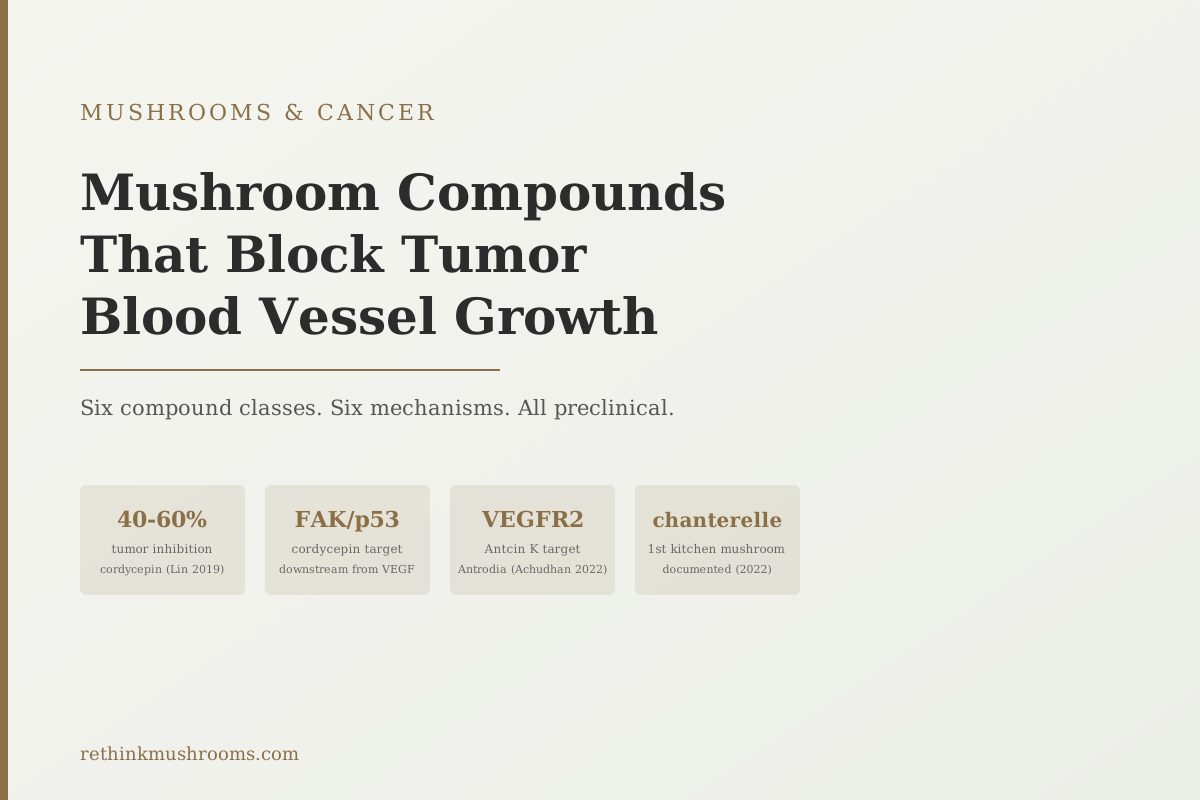
40-60% tumor growth inhibition
Cordycepin from Cordyceps militaris inhibited tumor growth by 40-60% in xenograft mice by blocking the FAK/p53 signaling pathway that blood vessel-forming cells depend on for survival.
Lin et al., Cancers, 2019
6 compound classes
with distinct anti-angiogenic mechanisms identified across mushroom species in this catalog
VEGFR2/STAT3
molecular target of Antcin K, a lanostane triterpenoid from Antrodia cinnamomea (Achudhan 2022)
chanterelle
the first common kitchen mushroom shown to have measurable anti-angiogenic activity, with ergosterol and cinnabarinate as the active compounds (Marathe 2022)
Lin et al., Cancers, 2019
 View as image ↗
Tumors cannot grow beyond a few millimeters without recruiting a blood supply. To do this, they secrete vascular endothelial growth factor (VEGF), a signaling protein that instructs nearby blood vessels to sprout new branches toward the tumor. Blocking this process, called anti-angiogenesis, cuts off the tumor's oxygen and nutrient supply without directly killing tumor cells.
Pharmaceutical drugs that work this way (bevacizumab, sunitinib) are approved treatments for several cancers. Mushroom compounds have been studied for the same effect since the early 2000s. The research has identified six distinct compound classes with anti-angiogenic mechanisms, each hitting a different point in the VEGF signaling cascade. None of this has been tested in human clinical trials. All of it is cell culture or animal research.
For the broader picture of how mushroom compounds fit within medicinal mushrooms in cancer treatment, the pillar guide covers the full evidence landscape. This article is a compound-level catalog: what specific molecules have been identified, which species they come from, and what molecular mechanisms the research has characterized.
Key Takeaways
- Cordycepin (from Cordyceps militaris) inhibited tumor growth by 40-60% in xenograft mice and blocked endothelial cell tube formation in vitro by dephosphorylating FAK and upregulating p53; this FAK/p53 mechanism is the most molecularly specific anti-angiogenic finding in the mushroom literature (Lin et al., Cancers, 2019)
- Ganoderma lucidum polysaccharide-peptide (GLPP) demonstrated both antitumor and anti-angiogenic activity in tumor-bearing mice, reducing tumor weight and inhibiting neovascularization (Cao and Lin, Acta Pharmacol Sin, 2004)
- Agaricus blazei Murill yielded two distinct anti-angiogenic compounds: ergosterol (Takaku 2001) and sodium pyroglutamate (Kimura 2004), both confirmed to suppress tumor angiogenesis in animal models through different structural mechanisms
- Antrodia cinnamomea produces both anti-angiogenic polysaccharides (blocking VEGF receptor binding, Cheng 2005; Yang 2009) and Antcin K, a lanostane triterpenoid that inhibits VEGFR2 phosphorylation and downstream STAT3 signaling (Achudhan 2022)
- Phellinus linteus protein-bound polysaccharide (PBP) simultaneously reduced VEGF expression, suppressed tumor invasion, and blocked endothelial tube formation in SW480 colon cancer cells; a single compound hit three separate cancer-enabling processes at once (Song et al., BMC Cancer, 2011)
- Golden chanterelle (Cantharellus cibarius) extracts showed anti-angiogenic activity in endothelial cell assays via lipoxygenase pathway inhibition; ergosterol and cinnabarinate were identified as the active compounds (Marathe et al., 2022)
Cordycepin: The Most Mechanistically Precise Compound
Cordycepin is an adenosine analog produced by Cordyceps militaris. It has the same molecular backbone as adenosine but with one oxygen atom missing from the ribose sugar. This structural difference allows it to interfere with RNA synthesis in ways that normal adenosine cannot.
Its anti-angiogenic mechanism, characterized by Lin and colleagues in 2019, operates on a completely different pathway from the other compounds in this catalog.[1]
The target is FAK (focal adhesion kinase), a protein that endothelial cells depend on to attach to surfaces, migrate, and form new vessel structures. FAK becomes phosphorylated (activated) when angiogenesis is stimulated. Cordycepin dephosphorylates FAK, disrupting endothelial cell adhesion and mobility. Simultaneously, cordycepin upregulates p53, the tumor-suppressor protein that promotes cell death.
The combined effect: blood vessel cells cannot move toward the tumor, and those that do get recruited begin dying rather than forming tubes.
In HUVEC-based assays (using human umbilical vein endothelial cells, the standard in vitro model for angiogenesis research), cordycepin dose-dependently suppressed endothelial cell proliferation, migration, and tube formation. In xenograft mice with implanted tumors, it inhibited tumor growth by 40-60% compared to untreated controls.
Why this matters mechanistically: pharmaceutical anti-angiogenic drugs like bevacizumab trap circulating VEGF before it reaches endothelial cells, operating upstream. Cordycepin operates downstream, after VEGF has already bound its receptor, targeting the endothelial cell's mechanical machinery. This different point of intervention raises the possibility that cordycepin and VEGF-targeting drugs could work additively, a hypothesis not yet tested in clinical settings.
Ganoderma GLPP: Reducing Tumor Weight and Neovascularization Together
Ganoderma lucidum contains multiple compound classes with anti-cancer activity. On the anti-angiogenic side, the most directly tested fraction is GLPP, the polysaccharide-peptide complex.
Cao and Lin demonstrated in 2004 that GLPP administered to tumor-bearing mice reduced both tumor weight and neovascularization (new blood vessel formation into the tumor).[2] The dual outcome of smaller tumors and reduced tumor vasculature confirmed that the polysaccharide-peptide complex was acting through both anti-angiogenic and direct antitumor mechanisms simultaneously.
Ganoderma's broader anti-angiogenic activity involves VEGF suppression. The triterpenoid fraction of Ganoderma reduces VEGF secretion upstream at the tumor cell level, meaning tumors send weaker angiogenic signals to nearby blood vessels in the first place. This upstream suppression mechanism is distinct from the cordycepin FAK mechanism and from the receptor-binding approach used by Antrodia compounds.
For the species-specific depth on Ganoderma's cancer research, including clinical evidence, see ganoderic acids and cancer: specific anti-tumor research and Ganoderma lucidum as a cancer adjunct: clinical evidence.
Agaricus Blazei: Two Distinct Compounds from One Species
The research on Agaricus blazei Murill is notable for having identified two structurally different anti-angiogenic compounds from the same species, suggesting redundant anti-angiogenic activity through non-overlapping mechanisms.
The first, ergosterol, is a sterol found widely across mushrooms but shown to be the primary anti-tumor compound in Agaricus blazei specifically. Takaku and colleagues isolated it in 2001 and demonstrated antitumor activity in tumor-bearing mice including suppression of angiogenesis as part of the mechanism.[4]
The second, sodium pyroglutamate, is structurally unrelated to ergosterol and was isolated as the primary anti-angiogenic compound by Kimura and colleagues in 2004.[3] Sodium pyroglutamate reduced tumor metastasis in animal models by suppressing the formation of new blood vessels into tumors.
A 2020 review by Hetland and colleagues confirmed both compounds and placed Agaricus blazei's beta-glucan fraction as the primary anti-cancer agent, with ergosterol and sodium pyroglutamate as confirmed anti-angiogenic components within the mushroom's broader antitumor activity profile.[5]
Having two structurally dissimilar anti-angiogenic compounds from one species is unusual in the natural products literature and may explain why Agaricus blazei has shown robust anti-tumor activity across multiple experimental models.
Antrodia Cinnamomea: Polysaccharides and Triterpenoids Targeting the Same Receptor Differently
Antrodia cinnamomea, a medicinal mushroom from Taiwan, has produced anti-angiogenic research at two levels: polysaccharide fractions and a specific lanostane triterpenoid called Antcin K.
Polysaccharide level. Cheng and colleagues demonstrated in 2005 that Antrodia polysaccharides blocked VEGF binding to its primary receptor (KDR/flk-1, also called VEGFR2) and inhibited VEGF-induced endothelial cell migration and tube formation on Matrigel.[6] The competition-for-receptor mechanism is conceptually similar to how bevacizumab works, though at much lower potency.
Yang and colleagues followed in 2009 with a molecular weight study showing that anti-angiogenic potency varies with polysaccharide size: high-molecular-weight fractions most strongly inhibited VEGF-induced endothelial cell proliferation and tube formation, while lower-MW fractions showed weaker effects.[7] This MW-dependence confirms that the anti-angiogenic effect is structural.
Triterpenoid level. Achudhan and colleagues characterized Antcin K in 2022, identifying its molecular target as VEGFR2 phosphorylation and downstream STAT3 signaling.[8] STAT3 is a transcription factor that, when activated by VEGF receptor signaling, drives expression of genes promoting endothelial cell survival and vessel formation. Antcin K blocks this cascade at the receptor phosphorylation step.
Both compound classes from Antrodia target VEGFR2, but at different points in its activation cascade. For the broader Antrodia cancer apoptosis mechanisms, see how Antrodia induces cancer cell death.
Phellinus Linteus: One Complex That Blocks Three Cancer-Enabling Processes
Song and colleagues published a notable 2011 study showing that a single isolated compound from Phellinus linteus, the protein-bound polysaccharide (PBP), simultaneously reduced VEGF expression, suppressed tumor invasion, and blocked endothelial tube formation in SW480 human colon cancer cells.[9]
What makes this structurally important: tumor growth, invasion, and angiogenesis are three separate cancer-enabling processes. Most compounds affect one or two. A single purified polysaccharide-protein complex hitting all three simultaneously, while also altering the Wnt/beta-catenin signaling pathway that regulates tumor cell self-renewal, is unusual.
The mechanism involves AKT suppression, an upstream kinase that integrates signals for cell survival, growth, and angiogenesis. When AKT is blocked, downstream VEGF production decreases, invasion-promoting matrix metalloproteinases are reduced, and cells become more susceptible to apoptosis.
Lee and colleagues added in 2010 that the most potent anti-angiogenic fraction in Phellinus linteus is the phenolic-rich ethyl acetate fraction, which showed dose-dependent inhibition of VEGF-induced endothelial tube formation and cell migration.[10] This identifies a phenolic compound class distinct from the polysaccharide-protein complex, suggesting Phellinus linteus has anti-angiogenic redundancy across different compound classes.
The Chanterelle Discovery: A Kitchen Mushroom With Anti-Angiogenic Activity
The most recently discovered and most surprising entry in the compound catalog comes from a 2022 study of golden chanterelle (Cantharellus cibarius).
Marathe and colleagues demonstrated that chanterelle extracts showed significant anti-angiogenic activity in HUVEC-based assays and correlated this activity with lipoxygenase pathway inhibition.[12] Lipoxygenases are enzymes that convert fatty acids into signaling molecules that promote inflammatory angiogenesis. Inhibiting this pathway reduces inflammatory angiogenic signaling.
Ergosterol and cinnabarinate were identified as the primary bioactive compounds responsible for the anti-angiogenic effect. Cinnabarinate is a compound found in chanterelles and some related species but not widely documented in other common mushrooms.
The significance is not that chanterelles are potent anti-angiogenic agents. The significance is that anti-angiogenic activity has been found in a common kitchen mushroom that most people eat without thinking of it as medicinal. The ergosterol that drives anti-angiogenic activity in Agaricus blazei (Takaku 2001) and chanterelles (Marathe 2022) is the same compound, suggesting ergosterol may be a cross-species anti-angiogenic mechanism in mushrooms generally.
The Cross-Species Evidence and Combination Data
Two additional studies place the compound-specific findings in a broader context.
Chen and colleagues demonstrated in 2005 that polysaccharides isolated from multiple medicinal fungi showed anti-angiogenic activity in HUVEC-based tube formation assays, with high-molecular-weight fractions being the most active class across species.[11] This cross-species finding suggests high-MW fungal polysaccharides may have anti-angiogenic activity as a conserved class property rather than something unique to any one mushroom.
Jakopović and colleagues provided the most important in vivo evidence in 2020, testing a multi-mushroom formula in mice with advanced colorectal cancer.[13] The mushroom formula significantly reduced tumor volume and VEGF levels. When combined with 5-fluorouracil (5-FU, a standard chemotherapy drug), the formula showed additive anti-angiogenic effects. VEGF suppression, M1 macrophage polarization, and MMP-2/9 inhibition were all observed. This is the only animal study testing a multi-mushroom anti-angiogenic approach alongside conventional chemotherapy, and the additive finding is mechanistically plausible because the two approaches operate on different targets.
For population-level evidence on mushroom consumption and cancer risk, see daily mushroom consumption and cancer risk reduction and mushroom consumption and cancer risk: meta-analysis of population studies. For the complementary immune mechanism, see beta-glucans and anti-tumor immunity: mechanisms explained and can mushrooms make immunotherapy more effective?. For species-level comparisons of anti-angiogenic strength, see anti-angiogenic mushrooms: which species show the strongest effects?.
The Bottom Line
Six compound classes from mushrooms have characterized anti-angiogenic mechanisms: cordycepin (FAK/p53), Ganoderma GLPP (VEGF suppression and neovascularization reduction), Agaricus blazei ergosterol and sodium pyroglutamate, Antrodia polysaccharides and Antcin K (VEGFR2/STAT3), Phellinus linteus protein-bound polysaccharide (AKT/triple-blocking), and chanterelle ergosterol and cinnabarinate (lipoxygenase). All evidence is in vitro or animal. No human clinical trials on any of these compounds for anti-angiogenic cancer applications exist as of 2026. The 2020 combination data (mushroom formula plus 5-FU showing additive anti-angiogenic effects in colorectal cancer mice) is the most clinically suggestive finding.
Frequently Asked Questions
Sources & References
- 1RTHM-00573·Lin, Yi-Ting et al. (2019). “Cordycepin Suppresses Endothelial Cell Proliferation, Migration, Angiogenesis, and Tumor Growth by Regulating Focal Adhesion Kinase and p53..” Cancers.Study breakdown →PubMed →↩
- 2RTHM-00067·Cao, Qi-Zhen et al. (2004). “Antitumor and anti-angiogenic activity of Ganoderma lucidum polysaccharides peptide..” Acta pharmacologica Sinica.Study breakdown →PubMed →↩
- 3RTHM-00073·Kimura, Yoshiyuki et al. (2004). “Isolation of an anti-angiogenic substance from Agaricus blazei Murill: its antitumor and antimetastatic actions..” Cancer science.Study breakdown →PubMed →↩
- 4RTHM-00039·Takaku, T et al. (2001). “Isolation of an antitumor compound from Agaricus blazei Murill and its mechanism of action..” The Journal of nutrition.Study breakdown →PubMed →↩
- 5RTHM-00620·Hetland, Geir et al. (2020). “Antitumor, Anti-Inflammatory and Antiallergic Effects of Agaricus blazei Mushroom Extract and the Related Medicinal Basidiomycetes Mushrooms, Hericium erinaceus and Grifola frondosa: A Review of Preclinical and Clinical Studies..” Nutrients.Study breakdown →PubMed →↩
- 6RTHM-00150·Cheng, Jing-Jy et al. (2005). “Study for anti-angiogenic activities of polysaccharides isolated from Antrodia cinnamomea in endothelial cells..” Life sciences.Study breakdown →PubMed →↩
- 7RTHM-00321·Yang, Chih-Min et al. (2009). “Anti-angiogenic effects and mechanisms of polysaccharides from Antrodia cinnamomea with different molecular weights..” Journal of ethnopharmacology.Study breakdown →PubMed →↩
- 8RTHM-00739·Achudhan, David et al. (2022). “Antcin K inhibits VEGF-dependent angiogenesis in human rheumatoid arthritis synovial fibroblasts..” Journal of food biochemistry.Study breakdown →PubMed →↩
- 9RTHM-00437·Song, Kyoung-Sub et al. (2011). “Protein-bound polysaccharide from Phellinus linteus inhibits tumor growth, invasion, and angiogenesis and alters Wnt/β-catenin in SW480 human colon cancer cells..” BMC cancer.Study breakdown →PubMed →↩
- 10RTHM-00349·Lee, Yeon Sil et al. (2010). “Anti-angiogenic activity of methanol extract of Phellinus linteus and its fractions..” Journal of ethnopharmacology.Study breakdown →PubMed →↩
- 11RTHM-00148·Chen, Shih Chung et al. (2005). “Antiangiogenic activities of polysaccharides isolated from medicinal fungi..” FEMS microbiology letters.Study breakdown →PubMed →↩
- 12RTHM-00786·Marathe, Sandesh J et al. (2022). “Anti-Angiogenic Effect of Cantharellus cibarius Extracts, its Correlation with Lipoxygenase Inhibition, and Role of the Bioactives Therein..” Nutrition and cancer.Study breakdown →PubMed →↩
- 13RTHM-01208·Jakopovic, Boris et al. (2020). “Antitumor, Immunomodulatory and Antiangiogenic Efficacy of Medicinal Mushroom Extract Mixtures in Advanced Colorectal Cancer Animal Model..” Molecules (Basel.Study breakdown →PubMed →↩