Antrodia & Cancer: Mechanisms, Compound Classes, and Clinical Evidence
5 distinct mechanisms
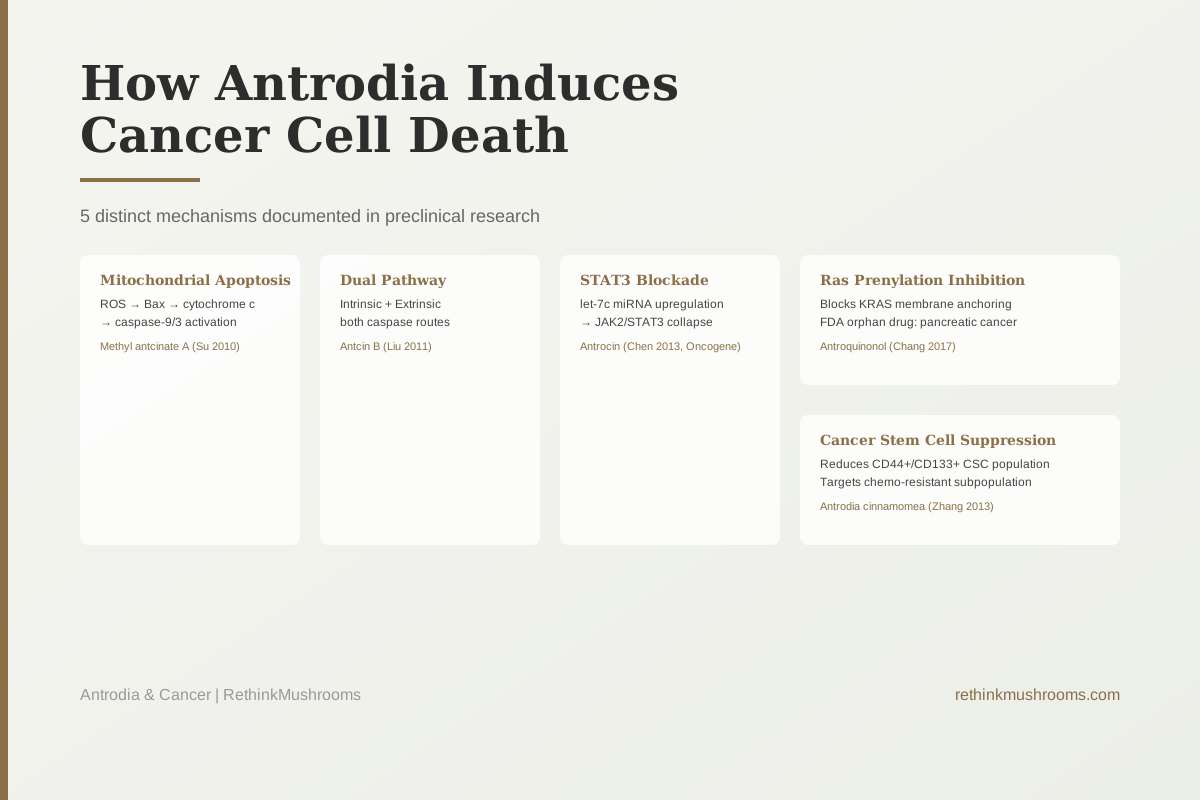
Research has mapped at least five distinct ways Antrodia camphorata compounds trigger cancer cell death, from mitochondrial apoptosis to cancer stem cell suppression. One compound received FDA orphan drug designation based on this preclinical evidence.
Chang et al., Molecular Cancer Therapeutics, 2017
Intrinsic + Extrinsic
both apoptosis pathways activated simultaneously by antcin B in liver cancer cells (Liu 2011)
FDA orphan drug
designation for antroquinonol in pancreatic cancer and AML, based on its Ras-blocking mechanism
Cancer stem cells
the chemotherapy-resistant subpopulation that Antrodia suppresses in colorectal cancer (Zhang 2013)
Chang et al., Molecular Cancer Therapeutics, 2017
 View as image ↗
All the statements that circulate in wellness media about Antrodia camphorata "fighting cancer" are referring to something real. This Taiwanese fungus has been studied in cancer research for more than twenty years, producing a research base that spans cell culture studies, animal models, and two Phase I human trials. The reason researchers kept coming back is that Antrodia's compounds interfere with cancer biology in multiple distinct ways, not through a single mechanism.
This article maps those mechanisms: how each compound class triggers cancer cell death, which molecular switches each one throws, and what the preclinical evidence shows. All evidence cited is preclinical (cell studies and animal models) except where noted. The Phase I human trial data on safety is covered in detail at Antrodia and Cancer: Comprehensive Research Review.
For an introduction to what Antrodia camphorata is and why Taiwan has driven most of its research, see Antrodia camphorata: Taiwan's National Treasure Mushroom and Its Research Base. For a comprehensive guide to its bioactive compound classes, see Antrodia Bioactive Compounds: Antcins, Triterpenoids, and Polysaccharides.
For background on the pillar compound context, see What Is Antrodia camphorata? Taiwan's National Treasure Mushroom.
Key Takeaways
- Antrodia camphorata compounds trigger cancer cell death through at least five distinct mechanisms, which operate on different molecular targets across different cancer types
- The mitochondrial apoptosis pathway (intrinsic pathway) is activated by the fruiting body extract and by methyl antcinate A via ROS generation, cofilin translocation, and Bax upregulation
- Antcin B is unusual in activating both intrinsic (mitochondrial) and extrinsic (death receptor) apoptotic pathways simultaneously in liver cancer cells
- STAT3, a signaling molecule constitutively active in many cancers, is blocked by Antrodia components including antrocin via an epigenetic mechanism (let-7c miRNA targeting JAK2)
- Antroquinonol blocks Ras activation by inhibiting the attachment process Ras proteins need to function, providing a mechanism relevant to KRAS-driven cancers like pancreatic cancer (FDA orphan drug designation)
- Zhang 2013 showed Antrodia suppressed the cancer stem cell subpopulation, the chemotherapy-resistant cells responsible for tumor relapse that conventional chemotherapy largely cannot target
How Cancer Cells Die: The Apoptosis Map
Before examining what Antrodia's compounds do specifically, it helps to understand the territory they are operating in.
Apoptosis is programmed cell death: an orderly sequence in which a cell activates a set of proteins that systematically dismantle it from within. It is one of the body's primary defenses against cancer, and cancer cells typically acquire mutations that allow them to resist it. The end result is that cancer cells that should die instead survive and proliferate.
There are two main routes into apoptosis. The intrinsic route is activated by internal signals: DNA damage, excessive oxidative stress inside the cell, or mitochondrial disruption. When the mitochondria (the cell's energy-producing structures) receive the signal, they release a protein called cytochrome c, which activates a cascade of death-executing enzymes called caspases. The two most relevant are caspase-9 (initiated first) and caspase-3 (the main executor). The balance between Bax (a death-promoting protein) and Bcl-2 (a survival protein) controls whether the mitochondria release this signal.
The extrinsic route is activated by signals from outside the cell, through receptor proteins on the cell surface. When death-signal molecules bind these receptors, they activate a different starting caspase, caspase-8, which then connects to the same downstream execution machinery.
Most Antrodia compounds engage the intrinsic route. One engages both simultaneously.
Mechanism 1: The Mitochondrial Route via ROS
The first identified mechanism for how Antrodia kills cancer cells came from a 2005 study by Chen and colleagues, who applied Antrodia camphorata fruiting body extract to human liver cancer (hepatocellular carcinoma, HCC) cells.[1] The extract triggered a dose-dependent increase in cell death signatures: caspase-9 and caspase-3 activation, fragmentation of DNA into the characteristic sub-G1 pattern, and cleavage of PARP (a repair protein whose destruction marks an irreversible commitment to apoptosis). This was the mitochondrial pathway.
The molecular detail of how this happens for one specific compound came from Su and colleagues in 2010, studying methyl antcinate A, one of the antcin family members.[2] The sequence was: methyl antcinate A generated ROS (reactive oxygen species, the unstable oxygen molecules that cause cellular oxidative damage) inside the cancer cells. This oxidative stress caused a protein called cofilin to migrate from the cytoplasm into the mitochondria. Cofilin's arrival there triggered Bax upregulation and mitochondrial dysfunction, releasing cytochrome c and activating caspase-9 and caspase-3.
The confirmation came when the researchers added NAC, an antioxidant that neutralizes ROS, to the cells alongside methyl antcinate A. The entire cascade stopped. This proved ROS generation was the upstream trigger, not a downstream side effect.
Cancer cells typically operate under higher baseline oxidative stress than normal cells, because they grow and divide rapidly. This metabolic state may be why Antrodia compounds preferentially affect cancer cells: normal cells can compensate for added oxidative stress, while cancer cells may already be at the threshold where additional ROS tips them past the point of no return.
Mechanism 2: Antcin B's Double Attack
Most Antrodia compounds engage either the intrinsic or extrinsic apoptotic pathway. Antcin B engages both simultaneously.
Liu and colleagues showed in 2011 that antcin B, isolated from Antrodia camphorata, activated both caspase-9 (the intrinsic initiator) and caspase-8 (the extrinsic initiator) in HCC cells.[3] Both activated at the same time, both converging on caspase-3 execution. The dual activation was accompanied by a loss of mitochondrial membrane potential, increased ROS, and PARP cleavage.
The significance is not merely redundancy. Cancer cells that have mutations disabling one apoptotic route often retain susceptibility to the other. A compound that activates both simultaneously is harder for mutated cancer cells to evade. Liu's team also found that an ester derivative of antcin B showed enhanced potency compared to the parent compound, suggesting that chemical modification of the antcin scaffold could produce even more effective agents.
Mechanism 3: Blocking STAT3, a Key Cancer Survival Signal
STAT3 is a transcription factor, a protein that sits inside the nucleus and controls which genes are switched on. In most normal cells, STAT3 is only active when specifically needed and then turns off. In many cancers, STAT3 is constitutively active: it stays permanently switched on, continuously driving production of survival proteins including Bcl-xL, survivin, and VEGF (a protein that stimulates tumor blood vessel growth).
Multiple Antrodia components block STAT3 activity. Chen and colleagues confirmed in a 2019 Scientific Reports study that Antrodia cinnamomea extract blocked constitutively active STAT3 in non-small cell lung cancer (NSCLC) cells, downstream of which Bcl-xL, survivin, and VEGF all decreased.[4] When STAT3 is suppressed, the cancer cell loses several simultaneous survival advantages.
The most mechanistically sophisticated version of this effect was published in Oncogene in 2013, one of the highest-impact journals in cancer biology. Chen and colleagues showed that antrocin, a sesquiterpene lactone (a different compound class from the antcins), blocked STAT3 via an epigenetic mechanism.[5]
The sequence: antrocin upregulated let-7c, a microRNA (a tiny genetic molecule) that targets JAK2 mRNA (the instructions for making JAK2, the activating kinase that sits upstream of STAT3). With less JAK2 being produced, there was less JAK2 to activate STAT3. The STAT3 signaling chain collapsed from two steps up its own ladder.
This is not the same as blocking a pathway with a drug that binds directly to the pathway component. Antrocin caused the cancer cell's own gene regulation machinery to turn down the production of a key component. This epigenetic mechanism has different properties from direct inhibition and may be more difficult for cancer cells to develop resistance against.
Mechanism 4: Akt/mTOR Inhibition and the Ras Prenylation Story
Akt/mTOR is a two-step survival signaling chain that many cancers depend on. Akt is a kinase (an enzyme that activates other proteins by adding a phosphate group to them). mTOR sits downstream of Akt and controls cell growth and protein synthesis. When this pathway is hyperactive, cancer cells grow rapidly and resist the normal growth-limiting signals. Drugs that inhibit this pathway are among the most developed in oncology.
Chen and colleagues identified antrocin as a selective Akt/mTOR inhibitor in MDA-MB-231 triple-negative breast cancer cells in a 2011 study.[6] Antrocin inhibited Akt phosphorylation (its activation step), suppressed mTOR downstream, and arrested the cancer cells in G0/G1 (the phase of the cell cycle before DNA replication). Notably, the effect was selective for cancer cells; it was less potent in normal epithelial cells at the same concentrations.
Antroquinonol, another Antrodia compound, blocks a different and particularly clinically significant target: Ras prenylation. Ras proteins are molecular switches that relay growth signals inside cells. To function, Ras must attach itself to the inner surface of the cell membrane, a process called prenylation (adding a fatty anchor). Without this membrane attachment, Ras stays in an inactive form in the cytoplasm rather than at the membrane where it normally relays signals.
Chang and colleagues showed in Molecular Cancer Therapeutics in 2017 that antroquinonol inhibited protein isoprenyltransferase, the enzyme responsible for adding this fatty anchor to Ras proteins.[7] Without prenylation, Ras could not anchor to the membrane and could not relay growth signals. In pancreatic cancer xenograft models (human pancreatic tumor cells implanted in mice), tumor growth was significantly suppressed.
This mechanism is particularly relevant to pancreatic cancer because KRAS, a specific mutated version of Ras, is the primary driver in approximately 90% of pancreatic cancers. The FDA granted antroquinonol orphan drug designation for pancreatic cancer and AML (acute myeloid leukemia) based in part on this preclinical evidence, which represents formal regulatory acknowledgment that the mechanism is compelling enough to warrant clinical investigation.
Mechanism 5: Targeting Cancer Stem Cells
The most differentiated finding in the Antrodia cancer research involves not the main tumor mass but a specific subpopulation within it.
Within most cancers, a small fraction of cells have properties resembling stem cells: they can self-renew indefinitely, generate new tumor cells, and resist most chemotherapy drugs. These cells are identified by surface markers including CD44 and CD133. After chemotherapy kills the bulk of a tumor, these cancer stem cells (CSCs) can survive and regenerate the tumor, which is why many initially responsive cancers relapse.
Zhang and colleagues showed in 2013 that Antrodia cinnamomea extract reduced the growth of colorectal cancer cells AND suppressed the CD44+/CD133+ cancer stem cell population specifically.[8] The self-renewal capacity of the CSC subpopulation was reduced. This is mechanistically distinct from simply killing dividing cancer cells, which is what most chemotherapy drugs do.
Whether Antrodia compounds suppress cancer stem cells through one of the mechanisms already described (STAT3, Akt/mTOR, and ROS are all implicated in CSC biology) or through an independent pathway has not been fully resolved in the preclinical literature. What the Zhang 2013 study established is that the CSC subpopulation is affected, not just the proliferating bulk tumor cells.
The Ca2+ Mechanism in Oral Cancer Cells
Peng and colleagues documented a different upstream trigger in oral squamous cell carcinoma cells: elevated intracellular calcium.[9] At 100-200 µg/mL, Antrodia camphorata extract raised intracellular Ca2+ levels in OC2 human oral cancer cells, triggering apoptosis in a dose-dependent manner. The MAPK pathway proteins (ERK, JNK, and p38) showed altered phosphorylation patterns alongside the cell death.
The calcium mechanism may represent an additional route into cell death relevant to specific cancer cell types where calcium homeostasis is already disrupted.
What This Evidence Shows, and What It Doesn't
The mechanisms described above are all documented in cell cultures or animal models. No study has directly visualized Antrodia compounds triggering these cascades inside tumor cells in a living person. The Phase I clinical trials (Wang 2015 for antroquinonol in NSCLC; Ko 2023 for AC-1101) established human safety and tolerability, not tumor cell killing.
The value of the mechanism research is different from clinical efficacy evidence. It explains why Antrodia deserves continued investigation and why researchers believe the effects observed in cell culture might translate to human tumors. The multi-mechanism pattern is particularly notable: a compound that engages STAT3, another that engages mitochondrial apoptosis, another that blocks Ras prenylation, and another that suppresses cancer stem cells. This is not a single-target story.
For the compound-by-compound breakdown of each antcin variant and its specific targets, see Antcin Compounds and Anti-Cancer Mechanisms and the related anti-inflammatory pathway coverage at Antcin K and NF-kB Inhibition. For cancer-type–specific evidence across liver, lung, and colorectal cancer, see Antrodia and Cancer: Comprehensive Research Review, Antrodia and Lung Cancer: Preclinical Evidence, and Antrodia and Oral Cancer: Research from Taiwan.
The Bottom Line
Antrodia camphorata compounds trigger cancer cell death through at least five distinct mechanisms: mitochondrial (intrinsic) apoptosis via ROS and Bax upregulation; simultaneous activation of both intrinsic and extrinsic apoptotic pathways by antcin B; STAT3 blockade, including an epigenetic mechanism via let-7c miRNA; Akt/mTOR suppression and Ras prenylation inhibition by antroquinonol (FDA orphan drug for pancreatic cancer); and suppression of cancer stem cells, the chemotherapy-resistant subpopulation responsible for tumor relapse. All evidence is preclinical. The mechanistic diversity across compound classes distinguishes Antrodia from single-target compounds and explains the research interest that has carried into Phase I human trials.
Frequently Asked Questions
Sources & References
- 1. Source details for this reference are not yet available.
- 2. Source details for this reference are not yet available.
- 3. Source details for this reference are not yet available.
- 4. Source details for this reference are not yet available.
- 5. Source details for this reference are not yet available.
- 6. Source details for this reference are not yet available.
- 7. Source details for this reference are not yet available.
- 8. Source details for this reference are not yet available.
- 9. Source details for this reference are not yet available.