Antrodia Overview
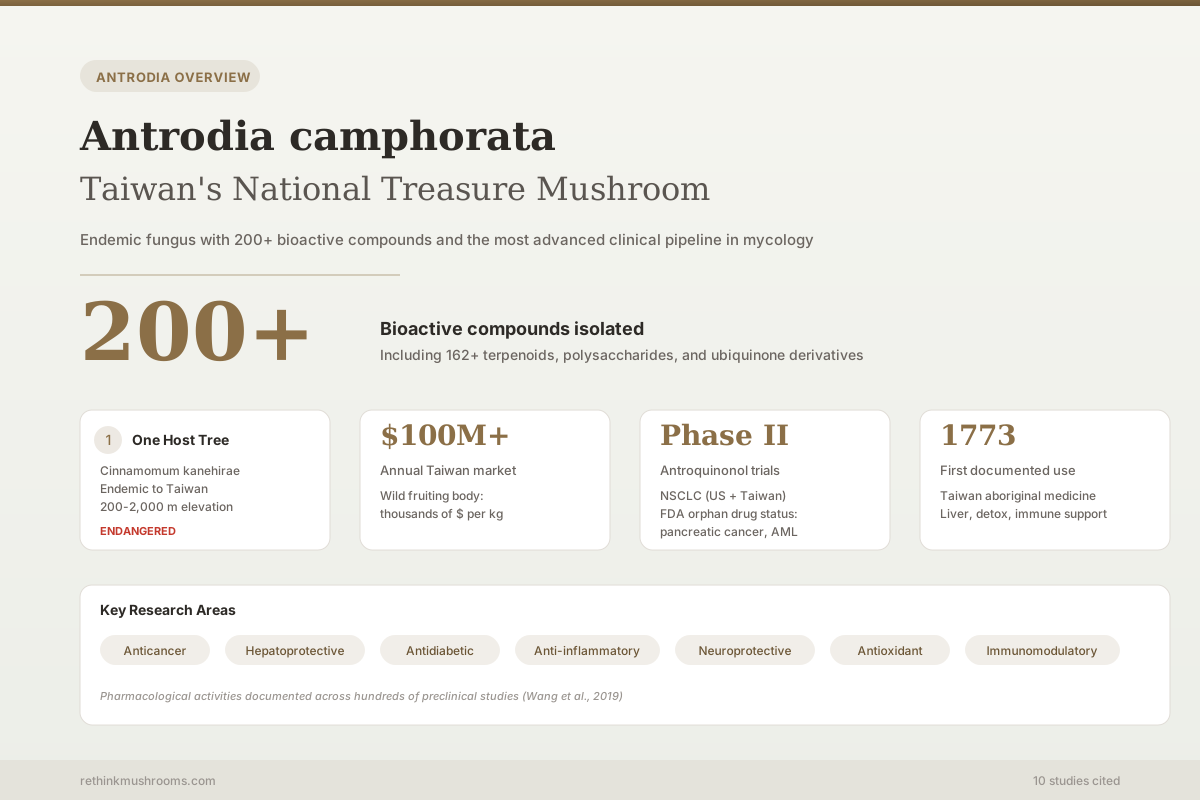
200+ compounds
Over 200 bioactive compounds have been isolated from Antrodia camphorata, including triterpenoids, polysaccharides, and ubiquinone derivatives.
Ganesan et al., Journal of Food Biochemistry, 2019
$100M+
annual Taiwan market
1 Host Tree
Cinnamomum kanehirae (endangered)
Phase II
antroquinonol in clinical trials
Ganesan et al., Journal of Food Biochemistry, 2019
 View as image ↗
Most medicinal mushrooms grow worldwide. Antrodia camphorata grows on exactly one tree species, in one country, on one island. The fungus is a parasite of Cinnamomum kanehirae Hayata, an aromatic camphor tree found only in the broad-leaved forests of Taiwan at elevations between 200 and 2,000 meters.[1] That extreme endemicity, combined with the tree's endangered status and the fungus's slow growth rate, has turned wild Antrodia into one of the most expensive medicinal materials in Asia, with annual sales exceeding $100 million in Taiwan alone. The same scarcity has driven decades of research into artificial cultivation methods and the isolation of individual bioactive compounds, yielding one of the most thoroughly characterized compound libraries in mycology.
Key Takeaways
- Over 200 bioactive compounds have been isolated from Antrodia camphorata, including 162+ terpenoids characterized since 1995 (Kuang et al., 2021)
- The fungus grows exclusively on Cinnamomum kanehirae, an endangered tree species found only in Taiwan's forests at 200-2,000 m elevation
- Wild fruiting body extract showed stronger anti-inflammatory activity than solid-state or liquid-state cultivated forms in a direct comparison (Liu et al., 2007)
- Antroquinonol, the most clinically advanced compound, has reached phase II clinical trials for non-small-cell lung cancer and received FDA orphan drug status for pancreatic cancer
- Annual Taiwan market exceeds $100 million, driving both conservation concern for the host tree and investment in artificial cultivation methods
- Pharmacological activities span anticancer, hepatoprotective, antidiabetic, anti-inflammatory, neuroprotective, antioxidant, and immunomodulatory effects across hundreds of studies (Wang et al., 2019)
A Fungus That Grows on One Tree
Taiwan's indigenous peoples were the first to document Antrodia's medicinal properties. Historical records from 1773 describe Dr. Wu-Sha observing that Taiwan aborigines chewed the fruiting bodies for discomfort caused by excess alcohol or physical exhaustion. From those observations, the fungus entered traditional use for diarrhea, abdominal pain, hypertension, viral infection, liver cirrhosis, and a range of other conditions.[1]
The relationship between Antrodia and its host tree is obligate: the fungus causes brown heart rot in the inner cavity of living Cinnamomum kanehirae. No other tree species supports its growth. This creates a conservation paradox. The demand for Antrodia as medicine has incentivized illegal logging of the host tree, leading Taiwan to place C. kanehirae on its national endangered species list. The camphor tree population has declined steadily, and with it, the wild supply of Antrodia fruiting bodies.
Wild fruiting bodies grow at an extremely slow rate, sometimes taking years to develop a harvestable mass. A single kilogram of wild Antrodia fruiting body can sell for thousands of dollars. This scarcity, rather than dampening interest, has attracted substantial research investment from Taiwan's government and biotech sector. For more on why Antrodia only grows on Taiwanese camphor trees, the host specificity has its own dedicated analysis.
Niu-Chang-Chih: Market and Economic Significance
In Taiwan, Antrodia is known as "niu-chang-chih" (牛樟芝), meaning "bull camphor tree mushroom." The domestic market for Antrodia products exceeds $100 million annually, making it one of the most commercially valuable medicinal fungi globally on a per-kilogram basis. Products range from raw dried fruiting body (the most expensive) to capsules of cultivated mycelium, tinctures, and standardized extracts.
The economic value has created a dual problem. On one side, it drives illegal logging of C. kanehirae to harvest wild Antrodia, threatening both the tree and the fungus. On the other, it has funded substantial research investment: Taiwan's National Science Council, Ministry of Science and Technology, and private biotechnology companies have collectively supported hundreds of studies. Golden Biotechnology, the company developing antroquinonol, has invested in clinical trials that no academic lab could fund independently.
This commercial ecosystem means Antrodia has a more developed translational research pipeline than most medicinal mushrooms. The trade-off is that financial interests intersect with scientific ones in ways that merit scrutiny when evaluating the evidence. For more on the cultural significance of this fungus, see Niu-Chang-Chih: The Rarest and Most Expensive Medicinal Mushroom.
The Naming Problem
The scientific literature uses at least three names for the same organism: Antrodia camphorata, Antrodia cinnamomea, and Taiwanofungus camphoratus. This is not just taxonomic trivia. It complicates literature searches and can cause researchers to miss relevant studies indexed under different names.
The fungus was first described as Ganoderma camphoratum before being reclassified. In 2004, Wu et al. established Taiwanofungus as a new genus based on phylogenetic analysis using nuclear large subunit and internal transcribed spacer sequences, which showed that the genus Antrodia is not monophyletic.[1] The reclassification placed the organism definitively within Fomitopsidaceae, separate from true Antrodia species. The wood-rot basidiomycete belongs to the family Fomitopsidaceae.
In practice, the three names appear interchangeably across the literature. Antrodia camphorata remains the most commonly used in international research. Taiwanofungus camphoratus is the officially accepted name in Taiwan. Antrodia cinnamomea appears frequently in Taiwanese publications. This article uses "Antrodia" or "A. camphorata" for consistency.
200+ Compounds and Counting
The chemical diversity of Antrodia is exceptional for a single fungal species. Geethangili and Tzeng (2011) identified over 78 compounds across six chemical classes: terpenoids, benzenoids, lignans, benzoquinone derivatives, succinic and maleic acid derivatives, and polysaccharides.[2] By 2019, Ganesan et al. reported more than 200 compounds isolated and identified from A. cinnamomea.[3]
The terpenoid fraction dominates. Kuang et al. (2021) catalogued 162 terpenoids including triterpenoids, meroterpenoids, sesquiterpenoids, diterpenoids, and steroids characterized from 1995 onward. Ergostane-type triterpenoids (the antcin family) and meroterpenoids (antroquinonols) are the characteristic constituents not found in other medicinal mushrooms.[4] Terpenoids account for roughly 63% of the compounds found in fruiting bodies.
The polysaccharide fraction is the second major bioactive class. Beta-glucans from Antrodia show immunomodulatory activity through Toll-like receptor and dectin-1 signaling, similar to beta-glucans from other medicinal mushrooms but with structural features specific to this species.[2] Ubiquinone derivatives, particularly antroquinonol, represent a third chemical class with distinct pharmacological profiles from the terpenoids.
Chemical analysis of whole extract reveals the relative abundance of key compounds. Peng et al. (2017) quantified the triterpene profile: antcin K was the most abundant, followed by sulphurenic acid, eburicoic acid, antcin C, dehydrosulphurenic acid, antcin B, and propanoic acid.[5] For a deeper look at the triterpenoid family, see Antrodia Bioactive Compounds: Antcins, Triterpenoids, and Polysaccharides.
The Research Landscape
Wang et al. (2019) published what is arguably the most comprehensive review of Antrodia's pharmacological activities in Applied Microbiology and Biotechnology. The documented activities span: anticancer (breast, cervical, ovarian, prostate, bladder, colorectal, pancreatic, liver, lung cancers, melanoma, leukemia, lymphoma, neuroblastoma, glioblastoma), anti-inflammatory, immunoregulatory, antiobesity, antidiabetic, antihyperlipidemic, antiatherosclerotic, antihypertensive, antioxidative, hepatoprotective, renoprotective, neuroprotective, antiviral, antibacterial, and wound healing.[6]
That list is almost suspiciously broad. The pattern is common in early-stage medicinal mushroom research: a chemically complex extract tested in cell lines and animal models will produce detectable activity across many disease categories. The important questions are which effects are strong enough to be clinically relevant and which compounds are responsible.
Three research areas have attracted the most sustained attention:
Cancer. Antroquinonol, a ubiquinone derivative, is the most clinically advanced compound. Angamuthu et al. (2019) reviewed its pharmacological profile, which includes antiproliferative, anti-inflammatory, and antilipogenic activities across multiple cancer cell lines.[7] It has reached phase II clinical trials for non-small-cell lung cancer (NSCLC) in the US and Taiwan and received FDA orphan drug designation for pancreatic cancer and acute myeloid leukemia. For comprehensive coverage, see Antrodia and Cancer: Comprehensive Research Review.
Liver protection. The traditional use of Antrodia for liver ailments has generated substantial preclinical evidence. The only published human randomized controlled trial tested 420 mg/day of Antrodia mycelium in 28 NASH patients for 6 months, producing measurable improvement in steatosis scores (0.66 to 0.49, p < 0.029) and reduced TNF-α.[8] See Antrodia and Alcohol-Related Liver Damage for the hepatoprotective evidence.
Metabolic syndrome. Multiple triterpenoids (antcin K, ergostatrien-3β-ol, dehydroeburicoic acid) target AMPK, GLUT4, and SREBP pathways. Antcin K at 40 mg/kg/day matched metformin's glucose-lowering effect and fenofibrate's triglyceride reduction in preclinical models.[9] The full metabolic evidence is reviewed in Antrodia and Metabolic Syndrome: Multi-Target Effects.
Wild vs. Cultivated: Does It Matter?
The scarcity of wild Antrodia has driven three major cultivation approaches:
Wild fruiting body grows naturally on C. kanehirae heartwood over months to years. It commands the highest prices and, according to available evidence, produces the most potent extracts.
Solid-state culture grows mycelium on a solid substrate (often grain or wood chips) in controlled environments. This produces a harvestable product within weeks to months.
Liquid-state (submerged) fermentation grows mycelium in liquid culture medium in bioreactors. Incubation takes 7-14 days, making it the most scalable method for industrial production.
Liu et al. (2007) conducted the only direct head-to-head comparison of all three forms using anti-inflammatory activity in microglia cells as the endpoint. The potency ranking was: wild fruiting body > solid-state culture > liquid-state fermentation. Methanol extracts from wild fruiting body inhibited iNOS expression, NF-κB activation, and COX-2 expression more effectively than either cultivated form.[10]
This finding has practical implications. The compounds present in wild fruiting bodies are not identical to those produced in artificial culture. Antroquinonol, for example, is readily produced in solid-state fermentation but not in submerged fermentation.[3] The triterpenoid profiles differ between cultivation methods, which means bioactivity comparisons of "Antrodia extract" across studies need to account for how the material was produced.
Gaps in the Evidence
For a fungus with over 200 characterized compounds and hundreds of published studies, the clinical evidence base is remarkably thin.
Almost no human trials. The vast majority of Antrodia research uses cell lines and rodent models. The NASH trial (n=28) and the phase I antroquinonol trial are the only published human clinical data. Cell culture and animal model results do not reliably predict human outcomes.
Cultivation variability. Different cultivation methods produce different compound profiles. Most studies do not standardize their extracts or report the specific cultivation method and compound concentrations, making cross-study comparison difficult.
Geographic research concentration. Nearly all Antrodia research originates from Taiwan, which is logical given the fungus's endemicity but limits independent replication from other research groups.
Publication bias. The economic importance of Antrodia in Taiwan creates incentive structures that may favor positive results. The absence of large, well-funded, negative studies is notable.
Dose translation. Animal studies use compound doses (10-40 mg/kg of isolated triterpenoids) with no established human equivalents. The relationship between commercially available Antrodia supplement doses and the doses studied in research is unclear.
Despite these gaps, the breadth of preclinical evidence, the identified compound library, and the progression of antroquinonol to phase II trials represent a more advanced research pipeline than most medicinal mushrooms possess. The key missing piece is the clinical validation that would either confirm or refute the preclinical promise. For a broader introduction to this fungus aimed at newcomers, see What Is Antrodia camphorata?.
The Bottom Line
Antrodia camphorata is a medicinal fungus endemic to Taiwan that grows exclusively on the endangered camphor tree Cinnamomum kanehirae. Over 200 bioactive compounds have been isolated, with triterpenoids (antcins) and meroterpenoids (antroquinonols) as characteristic constituents. Preclinical evidence spans anticancer, hepatoprotective, antidiabetic, anti-inflammatory, and neuroprotective activities. Antroquinonol has progressed to phase II clinical trials for lung cancer. Wild fruiting body extracts appear more potent than cultivated forms in direct comparisons. Clinical evidence remains thin, with only one small RCT published for metabolic/liver endpoints.
Frequently Asked Questions
Sources & References
- 1RTHM-00274·Yue, Patrick Ying-Kit et al. (2012). “Review of biological and pharmacological activities of the endemic Taiwanese bitter medicinal mushroom, Antrodia camphorata (M. Zang et C. H. Su) Sh. H. Wu et al. (higher Basidiomycetes)..” International journal of medicinal mushrooms.Study breakdown →PubMed →↩
- 2RTHM-00214·Geethangili, Madamanchi et al. (2011). “Review of Pharmacological Effects of Antrodia camphorata and Its Bioactive Compounds..” Evidence-based complementary and alternative medicine : eCAM.Study breakdown →PubMed →↩
- 3RTHM-00555·Ganesan, Nagarajan et al. (2019). “Antrodia cinnamomea-An updated minireview of its bioactive components and biological activity..” Journal of food biochemistry.Study breakdown →PubMed →↩
- 4RTHM-00695·Kuang, Yi et al. (2021). “Terpenoids from the medicinal mushroom Antrodia camphorata: chemistry and medicinal potential..” Natural product reports.Study breakdown →PubMed →↩
- 5RTHM-00487·Peng, Chiung-Huei et al. (2017). “Antrodia cinnamomea Prevents Obesity, Dyslipidemia, and the Derived Fatty Liver via Regulating AMPK and SREBP Signaling..” The American journal of Chinese medicine.Study breakdown →PubMed →↩
- 6RTHM-00591·Wang, Caicheng et al. (2019). “Diversity of potentially exploitable pharmacological activities of the highly prized edible medicinal fungus Antrodia camphorata..” Applied microbiology and biotechnology.Study breakdown →PubMed →↩
- 7RTHM-00542·Angamuthu, Venkatachalam et al. (2019). “Pharmacological activities of antroquinonol- Mini review..” Chemico-biological interactions.Study breakdown →PubMed →↩
- 8RTHM-00681·Chiou, Ya-Ling et al. (2021). “Hepatoprotective Effect of Antrodia cinnamomea Mycelium in Patients with Nonalcoholic Steatohepatitis: A Randomized, Double-Blind, Placebo-Controlled Trial..” Journal of the American College of Nutrition.Study breakdown →PubMed →↩
- 9RTHM-00430·Kuo, Yueh-Hsiung et al. (2016). “Antcin K, a Triterpenoid Compound from Antrodia camphorata, Displays Antidiabetic and Antihyperlipidemic Effects via Glucose Transporter 4 and AMP-Activated Protein Kinase Phosphorylation in Muscles..” Evidence-based complementary and alternative medicine : eCAM.Study breakdown →PubMed →↩
- 10RTHM-00119·Liu, Der-Zen et al. (2007). “Comparative anti-inflammatory characterization of wild fruiting body, liquid-state fermentation, and solid-state culture of Taiwanofungus camphoratus in microglia and the mechanism of its action..” Journal of ethnopharmacology.Study breakdown →PubMed →↩