Antrodia camphorata
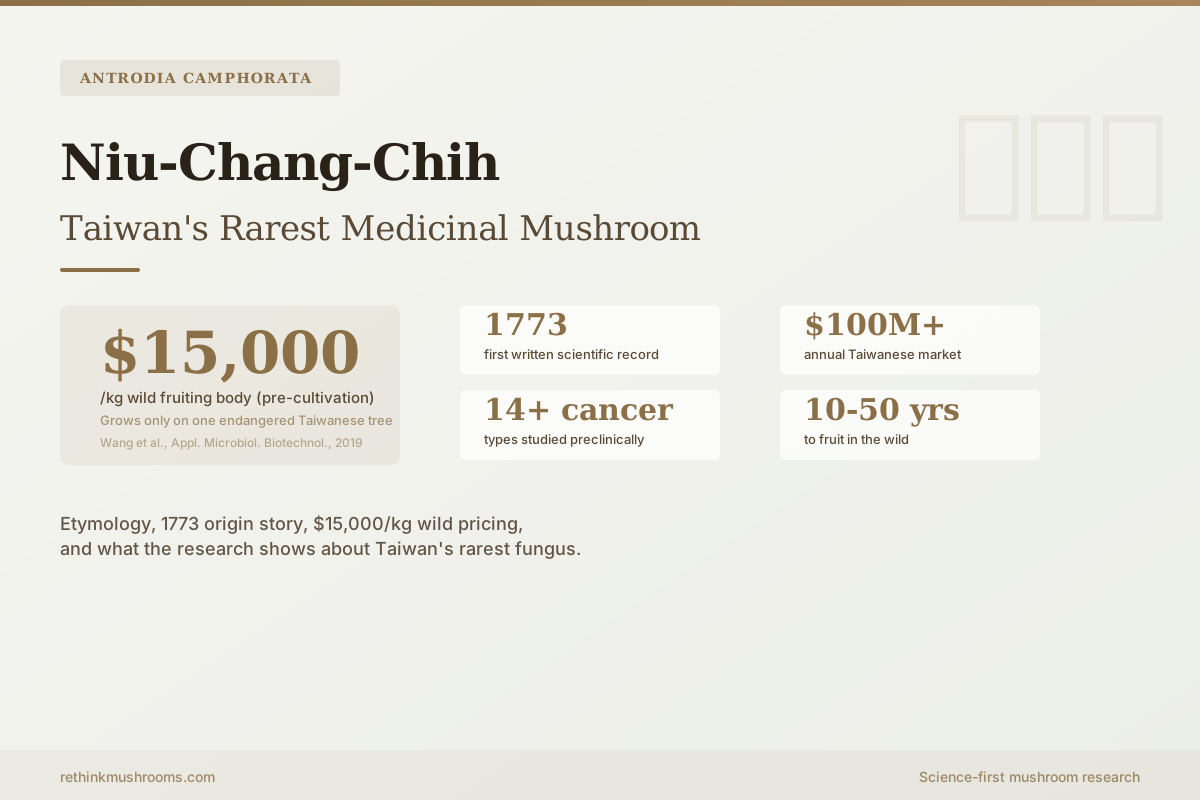
$15,000/kg wild fruiting body
Wild niu-chang-chih once sold for up to $15,000 per kilogram — the price of a fungus that grows only on one endangered tree species found only in Taiwan.
Wu, Ryvarden & Chang, Bot. Bull. Acad. Sin., 1997
1773
year of first written scientific record of traditional use
14+
cancer types studied preclinically (Wang et al., 2019)
$100M+
annual Taiwanese niu-chang-chih market at peak
Wu, Ryvarden & Chang, Bot. Bull. Acad. Sin., 1997
 View as image ↗
In 1773, a naturalist named Dr. Wu-Sha recorded something notable in Taiwan's mountain forests: Aboriginal hunters from the Atayal and Bunun tribes had long harvested a bitter, rare fungus from the inner heartwood of ancient camphor trees to treat liver complaints after heavy alcohol consumption. They called it niu-chang-chih. Nobody outside Taiwan had heard of it.
Two and a half centuries later, that same niu-chang-chih mushroom (牛樟芝) sells for up to $15,000 per kilogram in wild-harvested form and has generated hundreds of published studies examining its pharmacological properties. It remains the most extensively researched endemic medicinal fungus in Asia — and it grows nowhere on Earth except Taiwan.
This article covers the etymology and cultural history of niu-chang-chih, what the research documents about its biological effects, and why the ecological constraints that make it rare also shape its chemical profile. For the broader scientific overview of the species, its bioactive compounds, and the full research landscape, see What Is Antrodia camphorata? Taiwan's National Treasure Mushroom.
Key Takeaways
- Niu-chang-chih (牛樟芝) translates as "sacred fungus of the massive camphor tree": niu (牛) describes the tree's enormous size, chang (樟) identifies the camphor tree host, and chih (芝) places the fungus in the classical Chinese category of revered medicinal fungi — the same category as reishi (líng zhī)
- Aboriginal Atayal and Bunun tribes in Taiwan used niu-chang-chih for liver protection after alcohol consumption for generations before any scientific documentation; the first written record was made by Dr. Wu-Sha in 1773
- Huang et al. (2010) confirmed the traditional use in a preclinical study titled "Fruiting Body of Niuchangchih Protects Livers Against Chronic Alcohol Consumption Damage" — direct experimental validation of the 1773 observation
- Wild fruiting bodies sold for up to $15,000/kg before commercial cultivation was viable; cultivated mycelium now runs $100-$500/kg, but Lin et al. (2011) showed that camphor-tree-grown fruiting bodies produce a richer profile of the characteristic triterpenoids (the antcin class) than fruiting bodies grown on other wood substrates
- Wang et al. (2019) reviewed 100+ studies finding pharmacological evidence spanning liver protection, metabolic syndrome, neuroprotection, immune modulation, and preclinical cancer research across 14+ cancer types
- Cinnamomum kanehirae (the native camphor tree) has been a legally protected species in Taiwan since 2013, partly due to illegal logging driven by demand for the fungus growing inside
What the Three Characters 牛樟芝 Mean — and Why the Bull Refers to a Tree
The name niu-chang-chih is three Chinese characters, and each carries meaning that tells the mushroom's story.
牛 (niu, pronounced "nyoo") means bull or cow. In ordinary modern Mandarin, it refers to cattle. In the traditional naming context, the character was used to convey something enormous, ancient, and powerful. Here it describes the host tree: the Taiwan stout camphor tree (Cinnamomum kanehirae), which can reach 20 meters in height and live for over a thousand years. The largest specimens have trunks wide enough that several adults cannot encircle them with linked arms. The 牛 is the tree, not an animal.
樟 (chang, pronounced "chahng") means camphor. It identifies the host directly: the Cinnamomum kanehirae of Taiwan's mountain forests, known in Chinese simply as niuzhang. There are many camphor species across Asia, but Antrodia grows only on this specific one. The more common Cinnamomum camphora of mainland China, and other Cinnamomum relatives, do not produce the host-specific chemical signals that trigger Antrodia's full growth cycle and bioactive compound production. The 樟 is not generic — it points to this particular tree on this particular island.
芝 (zhī, romanized in older transliterations as chih) is the culturally weightiest of the three characters. In classical Chinese botanical and medical texts, 芝 designated a category of sacred, long-lived, highly potent fungi prized for their medicinal and sometimes spiritual properties. The same character appears in líng zhī (靈芝) — the name for Ganoderma lucidum, the reishi mushroom. The 芝 classification carried connotations of longevity, medical prestige, and spiritual potency across centuries of Chinese herbalism. Being called a 芝 placed niu-chang-chih in the highest tier of medicinal fungi before any modern research had been done.
Taken together: niu-chang-chih means something close to "the sacred fungus of the great camphor tree." The name is simultaneously ecological and cultural — it identifies the host, communicates the tree's scale, and positions the fungus within the millennia-long tradition of revered medicinal fungi.
The fungus carries several other names in current usage. Antrodia camphorata is the most common scientific name; Antrodia cinnamomea is an accepted synonym that emphasizes the Cinnamomum host; and Taiwanofungus camphoratus is a separate genus name proposed in 2004 to reflect the species' unique ecological and chemical character. All three scientific names refer to the same organism.
1773: The Oldest Written Record of a Fungus Used for Generations Before That
In 1773, Dr. Wu-Sha became the first person to commit to writing what Atayal and Bunun people in Taiwan's mountains had been doing for generations: harvesting a bitter, rust-colored fungus from the hollow interiors of ancient camphor tree trunks to treat liver distress from heavy drinking.
The traditional preparation was specific. Dried chunks of the fruiting body were soaked in rice wine or brewed as a tea. The preparation was consumed after drinking sessions or during recovery from alcohol-related illness. Among mountain-dwelling aboriginal communities who had little access to Chinese medicine practitioners, this fungus was a primary remedy for one of the most common health problems they faced.
This is not an account of a fungus used as a general tonic or a vaguely defined traditional remedy. The recorded use was targeted: liver, alcohol, distress. That specificity matters for how the modern research should be read.
Huang et al.'s 2010 study in the Journal of Agricultural and Food Chemistry is notable partly for its title: "Fruiting Body of Niuchangchih (Antrodia camphorata) Protects Livers Against Chronic Alcohol Consumption Damage."[1] The study used the traditional name alongside the Latin classification, a rare choice in scientific publishing that underscores the cultural context. In a rodent model of chronic alcohol consumption, fruiting body extracts reduced oxidative stress markers and protected liver tissue from alcohol-induced damage.
The traditional use and the 2010 preclinical result are not coincidentally aligned — both concern liver protection from alcohol, measured by markers of oxidative damage. This kind of ethnobotanical validation, where modern science confirms a specific traditional claim rather than a vague one, is relatively uncommon in the medicinal mushroom literature. For a detailed look at how the hepatoprotective research has developed from this foundation, see Antrodia and Alcohol-Related Liver Damage: Research Review.
Why Wild Niu-Chang-Chih Once Sold for $15,000 per Kilogram
Wild niu-chang-chih fruiting bodies sold for up to $15,000 per kilogram in Taiwan in the years before commercial cultivation was viable. That price was not speculation or marketing. It reflected genuine scarcity produced by a very specific set of biological constraints.
The fungus grows exclusively on the inner heartwood of Cinnamomum kanehirae. The tree must be large and old — typically a mature specimen that has stood for decades to centuries, with a heartwood cavity large enough to house the fungus. Wild Antrodia fruiting bodies develop with extreme slowness in nature: producing a visible fruiting body on a camphor tree trunk can take 10 to 50 years. The fungus colonizes dead or dying heartwood at elevations between roughly 450 and 2,000 meters in Taiwan's mountain forests — a constrained elevation range on an island measuring 36,000 square kilometers in total.
Three scarcity constraints operate simultaneously. First: the only qualifying host (Cinnamomum kanehirae) is itself uncommon and found nowhere outside Taiwan. Second: the fungus takes decades to fruit, making every wild specimen essentially irreplaceable on a human timescale. Third: harvest removes the fruiting body permanently. No cultivation or reseeding strategy could restore it.
The legal dimension added further constraint. Commercial demand for niu-chang-chih created significant pressure on the already-rare camphor tree. Illegal logging of ancient Cinnamomum kanehirae — specifically to sell the Antrodia growing inside the heartwood — was a documented conservation problem across the 1990s and 2000s. Taiwan listed the species for legal protection in 2013, after which wild harvest became heavily restricted. For the detailed ecological explanation of why Antrodia is uniquely dependent on this tree, including the host-factor chemistry that no other wood can replicate, see Why Antrodia Only Grows on Taiwanese Camphor Trees.
The result was a product that was genuinely finite in wild form: bound to a single host species, found on a single island, requiring decades to produce, and legally protected from collection. The $15,000/kg price was an accurate signal of that reality.
What 100+ Studies Across 20 Years of Research Have Found
The pharmacological research on niu-chang-chih has developed into one of the largest bodies of work on any single endemic medicinal fungus in Asia.
Geethangili and Tzeng's 2011 review in Evidence-Based Complementary and Alternative Medicine synthesized early research across liver protection, anti-cancer activity, anti-inflammatory effects, immune modulation, antioxidant activity, and metabolic effects.[2] The review cataloged the characteristic bioactive compound classes: antcins (ergostane-type triterpenoids), antroquinonols (meroterpenoids), polysaccharides, and phenolic compounds. Antcins are particularly distinctive — they represent a structural class not found in any other mushroom genus. The group includes antcin A through K, each with a slightly different molecular structure and corresponding biological activity profile.
Wang et al.'s 2019 review in Applied Microbiology and Biotechnology — one of the most comprehensive assessments of the research to date — synthesized over 100 studies and documented preclinical evidence across 14 cancer types, alongside research into liver protection, neuroprotection, cardiovascular effects, metabolic syndrome, and antimicrobial activity.[3] The title's phrase "highly prized edible medicinal fungus" connects the research value to the market value — both are real.
The cancer research, while extensive in preclinical models, remains at an early stage in terms of human clinical evidence. The mechanistic evidence for anti-cancer compounds is detailed (apoptosis induction, NF-κB pathway inhibition, Nrf2 pathway activation), but no randomized clinical trials have confirmed cancer treatment effects in humans. This is an important limitation that the research breadth does not resolve. For the specific cancer research, see Antrodia and Cancer: Comprehensive Research Review, and for antcin mechanisms specifically, see Antcin Compounds and Anti-Cancer Mechanisms.
The liver protection evidence is the most clinically grounded area, partly because it is the oldest research thread, partly because animal models of alcohol-induced liver damage are well-validated, and partly because Huang et al.'s 2010 fruiting body study provided a strong preclinical anchor for the traditional claim.[1]
Why Camphor Wood Determines Bioactive Potency: The Substrate Data
The question of whether camphor-tree-grown niu-chang-chih is meaningfully different from cultivated alternatives has a published scientific answer, and the answer is: the substrate matters.
Lin et al.'s 2011 study in the Journal of Agricultural and Food Chemistry analyzed metabolite profiles of Antrodia fruiting bodies grown on different wood substrates, harvested at different ages.[4] The fruiting bodies grown on native Cinnamomum kanehirae camphor wood produced the richest array of these ergostane-type triterpenoids — the antcin class — of all substrates tested; fruiting bodies grown on other wood species yielded a measurably sparser metabolite profile. Harvest age was the second key variable: the triterpenoid content increased with fruiting body maturity, which is one reason wild specimens that have fruited over decades are prized over artificially cultivated younger fruiting bodies.
The antrodia-bioactive-compounds article explores what this means chemically in more depth. For the purposes of understanding the price premium: the Lin 2011 data means that the camphor tree is not merely a habitat for Antrodia — the specific chemical composition of camphor heartwood is the environmental trigger that drives the fungus to produce its most characteristic and highest-concentration compounds. An Antrodia product grown on a different substrate is not the same product grown on a worse substrate. It is a chemically distinct product. See Antrodia Bioactive Compounds: Antcins, Triterpenoids, and Polysaccharides for the compound-level details.
From $15,000/kg Wild to the Modern Cultivated Market
Geng et al.'s 2013 study in Applied Microbiology and Biotechnology established a critical step forward for cultivation science: Antrodia can sporulate asexually in submerged liquid culture.[5] This finding — that the fungus can complete a growth cycle without the camphor tree host in a controlled liquid fermentation environment — opened the door to commercial-scale production. Submerged culture still produces slowly by agricultural standards, but it produces at a cost fundamentally different from wild harvest.
The price arc that followed is now largely complete:
Before cultivation technology was viable (roughly pre-2000), wild fruiting body was essentially the only commercial form. The $15,000/kg price reflected genuine irreplaceability.
As liquid-state fermentation became established, mycelium-based products entered the market at $100 to $500 per kilogram. Accessible but chemically different from the wild fruiting body, given the Lin 2011 substrate data.
Solid-state cultivation on camphor-derived wood substrates developed as a middle path: slower than liquid fermentation, less bioactively distinct from wild than liquid culture mycelium, but still not identical to a fruiting body that developed over decades on a living camphor tree.
Wild fruiting body, now legally restricted, still commands the highest prices in specialist Taiwanese markets. The substrate data provides the scientific rationale for why: camphor-specific host factors that liquid culture cannot replicate are responsible for the richest triterpenoid profiles documented in the published substrate comparisons.
The Price Collapse
From $15,000/kg Wild to $100–500/kg Cultivated
Cultivation technology did not lower the price of the wild fungus — it created cheaper substitutes. Wild fruiting body still commands the top of the market, because the camphor-tree host produces compounds no other substrate fully replicates.
Bars are log-scaled across the $100–$15,000/kg range to show the order-of-magnitude drop in one view. The solid-state tier is an intermediate, variable premium — no single published figure fixes it, so its bar is shown qualitatively between the two anchored prices.
Sources: wild price — Wu, Ryvarden & Chang (1997); cultivation milestone — Geng et al. (2013); substrate-quality basis — Lin et al. (2011).
The Taiwanese market for niu-chang-chih products — spanning liquid extracts, capsule supplements, solid-state fruiting body products, and fermented beverages — has been estimated to exceed $100 million per year at its peak. The supply chain is almost entirely Taiwan-based. Cultivation knowledge developed in Taiwanese academic and commercial labs, the host tree is found only on the island, and most commercial products are manufactured there. This geographic concentration is part of why the product remains relatively expensive even in cultivated form: there is no equivalent sourcing geography anywhere else in the world.
The Bottom Line
Niu-chang-chih (牛樟芝) is Taiwan's only endemic medicinal fungus of major commercial significance. It grows exclusively on the inner heartwood of Cinnamomum kanehirae, a protected tree found only in Taiwan, and produces a unique class of triterpenoids called antcins that are not found in any other mushroom genus. Aboriginal use recorded since 1773 focused on liver protection after alcohol consumption — a use that Huang et al. (2010) confirmed preclinically. Wild fruiting bodies once reached $15,000/kg; commercially cultivated alternatives are now widely available, though Lin et al. (2011) documented that camphor-tree-grown fruiting bodies produce a richer triterpenoid (antcin) profile than fruiting bodies grown on other substrates.
Frequently Asked Questions
Sources & References
- 1RTHM-00184·Huang, Chia-Hsin et al. (2010). “Fruiting body of Niuchangchih (Antrodia camphorata) protects livers against chronic alcohol consumption damage..” Journal of agricultural and food chemistry.Study breakdown →PubMed →↩
- 2RTHM-00214·Geethangili, Madamanchi et al. (2011). “Review of Pharmacological Effects of Antrodia camphorata and Its Bioactive Compounds..” Evidence-based complementary and alternative medicine : eCAM.Study breakdown →PubMed →↩
- 3RTHM-00591·Wang, Caicheng et al. (2019). “Diversity of potentially exploitable pharmacological activities of the highly prized edible medicinal fungus Antrodia camphorata..” Applied microbiology and biotechnology.Study breakdown →PubMed →↩
- 4RTHM-00225·Lin, Ting-Yu et al. (2011). “Metabolite profiles for Antrodia cinnamomea fruiting bodies harvested at different culture ages and from different wood substrates..” Journal of agricultural and food chemistry.Study breakdown →PubMed →↩
- 5RTHM-00285·Geng, Yan et al. (2013). “Antrodia camphorata ATCC 200183 sporulates asexually in submerged culture..” Applied microbiology and biotechnology.Study breakdown →PubMed →↩