Antrodia camphorata
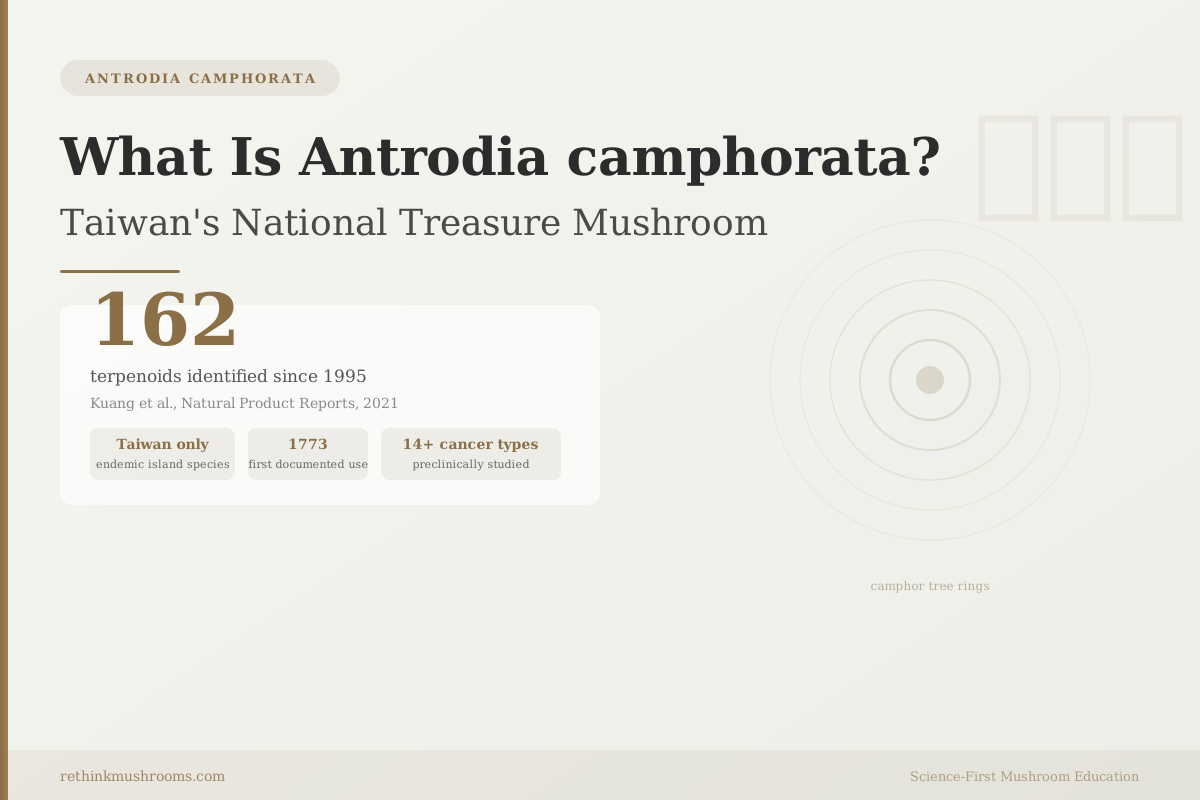
162 terpenoids identified in a single fungal species
No other medicinal mushroom has produced a compound library this diverse from one species. Antrodia's most distinctive class, the antcins, are ergostane-type triterpenoids known only from the genus Antrodia.
Kuang et al., Natural Product Reports, 2021
Taiwan only
endemic to a single island, growing exclusively on Cinnamomum kanehirae heartwood
1773
year Wu Sha, a Han pioneer in Yilan, first obtained the fungus in trade with Taiwanese aborigines
14 cancer types
number named in the anticancer section of the 2019 pharmacology review — all of it cell and animal work (Wang et al., 2019)
Kuang et al., Natural Product Reports, 2021
 View as image ↗
In Taiwan, a fungus grows inside dead camphor trees on mountain slopes between roughly 450 and 2,000 meters elevation. It grows nowhere else on Earth. A wild fruiting body takes years to develop, and before cultivation methods existed, premium wild specimens were reported at up to US$15,000 per kilogram. Taiwanese indigenous communities had been using it for the aftermath of drinking and for food and drug intoxication long before anyone characterized its chemistry.
This is Antrodia camphorata, also called niu-chang-chih (牛樟芝) in Mandarin, and its research profile is unlike any other medicinal mushroom. Most of the major fungal species in Western supplement markets — lion's mane, reishi, cordyceps, shiitake — were first studied by Japanese and Chinese researchers and then moved into global research. Antrodia followed a different path. It remained largely exclusive to Taiwanese science for decades, accumulated an enormous domestic research base, became Taiwan's most studied medicinal fungus, and has only recently entered broader international awareness.
Antrodia camphorata (also published as Antrodia cinnamomea and Taiwanofungus camphoratus) is a medicinal mushroom found only in Taiwan, growing on the inner heartwood of the endangered camphor tree Cinnamomum kanehirae. It is among the most studied medicinal fungi in Asia, with 162 terpenoids identified and documented preclinical activity across liver protection, immune modulation, cancer biology, and neuroprotection. The first recorded acquisition by a Han settler dates to 1773.
That last distinction matters more than it looks, and it runs through this whole article. Antrodia's preclinical literature runs to several hundred papers. Its human literature runs to five studies. Keeping those two numbers separate is the single most useful thing a reader can do with this mushroom.
Key Takeaways
- Antrodia camphorata is endemic to Taiwan and found nowhere else on Earth, growing on the inner heartwood of Cinnamomum kanehirae (Taiwan stout camphor tree) in mountain forests at roughly 450-2,000 meters
- Taiwanese aboriginal communities used niu-chang-chih for hangover, food and drug intoxication, and fatigue long before 1773; that year marks not a scientific study but the first recorded acquisition by a Han settler, Wu Sha, trading with aborigines in Yilan
- A 2021 review in RSC Natural Product Reports cataloged 162 terpenoids characterized in Antrodia camphorata since 1995, spanning triterpenoids, meroterpenoids, sesquiterpenoids, diterpenoids and steroids (Kuang et al., 2021)
- The antcins are ergostane-type triterpenoids known only from the genus Antrodia — twelve are named (A-I, K, M, N), alongside twelve epimers and seven methyl analogs — and they occur in A. salmonea as well as A. cinnamomea, so they are genus-restricted rather than species-unique (Senthil Kumar et al., 2020)
- Camphor-tree chemistry does boost Antrodia's output, but through two separately demonstrated routes: a polysaccharide fraction from C. camphora (Hsu et al., 2006) and the monoterpenes linalool and α-pinene from the true host C. kanehirae (Luo et al., 2023). Neither study shows the fungus cannot grow without the tree
- Wild fruiting body outperformed both solid-state culture and liquid-state fermentation on anti-inflammatory activity in microglia, in that order (Liu et al., 2007)
- The entire human record is five studies: two randomized trials, two phase I trials, and one EFSA safety opinion. The larger randomized trial, in advanced cancer, found no survival or disease-control benefit (Tsai et al., 2016)
What Actually Happened in 1773
The name niu-chang-chih (牛樟芝) breaks into three characters. Niu (牛) means bull or ox, and here it points to the massive scale of the host tree: the Taiwan stout camphor tree grows to extraordinary size. Chang (樟) means camphor. Chih (芝) is the classical Chinese character for a sacred or medicinal fungus, the same character used in lingzhi (reishi). Together: "the sacred fungus of the bull camphor tree."
The date 1773 attaches to that name in nearly every account of this mushroom, and it is almost always described wrongly — including in earlier versions of this article. It is not the year a scientist documented the fungus, and Wu Sha was not a researcher or a physician. Wu Sha was a Han Chinese pioneer active in the Yilan area of northeastern Taiwan, and 1773 is the year he is recorded as having obtained niu-chang-chih through trade with aboriginal communities. He was the first person of Han descent recorded doing so.
The distinction is worth holding onto because it changes what the date is evidence of. It is not evidence that the fungus worked. It is evidence that indigenous use was already well established by the late eighteenth century — established enough to be worth trading for. Aboriginal communities used it for hangover and the after-effects of drinking, for food and drug intoxication, for diarrhea and abdominal pain, and for fatigue. Yue and colleagues, in their 2012 review, record the same traditional indications: liver disease and protection from food and drug intoxication.[3]
Modern work on that traditional use came much later. Huang and colleagues published a 2010 study whose title preserved the traditional name: "Fruiting body of Niuchangchih (Antrodia camphorata) protects livers against chronic alcohol consumption damage."[1] This was a rat study. Alcoholic fatty liver was induced with 20% alcohol drinking water, and treatment groups received either the reference drug silymarin at 0.25 g/kg body weight or Antrodia fruiting body at 0.025 or 0.1 g/kg. At the higher dose, Antrodia reduced hepatic lipids, increased fecal cholesterol and bile acid output, downregulated the lipid-synthesis genes HMG-CoA reductase, SREBP-1c, acetyl-CoA carboxylase and fatty acid synthase, raised liver glutathione and the antioxidant enzymes superoxide dismutase, catalase and glutathione peroxidase, lowered the oxidative-damage marker malondialdehyde, and lowered serum AST with no lesions on histology.
For the full story of the niu-chang-chih name, its etymology, price history and traditional-use record, see niu-chang-chih: the rarest and most expensive medicinal mushroom.
An Island Endemic: Found Nowhere Else on Earth
Antrodia camphorata is what biologists call a strict endemic. It is not rare in the way that some species are rare while technically growing on several continents. It does not exist outside Taiwan. Not in China, not in Japan, not in any other country with camphor tree populations.
Yue and colleagues, reviewing the biology and pharmacology of Antrodia in the International Journal of Medicinal Mushrooms in 2012, describe it as an extremely rare fungus native to Taiwan's forested regions, used by Taiwanese aborigines for liver disease and intoxication.[3] It colonizes the inner heartwood of dead or dying Cinnamomum kanehirae trees; the elevation band usually reported for those forests runs from about 450 to 2,000 meters. Antrodia is a brown-rot fungus, which is why affected camphor trees develop a characteristic brown, crumbly interior.
The restriction to one host species on one island has two practical consequences. First, natural supply is inherently limited. Second, the host tree is itself in trouble. Cinnamomum kanehirae was heavily logged through the twentieth century and then selectively cut to reach the fungus growing inside it. Taiwan has since designated it a protected conservation species and prohibited its felling, which makes wild harvest of the fungus effectively illegal. Illegal logging nonetheless persists. The combination of a single-island range, a slow-developing fruiting body, and a protected host is what pushed wild Antrodia to prices reported at up to US$15,000 per kilogram in the pre-cultivation era.
What the Camphor Tree's Chemistry Actually Does
The ecological specificity goes deeper than habitat preference, but the popular version of this story overshoots badly. The common claim is that a 2006 study identified camphane-type monoterpenes and phenolics in camphor heartwood that switch on antcin production, and that without them the fungus cannot make its characteristic compounds. That is not what the study found, and the "cannot" is not supported by any study.
Two separate pieces of work established two separate host-factor chemistries, seventeen years apart, on two different tree species.
Two Host Factors, Two Chemistries
The Tree Does Not Send One Signal — It Sends At Least Two
Popular accounts compress this into a single discovery: camphor heartwood terpenes switch on antcin production. The literature is messier and more interesting. Two studies, seventeen years apart, on two different tree species, found two chemically unrelated host factors — a polysaccharide and a pair of monoterpenes — that both push the fungus toward making more terpenoids.
Cinnamomum camphora
Hsu and colleagues, 2006 · the common camphor tree — a relative of the native host, not the native host itself
Active host factor
A polysaccharide
The growth-promoting activity tracked to the polysaccharide fraction, active between 80 and 320 mg/L. Size-exclusion and anion-exchange analysis put its molecular weights at 728.2, 187.5, 28.7, 7.5 and 1.9 kDa, with galactosamine, mannose and glucose as the major monosaccharides.
What it did
Mycelial growth rose from 2.88 g/L to 5.50 g/L over a 14-day culture. Prolonged incubation with the water-soluble extract raised two lanostane-type compounds — dehydrosulphurenic acid and 15α-acetyl-dehydrosulphurenic acid — both of which occur in wild fruiting bodies.[4]
Reach: Identifies a sugar-based host factor from a related tree. It did not test Cinnamomum kanehirae, and it did not measure antcins.
Cinnamomum kanehirae
Luo and colleagues, 2023 · the native host — the tree Antrodia actually colonises in the wild
Active host factor
Monoterpenes
A methanol extract of C. kanehirae trunk (MECK) contained 27 monoterpenes and 16 sesquiterpenes. The two most abundant, linalool and α-pinene, were isolated and tested individually.
What it did
MECK at 2 g/L drove triterpenoid production to 115.6 mg/L. Linalool and α-pinene each raised terpenoid output and shifted the mRNA expression of nine key mevalonate-pathway genes, measured by RT-qPCR.[5]
Reach: Demonstrates a terpene-based host factor from the true host, with a named pathway. It is submerged fermentation with an extract — not a fungus growing inside a standing tree.
The 93 terpenoids found in host-extract-treated mycelia
Antrodia camphorata grown in submerged culture with 2 g/L of C. kanehirae trunk extract. Twenty-one of the 93 are the same terpenoids found in wild fruiting bodies — which is the closest anyone has come to reproducing the wild chemical profile without the tree.[5]
Upregulated
49 of 93
Already present, but produced in greater abundance once host extract was supplied
Newly formed
8 of 93
Not detected at all until the host extract was added
Unchanged
36 of 93
Detected in treated mycelia without a reported increase
Neither study shows that the host tree is chemically irreplaceable. Both show the opposite in a narrow sense — the active factors were extracted, moved into a fermenter, and still worked. What no one has yet reproduced is the full wild profile, and that gap is where the price premium lives.
Polysaccharide fraction and growth figures from ref [4]; extract composition, terpenoid counts and pathway genes from ref [5]
Hsu and colleagues, publishing in the International Journal of Food Microbiology in 2006, worked with Cinnamomum camphora — the common camphor tree, a relative of the true host rather than the host itself.[4] They traced the hyphal growth-promoting activity to the polysaccharide fraction, active between 80 and 320 mg/L, with galactosamine, mannose and glucose as its major sugars. Mycelial growth rose from 2.88 g/L in controls to 5.50 g/L over a 14-day culture, and prolonged incubation raised two lanostane-type compounds, dehydrosulphurenic acid and 15α-acetyl-dehydrosulphurenic acid, both of which occur in wild fruiting bodies. No monoterpenes, no phenolics, and no antcins were measured.
The monoterpene half of the story is real, but it belongs to Luo and colleagues in 2023, working on the actual native host.[5] A methanol extract of C. kanehirae trunk contained 27 monoterpenes and 16 sesquiterpenes; at 2 g/L it drove triterpenoid production to 115.6 mg/L. Of 93 terpenoids identified in the treated mycelium, 8 were newly formed and 49 were upregulated. The two most abundant monoterpenes, linalool and α-pinene, each raised terpenoid output on their own and shifted the expression of nine mevalonate-pathway genes.
Note what neither study shows. In both cases the active host factor was extracted, moved into a fermenter, and still worked — which is the opposite of chemical irreplaceability. And in Hsu's experiment the untreated control still grew. Host chemistry is an amplifier here, not an on-switch.
What has not been reproduced is the full wild profile. In Luo's work, only 21 of the 93 terpenoids in host-extract-treated mycelium matched those found in wild fruiting bodies. That leaves roughly three-quarters of the induced chemistry differing from the wild article, and that gap is where the price premium actually lives.
Liu and colleagues tested the downstream consequence in 2007, comparing wild fruiting body against solid-state culture and liquid-state fermentation in microglia, the immune cells of the brain.[6] Methanol extracts were the most potent inhibitors of iNOS expression, and the ranking was consistent: wild fruiting body > solid-state culture > liquid-state fermentation. The fruiting-body extract also suppressed ERK, JNK and STAT-1 phosphorylation and NF-κB activation. This is one assay in one cell type, not a global potency verdict — but it points the same direction as the chemistry.
For the full analysis, see why Antrodia only grows on Taiwanese camphor trees.
162 Terpenoids: A Compound Library Found in No Other Mushroom
The chemistry of Antrodia camphorata is among the richest in the fungal kingdom, and its scope is still being characterized.
Kuang and colleagues published the definitive structural catalog in Natural Product Reports in 2021, a Royal Society of Chemistry journal that carries only major natural-product reviews.[7] Covering the literature to February 2020, they record that since 1995 a total of 162 terpenoids have been characterized, spanning triterpenoids, meroterpenoids, sesquiterpenoids, diterpenoids and steroids. The ergostane-type triterpenoids (antcins) and the meroterpenoids (antroquinonols) are identified as the characteristic constituents. For comparison, Geethangili and Tzeng's 2011 review counted over 78 compounds in total across all classes[2] — the catalog roughly doubled in a decade.
The antcins are the most scientifically distinctive class. Senthil Kumar and colleagues published a mechanistic review in the Journal of Food and Drug Analysis in 2020 that defines them precisely: twelve antcins have been identified — A, B, C, D, E, F, G, H, I, K, M and N — along with twelve derivatives and epimers and seven methyl analogs.[8] There is no antcin J in the series, and the range is not a simple A-through-K run.
One widely repeated claim needs correcting here. Antcins are frequently described as found in no other species on Earth. Senthil Kumar's review states directly that they are isolated from Antrodia cinnamomea and Antrodia salmonea, both endemic to Taiwan. Antcins are therefore restricted to the genus Antrodia, not unique to a single species. That is still remarkable — they are absent from every other medicinal mushroom in commerce — but the stronger version of the claim is wrong.
The activities attributed to antcins in cell and animal studies include anti-cancer, anti-inflammatory, antioxidant, anti-diabetic, anti-aging, immunomodulatory, hepatoprotective and hypolipidemic effects. Alongside them, Antrodia produces antroquinonols, a class of meroterpenoids with their own profiles, plus polysaccharides, benzenoids, lignans and maleic and succinic acid derivatives.
For a deep dive into the structural chemistry, see Antrodia bioactive compounds: antcins, triterpenoids, and polysaccharides.
The Research Scope: Broad Preclinical Reach
The breadth of Antrodia research is unusual even by the standards of heavily studied medicinal mushrooms.
Wang and colleagues published a review in Applied Microbiology and Biotechnology in 2019 surveying the mushroom's pharmacological activities.[9] The anticancer section alone names fourteen cancer types: breast, cervical, ovarian, prostate, bladder, colorectal, pancreatic, liver and lung cancers, plus melanoma, leukemia, lymphoma, neuroblastoma and glioblastoma. Beyond cancer the review catalogs anti-inflammatory, anti-atopic-dermatitis, anticachexia, immunoregulatory, antiobesity, antidiabetic, antihyperlipidemic, antiatherosclerotic, antihypertensive, antiplatelet, antioxidative, antiphotodamaging, hepatoprotective, renoprotective, neuroprotective, antiasthmatic, osteogenic, osteoprotective, antiviral, antibacterial and wound-healing activities.
That list is genuinely long. It is also, in its entirety, cell and animal work. The review's own framing is that these are activities "potentially exploitable" — a phrase that describes research promise, not clinical evidence.
The liver remains the historical core, and the reviews are candid about the ceiling. Geethangili and Tzeng concluded in 2011 that human clinical trials of A. camphorata extracts were limited and trials of pure compounds were entirely absent.[2] Yue and colleagues reached the same conclusion a year later: detailed mechanistic studies, and even clinical trials, remained rare.[3]
Antcin research is still expanding. Sharif and colleagues published a 2025 review of methyl antcinate A, the most studied individual antcin derivative, compiling its anti-apoptotic, anti-inflammatory, gastroprotective and antitumor properties from the literature through January 2024.[10] A 2025 review date means active work is still underway — 252 years after 1773, and 30 years after the systematic chemistry began in 1995.
For deeper analysis, see Antrodia and cancer: comprehensive research review and Antrodia and alcohol-related liver damage: research review. For antcin mechanisms specifically, see antcin compounds and anti-cancer mechanisms.
What the Human Evidence Actually Shows
This is the section most Antrodia write-ups get wrong in one of two directions. One version implies the preclinical breadth carries over to people. The other, more cautious but equally inaccurate, says there is no human evidence at all. Neither is right.
There are five human studies. Here is all of them.
How Far Each Claim Actually Reaches
The Human Evidence Is Small, Uneven, and Not Uniformly Positive
Antrodia is often described as having “no human evidence.” That is not right either. Human trials exist — there are just very few of them, they cover three of the claimed domains and none of the rest, and the one randomised trial that measured cancer outcomes found nothing. Each row below shows the highest rung of human evidence that domain has actually reached.
Liver — non-alcoholic steatohepatitis
PositiveHighest human evidence
Chiou 2021: randomised, double-blind, placebo-controlled. 28 participants, 420 mg/day mycelium vs 420 mg starch, 6 months.
What it found
SteatoTest fell from 0.66 to 0.49 and ActiTest from 0.46 to 0.30 (both p < 0.029); TNF-α reduced. The authors describe it as the first clinical investigation of the mycelium in NASH.[11]
Cancer — survival and disease control
No benefitHighest human evidence
Tsai 2016: double-blind randomised. 37 patients with advanced adenocarcinoma on chemotherapy, 20 ml twice daily for 30 days vs placebo.
What it found
Mean overall survival 5.4 months on Antrodia vs 5.0 on placebo (p = 0.340). Disease control rate 41.2% vs 55% (p = 0.33) — numerically lower on Antrodia. Platelet counts were lower in the Antrodia arm.[12]
Cancer — single-agent tolerability
Tolerability onlyHighest human evidence
Lee 2015: open-label dose escalation of antroquinonol, 50–600 mg/day, in 13 patients with metastatic NSCLC after at least two prior regimens.
What it found
No dose-limiting toxicity at any level. Best response was stable disease in 3 patients. A phase I trial is designed to find a safe dose, not to demonstrate benefit, and this one did not.[13]
Healthy-adult tolerability
Tolerability onlyHighest human evidence
Liao 2023: first-in-human 3+3 escalation of the botanical drug LEAC-102 in 18 healthy adults, 597.6 to 2,988 mg/day for one month.
What it found
Maximum tolerated dose 2,988 mg/day. One participant developed urticaria; no serious adverse effects, and clinical biochemistry stayed in range.[14]
Regulatory safety assessment
Tolerability onlyHighest human evidence
Turck 2022: EFSA Panel opinion on freeze-dried mycelia as a novel food, at a proposed maximum of 990 mg/day.
What it found
Safe level derived at 16.5 mg/kg body weight per day; no genotoxicity concerns; judged safe at the proposed use level for ages 14 and above. This is a safety conclusion, not an efficacy one.[15]
Neuroprotection
Not tested in humansHighest human evidence
No human trial. The evidence base is cell culture and rodent models, surveyed in the pharmacology reviews.
What it found
Mechanistically detailed and internally consistent, but nothing has been carried into a human population.[9] [10]
Metabolic syndrome, immune modulation, cardiovascular
Not tested in humansHighest human evidence
No trial has tested these as endpoints. Wang 2019 catalogues the activities across cells and animals; the anticancer section alone names 14 cancer types.
What it found
This is where the gap between the size of the preclinical literature and the size of the human literature is widest.[9]
Two randomised trials, two phase I trials and one regulatory safety opinion is the entire human record for a fungus with several hundred preclinical papers. The largest of those trials enrolled 37 people. Nothing here supports a specific health claim, and the trial that came closest to testing one — Tsai 2016, in cancer — did not find a benefit.
Trial designs, sample sizes and results as published in refs [9]–[15]
The most encouraging is Chiou and colleagues' 2021 trial in non-alcoholic steatohepatitis, the only randomized Antrodia trial to report a positive result on its primary measures.[11]
Chiou et al. (2021) · Journal of the American College of Nutrition
- Population
- 28 participants with non-alcoholic steatohepatitis (NASH)
- Intervention
- Three capsules daily containing 420 mg Antrodia cinnamomea mycelium, for 6 months
- Comparator
- 420 mg starch placebo, double-blind
- Finding
- SteatoTest scores fell from a mean of 0.66 at baseline to 0.49 at six months (p < 0.029), and ActiTest scores from 0.46 to 0.30 (p < 0.029). The inflammatory marker TNF-α decreased at both three and six months. The authors describe this as the first clinical investigation of A. cinnamomea mycelium in NASH.
preliminary Real randomized, placebo-controlled evidence — but 28 participants is a pilot-scale sample, the endpoints are serum-panel surrogates rather than biopsy, and no second trial has replicated it.
Chiou et al., J Am Coll Nutr, 2021
The trial that came closest to testing a headline health claim is the one most summaries leave out.[12]
Tsai et al. (2016) · BMC Complementary and Alternative Medicine
- Population
- 37 patients with advanced or metastatic adenocarcinoma (gastric, lung, liver, breast, colorectal) receiving routine chemotherapy — 17 assigned Antrodia, 20 placebo
- Intervention
- 20 ml Antrodia cinnamomea orally twice daily for 30 days, added to standard chemotherapy
- Comparator
- Placebo plus the same chemotherapy, double-blind
- Finding
- Mean six-month overall survival was 5.4 months on Antrodia versus 5.0 months on placebo (p = 0.340). Disease control rate was 41.2% versus 55% (p = 0.33) — numerically lower in the Antrodia arm. Platelet counts were lower in the Antrodia group.
null No survival or disease-control benefit was demonstrated. The trial is small and short, so it cannot rule out a modest effect — but it is the only randomized test of an Antrodia cancer claim in humans, and it did not find one.
Tsai et al., BMC Complement Altern Med, 2016
The remaining three are safety studies rather than efficacy studies. Lee and colleagues ran the first-in-human phase I trial of antroquinonol in 2015: 13 patients with metastatic non-small-cell lung cancer who had already received at least two prior regimens, escalating from 50 to 600 mg once daily.[13] No dose-limiting toxicity occurred at any level; the commonest adverse events were diarrhea, vomiting and nausea; the best tumor response was stable disease in three patients. Liao and colleagues ran a first-in-human phase I of the botanical drug LEAC-102 in 2023, using a standard 3+3 escalation in 18 healthy adults at 597.6 to 2,988 mg/day for one month; the maximum tolerated dose was 2,988 mg/day, one participant developed urticaria, and no serious adverse effects were seen.[14]
The fifth is regulatory rather than clinical. In 2022 the EFSA Panel on Nutrition, Novel Foods and Food Allergens assessed freeze-dried Antrodia camphorata mycelia as a novel food at a proposed maximum of 990 mg/day.[15] Drawing on a 90-day repeated-dose toxicity study and a prenatal developmental toxicity study, the Panel found no genotoxicity concerns and derived a safe level of 16.5 mg/kg body weight per day, concluding the ingredient is safe at the proposed use level for people aged 14 and over. That is a meaningful safety anchor. It says nothing about whether the ingredient does anything.
- Cell studiescompleted
Several hundred papers across cancer, inflammation, liver, neuro and metabolic targets. This is the bulk of the literature.
- Animal studiescompleted
Extensive rodent work, including the hepatoprotective models that follow directly from the traditional use.
- Case reportscompleted
Isolated published cases, including one reporting prolonged survival in small cell lung cancer. Hypothesis-generating only.
- Small human trialscurrent
Two randomized trials (28 and 37 participants) and two phase I trials (13 and 18 participants). One positive on surrogate liver markers; one null on cancer outcomes.
- Large randomized trialsmissing
None. No Antrodia trial has enrolled more than 37 participants.
- Meta-analysis of human trialsmissing
Not possible — there are too few human trials, and they are too heterogeneous, to pool.
Antrodia has one of the largest preclinical literatures of any medicinal mushroom and one of the smallest human literatures. The gap between those two facts is the single most important thing to understand about this fungus. Its safety at supplement doses is reasonably well characterized; its efficacy for any specific condition is not established.
Chiou et al. 2021; Tsai et al. 2016; Lee et al. 2015; Liao et al. 2023; Turck et al. (EFSA), 2022
Safety
ModerateAntrodia is not established therapy for any condition, and one trial paired it with chemotherapy
Concern
Antrodia is marketed heavily on the strength of its cancer and liver research, nearly all of which is cell and animal work. The one randomized trial that added it to chemotherapy in advanced cancer found no survival benefit, a numerically lower disease control rate, and lower platelet counts in the Antrodia arm — a signal worth attention in people already at risk of low platelets.
What the research says
Regulatory safety at supplement doses is reasonably well characterized: EFSA derived a safe level of 16.5 mg/kg body weight per day and judged freeze-dried mycelia safe at up to 990 mg/day for ages 14 and above, and phase I trials found no dose-limiting toxicity up to 2,988 mg/day. Safety at a dose is not evidence of benefit at that dose, and none of this establishes Antrodia as a treatment.
Particularly relevant for: Anyone considering Antrodia during cancer treatment, with liver disease, or alongside prescription medication
What to do
This article is educational information, not medical advice. Antrodia should not replace or be added to treatment for any diagnosed condition without a clinician's involvement — particularly during chemotherapy, where the platelet signal from Tsai 2016 has not been resolved.
Tsai et al., BMC Complement Altern Med, 2016; Turck et al., EFSA Journal, 2022
Wild vs. Cultivated: Why Origin Still Matters for Quality
The quality question around Antrodia differs from most medicinal mushrooms, and the chemistry above explains why.
Most medicinal mushrooms can be cultivated under controlled conditions and yield bioactive profiles broadly comparable to wild specimens, differing in concentration rather than in compound class. Antrodia is closer to an exception. Luo's finding that only 21 of 93 terpenoids in host-extract-treated mycelium matched the wild fruiting-body profile[5] quantifies a gap that Liu's microglia comparison had already shown functionally.[6]
The commercial market reflects this in three tiers. Wild fruiting body, harvested from ancient camphor logs before host-tree protection took effect, sits at the top on both potency and price, and now exists only in legacy stock. Cultivated fruiting body, grown on legally sourced camphor wood in controlled conditions, is the closest commercial approximation. Mycelium fermentation, the most common form outside Taiwan, produces a different metabolite profile with generally lower concentrations of the characteristic antcins and antroquinonols.
One caveat on the tiering: the potency ranking rests largely on Liu 2007, a single anti-inflammatory assay in one cell type. It is consistent with the chemistry, but it is not a broad head-to-head across endpoints, and no such comparison exists.
This also explains why Antrodia is rarely sold in the inexpensive powdered formats common for lion's mane or reishi. Production cost is structurally higher, the substrate is legally constrained, and the chemistry differences between forms are documented. For the full cultivation analysis, see Antrodia camphorata: Taiwan's national treasure mushroom and its research base.
Antrodia camphorata, cinnamomea, or Taiwanofungus? The Naming Problem
The same organism appears in the literature under several names, and the usual explanation of why is itself wrong.
One Fungus, Four Published Names
Why cinnamomea and camphorata Both Survived
The usual summary — “named Antrodia camphorata in 1990, renamed Antrodia cinnamomea in 1995” — has the order backwards. The 1990 name was not an Antrodia at all, and the cinnamomea combination reached print two years before the camphorata one. That inversion, not carelessness, is why both names are still in use.
- 1990Ganoderma camphoratumM. Zang & C.H. Su
Genus placement: Ganoderma
The first formal description. Zang and Su placed the fungus in Ganoderma — the reishi genus — which later work rejected on morphological and molecular grounds. This is the basionym: the original published name that every later combination is built from.
Where you meet it: Basionym. No longer used as the accepted name, but it is the legal root of the others.
- 1995Antrodia cinnamomeaT.T. Chang & W.N. Chou
Genus placement: Antrodia
Described as a species new to science, in Antrodia, apparently without recognising that Zang and Su had already named the same fungus five years earlier under Ganoderma. This is the first published Antrodia name for the organism.
Where you meet it: In wide current use — the name most modern chemistry and pharmacology papers prefer.
- 1997Antrodia camphorata(M. Zang & C.H. Su) Sh.H. Wu, Ryvarden & T.T. Chang
Genus placement: Antrodia
Wu, Ryvarden and Chang transferred Zang and Su’s 1990 basionym into Antrodia. Because it carries the older 1990 basionym, this name has a claim to priority even though the Antrodia cinnamomea combination reached print two years earlier.
Where you meet it: In wide current use — the name most traditional-use, ecology and review literature prefers.
- laterTaiwanofungus camphoratusSh.H. Wu and colleagues
Genus placement: Taiwanofungus
A segregate genus erected to hold this fungus and its close relatives, on the argument that it sits far enough from the rest of Antrodia to warrant its own genus. Adoption has been partial rather than universal.
Where you meet it: Used mainly in Taiwanese-authored taxonomy and in some immunology papers.
What this means when you are reading
All four names denote one organism. A paper titled Antrodia cinnamomea and a paper titled Antrodia camphorata are not studying two mushrooms, and a supplement label using either is not describing a different ingredient. The name tells you something about the authors’ taxonomic preference and often their research tradition — it tells you nothing about the material.
Basionym and transferring authorities as carried in the published title of ref [3]
The version that circulates most widely says the fungus was described as Antrodia camphorata by Zang and Su in 1990 and reclassified as Antrodia cinnamomea in 1995. Both halves are incorrect. Zang and Su's 1990 name was Ganoderma camphoratum — they placed it in the reishi genus. Chang and Chou then described the same fungus as a species new to science under the name Antrodia cinnamomea in 1995. The combination Antrodia camphorata was not published until 1997, when Wu, Ryvarden and Chang transferred Zang and Su's 1990 basionym into Antrodia. The authority string carried in the title of Yue's 2012 review — "Antrodia camphorata (M. Zang et C. H. Su) Sh. H. Wu et al." — encodes exactly this history: parenthetical authors published the basionym, the authors following it made the combination.[3] A later segregate genus, Taiwanofungus, split the fungus out of Antrodia entirely; adoption has been partial.
So Antrodia cinnamomea reached print two years before Antrodia camphorata, while Antrodia camphorata carries the older basionym. That tension — not sloppiness — is why both names survived thirty years.
For practical purposes: if a supplement label or a research paper uses any of these names, it refers to the same organism. The name signals the authors' taxonomic preference and often their research tradition. It tells you nothing about the material.
What the Evidence Has and Hasn't Established
Antrodia camphorata is one of the most chemically distinctive fungi ever characterized, and the honest summary is a split verdict.
Established: it is endemic to Taiwan and grows on Cinnamomum kanehirae; it produces 162 characterized terpenoids including the genus-restricted antcins; host-tree chemistry measurably raises terpenoid output through at least two independent routes; cultivated material does not reproduce the wild chemical profile; and at supplement doses it appears well tolerated, with a derived EFSA safe level of 16.5 mg/kg body weight per day and no dose-limiting toxicity up to 2,988 mg/day in healthy adults.
Not established: efficacy for any specific health condition. The preclinical literature is broad, mechanistically coherent, and almost entirely confined to cells and rodents. The human record is five studies. The single positive randomized result — Chiou's NASH trial — enrolled 28 people, used serum-panel surrogates rather than biopsy, and has not been replicated. The single randomized test of a cancer claim was null.
Taiwan's regulatory framework classifies niu-chang-chih as a food rather than a pharmaceutical, which reflects its traditional food status and is not evidence of clinical efficacy. Generations of consumption without documented serious adverse effects carries some weight for safety, and essentially none for efficacy. The hepatoprotective work remains the most clinically plausible line, because it is the only one where traditional use, animal mechanism and a positive human trial point the same way. Even there, one 28-person trial is a starting point, not a conclusion.
The Bottom Line
Antrodia camphorata is a strict Taiwanese endemic that grows on the heartwood of the endangered camphor tree Cinnamomum kanehirae, and it carries one of the richest chemical profiles in the fungal kingdom — 162 characterized terpenoids, including the antcins, ergostane-type triterpenoids known only from the genus Antrodia. Its host relationship is real but more nuanced than usually described: two separate studies identified two chemically unrelated host factors that raise terpenoid output, and neither shows the fungus cannot grow without the tree. What cultivation has not reproduced is the wild chemical profile, which is where the price premium sits. The research picture is a genuine split. The preclinical literature is enormous and spans liver protection, cancer biology, neuroprotection, metabolic and immune effects. The human literature is five studies: two small randomized trials, two phase I safety trials, and one EFSA safety opinion. Safety at supplement doses is reasonably characterized. Efficacy for any specific condition is not — and the only randomized trial to test a cancer claim in people found no benefit.
Frequently Asked Questions
Sources & References
- 1RTHM-00184·Huang, Chia-Hsin et al. (2010). “Fruiting body of Niuchangchih (Antrodia camphorata) protects livers against chronic alcohol consumption damage..” Journal of agricultural and food chemistry.Study breakdown →PubMed →↩
- 2RTHM-00214·Geethangili, Madamanchi et al. (2011). “Review of Pharmacological Effects of Antrodia camphorata and Its Bioactive Compounds..” Evidence-based complementary and alternative medicine : eCAM.Study breakdown →PubMed →↩
- 3RTHM-00274·Yue, Patrick Ying-Kit et al. (2012). “Review of biological and pharmacological activities of the endemic Taiwanese bitter medicinal mushroom, Antrodia camphorata (M. Zang et C. H. Su) Sh. H. Wu et al. (higher Basidiomycetes)..” International journal of medicinal mushrooms.Study breakdown →PubMed →↩
- 4RTHM-00099·Hsu, Feng-Lin et al. (2006). “Promotion of hyphal growth and underlying chemical changes in Antrodia camphorata by host factors from Cinnamomum camphora..” International journal of food microbiology.Study breakdown →PubMed →↩
- 5RTHM-00842·Luo, Zhi-Shan et al. (2023). “Characterization of Cinnamomum kanehirae Extract-Stimulated Triterpenoids Synthesis in Submerged Fermentation of Antrodia camphorata via Untargeted Metabolomics..” Journal of agricultural and food chemistry.Study breakdown →PubMed →↩
- 6RTHM-00119·Liu, Der-Zen et al. (2007). “Comparative anti-inflammatory characterization of wild fruiting body, liquid-state fermentation, and solid-state culture of Taiwanofungus camphoratus in microglia and the mechanism of its action..” Journal of ethnopharmacology.Study breakdown →PubMed →↩
- 7RTHM-00695·Kuang, Yi et al. (2021). “Terpenoids from the medicinal mushroom Antrodia camphorata: chemistry and medicinal potential..” Natural product reports.Study breakdown →PubMed →↩
- 8RTHM-00652·Senthil Kumar, K J et al. (2020). “A mechanistic and empirical review of antcins, a new class of phytosterols of formosan fungi origin..” Journal of food and drug analysis.Study breakdown →PubMed →↩
- 9RTHM-00591·Wang, Caicheng et al. (2019). “Diversity of potentially exploitable pharmacological activities of the highly prized edible medicinal fungus Antrodia camphorata..” Applied microbiology and biotechnology.Study breakdown →PubMed →↩
- 10RTHM-00950·Sharif, Maria et al. (2025). “Unlocking the biological potential of methyl antcinate A: a new frontier in cancer and inflammation application..” Naunyn-Schmiedeberg's archives of pharmacology.Study breakdown →PubMed →↩
- 11RTHM-00681·Chiou, Ya-Ling et al. (2021). “Hepatoprotective Effect of Antrodia cinnamomea Mycelium in Patients with Nonalcoholic Steatohepatitis: A Randomized, Double-Blind, Placebo-Controlled Trial..” Journal of the American College of Nutrition.Study breakdown →PubMed →↩
- 12RTHM-00453·Tsai, Ming-Yen et al. (2016). “A preliminary randomised controlled study of short-term Antrodia cinnamomea treatment combined with chemotherapy for patients with advanced cancer..” BMC complementary and alternative medicine.Study breakdown →PubMed →↩
- 13RTHM-00387·Lee, Yu-Chin et al. (2015). “A phase I multicenter study of antroquinonol in patients with metastatic non-small-cell lung cancer who have received at least two prior systemic treatment regimens, including one platinum-based chemotherapy regimen..” Molecular and clinical oncology.Study breakdown →PubMed →↩
- 14RTHM-00839·Liao, Yu-Tso et al. (2023). “A Botanical Drug Extracted From Antrodia cinnamomea: A First-in-human Phase I Study in Healthy Volunteers..” Journal of the American Nutrition Association.Study breakdown →PubMed →↩
- 15RTHM-00799·Turck, Dominique et al. (2022). “Safety of freeze-dried mycelia of Antrodia camphorata as a novel food pursuant to regulation (EU) 2015/2283..” EFSA journal. European Food Safety Authority.Study breakdown →PubMed →↩