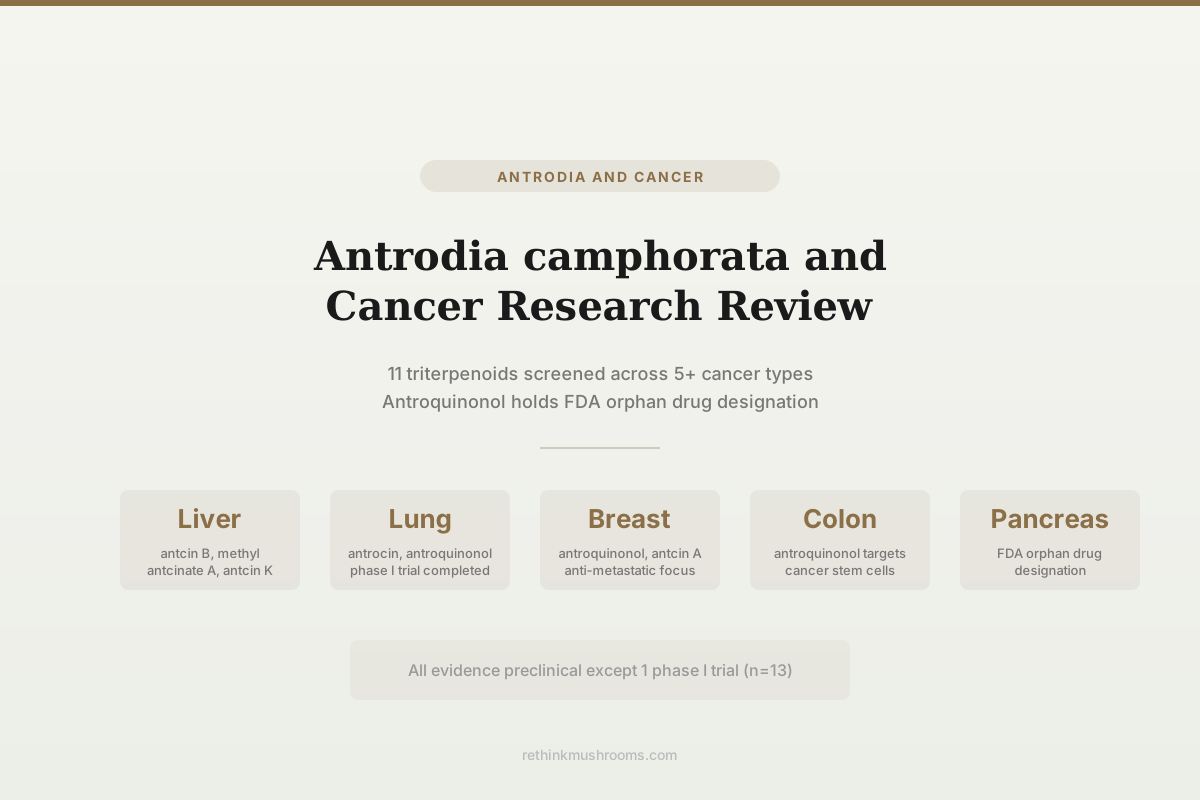
Antrodia and Cancer
11 triterpenoids screened
Lee et al. tested eleven distinct triterpenoids from Antrodia camphorata against multiple cancer cell lines, finding cytotoxic activity in the low micromolar range for several compounds.
Lee et al., Anticancer Research, 2012
5+ cancer types
liver, lung, breast, colon, pancreatic
Orphan drug
antroquinonol FDA orphan status for 3 cancers
1 phase I trial
antroquinonol in NSCLC completed
Lee et al., Anticancer Research, 2012
 View as image ↗
Antrodia camphorata is the most extensively studied medicinal mushroom for anticancer activity among species endemic to a single region. Over two decades of research from Taiwanese laboratories has identified multiple compound classes with cytotoxic, pro-apoptotic, and anti-metastatic effects across liver, lung, breast, colon, and pancreatic cancer cell lines. Antroquinonol, a ubiquinone derivative, has progressed furthest toward clinical application, receiving orphan drug designation from the U.S. FDA for pancreatic cancer, hepatocellular carcinoma, and acute myeloid leukemia. A completed phase I trial in non-small-cell lung cancer (NSCLC) established safety at doses up to 600 mg daily.[1]
The preclinical breadth is impressive. The clinical depth is thin. That asymmetry defines where Antrodia cancer research stands: dozens of cell line and mouse studies demonstrating multiple anticancer mechanisms, but almost no controlled human efficacy data. This review maps the evidence landscape across cancer types and compound classes. For the specific mechanisms of how antcin compounds drive cancer cell death, see the dedicated mechanistic article.
Key Takeaways
- Eleven triterpenoids from Antrodia camphorata showed cytotoxic activity against cancer cell lines, with zhankuic acids and antcins showing the strongest effects at low micromolar concentrations (Lee et al., 2012)
- Antroquinonol inhibited colon cancer stem cell-like properties by targeting Wnt/beta-catenin signaling and reducing CD44-positive/CD133-positive cell populations (Lin et al., 2017)
- Antcin B induced apoptosis in hepatocellular carcinoma cells through both intrinsic (mitochondrial) and extrinsic (death receptor) pathways with IC50 values of 15 to 25 micromolar (Hsieh et al., 2011)
- Antrodia camphorata fruiting body extract inhibited pancreatic cancer cell growth with triterpenoids, polysaccharides, and beta-glucan each contributing through different mechanisms (Lee et al., 2014)
- Antroquinonol suppressed breast cancer migration and invasion by inhibiting MMP-9 expression through ERK-AP-1 and AKT-NF-kappaB dual pathway blockade (Lee et al., 2015)
- Antroquinonol completed a phase I trial in metastatic NSCLC showing safety at 600 mg daily with stable disease as the best response in 3 of 13 patients
The compound classes: triterpenoids, antroquinonol, and polysaccharides
Antrodia camphorata's anticancer compounds fall into three major categories, each with distinct mechanisms. Understanding which compound does what is essential because "Antrodia extract" is not a single agent; it is a complex mixture whose anticancer effects depend on which components are present and at what concentrations.
Triterpenoids include the antcins (A, B, C, H, K), zhankuic acids, methyl antcinates, ergostatrien-3beta-ol, and related compounds. Lee et al. (2012) conducted the most systematic screen, testing eleven triterpenoids against hepatoma (Hep3B, HepG2), lung (A549), and breast (MCF-7, MDA-MB-231) cancer cell lines. Several showed cytotoxic activity at low micromolar concentrations, with zhankuic acid C and methyl antcinate A among the most potent.[2]
Antroquinonol is a ubiquinone (coenzyme Q0) derivative unique to Antrodia camphorata. It operates through different mechanisms than the triterpenoids, primarily targeting Ras/MAPK and PI3K/Akt/mTOR signaling. Antroquinonol D, a structural variant, was shown to have DNA demethylation activity, a distinct epigenetic mechanism.[3]
Polysaccharides and beta-glucans from Antrodia camphorata show immunomodulatory anticancer effects rather than direct cytotoxicity. They stimulate natural killer cells and macrophages rather than killing cancer cells directly. Lee et al. (2014) showed that the polysaccharide fraction and 1,3-beta-D-glucan from Antrodia fruiting bodies had anticancer effects on pancreatic cancer cells through different mechanisms than the triterpenoid fraction.[4]
For a focused analysis of the antcin compound family, including their biosynthesis and structure-activity relationships, see the compound overview.
Hepatocellular carcinoma: the deepest evidence base
Liver cancer has the most extensive Antrodia research, reflecting both the fungus's traditional use in Taiwan for liver conditions and the high incidence of hepatocellular carcinoma (HCC) in the region.
Hsieh et al. (2011) demonstrated that antcin B induced apoptosis in Hep3B hepatocellular carcinoma cells through both intrinsic and extrinsic apoptotic pathways. The intrinsic pathway involved mitochondrial membrane depolarization, cytochrome c release, and caspase-9 activation. The extrinsic pathway involved Fas/FasL upregulation and caspase-8 activation. IC50 values ranged from 15 to 25 micromolar depending on the cell line.[5]
The dual pathway activation is mechanistically meaningful. Cancer cells frequently develop resistance to apoptosis by disabling one pathway. A compound that activates both simultaneously may be harder for cancer cells to evade. However, this was demonstrated in cell culture only, where drug concentrations are controlled. Whether oral antcin B reaches hepatic tissue at 15 to 25 micromolar concentrations is unknown.
Hsieh et al. (2010) showed that methyl antcinate A induced apoptosis in human liver cancer cells through oxidant-mediated pathways, generating reactive oxygen species (ROS) that triggered mitochondrial dysfunction and caspase activation.[6]
Antcin K added to the HCC evidence. Lai et al. (2016) demonstrated that antcin K from basswood-cultivated Antrodia cinnamomea induced both mitochondrial stress and endoplasmic reticulum (ER) stress-mediated apoptosis in human hepatoma cells. The ER stress pathway involved CHOP upregulation and GRP78 induction, markers of the unfolded protein response.[7]
Three different compounds (antcin B, methyl antcinate A, antcin K), three different apoptotic mechanisms, all effective against HCC cell lines. The convergence across compounds strengthens the case that Antrodia has genuine hepatotoxic selectivity toward cancer cells, but all three studies used HCC cell lines in culture. In vivo HCC models are scarce in Antrodia research. For how Antrodia induces cancer cell death across multiple pathways, see the mechanistic deep-dive.
Lung cancer: from proteomics to clinical trials
Antrodia's lung cancer research spans the longest timeline, from early proteomic studies to the only completed clinical trial.
Wu et al. (2006) published one of the earliest studies, using proteomic analysis to identify protein expression changes in A549 human lung cancer cells treated with Antrodia camphorata extract. The analysis revealed downregulation of proliferation-related proteins and upregulation of apoptosis-related proteins, providing an early molecular roadmap.[8]
Yeh et al. (2013) identified a specific compound and mechanism. Antrocin, a sesquiterpene lactone from Antrodia camphorata, negatively modulated JAK2/STAT3 signaling via microRNA let-7c in lung cancer cells. STAT3 is constitutively active in many lung cancers and drives proliferation, survival, and immune evasion. Antrocin downregulated STAT3 phosphorylation, reduced cyclin D1 and Bcl-2 expression, and induced apoptosis.[9]
The microRNA mechanism is notable. Antrocin upregulated let-7c, a tumor-suppressive microRNA frequently silenced in lung cancer. Let-7c then suppressed its downstream targets, which include components of the JAK2/STAT3 pathway. This indirect mechanism through microRNA modulation is different from direct enzyme inhibition and suggests epigenetic-level anticancer activity.
The phase I clinical trial of antroquinonol in metastatic NSCLC enrolled 13 patients who had failed at least two prior regimens. Doses escalated from 50 to 600 mg daily in 4-week cycles. No dose-limiting toxicities were observed. The most common adverse events were gastrointestinal (diarrhea 77%, vomiting 69%, nausea 54%), all grade 1-2. The best response was stable disease in 3 patients (23%).[1]
Stable disease in heavily pretreated patients is a modest but not meaningless result. The trial established safety and tolerability, its primary objective. It did not demonstrate efficacy, which requires larger randomized trials. The recommended phase II dose of 600 mg or higher daily was established. For Antrodia research specifically focused on lung cancer preclinical models, see the dedicated lung cancer review.
Breast cancer: anti-metastatic mechanisms
Lee et al. (2015) demonstrated that antroquinonol suppressed breast tumor migration and invasion in MDA-MB-231 cells (a triple-negative breast cancer line known for aggressive metastatic behavior). The mechanism involved dual inhibition of ERK-AP-1 and AKT-NF-kappaB signaling pathways, which decreased MMP-9 expression and suppressed epithelial-mesenchymal transition (EMT).[10]
MMP-9 is a matrix metalloproteinase that degrades extracellular matrix, enabling cancer cells to invade surrounding tissue and metastasize. EMT is the process by which epithelial cancer cells acquire mesenchymal traits (motility, invasiveness). By blocking both MMP-9 and EMT, antroquinonol targeted two of the key steps in metastatic progression.
Kumar et al. (2019) extended the anti-metastatic findings to antcin A, showing it modulated EMT markers and inhibited migratory and invasive potential in triple-negative breast cancer cells through regulation of the PI3K/AKT/mTOR pathway.[11]
Both studies used MDA-MB-231 cells, which are among the most aggressive and drug-resistant breast cancer lines. Activity against this cell line suggests potential relevance to the hardest-to-treat breast cancer subtype, but cell line sensitivity does not predict clinical response. In vivo breast cancer models with Antrodia compounds have not been published.
Colon cancer: targeting cancer stem cells
Lin et al. (2017) published the most mechanistically sophisticated Antrodia colon cancer study. Rather than measuring bulk tumor cell killing, they focused on cancer stem cells (CSCs), the subpopulation believed to drive tumor recurrence and metastasis.
Antroquinonol inhibited colon cancer stem cell-like properties in HCT-116 and HT-29 cells. It reduced the CD44-positive/CD133-positive cell population (a CSC marker combination), decreased sphere-forming ability (a functional CSC assay), and suppressed Wnt/beta-catenin signaling, the pathway most commonly activated in colorectal cancer.[1]
Targeting CSCs is a current frontier in oncology. Conventional chemotherapy kills bulk tumor cells but often spares CSCs, which then regenerate the tumor. If antroquinonol genuinely targets CSCs, it could have value as an adjunct to chemotherapy. This remains a hypothesis. The study was entirely in vitro, and the CSC phenotype in cell lines may not fully recapitulate CSC behavior in patient tumors.
Pancreatic cancer: multiple compound fractions
Pancreatic cancer is the cancer type for which antroquinonol received FDA orphan drug designation, though this designation is based on preliminary evidence and reduced patient population, not demonstrated efficacy.
Lee et al. (2014) tested three different fractions of Antrodia camphorata fruiting body against human pancreatic cancer PANC-1 cells: a triterpenoid-enriched fraction, a polysaccharide fraction, and a 1,3-beta-D-glucan fraction. Each showed anticancer activity, but through different mechanisms. The triterpenoid fraction was directly cytotoxic. The polysaccharide and glucan fractions inhibited cell migration and altered adhesion properties rather than killing cells outright.[4]
This multi-fraction analysis is important because it shows that different Antrodia components contribute different anticancer effects. A whole extract would deliver all three mechanisms simultaneously. A purified triterpenoid would deliver only direct cytotoxicity. This has implications for product formulation and clinical trial design. For Antrodia research on oral cancer specifically, see the Taiwan-focused review.
The clinical evidence gap
The disparity between preclinical promise and clinical reality defines Antrodia cancer research. The preclinical data shows consistent cytotoxic activity across multiple cancer types through well-characterized molecular mechanisms. The clinical data consists of a single phase I safety study in 13 NSCLC patients.
Antroquinonol has FDA orphan drug designation for three cancers (pancreatic, HCC, AML). Orphan drug status provides development incentives but does not indicate proven efficacy. It reflects the rarity of the condition and the sponsor's intent to develop the drug, not completed clinical trials demonstrating benefit.
Several factors complicate clinical translation. Antrodia camphorata grows only on the heartwood of Cinnamomum kanehirai, an endangered tree species endemic to Taiwan. Natural supply is extremely limited. Artificial cultivation methods (solid-state fermentation, submerged culture) produce mycelium with different compound profiles than wild fruiting bodies, and the anticancer compound concentrations vary with cultivation method, substrate, and fermentation conditions.
Bioavailability data for antroquinonol exists from the phase I trial (pharmacokinetics were measured), but bioavailability data for the triterpenoids that dominate the cell culture literature (antcins, zhankuic acids, methyl antcinates) does not exist in humans. It is possible that orally administered Antrodia extracts never deliver these compounds to tumor tissue at the concentrations used in cell culture studies.
The geographic concentration of research in Taiwan introduces both strength (deep local expertise) and limitation (lack of independent international replication). Most studies come from a small number of interconnected research groups.
The Bottom Line
Antrodia camphorata produces triterpenoids, antroquinonol, and polysaccharides with preclinical anticancer activity across liver, lung, breast, colon, and pancreatic cancer models. Mechanisms include apoptosis induction through multiple pathways, anti-metastatic EMT suppression, cancer stem cell targeting, and epigenetic modulation. Antroquinonol has progressed to a phase I trial in NSCLC (safe at 600 mg daily, stable disease in 23% of patients) and holds FDA orphan drug status for three cancers. The fundamental gap remains between extensive cell line data and the absence of controlled human efficacy trials.
Frequently Asked Questions
Sources & References
- 1RTHM-00481·Lin, Hsien-Chun et al. (2017). “Antroquinonol, a Ubiquinone Derivative from the Mushroom Antrodia camphorata, Inhibits Colon Cancer Stem Cell-like Properties: Insights into the Molecular Mechanism and Inhibitory Targets..” Journal of agricultural and food chemistry.Study breakdown →PubMed →↩
- 2RTHM-00252·Lee, Yi-Pang et al. (2012). “Anticancer effects of eleven triterpenoids derived from Antrodia camphorata..” Anticancer research.Study breakdown →PubMed →↩
- 3RTHM-00355·Wang, Sheng-Chao et al. (2014). “Antroquinonol D, isolated from Antrodia camphorata, with DNA demethylation and anticancer potential..” Journal of agricultural and food chemistry.Study breakdown →PubMed →↩
- 4RTHM-00332·Lee, Chu-I et al. (2014). “Anticancer effects on human pancreatic cancer cells of triterpenoids, polysaccharides and 1,3-β-D-glucan derived from the fruiting body of Antrodia camphorata..” Food & function.Study breakdown →PubMed →↩
- 5RTHM-00217·Hsieh, Yun-Chih et al. (2011). “Antcin B and its ester derivative from Antrodia camphorata induce apoptosis in hepatocellular carcinoma cells involves enhancing oxidative stress coincident with activation of intrinsic and extrinsic apoptotic pathway..” Journal of agricultural and food chemistry.Study breakdown →PubMed →↩
- 6RTHM-00183·Hsieh, Yun-Chih et al. (2010). “Methyl antcinate A from Antrodia camphorata induces apoptosis in human liver cancer cells through oxidant-mediated cofilin- and Bax-triggered mitochondrial pathway..” Chemical research in toxicology.Study breakdown →PubMed →↩
- 7RTHM-00432·Lai, Chiao-I et al. (2016). “Antcin K, an active triterpenoid from the fruiting bodies of basswood cultivated Antrodia cinnamomea, induces mitochondria and endoplasmic reticulum stress-mediated apoptosis in human hepatoma cells..” Journal of traditional and complementary medicine.Study breakdown →PubMed →↩
- 8RTHM-00108·Wu, Hung et al. (2006). “Proteomic analysis of the effect of Antrodia camphorata extract on human lung cancer A549 cell..” Proteomics.Study breakdown →PubMed →↩
- 9RTHM-00312·Yeh, Chi-Tai et al. (2013). “A sesquiterpene lactone antrocin from Antrodia camphorata negatively modulates JAK2/STAT3 signaling via microRNA let-7c and induces apoptosis in lung cancer cells..” Carcinogenesis.Study breakdown →PubMed →↩
- 10RTHM-00386·Lee, Wai-Theng et al. (2015). “Antroquinonol from Antrodia Camphorata suppresses breast tumor migration/invasion through inhibiting ERK-AP-1- and AKT-NF-κB-dependent MMP-9 and epithelial-mesenchymal transition expressions..” Food and chemical toxicology : an international journal published for the British Industrial Biological Research Association.Study breakdown →PubMed →↩
- 11RTHM-00565·Kumar, K J Senthil et al. (2019). “Antcin-A Modulates Epithelial-to-Mesenchymal Transition and Inhibits Migratory and Invasive Potentials of Human Breast Cancer Cells via p53-Mediated miR-200c Activation..” Planta medica.Study breakdown →PubMed →↩