Antrodia and Cancer
100-200 mcg/ml
Antrodia camphorata extracts induced apoptosis in OC2 human oral cancer cells at concentrations of 100 to 200 micrograms per milliliter in a dose-dependent manner.
Huang et al., Chinese J Physiol, 2009
Taiwan context
highest oral cancer rates globally from betel nut
OC2 + HSC3 + SAS
3 oral cancer cell lines tested
0 clinical trials
all preclinical for oral cancer
Huang et al., Chinese J Physiol, 2009
 View as image ↗
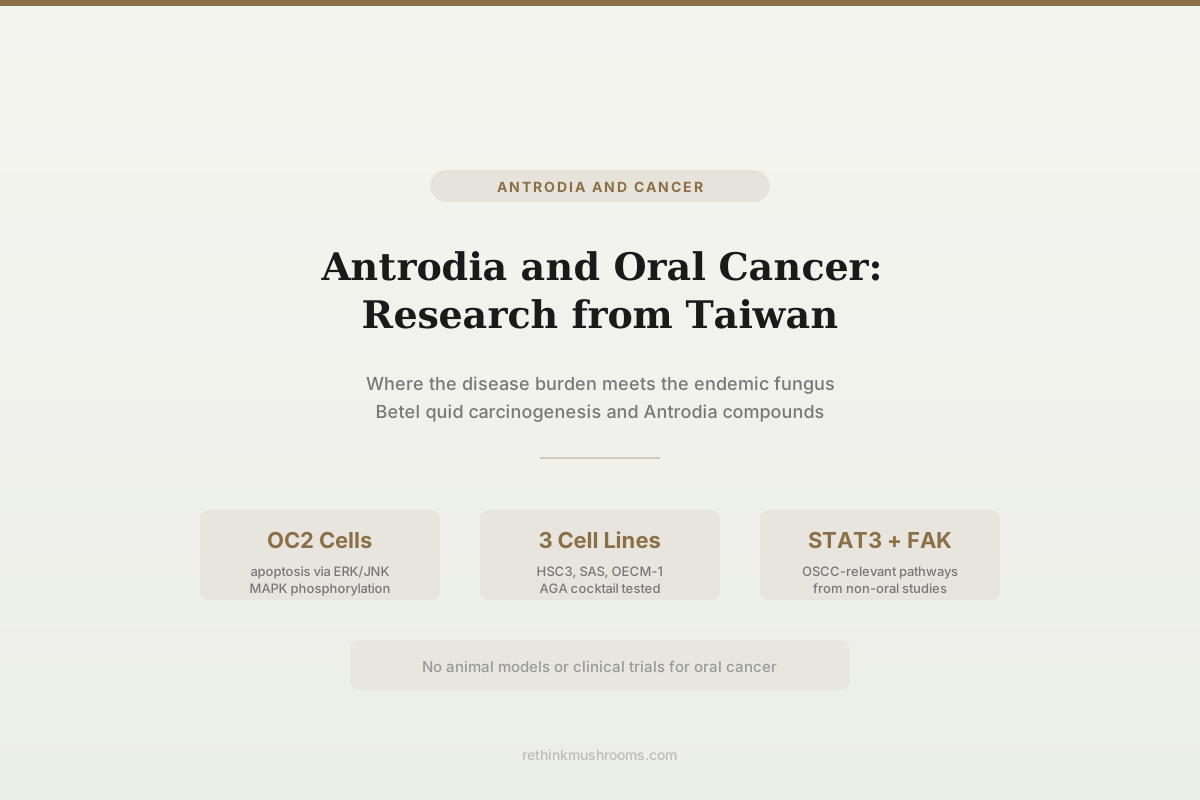
Taiwan has one of the highest oral cancer rates in the world, driven primarily by betel quid chewing. Over 8,000 new oral cancer cases are diagnosed annually in Taiwan, making it the fourth most common cancer in Taiwanese men. Antrodia camphorata, a fungus found exclusively on the Taiwanese endemic tree Cinnamomum kanehirai, has been tested directly against oral cancer cell lines, with two published studies demonstrating apoptosis induction, cell cycle arrest, and migration inhibition. Antrodia extract induced apoptosis in OC2 human oral cancer cells at 100 to 200 micrograms per milliliter through MAPK phosphorylation.[1]
The convergence of Taiwan's oral cancer burden and Taiwan's endemic anticancer fungus makes this a research area of particular local significance. For the broader landscape of Antrodia and cancer research across all tumor types, see the comprehensive review.
Key Takeaways
- Antrodia camphorata extract at 100 to 200 mcg/ml induced apoptosis in OC2 human oral cancer cells, with ERK and JNK MAPK phosphorylation and disrupted intracellular calcium signaling (Huang et al., 2009)
- A herbal cocktail containing Antrodia camphorata inhibited proliferation of three oral cancer cell lines (HSC3, SAS, OECM-1) and induced cell cycle arrest at subG1 phase (Lu et al., 2020)
- Eleven triterpenoids screened from Antrodia camphorata showed cytotoxic activity against multiple cancer cell lines at low micromolar concentrations, several of which are relevant to OSCC pathways (Lee et al., 2012)
- Antrocin from Antrodia camphorata inhibited JAK2/STAT3 signaling, a pathway constitutively active in oral squamous cell carcinoma (Yeh et al., 2013)
- Antcin-H inhibited cancer cell invasion partly through inactivation of the FAK signaling pathway, a key mediator of OSCC metastasis (Chiu et al., 2017)
- Antroquinonol suppressed MMP-9 and EMT, two processes central to oral cancer local invasion and lymph node metastasis (Lee et al., 2015)
Taiwan's oral cancer epidemic and why Antrodia research matters here
Oral squamous cell carcinoma (OSCC) accounts for over 90 percent of oral cancers. In Taiwan, the primary driver is betel quid (areca nut) chewing, often combined with tobacco use. Betel quid is classified as a Group 1 carcinogen by the International Agency for Research on Cancer. The habit is culturally embedded among working-class men in Taiwan, where oral cancer is the fourth most common male cancer and a leading cause of cancer death in men aged 25 to 44.
OSCC in Taiwan tends to present at advanced stages, with frequent lymph node metastasis and local invasion into surrounding structures. Five-year survival for advanced OSCC remains around 50 percent despite surgery, radiation, and chemotherapy. The molecular drivers of betel-quid-associated OSCC include NF-kappaB activation, STAT3 constitutive signaling, MMP-mediated extracellular matrix degradation, and epithelial-mesenchymal transition (EMT). Each of these pathways has been targeted by Antrodia camphorata compounds in studies of other cancer types.
The fact that both the cancer burden and the medicinal fungus are endemic to the same island is a research coincidence worth noting. Antrodia camphorata has deep roots in Taiwanese traditional medicine for liver protection and inflammation. Its pivot toward oral cancer research reflects Taiwan's public health priorities.
Direct evidence: Antrodia extracts against oral cancer cell lines
Huang et al. (2009) conducted the first study specifically testing Antrodia camphorata against oral cancer cells. They treated OC2 cells (a human oral squamous cell carcinoma line established from a Taiwanese patient) with Antrodia extracts and measured viability, apoptosis, calcium signaling, and MAPK phosphorylation.[1]
At concentrations of 100 to 200 mcg/ml, Antrodia extract induced apoptosis in a dose-dependent manner, confirmed by propidium iodide staining. The extract induced phosphorylation of ERK and JNK MAPKs but not p38 MAPK. It also disrupted intracellular calcium homeostasis, causing a rise in cytoplasmic calcium that precedes mitochondrial membrane depolarization and caspase activation.[1]
The ERK/JNK activation pattern is mechanistically specific. In oral cancer cells, sustained ERK activation can be pro-apoptotic (unlike the brief ERK activation that drives proliferation), and JNK activation is a well-established pro-apoptotic signal through Bcl-2 family protein phosphorylation. The absence of p38 activation suggests selectivity in the MAPK response rather than non-specific kinase activation.
Lu et al. (2020) took a different approach, testing a herbal cocktail called AGA (containing Antrodia camphorata alongside Ganoderma lucidum and Angelica sinensis) against three oral cancer cell lines: HSC3, SAS, and OECM-1. The combination inhibited proliferation in a dose- and time-dependent manner across all three lines. The mechanism involved apoptosis induction, migration inhibition, and cell cycle arrest at the subG1 phase. Cyclin expression was suppressed, explaining the cell cycle arrest.[2]
The AGA cocktail study has a limitation for understanding Antrodia's specific contribution: because three herbs were combined, the individual effect of Antrodia camphorata cannot be isolated. The observed anticancer effects may come from Antrodia, Ganoderma, Angelica, or synergistic interactions between them. The study confirms that an Antrodia-containing formulation is active against oral cancer cells but does not attribute the activity specifically to Antrodia compounds.
Relevant mechanisms from other Antrodia cancer studies
Several Antrodia compounds tested in non-oral cancer models target the exact molecular pathways that drive OSCC progression. These studies are not oral cancer studies, but they provide mechanistic rationale for investigating these compounds in OSCC specifically.
JAK2/STAT3 inhibition
STAT3 is constitutively activated in a majority of OSCC tumors and is associated with resistance to apoptosis, proliferation, and immune evasion. Yeh et al. (2013) showed that antrocin, a sesquiterpene lactone from Antrodia camphorata, negatively modulated JAK2/STAT3 signaling in lung cancer cells through upregulation of microRNA let-7c. Antrocin reduced STAT3 phosphorylation, decreased cyclin D1 and Bcl-2, and induced apoptosis.[3]
The STAT3 pathway operates identically in OSCC, where it drives resistance to both cisplatin-based chemotherapy and radiation. A compound that inhibits STAT3 signaling in lung cancer would be expected to have similar effects in OSCC cells, though this has not been directly tested with antrocin. For the full analysis of how Antrodia induces cancer cell death, see the dedicated mechanistic article.
Anti-metastatic activity: MMP-9 and EMT suppression
Local invasion and lymph node metastasis determine OSCC staging and prognosis. Two molecular processes drive this: MMP-mediated extracellular matrix degradation and epithelial-mesenchymal transition (EMT).
Lee et al. (2015) demonstrated that antroquinonol suppressed MMP-9 expression in breast cancer cells through dual inhibition of ERK-AP-1 and AKT-NF-kappaB signaling. Antroquinonol also suppressed EMT markers, reducing the invasive phenotype.[4]
Chiu et al. (2017) showed antcin-H inhibited cancer cell invasion partly through inactivation of the focal adhesion kinase (FAK) signaling pathway. FAK is overexpressed in OSCC and correlates with lymph node metastasis and poor prognosis.[5]
MMP-9 is among the most consistently overexpressed MMPs in OSCC, where it enables invasion through the basement membrane and surrounding connective tissue. EMT is activated in OSCC cells at the invasive front of tumors. Both are validated therapeutic targets in head and neck cancer research. For the broader antcin compound class and their cancer mechanisms, see the dedicated article.
Broad triterpenoid cytotoxicity screen
Lee et al. (2012) screened eleven triterpenoids from Antrodia camphorata against hepatoma, lung, and breast cancer cell lines. Several compounds showed cytotoxic activity at low micromolar concentrations. While oral cancer cell lines were not included in this screen, the compounds target conserved apoptotic pathways (mitochondrial membrane permeabilization, caspase cascade activation) that are not cell-type-specific.[6]
Methyl antcinate A, one of the compounds identified as potent in the screen, has been specifically noted in other research for activity against oral cancer through mitochondrial-dependent apoptosis. Hsieh et al. (2010) demonstrated that methyl antcinate A induced apoptosis through reactive oxygen species generation and mitochondrial pathway activation.[7]
Antcin B showed similar apoptotic activity through dual pathway activation (intrinsic and extrinsic) in hepatocellular carcinoma cells, with IC50 values of 15 to 25 micromolar.[8] The dual pathway mechanism could be particularly relevant for OSCC, which frequently develops apoptosis resistance through single-pathway inactivation. For how these compounds relate to Antrodia's lung cancer research, see the dedicated review.
What oral cancer-specific research is still needed
The evidence gap for Antrodia and oral cancer is substantial despite the geographic logic connecting them. The field has two direct studies (one using whole extract, one using a multi-herb combination) and no studies testing purified Antrodia triterpenoids specifically against OSCC cell lines.
What is specifically needed:
Purified compound screening against OSCC lines. The eleven-triterpenoid screen by Lee et al. (2012) should be replicated using OSCC cell lines (OC2, SCC-4, SCC-9, HSC3, SAS). This would identify which Antrodia compounds are most potent against oral cancer specifically, rather than extrapolating from liver and lung cancer data.
Betel quid interaction studies. Betel quid carcinogens (arecoline, arecaidine) activate specific oncogenic pathways (RAS/MAPK, PI3K/AKT, NF-kappaB) in oral mucosal cells. Whether Antrodia compounds can counteract these specific activation patterns has not been tested. Given that betel quid drives most Taiwanese oral cancer, this is the most relevant mechanistic question for the local population.
In vivo OSCC models. Neither published oral cancer study included animal models. Orthotopic OSCC models (tumor implanted in the oral cavity) or chemically induced oral carcinogenesis models (using 4NQO, a chemical that mimics tobacco/betel quid carcinogenesis) would provide stronger evidence than cell culture alone.
Clinical trials in OSCC patients. Antroquinonol has completed a phase I trial in NSCLC. A similar safety and dose-finding study in OSCC patients, potentially combined with standard cisplatin-based chemotherapy, would be the logical clinical step.
The research opportunity is clear: Taiwan has the oral cancer burden, the endemic medicinal fungus, the research infrastructure, and the preclinical compound library. Connecting these assets into an oral cancer-specific research program has not yet happened systematically.
The Bottom Line
Antrodia camphorata extracts induce apoptosis in oral cancer cell lines through MAPK phosphorylation and calcium signaling disruption. Multiple Antrodia compounds target OSCC-relevant pathways (STAT3, MMP-9, EMT, FAK) in other cancer models but have not been tested specifically in oral cancer. Taiwan's high oral cancer rates from betel quid chewing create a compelling context for Antrodia research, but the oral cancer-specific evidence base remains thin at two cell culture studies with no animal models or clinical trials.
Frequently Asked Questions
Sources & References
- 1RTHM-00155·Huang, Chorng-Chih et al. (2009). “Effects of Antrodia camphorata extracts on the viability, apoptosis, [Ca2+]i, and MAPKs phosphorylation of OC2 human oral cancer cells..” The Chinese journal of physiology.Study breakdown →PubMed →↩
- 2RTHM-00634·Lu, Jui-Hua et al. (2020). “The Novel Herbal Cocktail AGA Alleviates Oral Cancer through Inducing Apoptosis, Inhibited Migration and Promotion of Cell Cycle Arrest at SubG1 Phase..” Cancers.Study breakdown →PubMed →↩
- 3RTHM-00312·Yeh, Chi-Tai et al. (2013). “A sesquiterpene lactone antrocin from Antrodia camphorata negatively modulates JAK2/STAT3 signaling via microRNA let-7c and induces apoptosis in lung cancer cells..” Carcinogenesis.Study breakdown →PubMed →↩
- 4RTHM-00386·Lee, Wai-Theng et al. (2015). “Antroquinonol from Antrodia Camphorata suppresses breast tumor migration/invasion through inhibiting ERK-AP-1- and AKT-NF-κB-dependent MMP-9 and epithelial-mesenchymal transition expressions..” Food and chemical toxicology : an international journal published for the British Industrial Biological Research Association.Study breakdown →PubMed →↩
- 5RTHM-00467·Chiu, Kun-Yuan et al. (2017). “Antcin-H Isolated from Antrodia cinnamomea Inhibits Renal Cancer Cell Invasion Partly through Inactivation of FAK-ERK-C/EBP-β/c-Fos-MMP-7 Pathways..” Evidence-based complementary and alternative medicine : eCAM.Study breakdown →PubMed →↩
- 6RTHM-00252·Lee, Yi-Pang et al. (2012). “Anticancer effects of eleven triterpenoids derived from Antrodia camphorata..” Anticancer research.Study breakdown →PubMed →↩
- 7RTHM-00183·Hsieh, Yun-Chih et al. (2010). “Methyl antcinate A from Antrodia camphorata induces apoptosis in human liver cancer cells through oxidant-mediated cofilin- and Bax-triggered mitochondrial pathway..” Chemical research in toxicology.Study breakdown →PubMed →↩
- 8RTHM-00217·Hsieh, Yun-Chih et al. (2011). “Antcin B and its ester derivative from Antrodia camphorata induce apoptosis in hepatocellular carcinoma cells involves enhancing oxidative stress coincident with activation of intrinsic and extrinsic apoptotic pathway..” Journal of agricultural and food chemistry.Study breakdown →PubMed →↩