Antrodia and Cancer
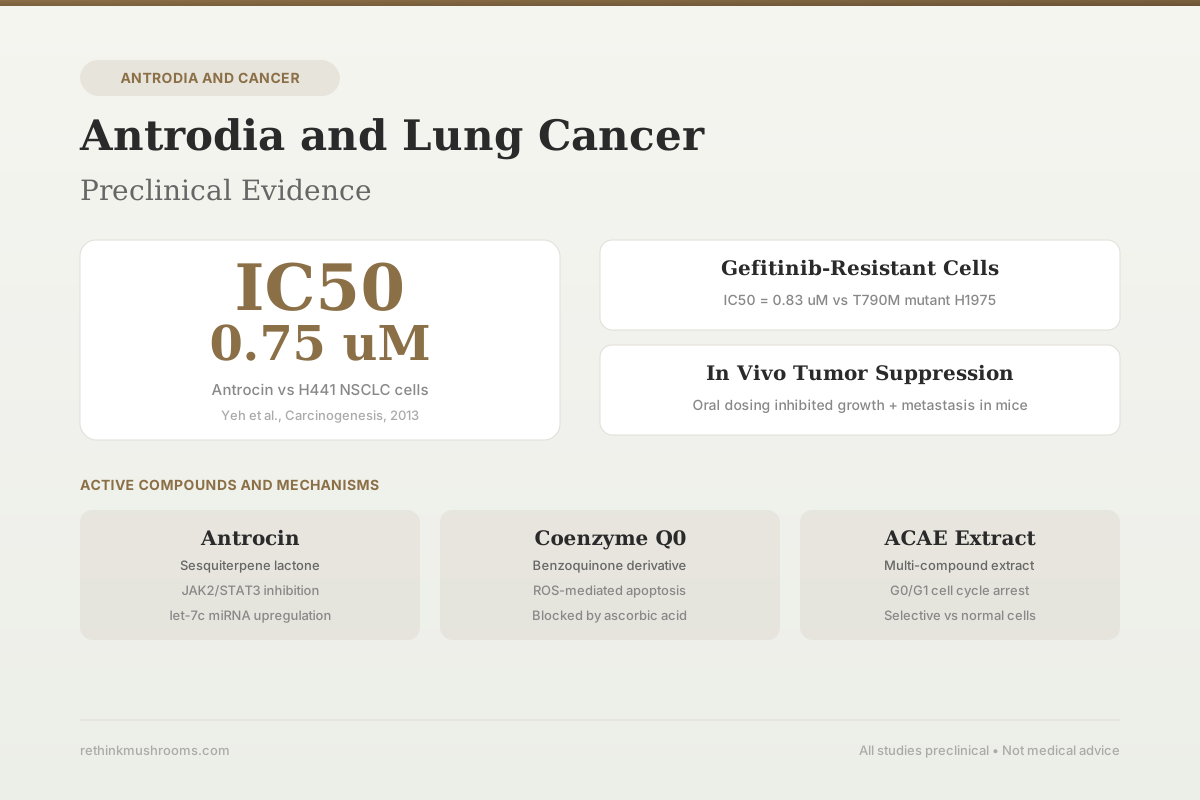
IC50 0.75 uM antrocin
The sesquiterpene lactone antrocin inhibited non-small cell lung cancer cell proliferation at sub-micromolar concentrations and suppressed tumor xenograft growth in vivo through JAK2/STAT3 pathway inhibition.
Yeh et al., Carcinogenesis, 2013
4 Cell Lines
H441, H1975, A549, LLC tested
3 Compounds
antrocin, ACAE, CoQ0 active
In Vivo
oral dosing inhibited tumor growth
Yeh et al., Carcinogenesis, 2013
 View as image ↗
Lung cancer kills more people worldwide than any other cancer type. Non-small cell lung cancer (NSCLC) accounts for approximately 85% of cases, and resistance to targeted therapies like gefitinib remains a persistent clinical problem. Antrodia camphorata, a medicinal fungus endemic to Taiwan, produces multiple compounds that kill lung cancer cells in laboratory studies through distinct molecular mechanisms. The most potent, antrocin, inhibits NSCLC cell proliferation at concentrations below 1 micromolar and suppresses tumor growth in xenograft mouse models.[1] This article examines the preclinical evidence across five studies spanning 2006 to 2019. For a broader view of how these findings fit into Antrodia's overall cancer research, the lung cancer data represents one of the best-characterized organ-specific areas.
Key Takeaways
- Antrocin inhibited proliferation in H441 (wild-type EGFR, IC50 = 0.75 micromolar) and H1975 (gefitinib-resistant T790M mutant, IC50 = 0.83 micromolar) non-small cell lung cancer cells through JAK2/STAT3 pathway suppression and microRNA let-7c upregulation (Yeh et al., 2013)
- Intraperitoneal antrocin administration significantly suppressed lung cancer xenograft growth in vivo, with the combination of antrocin and JAK2/STAT3 gene silencing increasing apoptosis beyond either treatment alone (Yeh et al., 2013)
- Oral Antrodia camphorata ethanol extract inhibited Lewis lung carcinoma tumor growth and metastasis in mice without affecting body weight or serum parameters, reducing phosphorylated STAT3 in tumor tissue (Huang et al., 2019)
- Antrodia camphorata alcohol extract induced G0/G1 cell cycle arrest and apoptosis in H441GL cells, with oral dosing retarding tumorigenesis in a dose-dependent fashion monitored by bioluminescence imaging (Chiou et al., 2011)
- Coenzyme Q0 from Antrodia cinnamomea submerged cultures induced ROS-mediated apoptosis in A549 lung cancer cells, an effect blocked by the antioxidant ascorbic acid (Chung et al., 2014)
- Antrodia extract selectively killed A549 lung cancer cells while sparing normal MRC-5 fetal lung fibroblasts, with proteomic analysis identifying five downregulated tumor-associated proteins (Wu et al., 2006)
Antrocin: Sub-Micromolar Potency Against Drug-Resistant Lung Cancer
Antrocin is a sesquiterpene lactone identified by Yeh et al. (2013) as the most potent anticancer compound among over 100 secondary metabolites isolated from Antrodia camphorata. Its activity against lung cancer cells was remarkable for two reasons: the concentrations required were extremely low, and it worked against drug-resistant cancer cells.[1]
In H441 cells carrying wild-type epidermal growth factor receptor (EGFR), antrocin produced an IC50 of 0.75 micromolar. In H1975 cells carrying the T790M mutation that confers resistance to the targeted therapy gefitinib, the IC50 was 0.83 micromolar. This near-identical potency against both wild-type and resistant cell lines suggests antrocin works through a mechanism independent of EGFR signaling.[1]
Gene profiling revealed that antrocin targets the JAK2/STAT3 signaling pathway. STAT3 (signal transducer and activator of transcription 3) is constitutively activated in many lung cancers, driving proliferation and survival. Antrocin suppressed both constitutively activated and IL-6-induced STAT3 phosphorylation and its subsequent nuclear translocation by suppressing upstream JAK2. Antrocin also increased expression of microRNA let-7c, a tumor suppressor microRNA that further suppresses STAT signaling.[1]
The combination of antrocin with JAK2/STAT3 gene silencing significantly increased apoptosis in H441 cells beyond either treatment alone. This dual interruption downregulated the antiapoptotic protein Mcl-1 and increased caspase-3 expression. In vivo, intraperitoneal antrocin administration significantly suppressed lung cancer xenograft growth.[1] For more on how antrocin and other antcin compounds work against cancer, the JAK2/STAT3 mechanism is one of several anti-cancer pathways Antrodia compounds engage.
STAT3 Inhibition Confirmed in a Second Model
Huang et al. (2019) independently confirmed the STAT3 mechanism using a different Antrodia preparation and different lung cancer model. Their Antrodia cinnamomea ethanol extract (ACEE) was tested against Lewis lung carcinoma (LLC) cells, a murine lung cancer cell line used for syngeneic transplant models that allow assessment of immune-mediated effects.[2]
ACEE produced dose-dependent cytotoxic effects and induced apoptosis in LLC cells. The molecular profile showed increased p53 and Bax expression, caspase-3 and PARP cleavage (hallmarks of apoptotic cell death), and reduced expression of the anti-apoptotic proteins survivin and Bcl-2. ACEE also reduced JAK2 levels and phosphorylated STAT3 in LLC cells, confirming the same pathway identified by Yeh et al. with purified antrocin.[2]
The in vivo results were particularly strong: oral administration of ACEE significantly inhibited LLC tumor growth and metastasis in a murine allograft model without affecting serum biological parameters or body weight. Tumor tissue analysis confirmed increased caspase-3 cleavage and decreased STAT3 phosphorylation. ACEE also reduced growth of human tumor xenografts in nude mice, demonstrating cross-species activity.[2]
The absence of body weight change or serum parameter alteration in treated mice is an important safety signal, suggesting the extract's cytotoxic effects were selective for tumor cells rather than causing generalized toxicity. This safety profile supports further preclinical development, though translation to human dosing remains uncharacterized.
Cell Cycle Arrest and Oral Dosing Efficacy
Chiou et al. (2011) evaluated Antrodia camphorata alcohol extract (ACAE) using a particularly innovative approach: non-invasive bioluminescence molecular imaging to track tumor progression in living mice after oral dosing. H441GL cells (H441 cells engineered to express luciferase) were implanted subcutaneously, and tumor response to oral ACAE was monitored by imaging bioluminescence intensity over time.[3]
In vitro, ACAE inhibited H441GL cell proliferation and migration/invasion in a dose-dependent manner. Flow cytometric analysis revealed that ACAE induced cell cycle arrest specifically at the G0/G1 phase, preventing cells from entering DNA synthesis. Annexin-V immunofluorescence and DNA fragmentation assays confirmed apoptosis in treated cells.[3]
In vivo, bioluminescence imaging revealed that tumorigenesis was significantly retarded by oral ACAE treatment in a dose-dependent fashion. The oral route of administration is clinically relevant because it mirrors how Antrodia supplements are consumed. The dose-dependent response across both in vitro and in vivo models strengthened the evidence for a genuine pharmacological effect rather than a non-specific toxicity.[3]
The G0/G1 cell cycle arrest mechanism is distinct from the JAK2/STAT3 inhibition described by Yeh et al. (2013), suggesting that Antrodia extracts (which contain multiple active compounds) may target lung cancer through parallel mechanisms. For detailed analysis of the different ways Antrodia induces cancer cell death, cell cycle arrest and apoptosis induction appear to operate simultaneously.
Coenzyme Q0: ROS-Mediated Killing of A549 Cells
Chung et al. (2014) identified a different active compound: coenzyme Q0 (2,3-dimethoxy-5-methyl-1,4-benzoquinone, CoQ0), derived from Antrodia cinnamomea submerged culture filtrates. CoQ0 represents a benzoquinone compound class structurally distinct from both the sesquiterpene lactones (antrocin) and triterpenoids (antcins) previously characterized for anticancer activity.[4]
CoQ0 reduced viability in A549 (lung cancer), HepG2 (liver cancer), and SW480 (colon cancer) cell lines, demonstrating broad anticancer activity. In A549 cells, CoQ0 induced reactive oxygen species (ROS) generation and subsequent apoptosis. The critical mechanistic experiment: the antioxidant ascorbic acid blocked CoQ0-induced apoptosis, confirming that the cell death was specifically mediated by ROS generation rather than an ROS-independent pathway.[4]
This ROS-mediated mechanism is notable because it operates through the opposite principle from Antrodia's antioxidant properties. While Antrodia's triterpenoids protect normal cells from oxidative damage (through Nrf2 activation and antioxidant enzyme upregulation), CoQ0 exploits cancer cells' already-elevated ROS levels by pushing them past a lethal threshold. The selectivity depends on the fact that cancer cells typically operate with higher baseline ROS than normal cells, making them more vulnerable to further oxidative stress.
Selective Toxicity: Cancer Cells vs. Normal Cells
Wu et al. (2006) addressed a critical question for any anticancer agent: does it kill cancer cells selectively, or does it damage normal cells equally? Using 0.2 to 2% v/v ethanol extracts of Antrodia camphorata cultivated by solid-state fermentation, they showed that the extract effectively impeded proliferation of A549 human NSCLC cells but did not harm primary human fetal lung fibroblast MRC-5 cells.[5]
The apoptosis in A549 cells appeared to involve endoplasmic reticulum (ER) stress, a mechanism where disruption of protein folding in the ER triggers a cell death cascade. Proteomic analysis using two-dimensional gel electrophoresis identified five proteins that were significantly downregulated in treated A549 cells: galectin-1 (a lectin involved in cell adhesion and metastasis), eukaryotic translation initiation factor 5A (involved in protein synthesis), Rho GDP dissociation inhibitor alpha (involved in cell migration), calpain 1/2 small subunit (a calcium-dependent protease), and annexin V (involved in apoptosis regulation). All five downregulations were confirmed by Western blotting.[5]
The selective toxicity between A549 cancer cells and MRC-5 normal lung cells is among the most clinically relevant findings in the Antrodia lung cancer literature. Effective chemotherapy drugs must discriminate between cancer and normal tissue, and the demonstration that Antrodia extract can make this distinction in lung cells (both types derived from lung tissue) suggests a genuine therapeutic window rather than general cellular toxicity.
Why Antrodia's Multi-Compound Approach Matters for Lung Cancer
Lung cancer is particularly difficult to treat because of its heterogeneity and resistance mechanisms. The standard targeted therapy gefitinib works well initially in tumors with activating EGFR mutations, but resistance develops within 9 to 14 months in most patients, often through the T790M mutation. The fact that antrocin is equally potent against both wild-type and T790M-mutant cells (IC50 0.75 vs 0.83 micromolar) suggests it bypasses EGFR-dependent resistance entirely by targeting JAK2/STAT3 instead.[1]
The diversity of active compounds and mechanisms in Antrodia may be an advantage. Antrocin targets JAK2/STAT3 signaling. CoQ0 induces ROS-mediated apoptosis. ACAE induces G0/G1 cell cycle arrest. Crude extracts downregulate metastasis-associated proteins. Attacking cancer through multiple pathways simultaneously makes resistance development more difficult, though this multi-target hypothesis has not been tested in resistance models. For perspective on how antcin K inhibits NF-kB, the anti-inflammatory pathway adds yet another dimension to Antrodia's anticancer potential.
Limitations
Every study described here is preclinical. No randomized controlled trial has tested Antrodia compounds against human lung cancer. A single case report (not a controlled study) has documented Antrodia use in a small cell lung cancer patient, but case reports cannot establish efficacy.
The in vivo studies used different administration routes (intraperitoneal for antrocin, oral for ACAE and ACEE) and different tumor models (xenografts vs. allografts). Dose translation from mice to humans involves substantial uncertainty, and the pharmacokinetics of antrocin, CoQ0, and other active compounds in humans are unknown.
The selectivity between cancer and normal cells (Wu et al., 2006) was demonstrated in only one normal cell type (MRC-5 fetal lung fibroblasts). A full toxicology profile would require testing against multiple normal cell types and organ systems. The antrocin IC50 values (0.75 to 0.83 micromolar) are promising but achieving these concentrations in human lung tissue after oral dosing has not been demonstrated.
Antrodia camphorata remains extremely rare and expensive, growing naturally only on a single endangered tree species in Taiwan. Any clinical development would require reliable cultivation methods and standardized extract preparations. Research on Antrodia's effects against oral cancer in Taiwanese populations may provide additional context for clinical translation in East Asian cancer research programs.
The Bottom Line
Preclinical evidence supports Antrodia camphorata's anticancer activity against lung cancer through at least three distinct mechanisms: JAK2/STAT3 pathway inhibition by antrocin (IC50 below 1 micromolar), ROS-mediated apoptosis by CoQ0, and G0/G1 cell cycle arrest by crude alcohol extracts. Antrocin is equally potent against gefitinib-sensitive and gefitinib-resistant NSCLC cells. Oral dosing of Antrodia extracts inhibited tumor growth and metastasis in mouse models without systemic toxicity. All evidence is preclinical with no controlled human trials.
Frequently Asked Questions
Sources & References
- 1RTHM-00312·Yeh, Chi-Tai et al. (2013). “A sesquiterpene lactone antrocin from Antrodia camphorata negatively modulates JAK2/STAT3 signaling via microRNA let-7c and induces apoptosis in lung cancer cells..” Carcinogenesis.Study breakdown →PubMed →↩
- 2RTHM-00561·Huang, Tsung-Teng et al. (2019). “Antrodia cinnamomea induces anti-tumor activity by inhibiting the STAT3 signaling pathway in lung cancer cells..” Scientific reports.Study breakdown →PubMed →↩
- 3RTHM-00211·Chiou, Jeng-Feng et al. (2011). “A Preclinical Evaluation of Antrodia camphorata Alcohol Extracts in the Treatment of Non-Small Cell Lung Cancer Using Non-Invasive Molecular Imaging..” Evidence-based complementary and alternative medicine : eCAM.Study breakdown →PubMed →↩
- 4RTHM-00318·Chung, Cheng-Han et al. (2014). “Coenzyme Q0 from Antrodia cinnamomea in Submerged Cultures Induces Reactive Oxygen Species-Mediated Apoptosis in A549 Human Lung Cancer Cells..” Evidence-based complementary and alternative medicine : eCAM.Study breakdown →PubMed →↩
- 5RTHM-00108·Wu, Hung et al. (2006). “Proteomic analysis of the effect of Antrodia camphorata extract on human lung cancer A549 cell..” Proteomics.Study breakdown →PubMed →↩