Cancer Immunotherapy Synergy
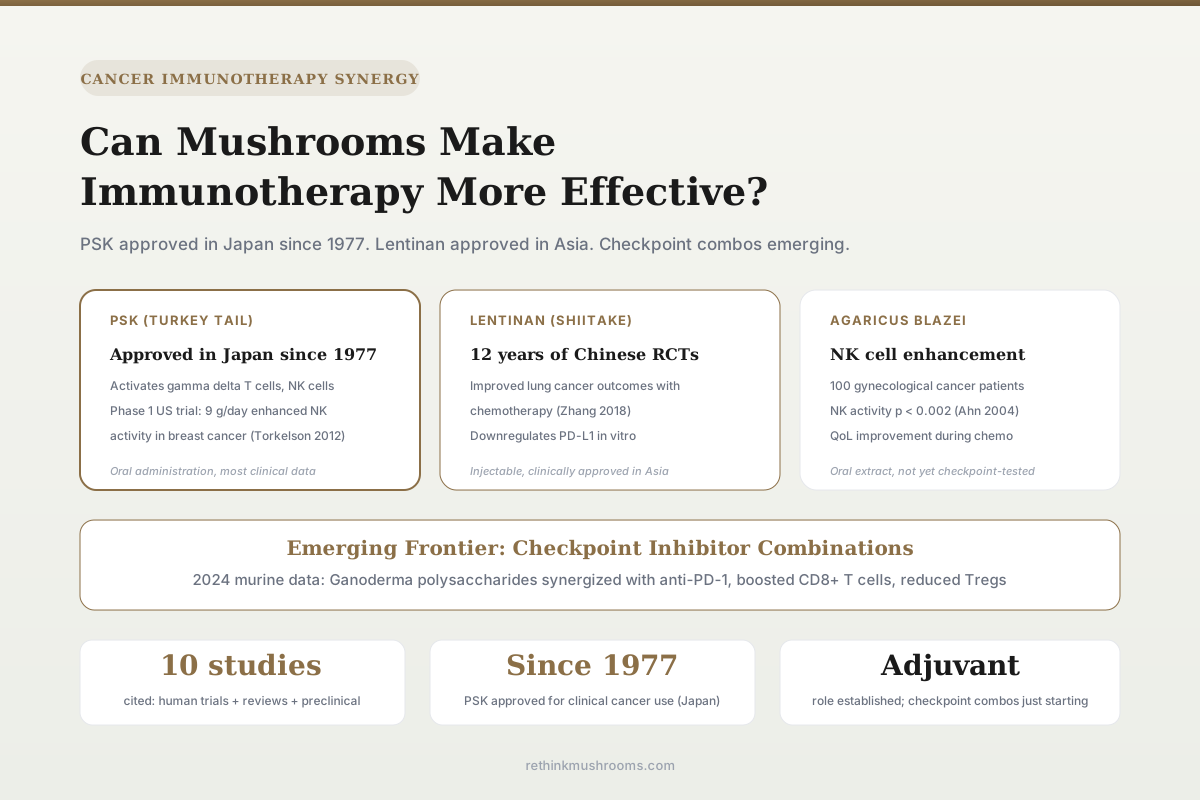
12 years of clinical data
A review of 12 years of randomized clinical trials in China found that lentinan, a beta-glucan from shiitake mushrooms, improved outcomes when combined with chemotherapy in lung cancer patients.
Zhang et al., Journal of Cancer Research and Clinical Oncology, 2018
PSK
from turkey tail is the most clinically tested mushroom immunotherapy compound, approved in Japan since 1977
Phase 1
Torkelson 2012: turkey tail dose escalation (3-9 g/day) in breast cancer patients showed NK cell enhancement
PD-L1
lentinan downregulated PD-L1 expression induced by platinum chemotherapy in gastric cancer cells (in vitro)
Zhang et al., Journal of Cancer Research and Clinical Oncology, 2018
 View as image ↗
The question of whether mushroom compounds can make cancer immunotherapy more effective sits at the intersection of traditional medicine, modern immuno-oncology, and a genuinely interesting body of clinical data. PSK (polysaccharide-K, also called Krestin) from turkey tail (Trametes versicolor) has been approved as a cancer immunotherapy adjuvant in Japan since 1977. Lentinan from shiitake (Lentinula edodes) is an approved drug in several Asian countries. A 2021 systematic review found clinical trials of fungal beta-glucans in cancer patients dating back to the 1980s. These are not fringe supplements: they are pharmaceutical products with decades of clinical use in specific regulatory contexts. The question now is whether they can synergize with modern immunotherapy approaches, particularly checkpoint inhibitors like anti-PD-1 and anti-PD-L1 antibodies. The preclinical evidence is surprisingly strong. The clinical evidence for combination therapy is just beginning to emerge. For the specific beta-glucan/checkpoint inhibitor interaction, see beta-glucans and checkpoint inhibitors: combination research.
Key Takeaways
- PSK (polysaccharide-K) from turkey tail activates gamma delta T cells, producing IFN-gamma and upregulating NKG2D expression; gamma delta T cell depletion abrogated PSK's anti-tumor effect in a mouse breast cancer model, confirming their role as effectors (Inatsuka et al., 2013)[1]
- A Phase 1 clinical trial of oral Trametes versicolor (3-9 g/day for 6 weeks) in breast cancer patients after radiotherapy found dose-dependent increases in lymphocyte counts and NK cell functional activity at the highest dose (Torkelson et al., 2012)[2]
- A review of 12 years of randomized clinical trials in China found that lentinan injection combined with chemotherapy improved clinical outcomes in lung cancer patients, with mechanisms including T cell activation, NK cell enhancement, and dendritic cell maturation (Zhang et al., 2018)[3]
- A PRISMA-compliant systematic review of fungal beta-glucans in cancer found clinical evidence dating from the 1980s, with lentinan and PSK as the most studied compounds, generally showing positive immunomodulatory outcomes as chemotherapy adjuvants (Steimbach et al., 2021)[4]
- In 100 gynecological cancer patients on chemotherapy, oral Agaricus blazei extract increased NK cell activity (p < 0.002) and improved quality of life compared with chemotherapy alone (Ahn et al., 2004)[5]
- Lentinan selectively attenuated AIM2 and non-canonical inflammasome activation while inducing autophagy in macrophages, demonstrating immunomodulatory specificity rather than broad immune suppression (Ahn et al., 2017)[6]
The Two Most Clinically Tested Compounds
PSK (Krestin) from Turkey Tail
PSK is the single most clinically studied mushroom immunotherapy compound. Extracted from the mycelium of Trametes versicolor (turkey tail), it has been used as an adjunctive cancer treatment in Japan since its approval in 1977. The compound is a protein-bound polysaccharide with a beta-1,4-glucan backbone and protein content of approximately 38%. Its primary route of administration in clinical use is oral.
Inatsuka et al. (2013) provided mechanistic clarity about how PSK activates the immune system against tumors. Using mouse splenocytes, they showed that gamma delta T cells produce IFN-gamma after PSK treatment and upregulate NKG2D, a receptor that recognizes stress ligands on tumor cells. In a mouse breast cancer model, depletion of gamma delta T cells abrogated PSK's anti-tumor effect, confirming that these innate-like T cells are essential effectors of PSK's mechanism, not bystanders. The study also confirmed prior work showing PSK activates toll-like receptor 2 (TLR2) and enhances NK cell function.[1]
Torkelson et al. (2012) published the first US-based Phase 1 clinical trial of Trametes versicolor in cancer patients. Eleven breast cancer patients who had completed standard chemotherapy and radiotherapy received oral turkey tail mushroom preparation at 3, 6, or 9 g/day in divided doses for 6 weeks. Nine women completed the study. The trial found that lymphocyte counts increased at 6 and 9 g/day doses, and NK cell functional activity was enhanced at the 9 g/day dose. No dose-limiting toxicities were identified. This trial established that oral turkey tail preparation is safe in post-treatment breast cancer patients and produces measurable immune enhancement at higher doses.[2]
Lentinan from Shiitake
Lentinan is a beta-1,3-glucan with beta-1,6 branches extracted from Lentinula edodes (shiitake). Unlike PSK, lentinan is primarily administered by injection (intravenous or intraperitoneal) in clinical use, which affects its bioavailability and immune interaction profile.
Zhang et al. (2018) reviewed 12 years of randomized clinical trials in China examining lentinan injection combined with chemotherapy in lung cancer patients. The review documented that lentinan combined with standard chemotherapy regimens improved clinical outcomes compared with chemotherapy alone. The mechanisms identified included enhanced T cell activation, increased NK cell cytotoxicity, dendritic cell maturation, and modulation of cytokine profiles toward anti-tumor Th1 responses.[3]
Ahn et al. (2017) demonstrated that lentinan's immunomodulatory action is surprisingly selective. Rather than broadly stimulating or suppressing inflammation, lentinan selectively attenuated AIM2 and non-canonical inflammasome activation while simultaneously inducing autophagy in macrophages. This selectivity is relevant to cancer immunotherapy because inflammasome activation can be either pro- or anti-tumor depending on context. By selectively dampening certain inflammatory pathways while maintaining macrophage autophagy (which supports antigen presentation), lentinan may help shape an immune microenvironment favorable to anti-tumor immunity.[6]
The Broader Clinical Evidence Base
Steimbach et al. (2021) conducted a systematic review under PRISMA guidelines of fungal beta-glucans as adjuvants for treating cancer patients. The review compiled clinical studies from the 1980s onward, with lentinan and PSK as the most frequently studied compounds. The overall finding: these compounds were generally associated with improved immune parameters and, in some studies, survival outcomes when combined with standard cancer treatments. The review noted heterogeneity in study designs, patient populations, beta-glucan preparations, and outcome measures, which limits cross-study comparison.[4]
Guggenheim et al. (2014) reviewed the immunological roles of five major mushrooms in oncology: Agaricus blazei, Cordyceps sinensis, Grifola frondosa, Ganoderma lucidum, and Trametes versicolor. The review examined cytokine modulation within specific cancer models, direct anti-cancer effects, and interactions with chemotherapeutic agents. A key finding: different mushroom species activate different arms of the immune system. Trametes versicolor (via PSK) primarily activates innate immunity through TLR2, NK cells, and gamma delta T cells. Ganoderma lucidum modulates T helper cell balance. Grifola frondosa (maitake) enhances dendritic cell function. This diversity suggests that multi-species combinations could provide complementary immune activation.[7]
Ahn et al. (2004) provided direct clinical evidence of mushroom extract effects on immune function during cancer treatment. In a study of 100 gynecological cancer patients receiving carboplatin-based chemotherapy, those who also consumed oral Agaricus blazei Murill Kyowa extract showed higher NK cell activity (p < 0.002) and improved quality of life scores compared with the chemotherapy-only group. This is one of the few studies demonstrating that oral mushroom supplementation can measurably enhance immune parameters during active cancer treatment.[5]
Tangen et al. (2015) ran a double-blind, randomized trial in 40 patients with multiple myeloma scheduled for high-dose chemotherapy and autologous stem cell transplantation. Patients received either the mushroom extract AndoSan (containing 82% Agaricus blazei Murill) or placebo for approximately seven weeks spanning the transplant period. Thirty-three patients were evaluable for all endpoints. The study examined immune cell recovery in the leukapheresis product and clinical outcomes during the critical aplasia period.[8]
The Checkpoint Inhibitor Question
The most compelling frontier is whether mushroom-derived beta-glucans can synergize with modern checkpoint inhibitors. Checkpoint inhibitors (anti-PD-1, anti-PD-L1, anti-CTLA-4 antibodies) work by releasing the brakes on T cell anti-tumor activity. Beta-glucans work by enhancing innate immune activation and bridging innate to adaptive immunity. Combining the two is logically complementary: beta-glucans activate the innate immune system and enhance antigen presentation, while checkpoint inhibitors ensure the resulting T cell response is not suppressed by tumor immune evasion.
Recent preclinical data supports this logic. A 2024 murine colorectal cancer study demonstrated that Ganoderma lucidum polysaccharides inhibited tumor growth, increased intratumoral CD8+ and Th1 cells, reduced immunosuppressive regulatory T cells, corrected gut dysbiosis, and synergized with anti-PD-1 immunotherapy. This is among the first direct demonstrations that a mushroom polysaccharide can enhance checkpoint inhibitor efficacy in a controlled animal model.
Separately, lentinan has been shown to downregulate PD-L1 expression induced by platinum compounds in gastric cancer cells in vitro. If confirmed in vivo, this would mean lentinan could both directly reduce tumor immune evasion (by lowering PD-L1, the ligand that checkpoint inhibitors target) and enhance innate immune activation (through its established beta-glucan mechanisms). This dual action would make lentinan a logical combination partner for anti-PD-1/PD-L1 therapy. For the specific preclinical evidence, see mushroom compounds and anti-PD-1 therapy: preclinical evidence.
Mechanism and Bioavailability
Chan et al. (2009) reviewed the effects of beta-glucans on human immune and cancer cells. They noted that non-prescriptional use of medicinal herbs among cancer patients is common worldwide, and that many of the alleged anti-cancer effects are based on in vitro or animal experiments. Beta-glucans exert their biological effects through both cytotoxic and immunomodulatory mechanisms. The review identified dectin-1, complement receptor 3 (CR3), and TLR2 as the primary receptors through which beta-glucans activate immune cells.[9]
Liu et al. (2024) demonstrated that a polysaccharide from the medicinal macrofungus Fomitopsis officinalis exhibited multi-target anti-cancer activity, including direct tumor inhibition and immune activation through multiple pathways. This multi-target profile is characteristic of fungal polysaccharides and may contribute to their clinical utility as adjuvants: rather than hitting a single target, they simultaneously enhance multiple arms of anti-tumor immunity.[10]
The bioavailability question is central and unresolved for oral preparations. PSK and the oral turkey tail preparations used in the Torkelson trial are taken orally and do produce measurable immune effects. Lentinan is given by injection in most clinical protocols. Oral beta-glucans from mushrooms interact with gut-associated lymphoid tissue (GALT) and may exert systemic immune effects through trained immunity and dendritic cell-mediated transport, but the degree of systemic bioavailability after oral administration remains debated. This matters because most consumer mushroom supplements are oral, while the strongest clinical evidence (lentinan) uses injectable formulations.
For how these compounds fit within broader integrative oncology approaches, see mushrooms and cancer immunotherapy: a synergistic approach?. For the complementary evidence on checkpoint inhibitors specifically, see can mushrooms enhance checkpoint inhibitor therapy? emerging oncology research. For the beta-glucan anti-tumor mechanisms that underpin all of this, see beta-glucans and anti-tumor immunity: mechanisms explained.
The Bottom Line
Mushroom-derived compounds have a longer history in cancer immunotherapy than most people realize. PSK from turkey tail has been approved in Japan since 1977 and activates gamma delta T cells, NK cells, and TLR2. Lentinan from shiitake has 12 years of Chinese clinical trial data as a chemotherapy adjuvant in lung cancer. A systematic review found clinical evidence dating from the 1980s. The emerging frontier is combination with modern checkpoint inhibitors: preclinical data shows mushroom polysaccharides can enhance anti-PD-1 therapy and downregulate PD-L1 expression. The clinical evidence for this combination is just beginning to develop.
Frequently Asked Questions
Sources & References
- 1RTHM-00291·Inatsuka, Carol et al. (2013). “Gamma delta T cells are activated by polysaccharide K (PSK) and contribute to the anti-tumor effect of PSK..” Cancer immunology.Study breakdown →PubMed →↩
- 2RTHM-00267·Torkelson, Carolyn J et al. (2012). “Phase 1 Clinical Trial of Trametes versicolor in Women with Breast Cancer..” ISRN oncology.Study breakdown →PubMed →↩
- 3RTHM-00538·Zhang, Yiran et al. (2018). “Lentinan as an immunotherapeutic for treating lung cancer: a review of 12 years clinical studies in China..” Journal of cancer research and clinical oncology.Study breakdown →PubMed →↩
- 4RTHM-00719·Steimbach, Laiza et al. (2021). “Fungal beta-glucans as adjuvants for treating cancer patients - A systematic review of clinical trials..” Clinical nutrition (Edinburgh.Study breakdown →PubMed →↩
- 5RTHM-00066·Ahn, W-S et al. (2004). “Natural killer cell activity and quality of life were improved by consumption of a mushroom extract, Agaricus blazei Murill Kyowa, in gynecological cancer patients undergoing chemotherapy..” International journal of gynecological cancer : official journal of the International Gynecological Cancer Society.Study breakdown →PubMed →↩
- 6RTHM-00459·Ahn, Huijeong et al. (2017). “Lentinan from shiitake selectively attenuates AIM2 and non-canonical inflammasome activation while inducing pro-inflammatory cytokine production..” Scientific reports.Study breakdown →PubMed →↩
- 7RTHM-00323·Guggenheim, Alena G et al. (2014). “Immune Modulation From Five Major Mushrooms: Application to Integrative Oncology..” Integrative medicine (Encinitas.Study breakdown →PubMed →↩
- 8RTHM-00404·Tangen, Jon-Magnus et al. (2015). “Immunomodulatory effects of the Agaricus blazei Murrill-based mushroom extract AndoSan in patients with multiple myeloma undergoing high dose chemotherapy and autologous stem cell transplantation: a randomized, double blinded clinical study..” BioMed research international.Study breakdown →PubMed →↩
- 9RTHM-00151·Chan, Godfrey Chi-Fung et al. (2009). “The effects of beta-glucan on human immune and cancer cells..” Journal of hematology & oncology.Study breakdown →PubMed →↩
- 10RTHM-00892·Liu, Wenhui et al. (2024). “A fungal polysaccharide from Fomitopsis officinalis as a multi-target molecule to combat cancer..” International journal of biological macromolecules.Study breakdown →PubMed →↩