Mushrooms and Cancer Immunotherapy
16 clinical trials
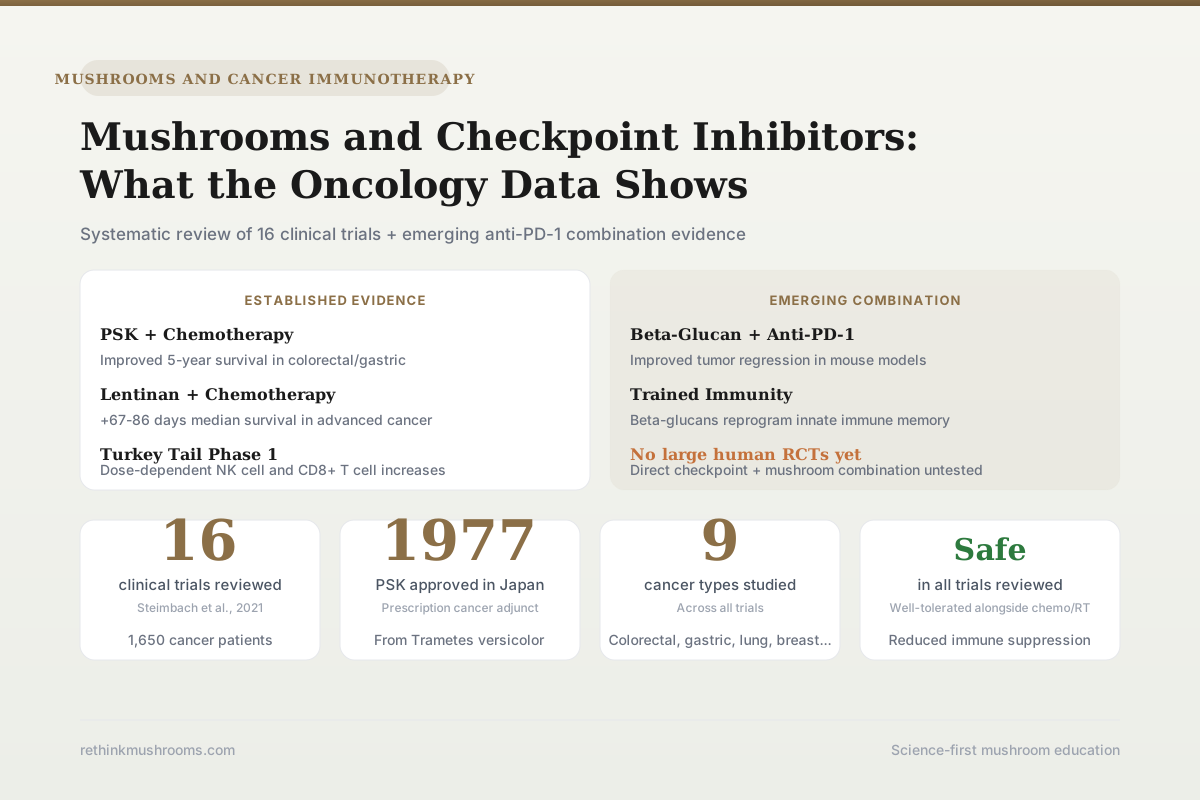
A systematic review of 16 clinical trials involving 1,650 cancer patients found that fungal beta-glucans administered alongside chemotherapy or radiotherapy were safe and reduced immune suppression in most studies.
Steimbach et al., Clinical Nutrition, 2021
1,650
cancer patients across reviewed trials
PSK/Krestin
most studied mushroom compound in oncology
Anti-PD-1
combination data still preclinical
Steimbach et al., Clinical Nutrition, 2021
 View as image ↗
Checkpoint inhibitors (anti-PD-1, anti-PD-L1, anti-CTLA-4) have transformed oncology by releasing the brakes on the immune system's ability to attack tumors. The response rates, however, are far from universal. Depending on tumor type, 60 to 80% of patients do not respond to checkpoint blockade alone. This has driven interest in combination strategies that could prime the immune system to respond better when the checkpoint brake is released. Mushroom-derived beta-glucans, which activate innate immune cells through the Dectin-1 receptor, are one candidate for this priming role. The evidence base is split across two eras: decades of clinical trials testing mushroom polysaccharides alongside conventional chemotherapy (mostly in Japan and China), and a newer wave of preclinical work specifically combining beta-glucans with checkpoint inhibitors. This article covers both. For the underlying immune mechanisms, see beta-glucans and anti-tumor immunity: mechanisms explained. For the specific beta-glucan plus checkpoint combination data, see beta-glucans and checkpoint inhibitors: combination research.
Key Takeaways
- A systematic review of 16 clinical trials (1,650 cancer patients, 9 cancer types) found fungal beta-glucans administered alongside chemotherapy or radiotherapy were safe and reduced treatment-induced immune suppression in most studies (Steimbach et al., 2021)
- PSK (polysaccharopeptide from Trametes versicolor) is the most extensively studied mushroom compound in oncology and has been an approved adjunctive cancer treatment in Japan since 1977, where Japanese RCTs reported improved disease-free and overall survival when PSK was added to chemotherapy for colorectal and gastric cancer
- A phase 1 trial of Trametes versicolor in breast cancer patients post-treatment found dose-dependent increases in NK cell functional activity and CD8+ T cell counts at 6 and 9 g/day doses (Torkelson et al., 2012)
- A pooled analysis of 38 randomized trials (3,117 lung cancer patients) found that adding injectable lentinan (a beta-glucan from shiitake) to platinum-based chemotherapy raised the objective response rate from 43.3% to 56.9% and improved quality of life across 12 years of Chinese clinical studies (Zhang et al., 2018)
- PSK activates gamma delta T cells through TLR2-mediated signaling, a distinct T cell population that can kill tumor cells without requiring antigen presentation by MHC molecules (Inatsuka et al., 2013)
- Direct combination of mushroom beta-glucans with anti-PD-1/PD-L1 checkpoint inhibitors has been tested only in preclinical models and small early-phase trials as of 2026; the most direct human test, a phase Ib/II trial of the beta-glucan Imprime PGG plus pembrolizumab in lung cancer, was safe but did not improve outcomes (Furqan et al., 2024)
What Checkpoint Inhibitors Do and Why They Sometimes Fail
Checkpoint inhibitors work by blocking inhibitory receptors (PD-1, PD-L1, CTLA-4) on T cells or tumor cells. Tumors exploit these checkpoints to evade immune detection: by expressing PD-L1 on their surface, cancer cells send a "don't attack me" signal to T cells bearing PD-1. Blocking this interaction with a monoclonal antibody allows T cells to recognize and kill tumor cells.
The approach fails when the immune system has not been adequately primed against the tumor in the first place. If there are few tumor-infiltrating lymphocytes (a "cold" tumor microenvironment), releasing the checkpoint brake has no effect because there are no activated T cells to release. This is why combination strategies focus on immune priming: get immune cells into the tumor first, then remove the checkpoint brake.
Beta-glucans from mushrooms activate innate immune cells (macrophages, dendritic cells, NK cells) through the Dectin-1 receptor, which recognizes the 1,3/1,6 branched glucan structure found in fungal cell walls. This activation can theoretically convert a "cold" tumor into a "hot" one by recruiting and activating immune cells at the tumor site. The question is whether this theoretical mechanism translates to clinical benefit when combined with checkpoint blockade.
The Established Evidence: Mushroom Polysaccharides With Chemotherapy
Steimbach 2021 Systematic Review
Steimbach et al. (2021) conducted a PRISMA-compliant systematic review of clinical trials testing fungal beta-glucans as adjuvants in cancer patients. From 1,018 articles, they included 16 trials involving 1,650 patients across 9 cancer types, with individual arm sizes ranging from 9 to 200 patients. The studies spanned 1992 to 2018.[1]
The review found that beta-glucan administration was safe and well-tolerated across all trials. Most studies reported that concurrent beta-glucan administration reduced the immune depression caused by chemotherapy or radiotherapy and accelerated white blood cell recovery. Some trials reported no statistically significant difference between beta-glucan and control groups, making the overall conclusion mixed rather than definitive.
The beta-glucans tested across the 16 trials came from several sources: baker's yeast (Saccharomyces cerevisiae), mushrooms including shiitake (Lentinula edodes, the source of lentinan) and split-gill fungus (Schizophyllum commune, the source of schizophyllan), and other undescribed fungal preparations. Separately from this review, the strongest oncology evidence base for any single mushroom compound belongs to PSK (polysaccharopeptide Krestin, from Trametes versicolor): Japanese RCTs of PSK added to standard chemotherapy for colorectal and gastric cancer reported improved disease-free and overall survival, and these results led to PSK's approval as a prescription adjunctive cancer treatment in Japan in 1977.
Lentinan in Chinese Lung Cancer
Zhang et al. (2018) reviewed 12 years of Chinese clinical studies testing lentinan as an immunotherapeutic adjunct for lung cancer, pooling 38 randomized controlled trials that together enrolled 3,117 patients. Adding injectable lentinan to platinum-based chemotherapy raised the mean objective response rate from 43.3% with chemotherapy alone to 56.9% with the combination (pooled relative risk 0.79, 95% CI 0.74 to 0.85, with no significant heterogeneity between studies). The review also reported improved quality-of-life scores and reduced chemotherapy side effects in the lentinan groups.[2]
A roughly 14-percentage-point gain in response rate is meaningful for patients with advanced disease, where few adjuncts add measurable benefit. The mechanism appears to be immune support during chemotherapy rather than direct anti-tumor activity: lentinan helped maintain white blood cell and lymphocyte counts during treatment, allowing patients to tolerate and complete more chemotherapy.
Turkey Tail Phase 1 Trial in Breast Cancer
Torkelson et al. (2012) conducted a phase 1 dose-escalation trial of Trametes versicolor (turkey tail mushroom) in 9 women with breast cancer who had completed standard treatment (surgery, chemotherapy, and/or radiotherapy). Patients received 3, 6, or 9 g/day of turkey tail mushroom preparation for 6 months.[3]
The primary endpoint was safety, which was confirmed at all dose levels. The immunological findings were the more interesting result: NK cell functional activity increased in a dose-dependent manner at 6 and 9 g/day, and CD8+ T cell counts (the cytotoxic T cells that directly kill tumor cells) also increased. These are exactly the immune cell populations that checkpoint inhibitors need to be present and active to work. While the trial was not designed to test efficacy against cancer recurrence and was too small (n = 9) to draw clinical conclusions, the immunological direction was favorable.
Stamets (2012) provided additional context on Trametes versicolor for breast cancer, reviewing the preclinical evidence for PSP (polysaccharopeptide) and PSK from turkey tail mushrooms, including immune activation through toll-like receptors and increased dendritic cell maturation.[4]
How PSK Activates a Distinct Anti-Tumor Immune Pathway
Inatsuka et al. (2013) demonstrated that PSK activates gamma delta T cells, a distinct T cell population that can recognize and kill tumor cells without requiring conventional antigen presentation through MHC molecules. PSK stimulated gamma delta T cell proliferation and cytotoxicity through TLR2-mediated signaling. When PSK-activated gamma delta T cells were transferred into tumor-bearing mice, they suppressed tumor growth.[5]
This finding is relevant to the checkpoint inhibitor question for a specific reason. Conventional checkpoint inhibitors primarily affect alpha beta T cells (the standard adaptive immune T cells). Gamma delta T cells operate partly in the innate immune system and are less dependent on checkpoint signaling. A combination approach using mushroom beta-glucans to activate gamma delta T cells alongside checkpoint inhibitors to unleash alpha beta T cells could theoretically engage two complementary arms of anti-tumor immunity simultaneously.
Beta-Glucan Mechanisms in Immune and Cancer Cells
Chan et al. (2009) reviewed the effects of beta-glucan on human immune cells and cancer cells. In immune cells, beta-glucan binding to Dectin-1 triggers phagocytosis, respiratory burst, and production of pro-inflammatory cytokines (TNF-alpha, IL-1beta, IL-6). Beta-glucans also prime neutrophils for enhanced complement-mediated killing of antibody-coated tumor cells. In some cancer cell lines, beta-glucans showed direct anti-proliferative effects, though this is less consistently demonstrated than the immune activation effects.[6]
The Dectin-1 pathway is particularly relevant for combination with checkpoint inhibitors because Dectin-1 activation triggers dendritic cell maturation. Mature dendritic cells present tumor antigens to T cells more effectively, which increases the number of tumor-specific T cells available to be "released" by checkpoint blockade. This priming-then-releasing sequence is the theoretical basis for the combination approach. For recent research on trained immunity from beta-glucans, see beta-glucans and innate immune memory: beyond adaptive immunity.
Emerging Data on Direct Combinations
Evidence · Closest to the Question → Furthest
How Strong Is the Case for Combining Mushrooms With Checkpoint Inhibitors?
The mushroom-oncology evidence is strongest for the setting we are not asking about (β-glucans alongside chemotherapy) and weakest for the one we are: the single direct human trial of a β-glucan plus an anti-PD-1 drug was safe but showed no benefit.
- 1
Mushroom β-glucan + chemotherapy
Strong evidenceA different setting, not checkpoint therapy
A systematic review of 16 trials (1,650 patients) found fungal β-glucans safe and able to reduce chemo/radiotherapy-induced immune suppression (Steimbach 2021). A pooled analysis of 38 RCTs (3,117 lung-cancer patients) found injectable lentinan raised the objective response rate from 43.3% to 56.9% (Zhang 2018).
Refs 1, 2
- 2
Human immune-priming signal
Suggestive signalDo β-glucans raise the immune cells checkpoint drugs need?
A phase 1 trial of turkey tail (Trametes versicolor) in breast-cancer patients found dose-dependent increases in NK-cell activity and CD8+ T-cell counts at 6 and 9 g/day (Torkelson 2012) — the exact cells checkpoint inhibitors rely on.
Ref 3
- 3
Preclinical checkpoint combination
Preclinical onlyDoes adding β-glucan help anti-PD-1/PD-L1 in animals?
In a tumor mouse model, whole glucan particle β-glucan plus PD-1/PD-L1-blocking antibodies increased immune-cell recruitment and delayed tumor progression versus checkpoint blockade alone (Wang 2022).
Ref 10
- 4
Direct human checkpoint combination
Tested, no benefitDoes it work in patients on checkpoint therapy?
A phase Ib/II trial (BTCRC LUN 15-017) of the β-glucan Imprime PGG plus pembrolizumab in 33 previously treated NSCLC patients was safe but did not improve outcomes: objective response rate 10%, median PFS 2.6 months. Most had already progressed on anti-PD-1/PD-L1 therapy (Furqan 2024).
Ref 11
Read top to bottom, the evidence gets thinner exactly as it gets closer to the clinical question. The preclinical rationale is real, but it has not yet translated into a positive human checkpoint-combination trial.
Sources: Steimbach et al. (2021); Zhang et al. (2018); Torkelson et al. (2012); Wang et al. (2022); Furqan et al. (2024)
Beta-Glucan Plus Anti-PD-1/PD-L1
Preclinical work has directly tested beta-glucan combined with checkpoint inhibitors. In a tumor mouse model, whole glucan particle (WGP) beta-glucan combined with PD-1/PD-L1-blocking antibodies increased the recruitment of immune-associated cells into the tumor, improved the balance between T cell activation and immune tolerance, and delayed tumor progression compared with checkpoint blockade alone (Wang et al., 2022).[10] The proposed mechanism is that beta-glucan recruits and activates myeloid cells in the tumor microenvironment, which then present tumor antigens to T cells; when the PD-1 checkpoint is simultaneously blocked, these newly primed T cells can attack the tumor without inhibition.
Human data are early and, so far, sobering. A phase Ib/II trial (BTCRC LUN 15-017) combined Imprime PGG, a pharmaceutical-grade 1,3/1,6 beta-glucan, with the anti-PD-1 antibody pembrolizumab in 33 patients with previously treated advanced non-small cell lung cancer (Furqan et al., 2024).[11] The combination was safe (maximum tolerated dose 4 mg/kg, no dose-limiting toxicities), but it did not improve outcomes: the confirmed objective response rate was 10%, median progression-free survival was 2.6 months, and prior immunotherapy predicted worse survival. Critically, most patients had already progressed on anti-PD-1/PD-L1 therapy, and adding a beta-glucan did not overcome that resistance. This is the most direct human test of the combination to date, and its negative result tempers the optimism generated by the preclinical models.
Ganoderma lucidum and Gut-Immune Axis
Guo et al. (2021) demonstrated that Ganoderma lucidum polysaccharide (from reishi mushroom) modulated gut microbiota composition and inhibited colon tumorigenesis in an animal model. The anti-tumor effect was mediated through immune cell function: the polysaccharide increased intestinal IgA production, enhanced T cell infiltration into tumors, and shifted the macrophage population toward the anti-tumor M1 phenotype.[7]
This gut-immune connection is increasingly recognized as relevant to checkpoint inhibitor response. Patients with diverse gut microbiota respond better to anti-PD-1 therapy. If mushroom polysaccharides can favorably shift gut microbiota composition (which multiple studies suggest they do), this could represent an additional mechanism by which mushroom consumption supports checkpoint inhibitor efficacy, separate from the direct Dectin-1 immune activation pathway.
Agaricus blazei and Trained Immunity
Xu et al. (2024) showed that Agaricus blazei polysaccharide exerted preventive anti-tumor immune effects on colorectal cancer with intraperitoneal metastasis through a mechanism involving trained immunity. Trained immunity is a form of innate immune memory in which prior exposure to microbial components (including beta-glucans) reprograms innate immune cells to respond more vigorously to subsequent challenges, including tumor cells.[8]
Timm et al. (2023) reviewed the broader landscape of mushroom beta-glucan applications in immunotherapy, noting that the structural diversity of mushroom glucans (varying in molecular weight, branching patterns, and protein conjugation) creates opportunities for optimizing immune activation profiles for different therapeutic contexts.[9]
What Remains Unknown
The gap between the existing evidence and the clinical question "should cancer patients take mushroom supplements during checkpoint inhibitor therapy?" is substantial.
No large RCT has tested the combination. The PSK and lentinan trials that show survival benefits used these compounds alongside conventional chemotherapy, not checkpoint inhibitors. The immune mechanisms are different: chemotherapy suppresses the immune system (and beta-glucans help restore it), while checkpoint inhibitors activate the immune system (and beta-glucans might amplify that activation). Whether the interaction is additive, synergistic, or potentially antagonistic in humans is unknown.
Dose and formulation matter. The beta-glucan content of mushroom supplements varies enormously by species, extraction method, and commercial product. PSK and lentinan used in Japanese and Chinese clinical trials are pharmaceutical-grade, standardized preparations. Over-the-counter mushroom supplements are not equivalent. For more on how mushroom species differ in their beta-glucan profiles, see can mushrooms make immunotherapy more effective?.
Autoimmune risk is theoretical but real. Checkpoint inhibitors already carry a risk of autoimmune side effects (immune-related adverse events or irAEs) because they remove immune restraints. Adding an immune-activating agent like beta-glucan could theoretically increase this risk. No clinical data directly address this concern. This article is educational and is not medical advice; anyone undergoing cancer treatment should consult their oncologist before starting any mushroom supplement, as supplements can interact with therapy.
The evidence base is geographically concentrated. Most clinical trials of mushroom polysaccharides in oncology were conducted in Japan and China, where these compounds have regulatory approval and cultural acceptance. Western oncology has largely not incorporated these findings into standard practice, partly because of the different regulatory framework and partly because the trial designs often do not meet Western evidence standards (many were not double-blinded or placebo-controlled). For the broader discussion of how mushroom compounds relate to anti-PD-1 specifically, see mushroom compounds and anti-PD-1 therapy: preclinical evidence.
The Bottom Line
Mushroom-derived beta-glucans (PSK, lentinan, and others) have a decades-long track record of clinical trials showing safety and modest survival benefits when added to conventional chemotherapy in cancer patients. The theoretical rationale for combining these compounds with checkpoint inhibitors is strong: beta-glucans activate innate immune cells and may convert "cold" tumors into "hot" ones amenable to checkpoint blockade. Preclinical data support this combination, but the first direct human test, a phase Ib/II trial of the beta-glucan Imprime PGG plus pembrolizumab in lung cancer, found the combination safe yet without improved outcomes. Large randomized trials testing the specific combination of mushroom beta-glucans with anti-PD-1/PD-L1 therapy in humans do not yet exist.
Frequently Asked Questions
Sources & References
- 1RTHM-00719·Steimbach, Laiza et al. (2021). “Fungal beta-glucans as adjuvants for treating cancer patients - A systematic review of clinical trials..” Clinical nutrition (Edinburgh.Study breakdown →PubMed →↩
- 2RTHM-00538·Zhang, Yiran et al. (2018). “Lentinan as an immunotherapeutic for treating lung cancer: a review of 12 years clinical studies in China..” Journal of cancer research and clinical oncology.Study breakdown →PubMed →↩
- 3RTHM-00267·Torkelson, Carolyn J et al. (2012). “Phase 1 Clinical Trial of Trametes versicolor in Women with Breast Cancer..” ISRN oncology.Study breakdown →PubMed →↩
- 4RTHM-00264·Stamets, Paul (2012). “Trametes versicolor (Turkey Tail Mushrooms) and the Treatment of Breast Cancer..” Global advances in health and medicine.Study breakdown →PubMed →↩
- 5RTHM-00291·Inatsuka, Carol et al. (2013). “Gamma delta T cells are activated by polysaccharide K (PSK) and contribute to the anti-tumor effect of PSK..” Cancer immunology.Study breakdown →PubMed →↩
- 6RTHM-00151·Chan, Godfrey Chi-Fung et al. (2009). “The effects of beta-glucan on human immune and cancer cells..” Journal of hematology & oncology.Study breakdown →PubMed →↩
- 7RTHM-00690·Guo, Cuiling et al. (2021). “Ganoderma lucidum polysaccharide modulates gut microbiota and immune cell function to inhibit inflammation and tumorigenesis in colon..” Carbohydrate polymers.Study breakdown →PubMed →↩
- 8RTHM-00916·Xu, Yongzhao et al. (2024). “Preventive intervention with Agaricus blazei murill polysaccharide exerts anti-tumor immune effect on intraperitoneal metastasis colorectal cancer..” International journal of biological macromolecules.Study breakdown →PubMed →↩
- 9RTHM-00854·Timm, Thaynã Gonçalves et al. (2023). “Mushroom β-glucans: application and innovation for food industry and immunotherapy..” Applied microbiology and biotechnology.Study breakdown →PubMed →↩
- 10RTHM-02281·Wang, Meng et al. (2022). “β-Glucan Combined With PD-1/PD-L1 Checkpoint Blockade for Immunotherapy in Patients With Advanced Cancer..” Frontiers in pharmacology.Study breakdown →PubMed →↩
- 11RTHM-02282·Furqan, Muhammad et al. (2024). “Phase Ib/II study of imprime PGG and pembrolizumab in patients with previously treated advanced non-small cell lung cancer (NSCLC): BTCRC LUN 15-017..” Translational lung cancer research.Study breakdown →PubMed →↩