Mushrooms & Cancer
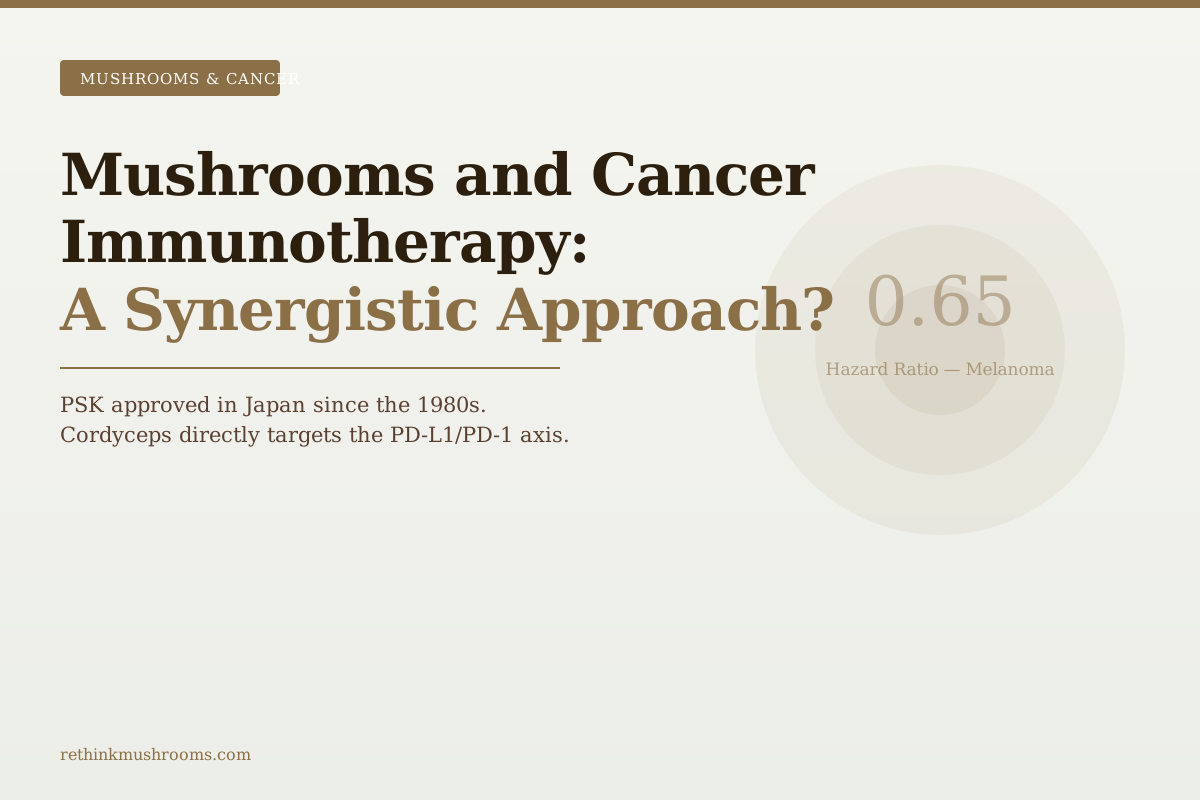
0.65 HR (melanoma)
A 2026 review of beta-glucan oncology research found an overall survival hazard ratio of 0.65 for melanoma and 0.72 for lung cancer in patients receiving beta-glucan alongside checkpoint inhibitor therapy, suggesting meaningful survival benefit.
Ameri Shah Reza et al., Naunyn Schmiedeberg's Arch Pharmacol, 2026
1980s
PSK (krestin from turkey tail) approved as cancer immunotherapy in Japan, providing decades of clinical safety data
PD-L1/PD-1
the checkpoint inhibitor axis that Cordyceps polysaccharide directly inhibits in tumor-associated macrophages in lab research
Resistance
reversal: a 2022 clinical study found beta-glucan improved outcomes in patients who had already failed anti-PD-1/PD-L1 therapy
Ameri Shah Reza et al., Naunyn Schmiedeberg's Arch Pharmacol, 2026
 View as image ↗
Medicinal mushrooms have been used alongside cancer treatment for decades. What has changed in recent years is the precision of the mechanism. The modern claim is not simply that mushrooms "boost the immune system" in a general sense. It is that specific mushroom polysaccharides appear to interact with the same molecular checkpoint that pembrolizumab and nivolumab target.
That specific claim deserves careful examination. This article covers the historical clinical foundation, the mechanistic research connecting mushroom compounds to checkpoint inhibitor biology, and the emerging clinical data, including findings from patients who had stopped responding to immunotherapy. It is part of the broader mushrooms and cancer treatment guide.
Key Takeaways
- PSK (polysaccharide K from turkey tail mushroom) has been approved as a cancer immunotherapy drug in Japan since the 1980s, providing a decades-long clinical evidence base that distinguishes it from most alternative supplements
- Cordyceps militaris polysaccharide specifically inhibited the PD-L1/PD-1 axis between tumor-associated macrophages and T lymphocytes in a 2020 in vitro study, the same molecular target of modern checkpoint inhibitor drugs
- A 2022 clinical study found that beta-glucan combined with re-challenge on anti-PD-1/PD-L1 therapy improved progression-free survival in patients with advanced cancer who had previously discontinued checkpoint therapy due to disease progression
- A 2024 study found that Ganoderma lucidum polysaccharide (GLP) combined with anti-PD-1 monoclonal antibody enhanced immunotherapy efficacy beyond either alone in colorectal cancer models, increasing CD8+ T cells and decreasing immunosuppressive Tregs
- Ganoderic acid T, a Ganoderma triterpenoid, enhanced anti-PD-L1 antibody efficacy in ovarian cancer models by downregulating galectin-1 and increasing tumor-infiltrating lymphocytes
- A 2026 comprehensive review of beta-glucan oncology research found hazard ratios of 0.65 (melanoma) and 0.72 (lung cancer) in patients receiving beta-glucan alongside checkpoint inhibitor therapy
PSK: The Mushroom Compound That Has Been Cancer Immunotherapy Since the 1980s
The claim that mushroom compounds interact synergistically with cancer immunotherapy is not speculation. It has a historical foundation in clinical medicine that most consumer content ignores entirely.
PSK, also called krestin, is a polysaccharide extract from Trametes versicolor (turkey tail mushroom). It was approved as a cancer immunotherapy drug in Japan in the 1980s and has been used alongside standard cancer treatment in Japanese oncology for more than 40 years. A 2002 review of PSK's mechanisms documented how it activates natural killer cells, T cells, and macrophages; enhances cytokine production; and reduces the immunosuppression that tumors use to evade immune attack.[1]
This is not alternative medicine. PSK is a pharmaceutically manufactured, regulated product with a clinical record spanning thousands of cancer patients. When the question is whether mushroom compounds can work alongside cancer immunotherapy, PSK is the answer that already exists in clinical use and has existed for four decades.
Fritz and colleagues published a 2015 systematic review of PSK and Coriolus versicolor extracts specifically for lung cancer, finding beneficial immunomodulatory effects and the potential to enhance survival outcomes.[4] The systematic review found the clinical evidence supportive, with PSK established as the most extensively studied mushroom polysaccharide in oncology.
This historical depth matters for context: the modern checkpoint inhibitor research is not a new hypothesis being tested on an untried substance. It is asking whether a class of compounds with 40 years of oncology use has specific mechanistic relevance to the newest generation of cancer immunotherapies.
How Checkpoint Inhibitors Work and Where Mushrooms Enter
Modern cancer immunotherapy drugs like pembrolizumab (Keytruda) and nivolumab (Opdivo) work by blocking the PD-1/PD-L1 checkpoint pathway. PD-1 is a receptor on T cells (immune cells that destroy cancer cells). PD-L1 is a protein expressed on tumor cells and on tumor-associated macrophages. When PD-L1 binds to PD-1, it sends a "stop attacking" signal to the T cell, effectively disguising the tumor as safe tissue.
Checkpoint inhibitor drugs block this interaction. By preventing PD-L1 from binding to PD-1, they allow T cells to continue recognizing and attacking tumor cells. The result, in tumors that respond, is a dramatic activation of anti-tumor immunity. In some patients, checkpoint inhibitor therapy produces durable complete remissions.
The limitation is resistance. Roughly half of patients do not respond initially (primary resistance), and many who respond initially eventually progress (acquired resistance). Overcoming checkpoint inhibitor resistance is one of the major unsolved problems in oncology.
Mushroom polysaccharides enter this picture through two pathways. First, several mushroom compounds appear to independently modulate the same PD-L1/PD-1 axis that checkpoint inhibitors target. Second, by activating a different set of immune receptors (pattern recognition receptors including Dectin-1, TLR-2, and CR3), they recruit additional immune cell populations that checkpoint inhibitors don't directly address.
Cordyceps Polysaccharide and the PD-L1/PD-1 Axis: The Most Direct Connection
The most mechanistically specific study connecting a mushroom compound to checkpoint inhibitor biology was published in 2020 by Bi and colleagues, studying Cordyceps militaris polysaccharide.[2]
The title of the paper states the finding directly: "Cordyceps militaris polysaccharide converts immunosuppressive macrophages into M1-like phenotype and activates T lymphocytes by inhibiting the PD-L1/PD-1 axis between TAMs and T lymphocytes."
What this means: Tumor-associated macrophages (TAMs) are a major mechanism through which tumors suppress immune response. TAMs typically adopt an M2 immunosuppressive phenotype and express PD-L1, which they use to shut down T lymphocytes that enter the tumor microenvironment. The Cordyceps polysaccharide converted these immunosuppressive M2 macrophages to pro-immune M1 macrophages AND specifically inhibited the PD-L1/PD-1 interaction between TAMs and T cells.
This is not a general "immune boost" claim. It is a specific mechanism that directly parallels the mechanism of pharmaceutical checkpoint inhibitor drugs, targeted at the same molecular interaction. The finding was made in cell culture (in vitro), not in clinical patients. But the mechanistic specificity is qualitatively different from most mushroom-cancer research, which typically shows general immune stimulation rather than checkpoint-specific activity.
For a comprehensive catalog of the preclinical evidence across mushroom compounds, species, and checkpoint inhibitor combinations, see Mushroom Compounds and Anti-PD-1 Therapy: Preclinical Evidence.
Reishi Polysaccharide Combined With Anti-PD-1 Antibody: The Colorectal Cancer Data
Li and colleagues (2024) published a study examining Ganoderma lucidum polysaccharide (GLP) both alone and in combination with an anti-PD-1 monoclonal antibody in colorectal cancer models (PMID: 38750669).
The key finding: while GLP alone inhibited tumor growth and activated anti-tumor immunity, the combination of GLP and anti-PD-1 further enhanced immunotherapy efficacy beyond either treatment alone. The immune cell profile in the combination group showed increased CD8+ cytotoxic T cells and Th1 helper cells alongside decreased immunosuppressive regulatory T cells (Tregs) in both the spleen and tumor tissue.
The mechanism: GLP supplementation appeared to shift the tumor microenvironment toward a more immunogenic state that amplified the anti-PD-1 antibody's ability to activate T cells. The polysaccharide and the antibody were not simply additive. Each created conditions that enhanced the other's activity.
This is preclinical data (animal model). It does not establish that the same combination would enhance immunotherapy in human patients. But it provides specific mechanistic rationale for the combination that researchers had not previously mapped in this detail.
The Resistance Reversal Question: Clinical Data From Failed Checkpoint Therapy
The most clinically striking finding in this space comes from a 2022 study by Wang and colleagues in Frontiers in Pharmacology (PMID: 35548349).
The study enrolled patients with advanced cancer who had previously discontinued anti-PD-1/PD-L1 therapy due to disease progression. These patients had already failed checkpoint inhibitor treatment. They had already failed checkpoint inhibitor treatment. These patients received beta-glucan combined with re-challenge on PD-1/PD-L1 blockade.
The outcome: progression-free survival improved in the beta-glucan combination group compared to patients receiving only continued checkpoint therapy. This suggests that beta-glucan may be capable of partially restoring checkpoint inhibitor sensitivity in patients who had become refractory to it.
If replicated in larger randomized trials, this finding would represent a significant clinical advance, addressing one of the major unmet needs in immunotherapy-treated patients. The study is a clinical study, not a randomized controlled trial, which limits the strength of conclusions that can be drawn. But the signal is real, and the patient population (failed checkpoint therapy) is one where alternative approaches are urgently needed.
In 2025, Wu and colleagues extended the beta-glucan plus checkpoint inhibitor combination to pancreatic cancer models (PMID: 41082797), one of the most immunotherapy-resistant cancer types. Beta-glucan combined with PD-1/PD-L1 checkpoint blockade suppressed pancreatic tumor growth after ablation therapy. This extends the potential application to a cancer type where checkpoint inhibitors alone have shown limited benefit.
Ganoderic Acid T: When Triterpenoids Enter the Picture
Most mushroom cancer research focuses on polysaccharides. A 2024 study published in Toxicology and Applied Pharmacology demonstrated that Ganoderma triterpenoids also have checkpoint inhibitor-relevant activity (PMID: 39142358).
Ganoderic acid T (GAT) downregulated galectin-1 (Gal-1) in the tumor microenvironment of ovarian cancer models. Galectin-1 is a protein expressed by cancer-associated fibroblasts that suppresses tumor-infiltrating lymphocytes and contributes to immune evasion. By reducing Gal-1, GAT reduced the cancer-associated fibroblast activity in the tumor and increased lymphocyte infiltration. When combined with anti-PD-L1 antibodies, the effect was significantly enhanced compared to anti-PD-L1 alone.
This finding matters because it adds a second independent mechanism from Ganoderma compounds. Galectin-1 suppression from the triterpenoid fraction complementing the PD-L1/PD-1 targeting from the polysaccharide fraction. The two Ganoderma compound classes appear to address different immunosuppressive pathways simultaneously.
What the 2026 Beta-Glucan Oncology Review Found
Ameri Shah Reza and colleagues published a comprehensive 2026 review of beta-glucan mechanisms in oncology, synthesizing the available evidence from preclinical studies and early clinical trials.[3]
The review documented four receptor activation pathways (Dectin-1, TLR, CR3, and scavenger receptors), M1/M2 macrophage polarization effects, PD-L1 downregulation across tumor types, and the synergistic effects observed with PD-1/PD-L1 checkpoint inhibitors in the clinical data available.
For survival data, the review identified hazard ratios from clinical evidence of 0.65 for melanoma and 0.72 for lung cancer in patients receiving beta-glucan alongside checkpoint inhibitor therapy. A hazard ratio below 1.0 indicates survival benefit relative to the control group. An HR of 0.65 for melanoma means the beta-glucan group had approximately 35% lower risk of death at any given time point during the study.
The 2026 review is the most current synthesis of this field. It frames beta-glucan as an emerging immunotherapy adjunct with a mechanistic rationale strong enough to have generated multiple combination clinical studies.
What Cancer Patients on Immunotherapy Should Know
The evidence summarized here is specific and real. It is also early-stage. The Cordyceps PD-L1/PD-1 study was in vitro. The Wang 2022 resistance-reversal data was a clinical study without randomized controls. The survival hazard ratio data comes from studies with varying designs and patient populations.
No oncology society has issued recommendations for mushroom supplements alongside checkpoint inhibitor therapy. Standard immunotherapy protocols do not include mushroom compounds.
The safety profile of mushroom compounds with checkpoint inhibitors specifically has not been comprehensively studied. PSK has 40 years of clinical safety data alongside conventional chemotherapy and has not shown adverse immune effects in that context. The immunosuppressive-agent concern relevant to transplant patients does not apply to checkpoint inhibitors, which work by removing suppression rather than adding it. However, combining any immune-modulating supplement with active immunotherapy requires the knowledge of the treating oncologist.
For cancer patients managing immunotherapy-related fatigue, quality of life data is covered separately in Mushrooms and Cancer Quality of Life: Fatigue, Sleep, and Emotional Well-Being Data. For the foundational mechanisms of how mushroom polysaccharides activate immune cells, see How Mushroom Sugars Activate Cancer-Fighting Immune Cells.
The Bottom Line
PSK from turkey tail mushroom has been cancer immunotherapy in Japan since the 1980s, establishing a clinical foundation for mushroom polysaccharides in oncology that predates modern checkpoint inhibitors. Cordyceps polysaccharide directly inhibits the PD-L1/PD-1 axis in tumor-associated macrophages in vitro, the same target as pembrolizumab and nivolumab. Ganoderma polysaccharide combined with anti-PD-1 antibody enhanced immunotherapy efficacy beyond either alone in colorectal cancer models. A 2022 clinical study found beta-glucan improved outcomes in patients who had failed checkpoint therapy. A 2026 review found hazard ratios of 0.65 and 0.72 for melanoma and lung cancer with beta-glucan plus checkpoint inhibitor therapy. The evidence is real and mechanistically specific. It is also early-stage, predominantly preclinical, and has not yet been translated into randomized trial recommendations.
Frequently Asked Questions
Sources & References
- 1RTHM-00089·Fisher, Monte et al. (2002). “Anticancer effects and mechanisms of polysaccharide-K (PSK): implications of cancer immunotherapy..” Anticancer research.Study breakdown →PubMed →↩
- 2RTHM-01171·Bi, Sixue et al. (2020). “Cordyceps militaris polysaccharide converts immunosuppressive macrophages into M1-like phenotype and activates T lymphocytes by inhibiting the PD-L1/PD-1 axis between TAMs and T lymphocytes..” International journal of biological macromolecules.Study breakdown →PubMed →↩
- 3RTHM-02222·Ameri Shah Reza, Mahdieh et al. (2026). “Beta-glucans in oncology: revolutionizing treatment with immune power & tumor targeting..” Naunyn-Schmiedeberg's archives of pharmacology.Study breakdown →PubMed →↩
- 4RTHM-00684·Fritz, Heidi et al. (2015). “Polysaccharide K and Coriolus versicolor extracts for lung cancer: a systematic review..” Integrative cancer therapies.Study breakdown →PubMed →↩