Mushrooms & Cancer
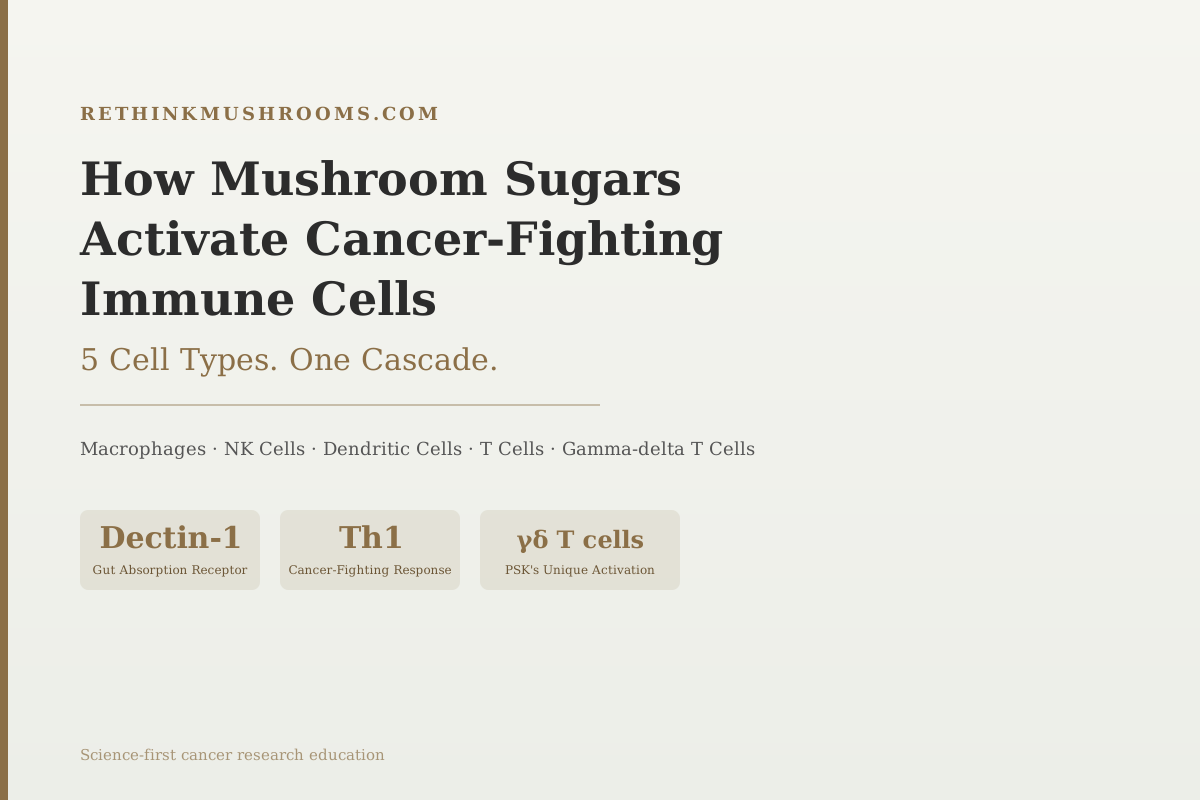
5 immune cell types activated
Mushroom polysaccharides activate five distinct cancer-fighting immune cell types: macrophages, NK cells, dendritic cells, cytotoxic T cells, and gamma-delta lymphocytes. Each reaches tumors through a different mechanism.
Maehara et al., Surg Today, 2012; Inatsuka et al., Cancer Immunol Immunother, 2013
Dectin-1
the gut receptor through which oral lentinan enters the lymphatic system to reach the immune system (Wang et al., 2024)
Th1
the cancer-fighting immune polarization that PSK and lentinan specifically drive, distinct from Th2 or immunosuppressive responses
Gamma-delta T cells
innate-like lymphocytes directly activated by PSK to kill tumors, a mechanism absent from most immune-boosting discussions (Inatsuka 2013)
Maehara et al., Surg Today, 2012; Inatsuka et al., Cancer Immunol Immunother, 2013
 View as image ↗
When people say mushrooms "boost the immune system," they are usually describing something vague. The actual mechanism is more specific: mushroom polysaccharides bind to pattern-recognition receptors on immune cells, triggering a cascade that activates five distinct cell types, each with a different anti-tumor function. This article explains how mushroom polysaccharides activate immune cells in the cancer context, from receptor binding to clinical evidence. For a broader overview of how these compounds fight tumors through multiple pathways, see mushroom polysaccharides and cancer: how they fight tumors. For the complete picture on medicinal mushrooms in cancer, see the complete guide to medicinal mushrooms in cancer treatment.
Key Takeaways
- Mushroom polysaccharides bind primarily to Dectin-1 and TLR4 pattern-recognition receptors on immune cells, triggering a Th1-polarized immune response specifically adapted for cancer defense (Ina et al., 2013; Maehara et al., 2012)
- Oral lentinan is absorbed through Dectin-1 receptors on M cells in Peyer's patches of the gut wall, then transported lymphatically to mononuclear phagocytes, explaining why oral administration produces systemic immune effects (Wang et al., 2024)
- PSK activates gamma-delta T cells, an innate-like lymphocyte population that kills tumors directly without prior antigen sensitization; this mechanism is absent from most discussions of mushroom immunity (Inatsuka et al., 2013)
- Maitake D-Fraction enhanced antitumor immune activity while simultaneously counteracting chemotherapy-induced immunosuppression in tumor-bearing mice (Kodama et al., 2005)
- A meta-analysis combining individual patient data found lentinan combined with chemotherapy significantly extended survival in unresectable gastric cancer vs. chemotherapy alone (Oba et al., 2009)
- Lentinan classified as a biological response modifier in Japan and China reached statistical significance for tumor response rate and 1-year survival in a meta-analysis of 17 trials across multiple advanced cancers (Wang et al., 2017)
Why Immune Activation Matters in Cancer
The immune system should be able to destroy cancer cells. When it works correctly, cytotoxic T cells and natural killer cells recognize transformed cells and eliminate them before they form tumors. The problem is that established tumors develop mechanisms to evade this surveillance: they suppress local immune activity, reduce the display of surface markers that identify them as foreign, and create an immunosuppressive microenvironment that disables the immune cells that enter it.
Mushroom polysaccharides work against this in two ways. First, they activate immune cells systemically, raising the baseline activity of NK cells, T cells, and macrophages throughout the body. Second, PSK specifically modulates the tumor microenvironment, helping to restore the Th1 (cancer-fighting) immune orientation in tissues that tumors had converted to immunosuppressive Th2 or Th3 activity.
This immune activation is distinct from what the word "boost" usually implies. Indiscriminate immune elevation would cause autoimmune disease. Polysaccharide activation is receptor-mediated and specifically directed toward innate and adaptive cancer-surveillance pathways. The distinction matters because it explains why decades of clinical use in Japan has not produced evidence of serious autoimmune complications.
How Oral Lentinan Gets From the Gut to the Immune System
One of the most frequently asked questions about mushroom polysaccharides as cancer adjuncts is whether oral administration actually works, or whether the polysaccharides are digested and inactivated before reaching the immune system. A 2024 mechanistic study provided the most detailed answer available.
Wang and colleagues examined how orally administered lentinan reaches the immune system in the body.[7] Lentinan is absorbed through Dectin-1 pattern-recognition receptors expressed on M cells, a specialized cell type in Peyer's patches (lymphoid tissue structures in the gut wall). From there, lentinan is transported through the lymphatic system to mononuclear phagocytes (macrophages and dendritic cells) in tissues throughout the body.
This Dectin-1/Peyer's patch pathway explains a long-standing question: how does a large polysaccharide molecule that cannot cross the intestinal epithelium by passive diffusion end up activating systemic immunity? The answer is that it uses an active receptor-mediated endocytic pathway specifically evolved to sample large bacterial cell wall components in the gut and relay that information to the immune system. Lentinan, which structurally resembles bacterial and fungal pathogen-associated patterns, uses the same pathway.
This finding is also relevant to dosing: the Peyer's patch mechanism is saturable, which may explain why there is a practical ceiling on how much immune stimulation is achievable through oral supplementation vs. injectable administration used in clinical protocols.
The 5 Immune Cells Mushroom Polysaccharides Activate Against Cancer
Once polysaccharides reach immune cells via the Dectin-1/TLR4 signaling axis, they activate a cascade of cell types with distinct anti-tumor functions.
1. Macrophages: the first responders
Macrophages express both Dectin-1 and TLR4, making them the primary initial targets of polysaccharide activation. When bound by PSK or lentinan, macrophages polarize toward the M1 phenotype: they increase production of inflammatory cytokines (TNF-alpha, IL-12, IFN-gamma) that alert other immune cells, upregulate phagocytic activity, and increase their capacity to present tumor antigens to T cells. Maehara and colleagues' comprehensive review of PSK established macrophage activation as the upstream event that initiates the entire cascade.[3]
2. Natural killer (NK) cells: tumor surveillance without sensitization
NK cells are innate immune cells that can destroy cancer cells without needing to learn their specific antigens first. PSK and lentinan both enhance NK cell activity, increasing the rate at which NK cells scan tissue for cells with reduced or absent surface markers characteristic of malignant transformation. This is particularly valuable in early tumor development when T-cell-mediated surveillance has not yet been primed. The Maehara 2012 review documented NK cell enhancement as one of PSK's four primary mechanisms.[3]
3. Dendritic cells: the teachers of adaptive immunity
Dendritic cells are the primary bridge between innate and adaptive immunity. They sample antigens from their environment, process them, and present peptide fragments to naive T cells to prime them against specific threats. Polysaccharide activation causes dendritic cell maturation: increased antigen presentation, greater production of IL-12 (which drives Th1 differentiation), and upregulated expression of co-stimulatory molecules that T cells need to become fully activated rather than tolerized.
This dendritic cell maturation step is why polysaccharides can work synergistically with cancer vaccines and checkpoint inhibitor immunotherapies: they improve the instructional capacity of the cells that train the adaptive immune response.
4. Cytotoxic T cells (CD8+): the precision killers
The downstream effect of activated dendritic cells presenting tumor antigens is the activation of CD8+ cytotoxic T lymphocytes. These cells, once primed against specific tumor antigens, become precision killers: they release perforin and granzyme proteins that punch holes in and trigger apoptosis specifically in cells displaying those antigens. PSK drives Th1 polarization of the overall response, meaning the activated T cells are predominantly of the cytotoxic/effector type rather than regulatory or helper types.[3]
Ina and colleagues documented the lentinan pathway specifically: TLR4 and Dectin-1 → MAPK signaling → Th1 cytokine production → CD8+ T-cell activation → tumor killing.[4] This is the most mechanistically detailed description of how a specific mushroom polysaccharide activates cytotoxic immunity against cancer.
5. Gamma-delta T cells: the innate assassins
This fifth immune cell type is the one most missing from mushroom immunity discussions. Gamma-delta T cells are a distinct T-cell lineage that combines properties of innate and adaptive immunity: they can kill tumor cells rapidly without antigen processing, respond to stress ligands that tumors express, and are present in high numbers in epithelial tissues (gut, lung, skin) where many cancers originate.
Inatsuka and colleagues demonstrated that PSK directly activates gamma-delta T cells and that this activation contributes to PSK's anti-tumor effect.[5] The mechanism involves direct PSK-induced cytokine production (IFN-gamma) by gamma-delta T cells and their subsequent cytotoxic activity against tumor targets. This finding distinguishes PSK from beta-glucan products that work only through macrophage and NK cell activation; PSK reaches a cell type that acts as an immediate tumor killer.
Th1 Polarization: Why the Direction of Immune Response Matters
Activating immune cells is not sufficient: the type of immune response matters. The immune system has multiple response modes. Th1 responses are characterized by IFN-gamma, TNF-alpha, and IL-12, and are specifically suited to fighting intracellular pathogens and tumors. Th2 responses drive allergy and parasite defense. Th3 and Treg responses suppress immune activity.
Cancer frequently drives Th2 or regulatory responses in the tumor microenvironment, suppressing the Th1 activity that would recognize and attack malignant cells. PSK specifically polarizes the immune response toward Th1: it increases Th1 cytokine production while reducing Th2 markers in tumor-bearing contexts.[3] This directional specificity is what distinguishes polysaccharide-mediated immune activation from non-specific stimulants that might amplify any immune response including immunosuppressive ones.
For the clinical drug context for how this Th1 activation is used in Japan-approved cancer protocols, see polysaccharide-based anti-cancer drugs from mushrooms. For the shiitake-specific lentinan story in depth, see lentinan: the shiitake compound approved for cancer treatment in Japan.
Maitake's Distinct Strategy: Counteracting Chemotherapy-Induced Immunosuppression
Maitake's D-Fraction provides a particularly instructive example of the clinical relevance of polysaccharide immune activation. Chemotherapy is itself profoundly immunosuppressive: it kills rapidly dividing cells, which includes not only cancer cells but also the hematopoietic precursors that produce immune cells. This creates a window of vulnerability during treatment when immune surveillance is compromised.
Kodama and colleagues demonstrated that Maitake D-Fraction, when combined with the chemotherapy drug mitomycin-C in tumor-bearing mice, enhanced the antitumor activity of the chemotherapy while simultaneously counteracting the chemotherapy-induced immunosuppression.[1] NK cell activity and T-cell levels were higher in the combination group than in chemotherapy alone, even though mitomycin-C would ordinarily deplete those populations. The D-Fraction appeared to provide a sustained immune-stimulating signal that partly offset the myelosuppressive effect of the chemotherapy.
This dual function (enhancing anti-tumor immunity while protecting immune cell populations against chemotherapy's depletion effects) is the mechanistic basis for the combination treatment protocols studied clinically in Japan. For the maitake-specific evidence on anti-tumor immunity, see how Maitake D-Fraction activates anti-tumor immunity.
Clinical Evidence: Does Immune Activation Translate to Survival?
Establishing a mechanistic pathway in cell culture or animal models is necessary but not sufficient. The immune activation must translate into clinical benefit for the evidence to matter.
Two meta-analyses provide the strongest clinical evidence for polysaccharide-mediated immune activation in cancer outcomes.
Oba and colleagues performed an individual patient-level meta-analysis of lentinan for unresectable or recurrent gastric cancer.[2] Individual patient meta-analyses pool raw data rather than summary statistics, and they represent a higher quality of evidence than conventional meta-analyses. The finding: lentinan combined with chemotherapy significantly extended median survival compared to chemotherapy alone in this difficult-to-treat population. The survival benefit correlated with immune response markers including NK cell activity and T-cell ratios, supporting the mechanistic hypothesis directly.
Wang and colleagues' 2017 meta-analysis pooled 17 randomized controlled trials of lentinan as a biological response modifier across multiple advanced cancer types.[6] Lentinan significantly improved tumor objective response rate (the proportion of patients whose tumors shrank or stabilized) and one-year survival rates versus chemotherapy alone, with an acceptable safety profile across the included studies.
A regulatory note: lentinan is approved for clinical use as a prescription injectable in Japan and China for gastric cancer and several other indications. PSK (Krestin) is approved in Japan for colorectal, gastric, and lung cancer. Neither is approved by the FDA in the United States. The clinical evidence from Japanese and Chinese trials should be understood in the context of approved medical use in those countries, not as evidence for over-the-counter supplementation.
The Bottom Line
Mushroom polysaccharides activate cancer-fighting immune cells through a receptor-mediated cascade: Dectin-1 and TLR4 recognition triggers M1 macrophage activation, dendritic cell maturation, NK cell enhancement, cytotoxic T-cell priming, and direct activation of gamma-delta T cells. The cascade is Th1-polarized, specifically suited to anti-tumor defense rather than allergy or immunosuppression. Oral lentinan reaches the immune system via Dectin-1 receptors on Peyer's patch M cells in the gut wall, transported lymphatically to mononuclear phagocytes. Clinical meta-analyses confirm the immune activation translates to survival benefit: lentinan combined with chemotherapy significantly extended survival in gastric cancer and improved response rates across multiple advanced cancer types. PSK and lentinan are approved clinical drugs in Japan; neither is FDA-approved.
Frequently Asked Questions
Sources & References
- 1RTHM-00161·Kodama, Noriko et al. (2005). “Maitake D-Fraction enhances antitumor effects and reduces immunosuppression by mitomycin-C in tumor-bearing mice..” Nutrition (Burbank.Study breakdown →PubMed →↩
- 2RTHM-00313·Oba, Koji et al. (2009). “Individual patient based meta-analysis of lentinan for unresectable/recurrent gastric cancer..” Anticancer research.Study breakdown →PubMed →↩
- 3RTHM-00475·Maehara, Yoshihiko et al. (2012). “Biological mechanism and clinical effect of protein-bound polysaccharide K (KRESTIN(®)): review of development and future perspectives..” Surgery today.Study breakdown →PubMed →↩
- 4RTHM-00528·Ina, Kenji et al. (2013). “The use of lentinan for treating gastric cancer..” Anti-cancer agents in medicinal chemistry.Study breakdown →PubMed →↩
- 5RTHM-00291·Inatsuka, Carol et al. (2013). “Gamma delta T cells are activated by polysaccharide K (PSK) and contribute to the anti-tumor effect of PSK..” Cancer immunology.Study breakdown →PubMed →↩
- 6RTHM-00921·Wang, Hui et al. (2017). “Efficacy of biological response modifier lentinan with chemotherapy for advanced cancer: a meta-analysis..” Cancer medicine.Study breakdown →PubMed →↩
- 7RTHM-02013·Wang, Kaiping et al. (2024). “Insights into oral lentinan immunomodulation: Dectin-1-mediated lymphatic transport from Peyer's patch M cells to mononuclear phagocytes..” Carbohydrate polymers.Study breakdown →PubMed →↩