Mushrooms & Cancer Research
4 mechanisms
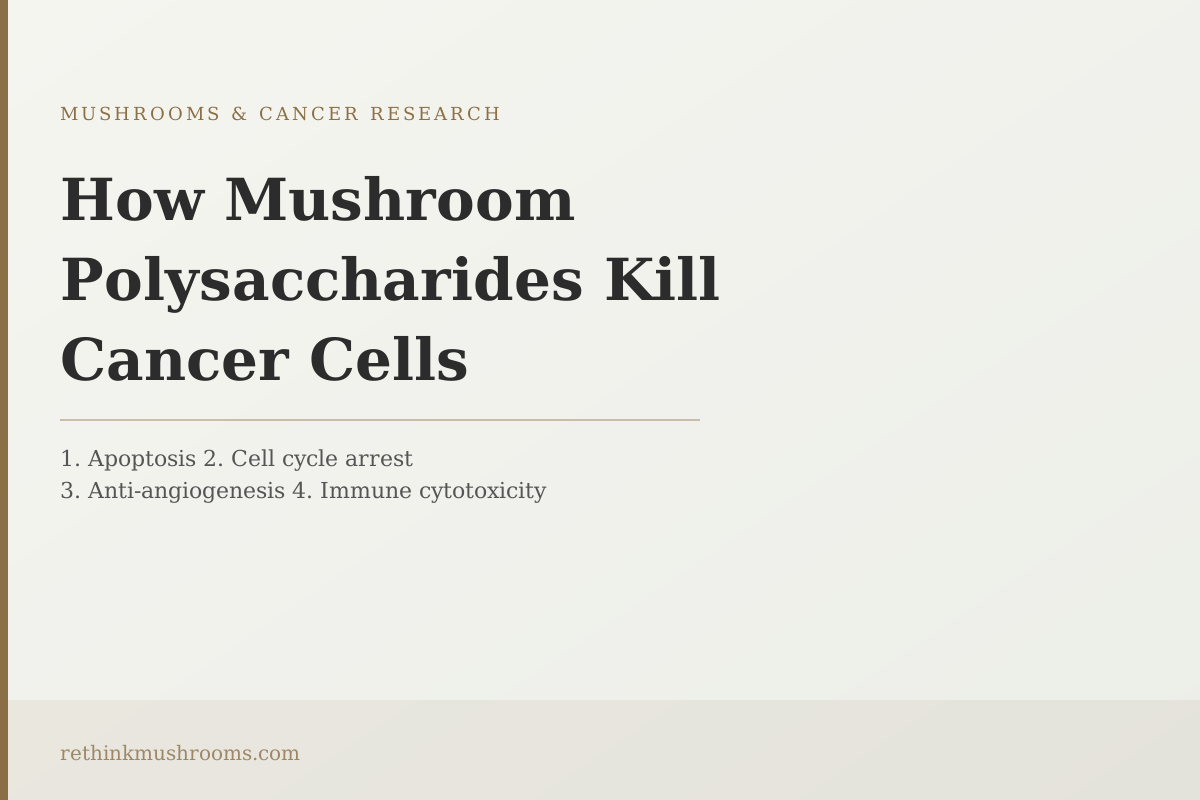
Laboratory research identifies four distinct pathways through which mushroom polysaccharides attack cancer cells: triggering programmed self-destruction, halting division, cutting off blood supply, and activating immune cells to kill tumors.
Wasser et al., Isr Med Assoc J, 2002; Maehara et al., Surg Today, 2012
Apoptosis
maitake D-fraction activated the BAK-1 self-destruct gene in breast cancer cells (Soares et al., 2011)
G2/M arrest
Phellinus polysaccharide locked colon cancer cells at the division checkpoint, preventing replication (Li et al., 2004)
Multi-target
Song 2011 showed a single polysaccharide simultaneously blocked tumor growth, invasion, and angiogenesis in one experiment
Wasser et al., Isr Med Assoc J, 2002; Maehara et al., Surg Today, 2012
 View as image ↗
Most descriptions of mushroom polysaccharides and cancer focus on one mechanism: immune activation. The idea is that beta-glucans stimulate macrophages, natural killer cells, and T cells, which then attack tumors. That mechanism is real, well-documented, and the basis for three polysaccharide-derived compounds approved as cancer treatments in Japan.
But the immune activation story is only part of what laboratory research has found. Polysaccharides from medicinal mushrooms also attack cancer cells through direct mechanisms that don't require immune system involvement at all. They can trigger cancer cells to self-destruct, stop cancer cells from dividing, and cut off the blood supply that tumors need to expand. Understanding all four mechanisms reveals why mushroom polysaccharides are a subject of serious oncological research, not just wellness marketing.
This article covers the preclinical mechanism research. For the clinical evidence and approved drugs (PSK, lentinan, schizophyllan), see Polysaccharide-Based Anti-Cancer Drugs from Mushrooms. For the full guide to mushrooms in cancer research, see Medicinal Mushrooms in Cancer Treatment: A Complete Guide.
Key Takeaways
- Mushroom polysaccharides attack cancer through four identified mechanisms: apoptosis (triggering cancer cell self-destruction), cell cycle arrest (halting division), anti-angiogenesis (cutting tumor blood supply), and immune-mediated cytotoxicity (arming immune cells to kill tumors)
- Maitake D-Fraction induced programmed cell death in breast cancer cells through BAK-1 pro-apoptotic gene activation, while Phellinus linteus activated multiple parallel caspase pathways in prostate cancer cells, a mechanistic redundancy that makes resistance less likely (Soares et al., 2011; Zhu et al., 2007)
- Phellinus linteus protein-bound polysaccharide arrested SW480 colon cancer cells at the G2/M checkpoint, the quality control gate before cell division completes, preventing further replication (Li et al., 2004)
- A single Phellinus polysaccharide simultaneously inhibited tumor cell growth, invasion capability, and angiogenesis in colon cancer cells while disrupting the Wnt/β-catenin signaling pathway, demonstrating multi-mechanism attack in one experiment (Song et al., 2011)
- Maitake D-Fraction altered the expression of multiple tumor-suppressor and oncogenes in breast cancer cells, providing gene-level evidence that polysaccharides actively rewrite cancer cell biology (Alonso et al., 2013)
- All four direct anti-cancer mechanisms are currently documented in cell culture and animal studies; clinical trials in humans have specifically studied the immune-activation mechanism (PSK, lentinan), not the direct cytotoxicity mechanisms
The Direct vs. Indirect Distinction
Polysaccharide anti-cancer research divides into two fundamentally different categories, and understanding the distinction clarifies what the evidence actually shows.
Indirect mechanisms work through the immune system. Beta-glucans bind Dectin-1 receptors on macrophages, dendritic cells, and other innate immune cells, activating them to recognize and attack tumors. This category also includes the enhancement of natural killer (NK) cells and T cells that can directly destroy cancer cells after immune activation. The clinical drugs PSK (from Turkey Tail) and lentinan (from shiitake) work primarily through these immune pathways, which is why clinical trials have been conducted and these compounds are approved for cancer treatment in Japan.
Direct mechanisms act on cancer cells themselves, without requiring immune cell involvement. This category includes:
- Triggering the cancer cell's built-in self-destruction program (apoptosis)
- Stopping cancer cells from completing the cell division cycle (cell cycle arrest)
- Blocking the formation of new blood vessels tumors require to grow (anti-angiogenesis)
A 2002 analysis by Wasser and colleagues established that PSK (the most clinically studied mushroom polysaccharide) operates through both indirect immune activation and direct antiproliferative effects on cancer cells, making it a dual-mechanism compound.[1] A 2012 comprehensive review by Maehara and colleagues confirmed this dual profile and mapped the specific immune and direct pathways involved in PSK's clinical anti-cancer activity.[2]
The direct mechanisms are documented primarily in cell culture (in-vitro) studies and some animal experiments. They are not yet the subject of clinical trials. This is an important distinction: the immune-mediated mechanisms have clinical human evidence; the direct cytotoxicity mechanisms have preclinical laboratory evidence.
Mechanism 1: Apoptosis (Making Cancer Cells Self-Destruct)
Every cell in the human body carries a built-in self-destruction program called apoptosis. When a cell is damaged, infected, or malignant, the program is supposed to activate: specific proteins called caspases (enzymes that systematically dismantle cellular machinery) begin a cascade that ends with the cell breaking apart into fragments that neighboring immune cells safely dispose of. In cancer cells, this program is typically suppressed or disabled, which is part of why cancer cells survive and multiply when normal cells would die.
Research has found that polysaccharides from several mushroom species can reactivate this suppressed self-destruction program in cancer cells.
A 2011 study by Soares and colleagues tested Maitake D-Fraction (a standardized beta-glucan extract from Grifola frondosa) on breast cancer cells in culture.[3] Maitake D-Fraction induced apoptosis through activation of BAK-1, a gene in the mitochondrial apoptosis pathway. BAK-1 functions as a gateway to the cell's self-destruct sequence: when it is switched on, it opens channels in mitochondrial membranes that release the molecular signals activating caspase cascades. In these breast cancer cells, the Maitake extract reactivated a pathway the cancer had suppressed.
A 2007 study by Zhu and colleagues, published in the British Journal of Cancer, found that Phellinus linteus (a medicinal mushroom common in Asian traditional medicine) activated not one but multiple parallel apoptosis pathways in prostate cancer cells.[4] Phellinus extract triggered both the intrinsic (mitochondrial, caspase-9-dependent) and extrinsic (death receptor, caspase-8-dependent) apoptosis pathways simultaneously, alongside cell cycle arrest.
The mechanistic redundancy documented by Zhu's team is significant. Single-target cancer drugs often lose effectiveness as cancer cells evolve resistance to one pathway. A compound that triggers two apoptosis pathways simultaneously provides a mechanistic explanation for why polysaccharide resistance might be harder to develop than resistance to single-target chemotherapy agents.
Mechanism 2: Cell Cycle Arrest (Locking the Division Gate)
Cancer cells divide uncontrollably, which is central to how tumors grow and spread. Normal cell division is regulated by a series of checkpoints (quality control gates that stop division if the cell's DNA is damaged or conditions aren't right). Cancer cells frequently bypass these checkpoints, continuing to divide despite damage that would trigger self-destruction in normal cells.
A 2004 study by Li and colleagues tested protein-bound polysaccharide from Phellinus linteus on SW480 human colon cancer cells in culture.[5] The polysaccharide arrested the cancer cells at the G2/M checkpoint, the gate between the final preparation phase and cell division itself. Cells stopped at G2/M cannot complete division and eventually undergo apoptosis.
G2/M arrest is a meaningful target because it represents the last point where division can be stopped before the cell creates two daughter cells that carry forward the cancer's genetic material. Polysaccharide-induced arrest at this checkpoint, combined with the apoptosis induction documented in other studies, means the compounds may simultaneously block cancer cell proliferation and eliminate existing cancer cells through multiple pathways.
The Zhu 2007 prostate cancer study confirmed G2/M arrest as an additional outcome alongside apoptosis in Phellinus linteus experiments, suggesting that cell cycle arrest and apoptosis induction frequently occur together as complementary anti-proliferative effects.
Mechanism 3: Anti-Angiogenesis (Cutting the Tumor's Blood Supply)
Tumors cannot grow beyond a few millimeters without recruiting a dedicated blood supply. They do this by secreting signaling proteins (primarily VEGF, vascular endothelial growth factor) that instruct nearby blood vessels to send out new branches into the tumor. This process is called angiogenesis. Tumors that cannot recruit adequate blood supply are starved of nutrients and oxygen and cannot grow or metastasize.
Anti-angiogenic drugs are a major category of cancer therapy, and research has found that mushroom polysaccharides have demonstrated anti-angiogenic properties in laboratory models.
A 2011 study by Song and colleagues, published in BMC Cancer, found that protein-bound polysaccharide from Phellinus linteus inhibited angiogenesis alongside tumor cell growth and invasion in SW480 colon cancer cells.[6] The Song study is notable for documenting all three direct anti-cancer mechanisms (growth inhibition, invasion inhibition, angiogenesis inhibition) from a single polysaccharide compound in one experimental system, providing an unusually integrated picture of how these effects co-occur.
The angiogenesis inhibition in the Song study operated through disruption of the Wnt/beta-catenin signaling pathway. Wnt/beta-catenin is a cell communication pathway frequently overactivated in colorectal cancer; it promotes cell survival, division, and the angiogenic signaling that recruits blood vessels. Phellinus polysaccharide's disruption of this pathway provides a molecular mechanism connecting polysaccharide exposure to angiogenesis reduction.
For a dedicated look at anti-angiogenic mushroom compounds and the evidence across multiple species, see Mushroom Anti-Angiogenic Compounds: Starving Tumors of Their Blood Supply.
Mechanism 4: Immune-Mediated Cytotoxicity (Arming the Killers)
The fourth mechanism is the one with the most clinical evidence: mushroom polysaccharides activate immune cells that are capable of directly recognizing and killing cancer cells.
Macrophages activated by polysaccharides shift toward a more aggressive tumor-fighting mode (M1 polarization) and directly kill tumor cells through reactive oxygen species and cytokine release. Natural killer (NK) cells, which are innate immune cells capable of destroying cancer cells without prior training, are enhanced in number and activity by polysaccharide treatment. Cytotoxic T cells (CD8+) are primed more effectively when dendritic cells receive polysaccharide-mediated activation signals.
The Maehara 2012 comprehensive review of PSK's mechanisms documented that these immune mechanisms, operating together, produce an immune environment in which cancer cells are at significantly higher risk of destruction by the body's own defense system.[2]
This is the mechanism category where clinical human evidence is strongest. Polysaccharide-derived drugs approved in Japan for clinical use (PSK/Krestin from Turkey Tail, lentinan from shiitake) work through immune activation and have demonstrated improved survival in randomized controlled trials for colorectal and gastric cancer when combined with chemotherapy.
For the immune activation mechanisms in the cancer context in more detail, see How Mushroom Sugars Activate Cancer-Fighting Immune Cells. For the clinical drugs and their approved indications, see Lentinan: The Shiitake Compound Approved for Cancer Treatment in Japan.
Why Multi-Mechanism Action Matters for Cancer Research
Single-target cancer treatments frequently encounter resistance. Cancer cells, evolving under the pressure of a targeted drug, can mutate or upregulate alternative pathways that bypass the drug's mechanism. This is a central challenge in oncology and one reason why combination chemotherapy (using multiple drugs targeting different pathways) became the standard of care for many cancers.
Polysaccharides present a different pharmacological profile. A 2013 study by Alonso and colleagues specifically investigated gene expression changes in breast cancer cells after Maitake D-Fraction treatment.[7] The analysis found both tumor-suppressor gene upregulation and oncogene downregulation. The polysaccharide was changing the expression of genes that cancer cells use to survive and proliferate. The gene expression changes were broad, affecting multiple pathways simultaneously rather than a single molecular target.
The multi-mechanism profile documented in the laboratory research suggests a potential explanation for why clinical resistance to polysaccharide-based drugs like PSK has not emerged as a clinical problem: cancer cells would need to simultaneously bypass four distinct killing mechanisms rather than one.
This is a hypothesis grounded in mechanistic laboratory data. Clinical trials are needed to confirm whether the multi-mechanism profile translates into real-world anti-resistance benefits in human cancer treatment.
What This Research Can and Cannot Tell Us
The mechanistic research summarized in this article was conducted in laboratory settings: cancer cells growing in dishes (in-vitro studies) and mouse cancer models (animal studies). These are essential first steps in understanding how compounds interact with cancer biology.
The gap between in-vitro and clinical outcomes in cancer research is wide. Many compounds that kill cancer cells in a dish do not produce the same effects in a living organism, where pharmacokinetics (how the body processes the compound), tumor microenvironment, and host immune status all affect whether the mechanism operates. Even among compounds that work in animal models, most do not demonstrate sufficient efficacy or safety to advance to human clinical trials.
The direct anti-cancer mechanisms described in this article (apoptosis induction, cell cycle arrest, anti-angiogenesis) have not been the subject of clinical trials in humans for mushroom polysaccharides. The clinical evidence base for mushroom polysaccharides in cancer treatment specifically covers the immune-activation mechanisms documented in PSK and lentinan clinical trials in Japan, where these compounds are approved for use alongside chemotherapy.
This means the four-mechanism framework presented here is currently a mechanistic research picture, not a clinical treatment framework. Researchers studying mushroom polysaccharides use this picture to develop hypotheses, design trials, and identify which compounds and mechanisms deserve the most clinical investigation.
The Bottom Line
Laboratory research has identified four distinct pathways through which mushroom polysaccharides attack cancer cells: triggering programmed cell death (apoptosis) through BAK-1 and caspase activation, halting division at cell cycle checkpoints (G2/M arrest), blocking tumor blood vessel formation (anti-angiogenesis), and activating immune cells to destroy tumors. Studies from multiple research groups using Phellinus linteus and Maitake D-Fraction have documented these mechanisms in human cancer cell lines, with the Song 2011 study notably showing all three direct mechanisms from one compound in a single experiment. The clinical evidence for mushroom polysaccharides in cancer specifically covers the immune-activation mechanism: PSK and lentinan are approved for clinical cancer treatment in Japan based on randomized controlled trial evidence. The direct cytotoxicity mechanisms remain at the preclinical research stage.
Frequently Asked Questions
Sources & References
- 1. Source details for this reference are not yet available.
- 2RTHM-00475·Maehara, Yoshihiko et al. (2012). “Biological mechanism and clinical effect of protein-bound polysaccharide K (KRESTIN(®)): review of development and future perspectives..” Surgery today.Study breakdown →PubMed →↩
- 3RTHM-00435·Soares, Raquel et al. (2011). “Maitake (D fraction) mushroom extract induces apoptosis in breast cancer cells by BAK-1 gene activation..” Journal of medicinal food.Study breakdown →PubMed →↩
- 4RTHM-00240·Zhu, T et al. (2007). “Phellinus linteus activates different pathways to induce apoptosis in prostate cancer cells..” British journal of cancer.Study breakdown →PubMed →↩
- 5RTHM-00140·Li, Ge et al. (2004). “Protein-bound polysaccharide from Phellinus linteus induces G2/M phase arrest and apoptosis in SW480 human colon cancer cells..” Cancer letters.Study breakdown →PubMed →↩
- 6RTHM-00437·Song, Kyoung-Sub et al. (2011). “Protein-bound polysaccharide from Phellinus linteus inhibits tumor growth, invasion, and angiogenesis and alters Wnt/β-catenin in SW480 human colon cancer cells..” BMC cancer.Study breakdown →PubMed →↩
- 7RTHM-00507·Alonso, Eliana Noelia et al. (2013). “Genes related to suppression of malignant phenotype induced by Maitake D-Fraction in breast cancer cells..” Journal of medicinal food.Study breakdown →PubMed →↩