Maitake D-Fraction & Cancer
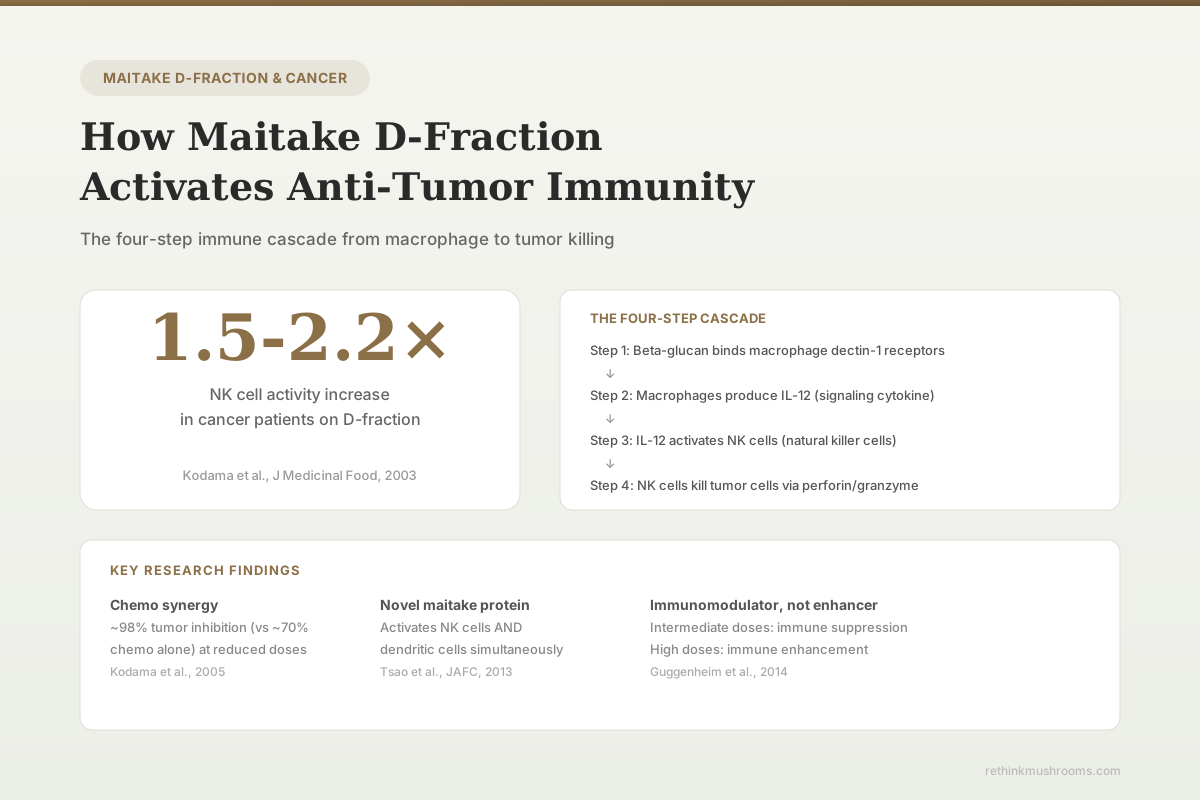
1.5-2.2× NK cell activity in cancer patients
In cancer patients treated with maitake D-fraction, natural killer cell activity increased 1.5 to 2.2 times baseline. NK cells are the immune system's frontline anti-tumor surveillance cells.
Kodama et al., Journal of Medicinal Food, 2003
4-step cascade
beta-glucan binds macrophage → IL-12 production → NK activation → tumor cytotoxicity
~98% inhibition
tumor inhibition when D-fraction combined with low-dose mitomycin-C in animal models
NK + dendritic
a novel maitake protein (non-glucan) activates both arms of anti-tumor immunity simultaneously
Kodama et al., Journal of Medicinal Food, 2003
 View as image ↗
Most immune-supporting supplements work in one of two ways: they either stimulate immune activity broadly, or they suppress inflammation. Maitake D-fraction does something more specific than either: it activates a particular arm of the immune system through a defined molecular sequence, and in cancer patients that sequence has been documented to produce measurable changes in the exact immune cells most relevant to tumor surveillance.
D-fraction is a beta-glucan polysaccharide extract from maitake mushroom (Grifola frondosa). Unlike many mushroom products described vaguely as "immune support," the D-fraction mechanism has been traced through four specific steps, from the molecular binding that starts the process to the tumor-killing activity that ends it. That mechanistic specificity is what separates the D-fraction research from most mushroom supplement literature.
For context on maitake's full range of documented effects and the history of D-fraction research, see what is maitake mushroom: the dancing mushroom explained. For the complete cancer evidence review, see maitake D-fraction and cancer: the complete research review.
Key Takeaways
- D-fraction activates anti-tumor immunity via a four-step cascade: beta-1,6-glucan binds macrophage surface receptors, stimulating IL-12 production; IL-12 activates NK cells; activated NK cells kill tumor cells (Kodama et al., Journal of Ethnopharmacology, 2005)
- NK cell activity increased 1.5 to 2.2× in cancer patients treated with D-fraction, with tumor marker decreases observed in all patients examined (Kodama et al., Journal of Medicinal Food, 2003)
- A novel non-beta-glucan protein isolated from maitake activated both NK cells and dendritic cells simultaneously, bridging innate and adaptive immunity in ways beta-glucan alone does not (Tsao et al., Journal of Agricultural and Food Chemistry, 2013)
- Combined D-fraction with low-dose mitomycin-C achieved approximately 98% tumor inhibition in mice, while D-fraction simultaneously reversed the immunosuppression caused by mitomycin-C at higher doses (Kodama et al., Nutrition and Cancer, 2005)
- D-fraction is an immunomodulator, not a simple immune enhancer: in the MSKCC phase I/II clinical trial, intermediate doses suppressed immune function while high doses enhanced it, a non-monotonic dose-response pattern with practical dosing implications (Guggenheim et al., Integrative Medicine, 2014)
- In a direct maitake-vs-shiitake comparison, maitake produced stronger NK cell activation than shiitake, though both enhanced T cell and macrophage activity (Vetvicka and Vetvickova, 2014)
The Four-Step Cascade: How D-Fraction Triggers Immune Activity
The mechanism runs from the surface of a macrophage to the killing of a tumor cell. Each step follows directly from the one before it.
Step 1: D-fraction binds macrophage surface receptors. Maitake D-fraction is a beta-1,6-glucan polysaccharide with beta-1,3-glucan branches. This molecular structure is recognized by pattern recognition receptors on macrophage surfaces, primarily dectin-1, which reads the beta-glucan as a signal associated with fungal pathogens. The macrophage responds to this signal as if it has detected microbial threat.
Step 2: Activated macrophages produce IL-12. Macrophage binding triggers the production of interleukin-12 (IL-12), a signaling protein. IL-12 is one of the primary cytokines the immune system uses to communicate between macrophages and natural killer cells. Kodama and colleagues demonstrated this cascade step directly in cell culture: D-fraction-stimulated macrophages produced IL-12 at measurably elevated levels, and blocking IL-12 attenuated the downstream NK activation.[1]
Step 3: IL-12 activates NK cells. Natural killer cells are lymphocytes specialized for detecting and killing cells that display markers of tumor transformation or viral infection. They do not require prior sensitization; unlike adaptive T cells, they can recognize and kill target cells on first contact. IL-12 from activated macrophages is one of the primary signals that puts NK cells into high-activity cytotoxic state.
Step 4: Activated NK cells kill tumor cells. NK cells in cytotoxic state release perforins and granzymes that punch holes in target cell membranes and trigger apoptosis. The elevated NK cell activity documented in Kodama's cancer patient study (1.5-2.2× baseline) reflects this final step: NK cells primed by the D-fraction-IL-12 cascade becoming measurably more effective at their surveillance function.
This cascade provides a mechanistic reason why D-fraction produces anti-tumor effects in research despite not being a direct chemotherapy agent. It does not kill tumor cells directly. It activates the immune cells whose job is to do so.
What Happened in Cancer Patients: NK Cell Data
The cascade described above runs through in vitro and animal data. What makes D-fraction research notable in the broader mushroom landscape is that NK cell activation was documented in actual cancer patients.
Kodama and colleagues gave D-fraction to cancer patients and measured NK cell activity before and after treatment.[3] NK cell activity increased 1.5 to 2.2 times baseline. Tumor markers decreased in all patients examined in the study. The researchers noted that D-fraction appeared to suppress metastatic progression.
This is a small, non-randomized cohort study, not a controlled trial. NK cell activity is a biomarker, not a clinical endpoint. Tumor marker decreases in a cancer patient cohort without a control group do not establish that D-fraction caused the outcomes. These important limitations apply. But NK cell activation in living cancer patients is a different class of evidence from NK activation in cell culture, and it places maitake D-fraction among a very small number of mushroom extracts with human immunological data.
The earlier animal work by Kodama and colleagues established the same pathway in controlled conditions: D-fraction inhibited tumor growth in mice, and the mechanism involved NK cell activation traceable to the macrophage-IL-12 step.[2]
The Unexpected Finding: A Non-Glucan Protein That Activates Both Arms of Immunity
The D-fraction mechanism described above is a beta-glucan story. But in 2013, Tsao and colleagues discovered that the beta-glucan is not the only immune-active compound in maitake.
The team isolated a novel protein from Grifola frondosa that was structurally distinct from the polysaccharide fraction. When they tested this protein in animal models, they found that it activated both NK cells and dendritic cells simultaneously.[4]
This is significant because NK cells and dendritic cells play different roles in anti-tumor immunity. NK cells are innate immune cells: they kill tumor cells directly without prior learning about that specific tumor. Dendritic cells are antigen-presenting cells that bridge innate and adaptive immunity: they capture material from killed cells, process it, and present it to T cells, "teaching" the adaptive immune system to recognize the tumor and mount a sustained response.
Activating NK cells alone is effective for immediate killing. Activating dendritic cells extends this into a longer adaptive immune response. A compound that activates both simultaneously is doing something more complete than either alone.
This maitake protein is essentially absent from consumer-facing content. No competitor article discusses it. The Tsao 2013 paper is not cited anywhere in wellness media. It is also a reminder that "D-fraction" as typically sold is a complex extract with multiple active components, not a single purified molecule.
Chemotherapy Synergy: The ~98% Inhibition Finding
One of the more striking results in the D-fraction literature involves combination with low-dose chemotherapy.
Kodama and colleagues tested D-fraction in combination with mitomycin-C (MMC), a chemotherapy agent, in tumor-bearing mice.[5] At low MMC doses that had modest effects on their own, the combination with D-fraction achieved approximately 98% tumor inhibition. This is substantially greater than what either compound produced alone.
The mechanism behind the synergy: chemotherapy agents like MMC typically suppress immune function as a side effect, reducing the patient's ability to mount immune responses even as the drug attacks the tumor. D-fraction appears to partially reverse this immunosuppression, enabling lower chemo doses to work more effectively without the immune-suppression consequence.
This finding has obvious practical implications for integrative oncology. Whether it translates to the human context depends on clinical trials that do not yet exist at adequate scale. The 2022 Hu randomized controlled trial tested maitake D-fraction during concurrent chemoradiotherapy in head and neck cancer patients and found that the D-fraction group had significantly reduced treatment adverse events and preserved quality of life, suggesting the immune-protective effect extends at least partially to humans. That trial is covered in the maitake D-fraction and cancer: the complete research review.
The Immunomodulator Distinction: Why Dose Is Not Simple
The most important nuance in the D-fraction immune mechanism literature is one that competitors consistently miss.
Guggenheim and colleagues published a detailed review in 2014 framing maitake D-fraction not as an immune enhancer but as an immunomodulator.[6] The distinction matters more than it sounds. An immune enhancer always increases immune activity. An immunomodulator adjusts immune activity up or down depending on the immune system's current state and the dose applied.
The MSKCC phase I/II trial in 34 postmenopausal breast cancer survivors found a non-monotonic dose-response. At intermediate doses, some immune parameters were suppressed. At high doses, the same parameters were enhanced. The same compound, at different doses in the same population, produced opposite effects.
This finding has direct practical implications. Taking a moderate amount of maitake D-fraction is not simply a weaker version of taking a large amount. The direction of immune effect may differ. This is why the dosing information from the clinical trial (0.1-5 mg/kg twice daily, with immune enhancement at the high end of this range) is more relevant to predicting outcomes than the general claim that D-fraction "supports immunity."
Vetvicka and Vetvickova's 2014 direct comparison confirms that maitake activates NK cells more strongly than shiitake in rodent models, while both enhanced T cell and macrophage activity comparably.[7] This comparison is useful for placing maitake within the broader mushroom immune landscape.
For more on how maitake compares to other mushroom extracts in the cancer context, including turkey tail PSK and reishi polysaccharides, see maitake D-fraction vs. other mushroom cancer extracts. For the evidence on maitake in breast cancer specifically, see maitake and breast cancer: D-fraction clinical evidence. For how maitake's MD-fraction differs structurally and clinically from the D-fraction, see maitake MD-fraction: the enhanced extract for cancer research.
For a cross-species comparison on NK activation and apoptosis mechanisms, see how Agaricus blazei activates anti-tumor immunity and Hericium erinaceus and apoptosis: how it may fight cancer cells.
The Bottom Line
Maitake D-fraction activates anti-tumor immunity through a four-step cascade: beta-1,6-glucan binds macrophage dectin-1 receptors, stimulating IL-12 production; IL-12 activates NK cells; NK cells kill tumor cells via perforin and granzyme release. NK cell activity increased 1.5-2.2× in cancer patients in human cohort data. A 2013 discovery identified a non-glucan maitake protein that simultaneously activates both NK cells and dendritic cells, bridging innate and adaptive immunity. Combined with low-dose mitomycin-C, D-fraction achieved approximately 98% tumor inhibition in animal models by reversing chemo-induced immunosuppression. Critically, D-fraction is an immunomodulator, not a simple enhancer: intermediate doses in the MSKCC trial suppressed immune function, while high doses enhanced it.
Frequently Asked Questions
Sources & References
- 1. Source details for this reference are not yet available.
- 2. Source details for this reference are not yet available.
- 3. Source details for this reference are not yet available.
- 4. Source details for this reference are not yet available.
- 5. Source details for this reference are not yet available.
- 6. Source details for this reference are not yet available.
- 7. Source details for this reference are not yet available.