Maitake D-Fraction & Cancer
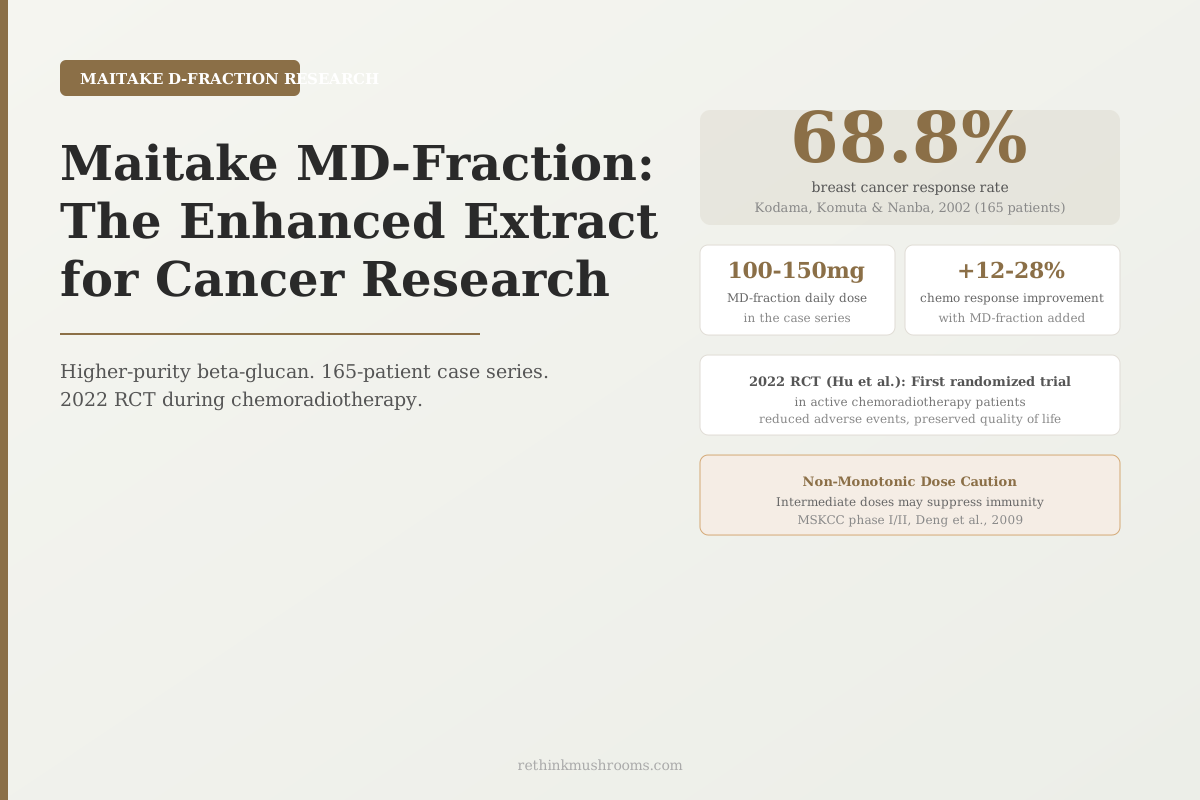
68.8% breast cancer response rate
Kodama's 165-patient case series — the backbone of maitake's cancer reputation — used MD-fraction specifically, at 100–150 mg combined with whole mushroom powder daily.
Kodama N et al., Alternative Medicine Review, 2002
12–28%
improvement when MD-fraction was added to chemotherapy
100–150 mg
MD-fraction dose used in Kodama's clinical protocol
2022
first RCT of D-fraction during active chemoradiotherapy
Kodama N et al., Alternative Medicine Review, 2002
 View as image ↗
When Kodama and colleagues published their 165-patient case series in 2002, they reported a 68.8% response rate in breast cancer patients and a 12–28% improvement when the extract was combined with chemotherapy.[2] These numbers appear, often without attribution, across decades of maitake cancer literature. What almost no discussion mentions: the extract in that study was MD-fraction, not D-fraction. Most product labels say one; the key study used the other.
MD-fraction is a refined version of D-fraction, with the protein component stripped away to produce a purer beta-glucan concentrate. Both contain the same immune-activating beta-1,6-glucan backbone, so biological activity overlaps substantially. But the structural difference matters when you're interpreting specific studies — or trying to figure out what the clinical protocols actually used. This article covers that distinction and traces the research specific to MD-fraction, from the original case series through the most recent controlled trial. For the broader D-fraction cancer evidence arc, see the complete D-fraction cancer review. For background on the mushroom itself, the maitake mushroom overview is the starting point.
Key Takeaways
- MD-fraction is a higher-purity form of D-fraction: the same beta-glucan backbone with the bound protein fraction removed, increasing the active-compound concentration per milligram
- The Kodama 2002 case series used 100–150 mg MD-fraction combined with 4–6 g of whole maitake powder daily across 165 patients with Stage II–IV cancers
- Cancer regression or significant improvement occurred in 58.3% of liver cancer cases, 68.8% of breast cancer cases, and 62.5% of lung cancer cases — though this was an uncontrolled series with no placebo group
- Adding MD-fraction to chemotherapy improved response rates by 12–28% depending on cancer type, according to the case series data
- The MSKCC phase I/II trial found a counterintuitive non-monotonic dose response: intermediate doses suppressed immune markers, while high doses enhanced them
- The 2022 RCT — the first randomized trial of D-fraction in patients undergoing active chemoradiotherapy — found reduced adverse events and preserved quality of life
Two Names for One Lineage: D-Fraction Came First, MD-Fraction Followed
The maitake cancer research line starts with Hiroaki Nanba, a Japanese researcher who identified a specific immune-activating fraction of the mushroom in the late 1980s. He named it D-fraction. A 2001 review in Alternative Medicine Review traced this discovery timeline and the early biological characterization work that followed.[1]
D-fraction's active structure is a beta-glucan — a long sugar chain with a 1,6-linked backbone and 1,3-linked side branches. That specific branching pattern is what immune cell receptors recognize. When those receptors encounter the glucan, a cascade begins: macrophages (the immune system's first-responders) activate, produce a signaling molecule called IL-12, and that signal reaches natural killer cells — the cells that patrol the body for cancer and viral threats. The full immune cascade is covered in how maitake D-fraction activates anti-tumor immunity.
In D-fraction, the beta-glucan arrives with protein molecules naturally bound to it. It is a proteoglycan — a combined protein-and-polysaccharide structure. MD-fraction is produced by taking D-fraction and removing those bound protein molecules. What remains is a purer beta-glucan preparation: more active compound per milligram, less mass being protein.[5]
The motivation for protein removal was partly scientific and partly practical. Removing protein makes the product easier to characterize — when you standardize by glucan content rather than total extract mass, each milligram delivers a more consistent amount of the active material. Wu and colleagues' 2021 review of Grifola frondosa bioactives confirmed that both fractions share the same core glucan architecture and that protein removal changes the purity profile, not the mechanism of action.[5]
Here is how the two extracts compare:
| Feature | D-Fraction | MD-Fraction |
|---|---|---|
| Core structure | Beta-1,6/1,3-glucan with bound protein | Beta-1,6/1,3-glucan, protein removed |
| Beta-glucan concentration | Lower per mg (protein occupies mass) | Higher per mg |
| Primary clinical protocol | Variable across studies | 100–150 mg/day (Kodama 2002) |
| Human dose-response data | MSKCC phase I/II (0.1–5 mg/kg) | Extrapolated from clinical proxy |
In practice, many products and many research papers use D-fraction and MD-fraction as synonyms. Mayell's 2001 review noted that the terminology was already inconsistent across the published literature by 2001 — the same extract described as D-fraction in one paper might be described as MD-fraction in another.[1] Understanding which was used in the foundational case series requires going back to the Kodama 2002 methods section.
The 165-Patient Case Series: An MD-Fraction Protocol Misread as D-Fraction Research
The Kodama 2002 paper in Alternative Medicine Review is the source of the numbers that appear across maitake cancer discussions for decades afterward. One hundred and sixty-five patients with Stage II through Stage IV cancers. The cancer types: breast, lung, liver, brain, leukemia, and prostate. The protocol: 100–150 mg of MD-fraction daily, combined with 4–6 grams of whole maitake powder.[2] Approximately half the patients also combined this protocol with conventional chemotherapy.
Response rates — defined as cancer regression or significant symptom improvement — by cancer type:
- Liver cancer: 58.3%
- Breast cancer: 68.8%
- Lung cancer: 62.5%
- Leukemia and prostate: intermediate results
- Brain cancer: lowest response rates among the types studied
In the subset who combined MD-fraction with chemotherapy, response rates were 12–28 percentage points higher than in those receiving chemotherapy alone.
These are substantial numbers, and they require honest context. This was an uncontrolled, non-randomized case series. There was no comparison group, no blinding, and no pre-specified standardized criteria for what counted as regression or significant improvement. Patients who chose this protocol were not randomly assigned — they may have differed from those who chose other approaches in ways that could affect outcomes, including disease stage, overall health, or prior treatment.
Mayell's 2001 review documented that Nanba's foundational animal and preliminary clinical observations first appeared in Japanese-language books and conference presentations, not peer-reviewed journals.[1] The Kodama 2002 paper was the first peer-reviewed English-language publication of these clinical numbers. That is a meaningful step up from conference data. It is not a randomized controlled trial, and the response rates it reports are not equivalent to efficacy estimates a controlled trial would produce.
What the case series does offer: a specific, reproducible protocol, a plausible signal across multiple cancer types consistent with mechanism, and an initial indication that MD-fraction combined with chemotherapy may improve response rates. Those are the valid uses of an uncontrolled case series — hypothesis generation and protocol specification, not treatment confirmation.
For the breast cancer data specifically — including in vitro apoptosis work that the case series doesn't cover — see maitake and breast cancer: D-fraction clinical evidence.
The Dose Problem: Why Intermediate Doses Suppressed Immunity at MSKCC
The Memorial Sloan Kettering Cancer Center conducted the most carefully controlled human study of a maitake polysaccharide extract in cancer patients. Deng and colleagues published it in Cancer Immunology, Immunotherapy in 2009.[4]
The 34 participants were postmenopausal women who had survived breast cancer and were in remission at enrollment. This starting point matters: the study was measuring immunological effects in disease-free patients, not tumor response in patients with active cancer.
The extract was given at doses from 0.1 mg/kg to 5 mg/kg twice daily. The dose-response finding was counterintuitive: at intermediate doses, several immune markers went down. The extract suppressed immune function at those dose levels. At higher doses, near the top of the range, immune markers improved. No dose-limiting toxicity appeared anywhere across the range — the extract was safe at all tested doses.
The plain-language meaning: some doses of this extract appear to work against immune activation, not for it. The intermediate-dose suppression was not simply a weaker positive effect. It was the opposite direction on the measured parameters.
This non-monotonic pattern — where the effect changes direction rather than simply increasing with dose — was not predicted by the prior animal models. Animal work on D-fraction had generally shown straightforward immune enhancement with increasing dose. The MSKCC human trial produced a more complicated picture.
The practical implication is direct. The commonly stated framing of maitake extract as an "immune enhancer" is incomplete as a description of what the most controlled human data found. The immunological effect depends on where in the dose range you land. A person taking what they believe is a therapeutic dose of a D-fraction product could theoretically be in the suppressive range if the dose falls at an intermediate level. There is no simple "more is better" inference available from the MSKCC data.
Understanding the pharmacology of Grifola frondosa provides additional mechanistic context for why this dose complexity arises.
How MD-Fraction Reversed Chemotherapy's Immune Suppression in Mice
A 2005 animal study by Kodama and colleagues addressed a specific clinical problem: many chemotherapy drugs suppress the immune system as a side effect of killing cancer cells. This immunosuppression limits how aggressively the drugs can be used and may reduce the body's own capacity to eliminate remaining tumor cells.[3]
In tumor-bearing mice, the researchers combined D-fraction with a low dose of mitomycin-C, a chemotherapy agent known for its immunosuppressive effects. The combination achieved approximately 98% tumor inhibition — substantially higher than either treatment alone. The more interesting part of the finding was why: D-fraction reversed the immune suppression that mitomycin-C normally produces. The drug was still killing tumor cells, but the immune cost it ordinarily imposed was cancelled out.
This is the proposed mechanism behind the "12–28% improvement" numbers from the Kodama case series. The hypothesis is not simply that MD-fraction adds its own antitumor effects on top of chemotherapy. It is that D-fraction counteracts one of chemotherapy's primary liabilities — the suppression of the immune system that limits response and increases infection risk — while the drug continues doing what it does.
If this mechanism transfers to human cancer treatment, MD-fraction's most useful role may be as a protective adjunct during chemotherapy rather than as a standalone anticancer agent. The direct human application of this finding hasn't been confirmed in a randomized trial focused on MD-fraction specifically. The 2022 RCT provides the closest controlled evidence that the concept transfers to humans — though in a different cancer context.
The 2022 RCT: Quality of Life Preserved During Active Chemoradiotherapy
The most recent controlled human evidence for D-fraction in a cancer context comes from a randomized trial published in the Journal of Ethnopharmacology in 2022. Hu and colleagues studied patients with advanced laryngeal and pharyngeal cancers who were actively undergoing concurrent chemoradiotherapy — simultaneous chemotherapy and radiation, not one or the other, not survivors in remission.[6]
That specific treatment context matters. Concurrent chemoradiotherapy carries a high burden of adverse effects — the two treatments compound each other's toxicity. Reducing treatment side effects and preserving quality of life in this setting has direct clinical meaning for patients who are deciding whether to continue treatment.
The D-fraction group had significantly fewer adverse events than the placebo group. They also showed preserved quality of life at the measured time points, while the placebo group's quality of life declined with the treatment burden.
The primary outcomes here were not tumor regression rates. The trial was not designed — and the results should not be interpreted — as showing that D-fraction extends survival or reduces tumor size. What the RCT showed is that D-fraction, in this specific patient population and treatment context, reduced the cost of going through concurrent chemoradiotherapy. That is a clinically meaningful finding for patients who face severe adverse effects as a limiting factor in their treatment.
This is the only randomized controlled trial of maitake extract in patients receiving simultaneous chemotherapy and radiation. It confirms, in controlled conditions, that the combination strategy the Kodama 2005 animal work proposed is feasible and produces measurable human benefit — at least in the adverse event and quality of life dimensions.
For context on how maitake's clinical evidence base compares to mushrooms with broader randomized trial records — including reishi's Cochrane-reviewed data — see Ganoderma lucidum as a cancer adjunct: clinical evidence and maitake D-fraction vs. other mushroom cancer extracts. For readers interested in the immune recovery angle after treatment ends, see maitake for immune recovery after chemotherapy.
The Current Picture: Strong Mechanistic Case, Still Limited Clinical Trials
Camilleri and colleagues' 2024 review in Heliyon is the most recent comprehensive summary of maitake science, and it frames the cancer evidence at its current level accurately.[7]
D-fraction and MD-fraction remain the primary anti-cancer bioactives identified in maitake. The mechanistic case — from in vitro work through animal models — is coherent. The immune cascade from beta-glucan receptor binding to NK cell activation has been characterized at a molecular level, and the combination effects with chemotherapy have been reproduced in animal models.
Count the relevant human datasets: one 165-patient uncontrolled case series using MD-fraction; one phase I/II immunological effects trial in 34 breast cancer survivors; one randomized controlled trial in head and neck cancer patients during active chemoradiotherapy. Three human studies, each with real constraints.
That is not an empty evidence base. The case series provides a specific protocol and a biologically plausible response signal. The MSKCC trial found real immunological effects — including the critical non-monotonic dose finding that complicates any simple "more is better" framing. The 2022 RCT is the first controlled confirmation that D-fraction produces measurable clinical benefit in an active treatment setting.
What it is not: sufficient to classify MD-fraction as an established cancer treatment. The case series response rates are not RCT efficacy estimates. The immunological changes in the MSKCC trial have not been linked to clinical outcomes. The 2022 RCT measured quality of life and adverse events, not tumor control.
Camilleri 2024 notes growing research interest in combination therapy approaches — using maitake extract as an adjunct to conventional treatment rather than as a standalone. The trajectory from the Kodama 2005 animal work through the 2022 RCT points in this direction. Using D-fraction or MD-fraction as a treatment adjunct that reduces the immune cost of chemotherapy and preserves quality of life during treatment is consistent with the full evidence arc. Using it as a replacement for conventional therapy is not what the data supports.
The Bottom Line
MD-fraction is a higher-purity derivative of maitake D-fraction with the bound protein fraction removed. The most-cited clinical dataset in maitake cancer research — Kodama's 165-patient case series — used this specific extract at 100–150 mg daily. The human evidence spans three datasets: the Kodama 2002 case series (strong response signals but no control group), the MSKCC phase I/II trial (real immunological effects with a counterintuitive non-monotonic dose response), and the 2022 RCT (reduced adverse events during active chemoradiotherapy). The mechanistic case is coherent; the controlled clinical evidence points most clearly toward adjunctive use alongside conventional therapy.
Frequently Asked Questions
Sources & References
- 1. Source details for this reference are not yet available.
- 2RTHM-00095·Kodama, Noriko et al. (2002). “Can maitake MD-fraction aid cancer patients?.” Alternative medicine review : a journal of clinical therapeutic.Study breakdown →PubMed →↩
- 3. Source details for this reference are not yet available.
- 4. Source details for this reference are not yet available.
- 5. Source details for this reference are not yet available.
- 6. Source details for this reference are not yet available.
- 7. Source details for this reference are not yet available.