Maitake & Immune Health
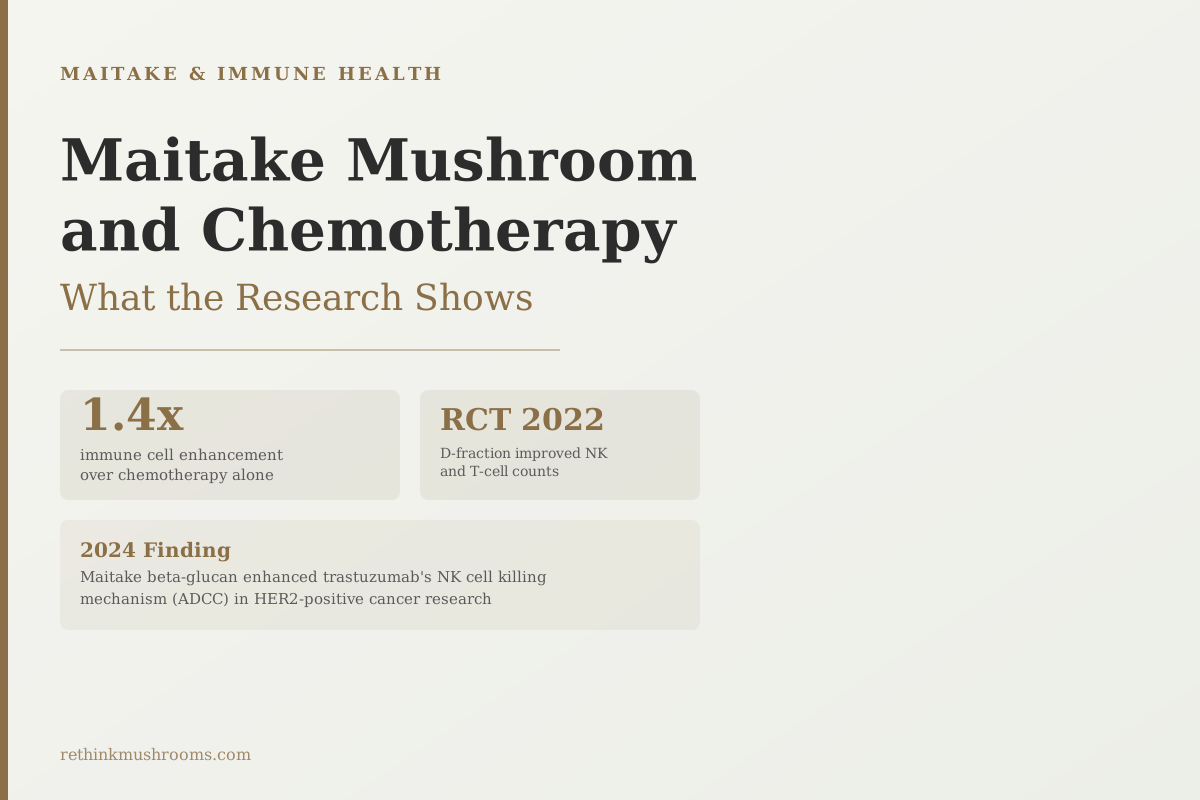
1.4x immune cell enhancement
In a clinical study of cancer patients, maitake MD-fraction added to standard chemotherapy improved immune-competent cell activity 1.2–1.4x over chemotherapy alone — the first human data on maitake during cancer treatment.
Nanba et al., Alternative Therapies in Health and Medicine, 2002
1.2–1.4x
immune enhancement over chemo alone (Nanba, 2002)
RCT 2022
D-fraction improved NK and T-cell counts during chemoradiotherapy (Hu)
2024 finding
Maitake enhanced trastuzumab's NK cell killing mechanism (Masuda)
Nanba et al., Alternative Therapies in Health and Medicine, 2002
 View as image ↗
Maitake mushroom, specifically its D-fraction and MD-fraction extracts, has been studied alongside chemotherapy for over two decades. The evidence base is thin by pharmaceutical standards — mostly animal models and small human trials — but it points in a consistent direction. Maitake's beta-glucans appear to protect and partially restore immune cell activity during certain chemotherapy regimens, including a 2022 randomized controlled trial showing improved NK cell and T-cell counts during treatment. A 2024 study added a new dimension: maitake beta-glucan enhanced the NK cell mechanism that the cancer drug trastuzumab depends on.
That evidence exists alongside an important caveat. A landmark breast cancer trial found that maitake produces both stimulatory and suppressive immune effects depending on dose. The biology is more complicated than "maitake boosts immunity during chemo." For background on how maitake works as a whole, see What Is Maitake Mushroom?.
Key Takeaways
- In a non-randomized clinical study, maitake MD-fraction plus chemotherapy improved immune-competent cell activity 1.2–1.4x vs. chemotherapy alone, with symptom improvement in 58–69% of patients depending on cancer type (Nanba, 2002)
- Maitake beta-glucan reduced cisplatin-induced bone marrow suppression and kidney toxicity in mice while enhancing the drug's antitumor effect (Masuda, 2009)
- D-fraction restored NK cell activity, T-cell function, and lymphocyte counts in mice after mitomycin-C chemotherapy had suppressed all three (Kodama, 2005)
- A 2022 RCT in head/neck cancer patients found D-fraction supplementation improved NK and T-cell counts and reduced treatment side effects during chemoradiotherapy vs. control (Hu, 2022)
- A 2024 animal study found maitake beta-glucan enhanced trastuzumab's ADCC mechanism — the pathway by which NK cells kill Herceptin-labeled HER2-positive cancer cells (Masuda, 2024)
- At certain doses in a 34-patient breast cancer trial, maitake produced immune-suppressive rather than stimulatory effects — the dual-effect finding that makes dosing non-trivial (Deng, 2009)
Why Chemotherapy Depletes the Immune System
The cells that defend you — NK cells, T-cells, neutrophils, macrophages — are produced continuously in the bone marrow. Chemotherapy targets cells that divide rapidly. Cancer cells divide rapidly. So does the bone marrow.
This is the core tradeoff of chemotherapy: to kill the tumor, you accept damage to the factory that makes immune cells. The clinical result is myelosuppression — a drop in bone marrow output that reduces white blood cell counts and leaves patients vulnerable to infection. For platinum-based drugs like cisplatin, myelosuppression is one of the most serious and treatment-limiting side effects.
This is why researchers have tested whether maitake's immune-active compounds might serve as a supportive adjunct: not to replace chemotherapy, but to reduce the immune toll it extracts.
What the Evidence Shows: A Summary of Six Studies
The maitake chemotherapy research to date shows three recurring signals, each with evidence at different strength levels:
-
Immune cell enhancement during treatment. Nanba's 2002 non-randomized clinical study found 1.2–1.4x immune cell improvement with MD-fraction plus chemotherapy. The 2022 Hu RCT confirmed NK and T-cell improvement vs. control during active treatment.
-
Bone marrow protection from chemotherapy toxicity. Masuda's 2009 mouse study found maitake beta-glucan reduced cisplatin-induced myelosuppression. Kodama's 2005 mouse study found D-fraction reversed mitomycin-C-induced immune suppression across NK cells, T-cells, and lymphocytes.
-
Potential synergy with targeted antibody therapy. Masuda's 2024 study found maitake beta-glucan enhanced trastuzumab's NK-cell-dependent killing mechanism — a finding specific to HER2-positive breast cancer treatment.
All three signals require more rigorous human evidence before they can be treated as clinical guidance. What follows is the detail behind each.
The First Human Data: Nanba's MD-Fraction Clinical Study
The first published evidence for maitake alongside chemotherapy came from Hiroaki Nanba — the researcher who developed D-fraction and its enhanced formulation, MD-fraction.
In a 2002 non-randomized clinical study, Nanba and colleagues gave cancer patients MD-fraction alongside standard chemotherapy and measured immune-competent cell activity over time.[1] Patients receiving MD-fraction showed immune cell activity 1.2 to 1.4 times higher than patients receiving chemotherapy alone. Reported symptom improvement ranged from 58 to 69 percent of patients, varying by cancer type.
These are striking numbers. But the study design has real limitations. Patients were not randomly assigned to MD-fraction or control groups. There was no blinding. The design cannot rule out that patient selection, disease staging, or reporting bias shaped the results.
That caveat does not erase the finding. It contextualizes it. Nanba's study was the first to document the specific question of immune activity during chemotherapy in human patients receiving maitake. It established what subsequent researchers spent the next two decades trying to verify with better methodology.
For the broader history of D-fraction and MD-fraction research in cancer, see Maitake D-Fraction and Cancer: The Complete Research Review.
Cisplatin and Bone Marrow: What Maitake Beta-Glucan Did in Mice
Cisplatin is among the most widely used chemotherapy drugs worldwide, and one of the most immunosuppressive. It causes severe myelosuppression and significant kidney toxicity — side effects that frequently limit the doses oncologists can safely use.
In 2009, Masuda and colleagues tested maitake beta-glucan alongside cisplatin in tumor-bearing mice.[2] Two findings emerged. First, the combination reduced the myelosuppression and kidney toxicity produced by cisplatin — the bone marrow and kidneys were better protected in mice receiving beta-glucan. Second, the antitumor effect of cisplatin was not reduced; it was enhanced.
The mechanism proposed is that maitake beta-glucans bind to receptors on immune cells in the bone marrow (the dectin-1 signaling pathway) and help sustain immune cell production under chemical stress. In Masuda's model, the result was protection without compromise.
This is mouse data. The distance from mice to humans is substantial, and no clinical trial has replicated this finding in cisplatin patients. But the mechanism is biologically plausible and the result — reducing a major side effect while enhancing efficacy — makes this one of the more consequential findings in the maitake-chemotherapy literature.
Reversing Chemo-Induced Immune Collapse: The Mitomycin-C Experiment
A 2005 experiment by Kodama and colleagues used a different chemotherapy agent — mitomycin-C — and asked a more specific question: once immune function has been suppressed by chemotherapy, can D-fraction reverse that suppression?[3]
In tumor-bearing mice treated with mitomycin-C alone, the expected happened. NK cell activity fell. T-cell function weakened. Lymphocyte counts dropped. In the mice that received both mitomycin-C and D-fraction, all three measures were restored toward pre-treatment levels. The recovery was not marginal — NK cell activity, T-cell function, and lymphocyte counts all returned close to baseline.
The study also found that D-fraction reduced immunosuppressive factors produced by the tumor itself, suggesting the effect addressed both chemotherapy toxicity and tumor-driven immune evasion simultaneously.
This connects to the direct NK cell literature. D-fraction enhances NK cell cytotoxic activity through perforin/granzyme release — the mechanism by which NK cells physically destroy cancer cells. For the focused NK cell evidence, see Maitake Beta-Glucans and NK Cell Enhancement.
The Strongest Clinical Evidence: A 2022 RCT During Active Treatment
The most rigorous human study of maitake during cancer treatment to date is a 2022 randomized clinical trial by Hu and colleagues, published in Acta Biochimica Polonica.[4]
Hu enrolled patients with advanced laryngeal and pharyngeal cancers undergoing concurrent chemoradiotherapy — a treatment regimen that combines chemotherapy and radiation, one of the more immunologically demanding protocols used in cancer care. Patients were randomly assigned to standard treatment alone or standard treatment with D-fraction supplementation.
The D-fraction group showed measurable improvement in NK cell counts and T-cell counts compared to the control group by the end of treatment. They also experienced fewer treatment-related side effects.
This study has the methodological weight that Nanba's 2002 study lacked: randomized assignment and a control group. The trial remains small in absolute scale, and head/neck cancer patients are a specific population. But as a controlled test of D-fraction during active chemotherapy in humans, it's the best evidence currently available.
For how maitake affects the wider immune cell network — not just NK and T-cells but macrophages and dendritic cells — see Maitake and Immune Health: How It Activates Immune Cells.
Maitake and Trastuzumab: A 2024 Finding for HER2-Positive Patients
The most recent study in this cluster connects maitake not to traditional chemotherapy but to targeted antibody therapy — and it introduces a specific mechanism that wasn't part of the earlier research.
In 2024, Masuda and colleagues tested maitake beta-glucan combined with trastuzumab, the monoclonal antibody used for HER2-positive breast cancer and sold as Herceptin.[5] Trastuzumab works in part through ADCC: antibody-dependent cellular cytotoxicity. In this mechanism, NK cells use trastuzumab molecules as a targeting guide — the antibody attaches to HER2-positive cancer cells and flags them for NK cell killing.
Masuda's study found that maitake beta-glucan enhanced this process. NK cells in peripheral blood and spleen showed greater trastuzumab-driven killing of HER2-positive cancer cells when maitake beta-glucan was present. The drug's therapeutic effect was also improved in the mouse model.
Two important caveats: this is an animal study plus experiments on human lymphocytes removed from blood samples and tested in lab conditions — not a clinical trial in trastuzumab patients. ADCC enhancement has not been confirmed in a controlled study of humans receiving trastuzumab plus maitake.
The mechanistic logic is specific enough that it warrants attention. For HER2-positive breast cancer patients, the connection to an NK-cell-dependent drug mechanism is directly relevant. For the broader breast cancer evidence around D-fraction, see Maitake and Breast Cancer: D-Fraction Clinical Evidence.
The Dose Problem: When Maitake Cuts Both Ways
One finding in the maitake immune literature gets almost no attention in consumer sources, but it may be the most practically important: at certain doses, maitake doesn't stimulate immune function — it suppresses it.
This came from the most rigorous human immune trial of maitake: a 2009 phase I/II dose-escalation study by Deng and colleagues at Memorial Sloan Kettering, involving 34 postmenopausal breast cancer patients.[6] The study tested doses from 0.1 to 5 mg/kg twice daily and measured multiple immune parameters at each dose level over time.
The result was not a straightforward dose-response relationship. At some doses and for some immune markers, maitake extract stimulated immune activity. At other doses and for other markers, it suppressed immune activity. The strongest stimulatory effects appeared around 3 mg/kg twice daily — but this was not consistent across all immune cell types measured.
Deng's trial did confirm no dose-limiting toxicity. The safety profile was acceptable across the full dose range. But the dual-effect finding changes the picture of how maitake interacts with the immune system during chemotherapy. Someone taking a high dose expecting maximum immune stimulation might instead be driving immunosuppressive effects on certain immune parameters.
This is one reason why the myelosuppression-protective effects from Masuda 2009 and the immune-restorative effects from Kodama 2005 don't translate automatically into clinical guidance. The same compound that restored immune function in those models may produce different effects at different doses and in different immune contexts.
What the Evidence Still Doesn't Answer
The research reviewed here shows a consistent signal across six independent studies. It does not yet support definitive conclusions about maitake as a clinical adjunct during chemotherapy.
No large randomized trial has tested maitake in a general chemotherapy population. The Hu 2022 RCT — the best current clinical evidence — covered one cancer type (head/neck), one treatment modality (chemoradiotherapy), and involved a small patient group. That's a limited window into a much larger question.
The animal studies used purified D-fraction or isolated beta-glucan extracts, not whole mushroom or commercial supplements. Whether dietary maitake or over-the-counter mushroom products deliver equivalent concentrations of active fractions to those tested in research is unknown.
Drug interaction concerns also apply. Maitake has been flagged by integrative oncology centers for potential interactions with anticoagulants like warfarin and with hypoglycemic medications used by some cancer patients. The immunomodulatory activity that makes maitake scientifically interesting also creates theoretical interactions with immunosuppressive drugs used in transplant patients and some cancer protocols.
None of this negates the findings. It frames the evidence accurately: a biologically coherent mechanism, consistent signals across animal models, clinical corroboration from a small RCT, and a 2024 finding that opens a new line of inquiry around targeted therapy synergy. The evidence is strong enough to justify further investigation. It is not yet strong enough to act on independently.
For comparison on how other mushrooms approach the chemotherapy immune recovery question, see Immune Recovery After Lung Cancer Treatment: Turkey Tail Evidence.
The Bottom Line
Maitake D-fraction and beta-glucan extracts have shown consistent immune-protective signals alongside chemotherapy across animal studies and small human trials: enhanced immune cell activity vs. chemo alone, bone marrow protection from cisplatin, NK and T-cell restoration during chemoradiotherapy in a 2022 RCT, and enhanced trastuzumab activity in a 2024 study. The evidence is limited by small sample sizes, animal-model reliance, and a dose-dependent dual effect observed in a breast cancer trial — where some doses suppressed rather than stimulated certain immune parameters.
Frequently Asked Questions
Sources & References
- 1. Source details for this reference are not yet available.
- 2RTHM-00309·Masuda, Yuki et al. (2009). “Maitake beta-glucan enhances therapeutic effect and reduces myelosupression and nephrotoxicity of cisplatin in mice..” International immunopharmacology.Study breakdown →PubMed →↩
- 3RTHM-00161·Kodama, Noriko et al. (2005). “Maitake D-Fraction enhances antitumor effects and reduces immunosuppression by mitomycin-C in tumor-bearing mice..” Nutrition (Burbank.Study breakdown →PubMed →↩
- 4RTHM-01536·Hu, Qinglei et al. (2022). “Effect of Maitake D-fraction in advanced laryngeal and pharyngeal cancers during concurrent chemoradiotherapy: A randomized clinical trial..” Acta biochimica Polonica.Study breakdown →PubMed →↩
- 5RTHM-01945·Masuda, Yuki et al. (2024). “Maitake Beta-Glucan Enhances the Therapeutic Effect of Trastuzumab via Antibody-Dependent Cellular Cytotoxicity and Complement-Dependent Cytotoxicity..” Biological & pharmaceutical bulletin.Study breakdown →PubMed →↩
- 6RTHM-00289·Deng, Gary et al. (2009). “A phase I/II trial of a polysaccharide extract from Grifola frondosa (Maitake mushroom) in breast cancer patients: immunological effects..” Journal of cancer research and clinical oncology.Study breakdown →PubMed →↩