Maitake & Immune Health
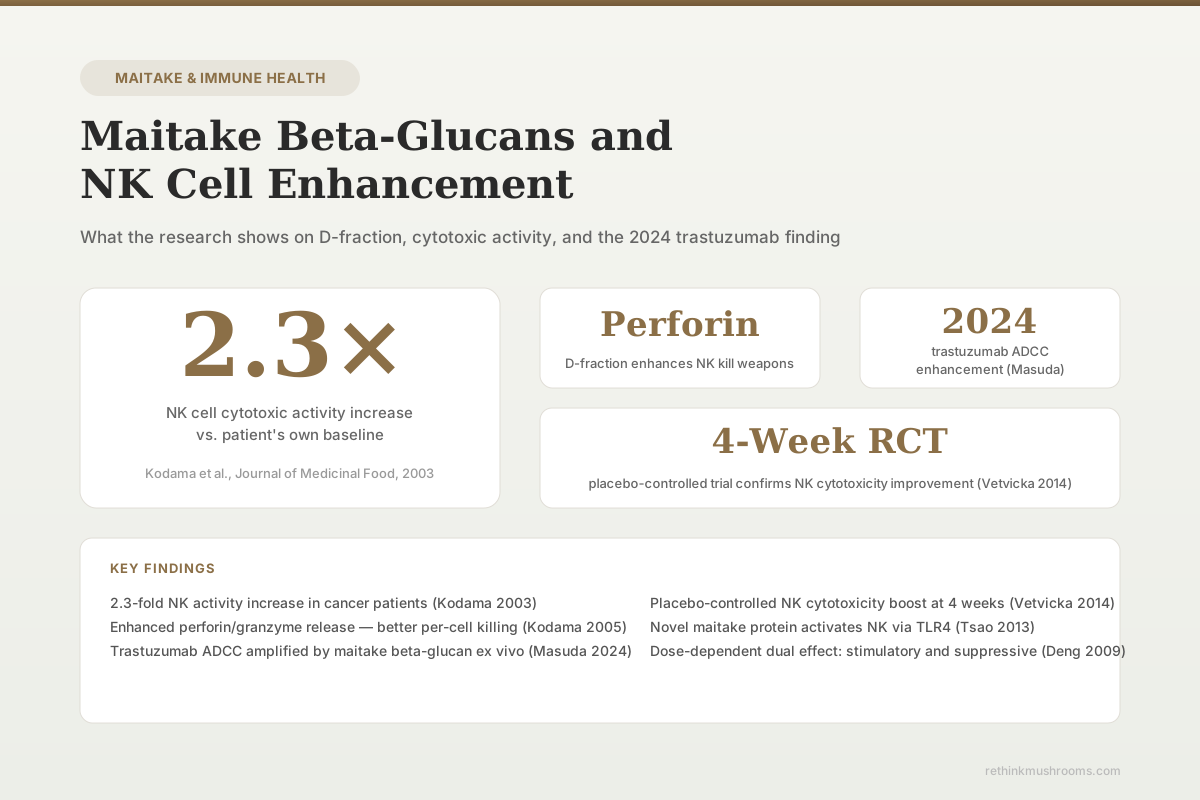
2.3× NK cell activity increase
In a cohort study of cancer patients taking maitake D-fraction orally, NK cell cytotoxic activity reached 2.3 times each patient's own baseline. That was the first human measurement of what maitake beta-glucan does to the immune system's front-line killers.
Kodama et al., Journal of Medicinal Food, 2003
2024
most recent study: maitake beta-glucan amplified trastuzumab-driven NK killing via ADCC (Masuda 2024)
4-week
placebo-controlled trial confirmed improved NK cytotoxicity vs. placebo (Vetvicka 2014)
Perforin
molecular weapon NK cells release more of when primed by D-fraction (Kodama 2005)
Kodama et al., Journal of Medicinal Food, 2003
 View as image ↗
In 2003, a cohort study gave maitake research something concrete: cancer patients who took D-fraction orally showed NK cell cytotoxic activity at up to 2.3 times their own baseline levels, dose-dependently, with the effect growing as the dose increased.[1] NK cells are the immune system's first-response killers, a class of white blood cell that can identify and destroy infected or cancerous cells on first contact, without needing to have encountered that specific threat before. The research on maitake beta-glucans and NK cells is not large, but it is specific: naming dose levels, measuring cytotoxic activity directly, and in 2024, finding that maitake enhances the NK-cell-dependent mechanism of a widely used cancer drug.
This article covers what NK cells do, what the human trials have measured, how the mechanism works at the molecular level, and what the 2024 finding about trastuzumab means. For a broader overview of the whole immune activation picture, including macrophages and dendritic cells, see Maitake and Immune Health: How It Activates Immune Cells. For the maitake mushroom introduction, see Maitake: The Dancing Mushroom Explained.
Key Takeaways
- In a cohort study of cancer patients, oral D-fraction supplementation increased NK cell cytotoxic activity by up to 2.3-fold compared to each patient's own baseline, with the effect dependent on dose (Kodama et al., 2003)
- The mechanism involves enhanced perforin and granzyme release from NK cells, the molecular weapons cells use to punch through and destroy their targets (Kodama et al., 2005)
- A 4-week placebo-controlled trial found maitake extract improved NK cell cytotoxicity, macrophage phagocytic activity, and T-cell counts compared to placebo, with effects comparable to shiitake (Vetvicka et al., 2014)
- In 2024, the first study to connect maitake beta-glucan to antibody-drug synergy found it enhanced trastuzumab-induced NK cell killing via ADCC in mouse models and ex vivo human lymphocytes (Masuda et al., 2024)
- A novel maitake protein (not a beta-glucan) activates NK cells through TLR4, a completely separate receptor pathway from the standard dectin-1 route, suggesting maitake has multiple independent NK-activating mechanisms (Tsao et al., 2013)
- Honest limitation: the Kodama 2003 human data has no placebo group; most mechanism data is animal or in vitro; the 34-patient Deng 2009 trial remains the most rigorous human immune evidence
What NK Cells Actually Do (And Why "Natural Killer" Is Surprisingly Accurate)
The name is not marketing. NK cells (natural killer cells) are a type of white blood cell defined by a specific ability: they can kill target cells without having been trained to recognize that specific target in advance.
Most immune cells in the adaptive branch of the immune system (T-cells and B-cells) require prior exposure to a pathogen to mount a targeted response. NK cells do not. They patrol the body and recognize cells that are behaving abnormally: cells infected by viruses that hide normal surface markers, or cancer cells that have lost the molecular signals healthy cells display to flag themselves as "self." When an NK cell encounters such a target, it deploys a coordinated kill mechanism.
The primary killing tools are perforin and granzyme, two proteins that work together. Perforin punches pores in the outer membrane of the target cell. Granzyme enters through those pores and triggers programmed cell death from the inside. The whole process can complete in minutes. The NK cell then detaches and moves on to the next target, intact and ready to kill again.
Killing efficiency, measured as how many target cells a given number of NK cells eliminate per unit of time, is what researchers call cytotoxic activity. When a study reports that maitake D-fraction increased NK cell cytotoxic activity, it means NK cells exposed to D-fraction were better at performing this kill sequence than NK cells that were not.
The 2.3-Fold Finding: What Kodama Actually Measured in 2003
The foundational human evidence comes from Kodama and colleagues, who gave cancer patients maitake D-fraction orally and measured NK cell cytotoxic activity at multiple time points.[1]
Two things distinguished this study. First, it used each patient as their own baseline; the comparison was not to a separate control group, but to each individual's NK cell activity before supplementation started. This design controls for baseline differences between people. Second, it found a dose-dependent relationship: higher D-fraction doses produced larger increases in NK activity. The maximum recorded effect was 2.3 times each patient's own pre-supplementation baseline.
Kodama identified this as the first human study to directly measure what D-fraction does to NK cell function in cancer patients. That matters because the word "boost" in immune health contexts often comes with no measurement attached. This study provided one.
What the design cannot tell us: without a placebo group, it is not possible to rule out that NK activity would have increased for some other reason during the same period. Time-series studies are subject to regression to the mean and placebo effects. The 2.3-fold figure is a real measurement, but its attribution entirely to D-fraction relies on comparing to baseline rather than a concurrent control. The placebo-controlled evidence came later, in 2014.
A 2014 comparative review by Guggenheim and colleagues[8] examined five medicinal mushrooms (reishi, shiitake, turkey tail, chaga, and maitake) in integrative oncology contexts. The review singled out maitake D-fraction for the relative strength of its NK cell and macrophage activation evidence compared to the other four mushrooms analyzed. That context matters for understanding where the NK cell evidence for maitake sits within the broader medicinal mushroom field.
How D-Fraction Gives NK Cells Better Weapons: The Perforin Mechanism
The 2003 Kodama study measured cytotoxic activity as an output. A follow-up animal study by the same lead author in 2005 identified what was happening at the molecular level.[2]
Kodama found that D-fraction enhanced NK cell cytotoxic activity in tumor-bearing mice by increasing perforin and granzyme release from NK cells. More perforin means NK cells can punch holes in more target cell membranes per encounter. More granzyme means more trigger events for programmed cell death once the NK cell has made contact.
The practical implication: D-fraction is not simply increasing the number of NK cells present. It is changing the killing efficiency of each individual NK cell. An NK cell primed by D-fraction apparently carries more loaded weapons into each encounter with a target cell.
This distinction between NK cell count and NK cell function is important for interpreting research. A compound that increases NK cell numbers has a different effect than one that makes each existing NK cell more lethal. The Kodama 2005 data points toward the latter mechanism, enhanced per-cell killing capacity, but the distinction has not been fully characterized in human trials.
The broader context: maitake beta-glucans bind to dectin-1 receptors on macrophages and NK cells, triggering a cytokine cascade that includes IL-12 and interferon-gamma release. IL-12 is a signal that makes resting NK cells become more active killers. Interferon-gamma is a signal released by activated NK cells that feeds back to coordinate the immune response further. For a detailed look at how this dectin-1 signaling pathway operates across mushroom species, How Medicinal Mushrooms Activate Macrophages covers the shared mechanism.
Placebo-Controlled: What Vetvicka's 2014 Trial Found
The Kodama studies provided a specific number for NK activity change and a mechanistic explanation. The missing element was a placebo comparison in human participants. Vetvicka and colleagues provided that in 2014.[5]
In a controlled 4-week trial, participants received oral maitake extract or placebo. The maitake group showed improvements in three immune markers compared to placebo:
- NK cell cytotoxicity
- Macrophage phagocytic activity (the capacity of macrophages to engulf foreign material)
- T-cell counts
The trial also ran a direct side-by-side comparison with shiitake extract. Both mushrooms produced comparable immune effects across the 4-week observation window, making this one of the few head-to-head comparisons of two medicinal mushrooms in a placebo-controlled human design.
The study's limitations are real. The exact sample size is not reported in available data. Four weeks is a short window; longer supplementation effects are unknown. The extract used was not a standardized D-fraction preparation, which makes direct dose comparisons to the Kodama studies difficult. But Vetvicka 2014 provides something neither Kodama study could: a concurrent control group against which the maitake effect is measured. That makes it the strongest human evidence for NK cell cytotoxicity improvement from maitake.
The 2024 Discovery: Maitake Amplifies Herceptin's NK-Dependent Kill Mechanism
The most recent addition to the maitake NK cell literature appeared in 2024 and covers terrain no previous maitake study had explored: what happens when maitake beta-glucan is combined with trastuzumab, the antibody-based cancer drug sold as Herceptin.[3]
Trastuzumab works against HER2-positive cancer cells through two mechanisms. One is direct: it blocks a growth-signaling receptor those cancer cells depend on. The other involves NK cells. When trastuzumab antibodies coat the surface of a cancer cell, NK cells can recognize the antibody-coated target through their own Fc receptors and destroy it; that process is called antibody-dependent cellular cytotoxicity, or ADCC. This NK-cell-dependent killing is a significant part of how trastuzumab works against HER2-positive breast cancer.
Masuda and colleagues found that maitake beta-glucan enhanced both this ADCC mechanism and a complement-driven killing pathway (CDC) in mouse models. Ex vivo testing of peripheral blood lymphocytes and splenic NK cells showed that maitake-treated NK cells performed better trastuzumab-induced killing than untreated NK cells. The finding also covered complement-dependent cytotoxicity, a parallel pathway where tagged cancer cells are destroyed by complement proteins rather than NK cells directly.
The honest framing: this is animal and ex vivo data. It has not been tested in cancer patients taking trastuzumab. The mechanisms identified are biologically plausible and consistent with what is already known about maitake NK cell priming and about how ADCC works, but biological plausibility in mouse models does not confirm clinical benefit. This is a hypothesis-generating finding, not a clinical recommendation.
What makes it editorially significant is that it is the first study to connect maitake beta-glucan to a specific, named cancer drug's mechanism of action. If the NK priming effect observed ex vivo translated to human trastuzumab treatment, it would represent a specific immune-oncology application, not the generic "immune support" framing that dominates mushroom health content. That translation has not been demonstrated.
For readers who want the broader clinical picture of maitake during active cancer treatment, including the Hu 2022 RCT showing improved NK and T-cell counts during chemoradiotherapy, see Maitake for Immune Recovery After Chemotherapy.
Not Just Beta-Glucan: A Maitake Protein That Activates NK Cells Through a Different Route
Beta-glucans are the primary focus of maitake immune research. In 2013, Tsao and colleagues identified something additional: a novel maitake protein that activates both NK cells and dendritic cells through a pathway completely separate from the standard beta-glucan route.[4]
The standard route involves beta-glucans binding to dectin-1 receptors on immune cells. The Tsao 2013 protein activated NK cells and dendritic cells through TLR4, a receptor better known for detecting bacterial danger signals. Bacterial fragments activate TLR4 to trigger an innate immune alarm response. Finding that a maitake protein can activate the same receptor suggests maitake has a secondary immune signaling pathway alongside the dectin-1 beta-glucan route.
The Tsao protein also induced interferon-gamma secretion from NK cells, one of the cytokines that coordinates the broader immune response after NK activation. The researchers tested this in an animal model: dendritic cells treated with the maitake protein were used in a vaccine design, and mice that received the TLR4-primed dendritic cell vaccine showed significantly reduced tumor growth compared to controls.
This finding matters for a narrow but important reason. Most maitake immune research assumes beta-glucans are doing all the work. The Tsao 2013 study showed that the protein fraction of maitake contributes an independent mechanism. Whole maitake extract therefore activates NK cells through at least two separate molecular paths, which may explain why whole-mushroom preparations show different effects than isolated beta-glucan fractions in some studies.
The detailed biology of how maitake compounds activate dendritic cells specifically, including the TLR4 protein mechanism and the DC vaccine research, is covered in depth in Maitake and Dendritic Cell Maturation.
What the Evidence Still Hasn't Tested
The most rigorous human immune data for maitake beta-glucans comes from Deng and colleagues, who enrolled 34 postmenopausal breast cancer patients in a Phase I/II dose-escalation trial testing 0.1 to 5 mg/kg twice daily.[7] No side effects serious enough to require stopping or lowering the dose were identified across the full range. The immunological results were more complicated than a simple "NK cells up" summary.
At 3 mg/kg twice daily, D-fraction produced the strongest stimulatory effects, including elevated NK cell activity. At other doses, and for other immune parameters measured in the same patients, the results moved in the opposite direction: suppression rather than stimulation. Deng documented both effects in the same patient population.
This is the finding that most consumer maitake content omits. Maitake D-fraction is not a simple immune amplifier. At certain doses it appears to suppress some immune markers while stimulating others. That dual effect, documented in a dose-escalation design, makes the question of optimal dose more important than the "does maitake boost immunity?" framing suggests.
A 2019 in vitro study by Mallard and colleagues found that combining reishi, shiitake, and maitake produced synergistic macrophage activation in human cells, exceeding what any single mushroom produced alone.[6] That synergy evidence is relevant to multi-mushroom immune products, though the study cannot identify which proportions or which combination of compounds drives the effect.
What the current literature cannot resolve: how D-fraction NK effects translate to healthy adults who are not cancer patients (all human data comes from cancer populations), which doses produce net stimulatory versus suppressive effects in non-cancer immune systems, and how the NK priming effect from acute supplementation compares to longer-term use. The 2024 Masuda ADCC finding opens an interesting question about drug synergy in HER2-positive breast cancer, one that would require a clinical trial to answer.
For a broader view of how maitake's beta-glucan NK activation fits within the full picture of mushroom polysaccharides and cancer-fighting immune cells, see How Mushroom Sugars Activate Cancer-Fighting Immune Cells. For the detailed D-fraction cancer evidence, see Maitake D-Fraction and Cancer: The Complete Research Review.
The Bottom Line
Maitake D-fraction raises NK cell cytotoxic activity through enhanced perforin and granzyme release, the molecular kill mechanism NK cells deploy against cancer and infected cells. The most concrete human measurement is a 2.3-fold increase relative to baseline from a 2003 cohort study; the most controlled human evidence is a 4-week placebo-controlled trial showing improved NK cytotoxicity, macrophage activity, and T-cell counts. A 2024 mouse and ex vivo study found maitake beta-glucan amplifies the NK-cell-dependent mechanism of trastuzumab (Herceptin), the first connection between maitake and a specific antibody cancer drug, though this has not been tested in clinical trials. A novel maitake protein (not a beta-glucan) activates NK cells through a separate TLR4 pathway, suggesting whole maitake has at least two independent NK-activating mechanisms.
Frequently Asked Questions
Sources & References
- 1RTHM-00112·Kodama, Noriko et al. (2003). “Effect of Maitake (Grifola frondosa) D-Fraction on the activation of NK cells in cancer patients..” Journal of medicinal food.Study breakdown →PubMed →↩
- 2RTHM-00162·Kodama, Noriko et al. (2005). “Enhancement of cytotoxicity of NK cells by D-Fraction, a polysaccharide from Grifola frondosa..” Oncology reports.Study breakdown →PubMed →↩
- 3RTHM-01945·Masuda, Yuki et al. (2024). “Maitake Beta-Glucan Enhances the Therapeutic Effect of Trastuzumab via Antibody-Dependent Cellular Cytotoxicity and Complement-Dependent Cytotoxicity..” Biological & pharmaceutical bulletin.Study breakdown →PubMed →↩
- 4RTHM-00558·Tsao, Yao-Wei et al. (2013). “Characterization of a novel maitake (Grifola frondosa) protein that activates natural killer and dendritic cells and enhances antitumor immunity in mice..” Journal of agricultural and food chemistry.Study breakdown →PubMed →↩
- 5RTHM-00654·Vetvicka, Vaclav et al. (2014). “Immune-enhancing effects of Maitake (Grifola frondosa) and Shiitake (Lentinula edodes) extracts..” Annals of translational medicine.Study breakdown →PubMed →↩
- 6RTHM-00580·Mallard, Brody et al. (2019). “Synergistic immuno-modulatory activity in human macrophages of a medicinal mushroom formulation consisting of Reishi, Shiitake and Maitake..” PloS one.Study breakdown →PubMed →↩
- 7RTHM-00289·Deng, Gary et al. (2009). “A phase I/II trial of a polysaccharide extract from Grifola frondosa (Maitake mushroom) in breast cancer patients: immunological effects..” Journal of cancer research and clinical oncology.Study breakdown →PubMed →↩
- 8RTHM-00323·Guggenheim, Alena G et al. (2014). “Immune Modulation From Five Major Mushrooms: Application to Integrative Oncology..” Integrative medicine (Encinitas.Study breakdown →PubMed →↩