Mushroom Immunology
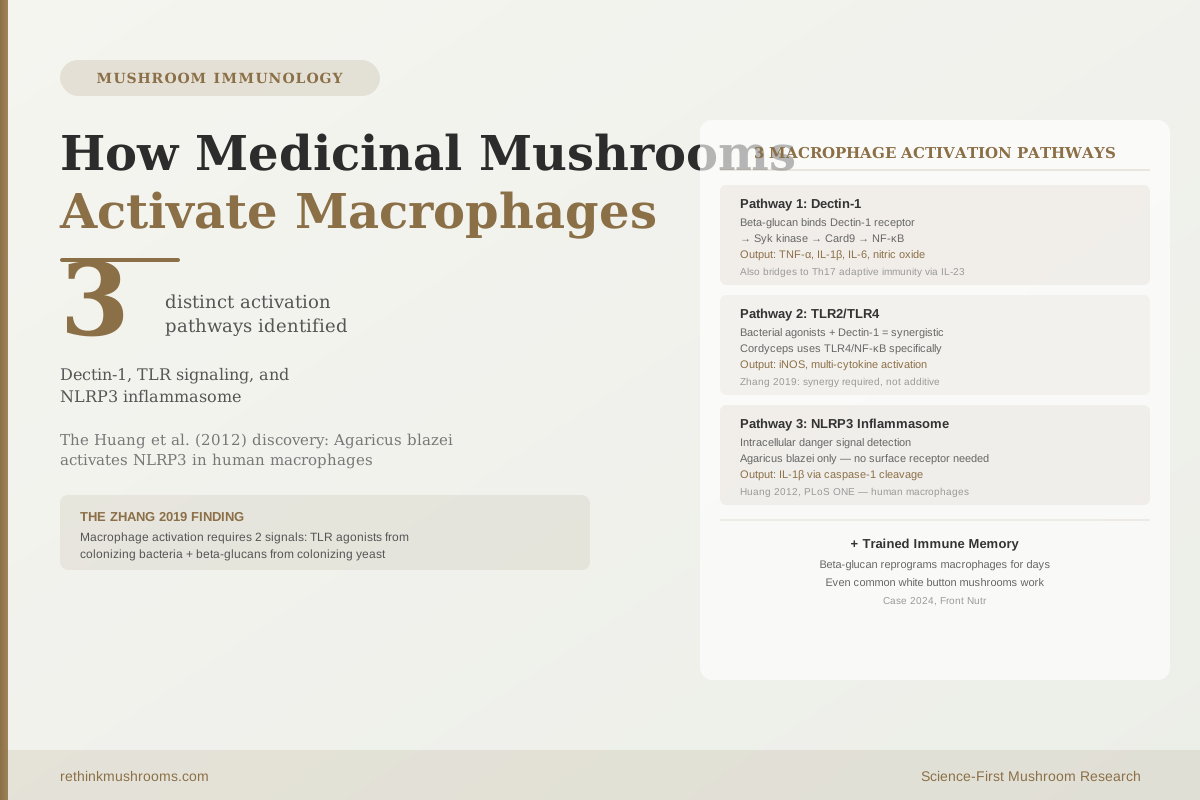
2 signals required
A 2019 study found mushroom macrophage activation requires two distinct signals working together: TLR agonists from bacteria colonizing the mushroom surface, and beta-glucans from colonizing yeast, not just the mushroom's own compounds.
Zhang et al., Food & Function, 2019
3 pathways
Dectin-1, TLR, and NLRP3 inflammasome each independently activate macrophages
Trained memory
macrophages retain enhanced immune response after beta-glucan exposure (Stothers 2021)
White button counts
ordinary supermarket Agaricus bisporus drives trained immunity in human monocytes (Case 2024)
Zhang et al., Food & Function, 2019
 View as image ↗
When a mushroom supplement company says its product "activates macrophages," the mechanism they're describing is real. Macrophages are a type of white blood cell that patrol tissues, engulf pathogens, and coordinate immune responses. And mushroom polysaccharides genuinely do activate them.
What the marketing rarely explains is which receptor triggers this, what the internal signaling cascade looks like, and, most interestingly, that at least part of the macrophage-activating signal may come not from the mushroom itself, but from the bacteria and yeast that colonize its surface during growth.
A 2019 study by Zhang and colleagues tested the macrophage-activating potential of edible mushrooms and found something unexpected. The full macrophage activation response required two components working together: water-soluble TLR agonists (compounds that trigger a family of immune receptors called Toll-like receptors) from bacteria colonizing the mushroom, and water-insoluble beta-glucans from yeast colonizing the mushroom. Mushrooms with low microbial colonization had minimal macrophage-activating activity. Co-stimulation of both pathways produced a synergistic response larger than either signal alone could generate.[1]
This is a more complex picture than "eat beta-glucans, activate macrophages." Understanding how medicinal mushrooms activate macrophages means understanding three distinct pathways.
For the overview of how all innate immune cells respond to mushrooms, see the pillar article on mushroom beta-glucans and immunity: the complete research guide. For the deeper story on Dectin-1 specifically, see the cross-cluster article on the Dectin-1 receptor: how your body recognizes mushroom beta-glucans.
Key Takeaways
- Mushroom macrophage activation requires synergistic co-stimulation of two signals: TLR agonists from bacteria colonizing the mushroom surface AND beta-glucans from colonizing yeast; mushrooms with low microbial colonization showed minimal macrophage-activating activity (Zhang et al., Food Funct, 2019)
- The primary receptor pathway: Dectin-1 binds beta-glucan → activates Syk kinase → recruits Card9 → activates NF-κB → macrophages produce cytokines and oxidative killers; Dectin-1 also bridges to Th17 adaptive immunity via IL-23 (Lee & Kim, IJMM, 2014; Batbayar et al., Biomol Ther, 2012)
- Beta-1,3 with 1,6 side-chain branching produces the strongest macrophage NF-κB activation and nitric oxide production; both the branching frequency and polymer chain length independently determine Dectin-1 binding strength (Volman et al., Mol Nutr Food Res, 2010)
- Species activate macrophages via different pathways: Phellinus linteus via protein kinase C and tyrosine kinase; Cordyceps militaris via TLR4/NF-κB; Agaricus blazei via both TLR/IL-12 and the NLRP3 inflammasome
- Agaricus blazei is the only medicinal mushroom with published evidence for NLRP3 inflammasome activation in human macrophages, a pathway distinct from both Dectin-1 and TLR signaling (Huang et al., PLoS ONE, 2012)
- Beta-glucan exposure induces trained immune memory in differentiated macrophages: enhanced cytokine production and phagocytosis lasting days after initial exposure; even ordinary white button and portobello mushrooms drive this effect in human monocytes (Stothers et al., J Immunol, 2021; Case et al., Front Nutr, 2024)
Mechanism · Three Independent Routes, One Output
How Mushrooms Switch On a Macrophage
Mushroom polysaccharides activate macrophages through three separate entry points — two surface receptors and one internal danger sensor — that converge on the same inflammatory output. This is direction of action from the mechanism studies, not a human-quantified effect size.
Cell surface
Dectin-1
Beta-1,3/1,6-glucan from the fungal cell wall
Lee & Kim 2014 [2]
Cell surface
TLR2 / TLR4
Bacterial patterns colonizing the mushroom; synergizes with beta-glucan
Zhang 2019 [1]
Inside the cell
NLRP3 inflammasome
Intracellular danger signals (Agaricus blazei only)
Huang 2012 [10]
Converge on
Inflammatory cytokines (TNF-α, IL-1β, IL-6) and nitric oxide for direct pathogen killing — plus, via Dectin-1, an IL-23 / Th17 bridge to adaptive immunity. (Batbayar 2012 [3])
The point of the diagram: “activates macrophages” is not one switch. Different mushroom species favor different routes, and only Agaricus blazei has published evidence for the intracellular NLRP3 route in human macrophages.
Sources: Zhang et al., Food & Function (2019) [ref 1]; Lee & Kim, International Journal of Medicinal Mushrooms (2014) [ref 2]; Batbayar et al., Biomolecules & Therapeutics (2012) [ref 3]; Huang et al., PLoS ONE (2012) [ref 10]
The Primary Pathway: How Dectin-1 Triggers the Macrophage Activation Cascade
Dectin-1 is a pattern recognition receptor found on the surface of macrophages, dendritic cells, and neutrophils. Its job is to recognize a specific molecular pattern: beta-1,3-glucan polymers found in the cell walls of fungi. Human cells don't have beta-1,3-glucan. When Dectin-1 detects it, the immune system knows a fungal particle is present.
When beta-glucan binds Dectin-1, the receptor clusters and recruits a signaling enzyme called Syk kinase inside the cell. Syk activates an adaptor protein called Card9, which in turn activates NF-κB, a transcription factor that switches on genes for inflammatory cytokines and antimicrobial molecules.
The downstream outputs include: tumor necrosis factor alpha (TNF-α, an inflammatory alarm signal), interleukin-1 beta (IL-1β, which activates fever and recruitment of more immune cells), interleukin-6 (IL-6, which coordinates systemic inflammation), and inducible nitric oxide synthase (iNOS), which produces nitric oxide (a toxic free radical that macrophages use to kill pathogens directly).
A 2014 review by Lee and Kim synthesized the evidence for this cascade: Dectin-1 is the master innate receptor for fungal beta-glucan, and the Syk/Card9/NF-κB signaling chain is the primary mechanism by which macrophages produce the full cytokine and oxidative burst response to mushroom polysaccharides.[2]
The Dectin-1 pathway also has a downstream connection to adaptive immunity. A 2012 review by Batbayar and colleagues showed that Dectin-1 activation also drives IL-23 production, which polarizes the adaptive immune response toward Th17 cells, a subset involved in mucosal defense against fungi and bacteria.[3] This means mushroom beta-glucan doesn't just activate the first-line responders; it shapes how the longer-term adaptive response is oriented.
Why Beta-Glucan Structure Determines Activation Strength
Not all beta-glucans are equally potent at activating macrophages. The molecular architecture of the polysaccharide matters.
A 2010 study by Volman and colleagues tested beta-glucan extracts from multiple mushroom species in bone marrow-derived macrophages, measuring NF-κB activation and nitric oxide production. The finding: beta-1,3-glucan with 1,6-side-chain branches produced the strongest activation. The branching frequency and polymer chain length both independently affected how strongly the molecule bound Dectin-1 and activated the downstream cascade.[4]
The practical implication: a mushroom supplement standardized only for "beta-glucan percentage" doesn't capture the structural quality of the polysaccharide. Two products with identical beta-glucan percentages can have different macrophage-activating potency depending on their branching architecture.
This also explains species differences. Different mushroom species produce beta-glucans with different chain lengths and branching patterns, which is one reason macrophage activation studies show species-specific variation in cytokine output profiles.
Species-Specific Pathways: Different Mushrooms Use Different Mechanisms
The Dectin-1 pathway is the primary route, but individual mushroom species activate macrophages through additional or alternative signaling mechanisms.
Phellinus linteus uses a distinct intracellular pathway. Kim and colleagues showed in 2003 that Phellinus linteus acidic polysaccharide triggered macrophage nitric oxide production via protein kinase C (PKC) and protein tyrosine kinase signaling, pathways normally associated with growth factor receptors, not pattern recognition.[5] A follow-up study in 2004 confirmed the same polysaccharide upregulated both nitric oxide and TNF-α, operating through two distinct intracellular routes simultaneously.[6]
Cordyceps militaris primarily activates macrophages through TLR4 signaling. A 2015 study by Lee and colleagues found that Cordyceps militaris culture broth polysaccharide triggered macrophage iNOS expression and cytokine production (TNF-α, IL-1β, IL-6) via TLR4 and downstream NF-κB, with minimal Dectin-1 involvement.[7] A 2011 study by Lee and Hong confirmed multi-cytokine macrophage activation (TNF-α, IL-1β, IL-6, and increased phagocytic activity) from Cordyceps militaris polysaccharides, alongside enhanced splenocyte proliferation.[8] This TLR4 route is not unique to macrophages: Kim and colleagues showed in 2010 that cordlan, a beta-glucan from the same Cordyceps militaris, matures dendritic cells (a related antigen-presenting immune cell) through TLR4 as well, reinforcing TLR4 as this species' dominant immune-activation channel.[12]
Agaricus blazei activates macrophages through at least two entry points. Kasai and colleagues showed in 2004 that Agaricus blazei fraction H triggered IL-12 production from macrophages through a TLR-dependent pathway.[9] IL-12 is a key cytokine that bridges innate and adaptive immunity by activating natural killer cells and polarizing T helper cells toward the Th1 response. White button mushroom (Agaricus bisporus), the supermarket variety, showed similar macrophage activation: Jeong and colleagues documented significant upregulation of phagocytosis, TNF-α, IL-6, and nitric oxide production from its polysaccharides.[11]
For a deeper dive on Cordyceps immune activation across cell types, see the companion article on mushrooms and innate immunity: how fungi prime your first line of defense.
The Third Pathway: How Agaricus blazei Activates the NLRP3 Inflammasome
The Dectin-1 and TLR pathways are not the only routes to macrophage activation. A 2012 study by Huang and colleagues identified a third mechanism specific to Agaricus blazei.
The NLRP3 inflammasome is a multi-protein complex inside macrophages that monitors for danger signals inside the cell, distinct from the surface receptors (Dectin-1, TLRs) that detect signals outside the cell. When NLRP3 is activated, it triggers production of a highly inflammatory form of IL-1β through caspase-1 cleavage, and can also initiate a form of inflammatory cell death called pyroptosis.
Huang and colleagues showed that Agaricus blazei Murill activated the NLRP3 inflammasome in human macrophages, triggering IL-1β production through a mechanism independent of TLR signaling.[10] This is the only published evidence linking a culinary or medicinal mushroom directly to inflammasome biology in human macrophages.
No competitor has covered this finding. It represents a third, distinct macrophage activation pathway: one that doesn't require surface receptor engagement at all, but detects intracellular signals of cellular stress or pathogen activity.
For a broader perspective on how Agaricus blazei modulates immune responses, see the cross-cluster article on how Agaricus blazei shifts the immune response from allergic to protective.
Beyond Activation: How Macrophages Retain Trained Immune Memory After Mushroom Exposure
The macrophage response to beta-glucan doesn't end when the polysaccharide is cleared from the system. Evidence from the last few years shows that beta-glucan exposure can reprogram macrophages for a period of days to weeks, a phenomenon called trained innate immunity.
A 2021 study by Stothers and colleagues exposed fully differentiated macrophages to beta-glucan and then assessed their function several days later. The beta-glucan-trained macrophages showed enhanced cytokine production, improved phagocytic capacity, and metabolic reprogramming that persisted long after the initial beta-glucan was removed from culture.[13] The memory was functional, not just molecular.
The molecular basis of this memory was detailed by Mata-Martínez and colleagues in a 2022 review. Dectin-1 activation drives mTOR kinase and HIF-1α (a protein that switches cells from their normal oxidative energy metabolism to a faster glycolytic mode), which in turn drives epigenetic changes. These changes include modifications to histone H3K4me3 marks at the promoters of inflammatory genes, essentially opening up the chromatin near the genes for TNF-α, IL-6, and IL-1β so they can be switched on faster and stronger in response to future threats.[14]
The 2024 Case study demonstrated that trained immunity is not limited to exotic medicinal species. Beta-glucans from ordinary commercial Agaricus bisporus products (including common supermarket white button and portobello mushrooms) drove trained immunity in human monocytes, producing the same enhanced cytokine response profile seen with pharmaceutical beta-glucan preparations.[15]
This is the most practically significant finding for readers who are not supplement consumers. Regularly eating common mushrooms, not medicinal extracts, may be enough to induce the macrophage memory mechanism. For the full story on trained immunity from mushroom beta-glucans, see the cross-cluster article on beta-glucans and innate immune memory: beyond adaptive immunity.
For how mushrooms also activate the companion innate immune cells, see the companion articles on mushrooms and natural killer cell activity and mushroom polysaccharides and neutrophil enhancement.
The Bottom Line
Medicinal mushrooms activate macrophages through at least three distinct pathways: Dectin-1/Syk/Card9/NF-κB (the primary beta-glucan recognition route), TLR2/TLR4 signaling (amplified by bacterial colonizers on the mushroom surface), and NLRP3 inflammasome activation (specific to Agaricus blazei in human macrophages). Beta-glucan structure matters: 1,3/1,6 branching produces the strongest activation. Species differ in their dominant pathway (Phellinus via PKC, Cordyceps via TLR4, Agaricus via both TLR and NLRP3). Beyond acute activation, beta-glucan exposure induces trained immune memory in macrophages: enhanced cytokine production and phagocytosis persisting days after exposure, with this effect documented in human monocytes from common supermarket mushrooms.
Frequently Asked Questions
Sources & References
- 1RTHM-01152·Zhang, Jin et al. (2019). “Macrophage activation by edible mushrooms is due to the collaborative interaction of toll-like receptor agonists and dectin-1b activating beta glucans derived from colonizing microorganisms..” Food & function.Study breakdown →PubMed →↩
- 2RTHM-00333·Lee, Dong Hee et al. (2014). “Innate immunity induced by fungal β-glucans via dectin-1 signaling pathway..” International journal of medicinal mushrooms.Study breakdown →PubMed →↩
- 3RTHM-00244·Batbayar, Sainkhuu et al. (2012). “Immunomodulation of Fungal β-Glucan in Host Defense Signaling by Dectin-1..” Biomolecules & therapeutics.Study breakdown →PubMed →↩
- 4RTHM-00200·Volman, Julia J et al. (2010). “Effects of mushroom-derived beta-glucan-rich polysaccharide extracts on nitric oxide production by bone marrow-derived macrophages and nuclear factor-kappaB transactivation in Caco-2 reporter cells: can effects be explained by structure?.” Molecular nutrition & food research.Study breakdown →PubMed →↩
- 5RTHM-00057·Kim, Gi-Young et al. (2003). “Acidic polysaccharide isolated from Phellinus linteus induces nitric oxide-mediated tumoricidal activity of macrophages through protein tyrosine kinase and protein kinase C..” Biochemical and biophysical research communications.Study breakdown →PubMed →↩
- 6RTHM-00072·Kim, Gi-Young et al. (2004). “Acidic polysaccharide isolated from Phellinus linteus enhances through the up-regulation of nitric oxide and tumor necrosis factor-alpha from peritoneal macrophages..” Journal of ethnopharmacology.Study breakdown →PubMed →↩
- 7RTHM-00707·Lee, Jong Seok et al. (2015). “Mechanism of macrophage activation induced by polysaccharide from Cordyceps militaris culture broth..” Carbohydrate polymers.Study breakdown →PubMed →↩
- 8RTHM-00412·Lee, Jong Seok et al. (2011). “Immunostimulating activity of the polysaccharides isolated from Cordyceps militaris..” International immunopharmacology.Study breakdown →PubMed →↩
- 9RTHM-00071·Kasai, H et al. (2004). “IL-12 Production Induced by Agaricus blazei Fraction H (ABH) Involves Toll-like Receptor (TLR)..” Evidence-based complementary and alternative medicine : eCAM.Study breakdown →PubMed →↩
- 10RTHM-00249·Huang, Tsung-Teng et al. (2012). “The anti-tumorigenic mushroom Agaricus blazei Murill enhances IL-1β production and activates the NLRP3 inflammasome in human macrophages..” PloS one.Study breakdown →PubMed →↩
- 11RTHM-00250·Jeong, Sang Chul et al. (2012). “Macrophage immunomodulating and antitumor activities of polysaccharides isolated from Agaricus bisporus white button mushrooms..” Journal of medicinal food.Study breakdown →PubMed →↩
- 12RTHM-00188·Kim, Hyung Sook et al. (2010). “Cordlan polysaccharide isolated from mushroom Cordyceps militaris induces dendritic cell maturation through toll-like receptor 4 signalings..” Food and chemical toxicology : an international journal published for the British Industrial Biological Research Association.Study breakdown →PubMed →↩
- 13RTHM-00721·Stothers, Cody L et al. (2021). “β-Glucan Induces Distinct and Protective Innate Immune Memory in Differentiated Macrophages..” Journal of immunology (Baltimore.Study breakdown →PubMed →↩
- 14RTHM-01584·Mata-Martínez, Pablo et al. (2022). “Dectin-1 Signaling Update: New Perspectives for Trained Immunity..” Frontiers in immunology.Study breakdown →PubMed →↩
- 15RTHM-00867·Case, Sarah et al. (2024). “β-glucans from Agaricus bisporus mushroom products drive Trained Immunity..” Frontiers in nutrition.Study breakdown →PubMed →↩