Mushrooms & Innate Immunity
3 studies have tested an actual mushroom glucan against a neutrophil — all of them lentinan
A 2025 Nature Immunology study found beta-glucan reprograms bone marrow stem cells to generate regulatory neutrophils that promote disease tolerance against influenza. The glucan was from baker's yeast, injected into the abdominal cavity — a detail almost every summary omits.
Khan et al., Nature Immunology, 2025
CR3
the receptor that carries the neutrophil's beta-glucan response, though Dectin-1 is present too
2 signals
priming plus a complement-tagged target — neither alone produces killing
Both ways
polysaccharides can enhance OR reduce neutrophil activity depending on context
Khan et al., Nature Immunology, 2025
 View as image ↗
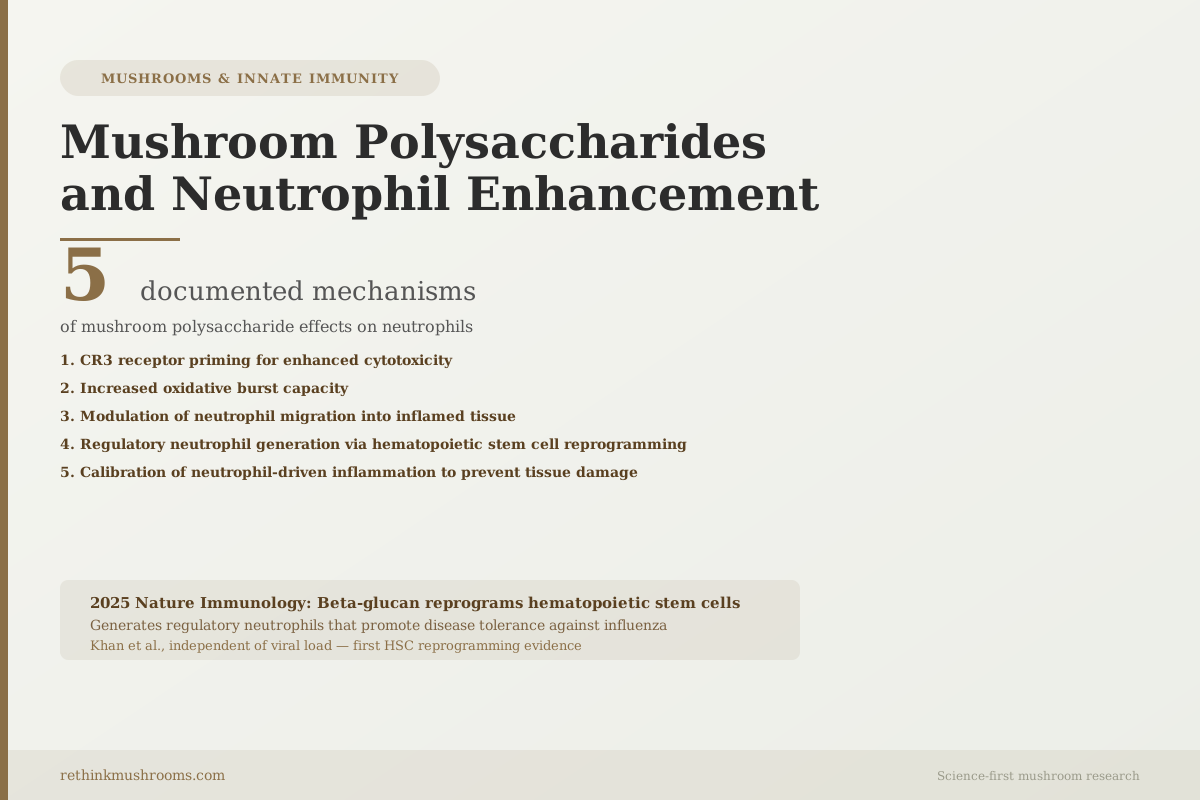
Neutrophils are the most abundant white blood cells in the human body and the first to arrive at a site of infection. In mushroom immunity research, they receive far less attention than macrophages or NK cells. That changed in early 2025, when a paper in Nature Immunology showed that beta-glucan doesn't just enhance neutrophil function through receptor signaling. It reprograms the bone marrow stem cells that produce neutrophils in the first place.[1]
That paper is the reason this topic is suddenly interesting. It is also the reason this article needs to open with a correction rather than a headline, because the study everyone cites as the mushroom trained-neutrophil result did not use a mushroom.
This article covers what the research actually shows: the receptor biology that determines how a neutrophil responds to beta-glucan, the two-signal gate that makes CR3 priming safer and stranger than "it boosts your immune system," the modulation story most sources miss, and an honest audit of where the mushroom evidence stops and the yeast evidence begins. For the full picture of how mushrooms engage all three innate immune cell types together, see the complete guide to mushroom beta-glucans and immunity.
Key Takeaways
- Neutrophils express both beta-glucan receptors. The widely repeated claim that they lack Dectin-1 is wrong: the paper that mapped Dectin-1 expression found the highest surface levels on monocyte/macrophage and neutrophil lineages. What differs between cell types is which downstream program carries the output, not which receptor is present.
- CR3 priming is a two-signal gate, not an amplifier. Beta-glucan binding the CD11b lectin site puts the neutrophil in a permissive state; killing happens only when a second signal — a complement-tagged (iC3b-opsonised) target — arrives. Priming alone produces nothing.
- The 2025 Nature Immunology study used beta-glucan from baker's yeast (Sigma G5011), given by intraperitoneal injection at 1 mg per mouse, seven days before influenza challenge. It is a landmark result in beta-glucan biology; it is not a mushroom study, and it is not an oral-dosing study.
- That study found beta-glucan reprograms hematopoietic stem cells via type I interferon signaling to generate a subset of immature neutrophils that run on mitochondrial oxidative metabolism and produce IL-10. Mice survived better without clearing virus faster — disease tolerance, not resistance.
- Mushroom polysaccharides can also reduce neutrophil activity. In a mouse colitis model, Pleurotus pulmonarius glucans suppressed myeloperoxidase activity, a tissue-level marker that tracks neutrophil infiltration.
- Nearly all the direct neutrophil evidence uses yeast or unspecified glucan. The exception is lentinan, the shiitake beta-glucan: it raised the oxidative burst in human neutrophils in 1985, drove a neutrophil-dependent antitumour effect in mice in 2022 — and failed to induce neutrophil adherence in a 2019 human assay. Three studies, one mushroom compound, mixed results. That is the entire mushroom-specific neutrophil literature.
The 2025 Discovery: Beta-Glucan Builds a New Kind of Neutrophil
In 2025, Khan and colleagues published a study in Nature Immunology documenting something no prior research had shown: beta-glucan doesn't only change how existing neutrophils behave. It changes what neutrophils the body makes.[1]
The design was straightforward. Mice received beta-glucan, and seven days later were infected with influenza A virus. Beta-glucan treatment had reprogrammed hematopoietic stem cells — the bone marrow cells that give rise to neutrophils, macrophages, and all other blood cells — to produce a distinct neutrophil population that hadn't been described before.
Three mechanistic details are worth stating precisely, because they are usually flattened.
The new cells are immature. The paper describes a subset with a less mature phenotype, not a super-charged version of a normal neutrophil. The reprogramming runs through type I interferon. In Ifnar1-deficient mice, which cannot signal through the type I interferon receptor, beta-glucan expanded upstream progenitors but failed to increase granulocyte progenitors — the training effect broke. And the survival benefit depends on getting those cells into the lung, which the authors trace to increased neutrophil recruitment via RORγt+ T cells.
The new subset also behaves differently in two respects. It runs on mitochondrial oxidative metabolism rather than the glycolysis that standard neutrophils use for rapid, high-intensity killing. And it produces IL-10, an anti-inflammatory cytokine — unusual for a cell type that normally emits pro-inflammatory signals.
Khan, Tran, Chevre, et al. (2025) · Nature Immunology
- Population
- Mice (C57BL/6), influenza A virus challenge
- Intervention
- Beta-glucan from baker's yeast (Sigma-Aldrich G5011), 1 mg per mouse, intraperitoneal injection, 7 days before infection
- Comparator
- PBS vehicle; Ifnar1-deficient mice to test type I interferon dependence; granulocyte and T cell manipulations
- Finding
- Reduced morbidity and mortality from influenza with no difference in pulmonary viral load. Beta-glucan promoted granulopoiesis in a type I interferon-dependent manner, generating immature neutrophils using mitochondrial oxidative metabolism and producing IL-10, recruited to lung via RORγt+ T cells.
positive Genuinely novel and well-controlled. But the intervention was yeast-derived beta-glucan delivered by injection — not a mushroom, and not by mouth. Applying it to mushroom supplements requires two unproven bridges: that mushroom beta-glucan behaves equivalently, and that oral dosing reaches the marrow at a comparable effective dose. A published erratum appeared in Nat Immunol 26(3):525.
Khan et al., Nature Immunology, 2025, 26(2):174-187 (PMID 39779870); methods section 'β-Glucan treatment'
Everything here is preclinical, in mouse models. But published in Nature Immunology in 2025, it represents the current frontier of what is known about beta-glucan and neutrophil biology. It also connects directly to the trained immunity story covered in Beta-Glucans and Innate Immune Memory: Beyond Adaptive Immunity.
The Receptor Story Most Articles Get Backwards
Understanding why polysaccharide effects on neutrophils look different from their effects on macrophages starts with the receptor biology — and this is where popular coverage reliably goes wrong.
The standard claim runs: macrophages use Dectin-1, neutrophils don't have it, so neutrophils use CR3 instead. The first and third parts are roughly right. The middle part is false.
Claim check
Do neutrophils lack the Dectin-1 receptor?
The claim
“Neutrophils don't express Dectin-1 — that's a macrophage receptor. Neutrophils recognise beta-glucan only through CR3.”
A compression of the real finding that CR3 dominates the neutrophil's functional response, hardened into a claim about which receptors the cell carries.
What research shows
MisleadingTaylor and colleagues mapped Dectin-1 expression with a purpose-built monoclonal antibody and found the receptor 'is not dendritic cell-restricted as first reported, but is broadly expressed, with highest surface expression on populations of myeloid cells (monocyte/macrophage and neutrophil lineages).' Neutrophils are among the highest Dectin-1 expressers of any cell type measured.
The shorthand still captures something true: CR3 is far more abundant on neutrophils, and the CR3 priming program — not Dectin-1 transcription — carries most of the measured neutrophil output. The error matters because the false version predicts that beta-glucan cannot drive cytokine transcription in a neutrophil, and it can.
Taylor et al., J Immunol, 2002, 169(7):3876-82 (PMID 12244185); Goodridge et al., Immunol Rev, 2009 (PMID 19594628)
In 2009, Goodridge and colleagues published a foundational review of how innate immune cells recognise beta-glucan.[2] Their framing is the accurate one: neutrophils, macrophages, and dendritic cells "among others express several receptors capable of recognizing beta-glucan in its various forms." Several receptors, on each cell type. Taylor and colleagues' expression mapping is what pins down the specifics.[11]
So what actually distinguishes the neutrophil? Not receptor inventory — downstream program.
When Dectin-1 binds beta-glucan, it activates a signaling chain through Syk kinase and a scaffold protein called Card9, which switches on NF-κB, a master regulator of inflammation. That pathway ends in gene transcription: pro-inflammatory cytokines like TNF-α and IL-1β, increased phagocytic capacity, reactive oxygen species. It takes hours, because new protein has to be made. This is the program that dominates the macrophage literature, and it is explained in our companion piece on how medicinal mushrooms activate macrophages. The receptor itself is covered in depth at The Dectin-1 Receptor: How Your Body Recognizes Mushroom Beta-Glucans.
CR3 — complement receptor 3, also called Mac-1 or CD11b/CD18 — runs a completely different kind of program. It requires no transcription. Beta-glucan binding shifts the receptor's conformation, and that's it: the cell is now permitted to do something it previously could not.
Correcting A Common Error
The Neutrophil Has Both Receptors. The Difference Is Which Program Runs.
A great deal of popular writing says neutrophils lack Dectin-1 and use CR3 instead. The paper that mapped Dectin-1 expression found the opposite: surface expression is highest on monocyte/macrophage and neutrophil lineages. Receptor presence is not what separates these cells.
One neutrophil, two beta-glucan receptors
Both are on the same cell at the same time. What follows below is not a story about which receptor a cell type owns — it is a story about which downstream program carries the functional output, and on what timescale.
Dectin-1
Present on neutrophils — at the highest surface levels of any cell type
Taylor et al. 2002
Signal chain
- 1beta-glucan binds
- 2Syk kinase
- 3Card9 scaffold
- 4NF-kB
- 5new gene transcription
Cytokine output: TNF-alpha, IL-1beta, reactive oxygen species
Hours — requires transcription
This is the program that dominates the macrophage literature, which is why almost every mechanism diagram online shows Dectin-1 on a macrophage and stops there.
CR3 (Mac-1, CD11b/CD18)
Present on neutrophils in far greater abundance; the dominant beta-glucan route here
Ross 2000; Xia 2002
Signal chain
- 1beta-glucan binds CD11b lectin site
- 2receptor conformation shifts
- 3cell is primed, not firing
- 4second signal: iC3b-opsonised target
- 5cytotoxic degranulation
Killing output: degranulation onto a complement-flagged target
Immediate — no transcription needed
A two-signal gate. Priming alone produces no killing, which is why beta-glucan does not simply make neutrophils indiscriminately aggressive.
Read it this way: “neutrophils use CR3, macrophages use Dectin-1” is a useful shorthand for which program dominates each cell’s measured output, and a false statement about which receptors each cell carries. The distinction matters because the shorthand invites a wrong prediction — that beta-glucan cannot drive cytokine transcription in a neutrophil. It can. And the honest limit runs the other way too: Taylor and colleagues measured surface expression, not the relative contribution of each receptor to a neutrophil’s response to a mushroom beta-glucan at a dietary dose. That comparison has not been run.
Sources: Taylor et al. (2002), J Immunol 169(7):3876-82 (PMID 12244185); Ross (2000), Crit Rev Immunol 20(3):197-222 (PMID 10968371); Xia et al. (2002), J Immunol 169(11):6417-26 (PMID 12444150); Goodridge et al. (2009), Immunol Rev 230(1):38-50 (PMID 19594628); Chan et al. (2009), J Hematol Oncol 2:25 (PMID 19515245).
Jin and colleagues' 2018 review confirms the broader receptor set: Dectin-1, CR3, CD5, lactosylceramide and others all participate in beta-glucan recognition.[6] Chan and colleagues' 2009 review makes the same point, listing Dectin-1, CR3 and TLR-2/6 as receptors engaged across macrophages, neutrophils, monocytes, NK cells and dendritic cells.[3] Neither review assigns one receptor to one cell type. That division of labour is a simplification introduced downstream of the literature, not found in it.
How CR3 Priming Works: A Gate, Not an Amplifier
The classical neutrophil story in beta-glucan research is CR3 priming for enhanced cytotoxicity. The one-sentence version — "beta-glucan primes neutrophils to kill better" — loses the structure that makes it both interesting and self-limiting.
Ross's 2000 review of Mac-1/CR3 states the mechanism with unusual precision.[12] Soluble beta-glucan polysaccharides bind a membrane-proximal lectin site on the receptor, and this "prime[s] the Mac-1/CR3 of circulating phagocytes and natural killer (NK) cells, permitting cytotoxic degranulation in response to iC3b-opsonized tumor cells that otherwise escape from this mechanism of cell-mediated cytotoxicity."
The load-bearing words are permitting and otherwise escape. Priming does not add force to a response the cell was already making. It opens a channel that was closed.
The binding site itself was characterised by Xia and colleagues in 2002.[13] A lectin domain within CD11b handles beta-glucan, and it is physically distinct from the site that binds complement. Two of their measurements are worth carrying forward, because they describe a real constraint. Stripping GPI-anchored surface proteins with phospholipase C increased beta-glucan binding to CD11b three-fold — meaning other molecules normally occupy that site. And activating neutrophils to form CR3/uPAR complexes cut beta-glucan binding by 75%. The beta-glucan site is contested, and an already-activated, adherent neutrophil is substantially less available for priming than a resting circulating one.
Mechanism, Precisely
Priming Is Permission, Not Activation
CR3 priming is a two-signal gate. Beta-glucan supplies the first signal and a complement-tagged target supplies the second. Neither alone produces killing — which is precisely why beta-glucan does not make neutrophils indiscriminately aggressive.
Signal 1
Priming
beta-glucan binds the CD11b lectin site
A membrane-proximal lectin domain on CD11b, separate from the I-domain that binds complement. Binding shifts the receptor conformation. Nothing is killed and no transcription is required.
Gate
Waiting
no target, no response
This is the step that gets dropped in summaries. A primed neutrophil that never meets an opsonised target does nothing at all. Priming is permission, not activation.
Signal 2
Trigger
iC3b-opsonised target engages the I-domain
Complement tags a bacterium, fungal cell or antibody-coated tumour cell with iC3b. Only a CR3 that has been primed at the lectin site converts that contact into killing.
What constrains signal 1 — the beta-glucan site is contested
3x
more beta-glucan binding to CD11b
after PI-specific phospholipase C stripped GPI-anchored proteins from the surface — evidence that other ligands physically occupy the site
75%
less beta-glucan binding
in neutrophils activated to form Mac-1/CR3/uPAR complexes — an adherent, already-activated neutrophil is far less available for priming
Read it this way: the strongest evidence that the neutrophil is the cell that actually does the killing is a deletion experiment, not a binding assay. Allendorf and colleagues found that oral beta-glucan combined with a tumour-targeting antibody stopped working entirely in granulocyte-depleted mice, and stopped working when neutrophil recruitment was blocked at the C5a receptor. Two honest limits: this is mouse work, and the beta-glucans in the CR3-priming literature are largely soluble yeast- and barley-derived preparations rather than mushroom hot-water extracts. The receptor biology transfers; the specific mushroom preparation has not been tested through this pathway.
Sources: Ross (2000), Crit Rev Immunol 20(3):197-222 (PMID 10968371); Xia et al. (2002), J Immunol 169(11):6417-26 (PMID 12444150); Allendorf et al. (2005), J Immunol 174(11):7050-56 (PMID 15905548).
The strongest evidence that the neutrophil is the cell that actually does the killing comes from a deletion experiment rather than a binding assay. Allendorf and colleagues combined oral beta-glucan with a tumour-targeting antibody in mice, then removed the candidate effector cells one at a time to see which removal broke the effect.[14]
Allendorf, Yan, Ross, et al. (2005) · Journal of Immunology
- Population
- C57BL/6 and BALB/c mice bearing tumours
- Intervention
- Oral and intravenous beta-glucan combined with an anti-tumour monoclonal antibody
- Comparator
- Granulocyte-depleted mice; C5aR antagonist; C3aR-deficient mice; BLT-1-deficient mice
- Finding
- Tumour regression was absent in granulocyte-depleted mice, identifying granulocytes as the essential killer cells. Blocking C5a-dependent chemotaxis with a C5aR antagonist abolished regression, while C3aR-deficient mice responded normally — establishing neutrophils as the major effector. Recruitment required leukotriene B4 amplification.
positive This is causal evidence, not correlation: the effect is removed by removing the cell. The limits are that it is a mouse tumour model and the beta-glucan is not identified as mushroom-derived.
Allendorf et al., J Immunol, 2005, 174(11):7050-56 (PMID 15905548)
This mechanism explains why beta-glucan could, in principle, enhance neutrophil responses to bacterial and fungal infections, which the complement system routinely tags. The mechanistic logic is solid. What remains unclear is whether a dietary dose of mushroom beta-glucan produces enough CR3 occupancy in circulating human neutrophils to shift function meaningfully — and given Xia's finding that the site is competed for, that is not a trivial gap.
The Modulation Story: Polysaccharides Can Also Turn Neutrophil Activity Down
The word "enhancement" in this article's title tells only half the story.
In 2010, Lavi and colleagues tested orally administered glucans from Pleurotus pulmonarius, an oyster mushroom species, in mice with dextran sulfate sodium-induced colitis.[4] Mice received 3.5% DSS for 18 days, with hot water solubles or mycelium extract at 2 or 20 mg per mouse daily in their food. High doses blocked colon shortening, improved macroscopic damage scores, and suppressed myeloperoxidase activity. Tissue TNF-α fell significantly and correlated with the degree of inflammation; IL-1β expression was attenuated across all treatments.
Lavi, Levinson, Peri, et al. (2010) · British Journal of Nutrition
- Population
- Mice with DSS-induced experimental colitis (3.5% DSS, 18 days)
- Intervention
- Pleurotus pulmonarius hot water solubles or mycelium extract, 2 or 20 mg per mouse daily, oral in food
- Comparator
- DSS-only controls; dosing both before and after DSS administration
- Finding
- Glucans attenuated and prevented colitis symptoms. High doses blocked colon shortening, suppressed myeloperoxidase activity and improved macroscopic score; histological damage was reduced at all doses; tissue TNF-α decreased significantly and IL-1β expression was attenuated.
positive Neutrophil involvement is inferred from myeloperoxidase activity — a tissue enzyme marker that tracks neutrophil infiltration but is not a direct measurement of neutrophil migration or function. The study did not count or assay neutrophils.
Lavi et al., Br J Nutr, 2010, 103(3):393-402 (PMID 19772681)
That distinction matters and is worth being careful about. Myeloperoxidase is an enzyme stored in neutrophil granules, so tissue MPO activity is a reasonable proxy for how many neutrophils have arrived. It is not the same as watching them arrive. The honest statement is that a mushroom glucan reduced a marker that tracks neutrophil infiltration, in a model where excessive infiltration drives the pathology.
Why that direction is a feature rather than a contradiction: in a healthy acute infection you want neutrophils flooding in fast to clear the pathogen. When inflammation continues past the threat, or recruitment escalates disproportionately, the resulting tissue damage can exceed the original insult. This is a recurring problem in inflammatory bowel disease, acute lung injury, and sepsis.
Volman and colleagues' 2010 work shows the same duality inside a single experiment.[5] Agaricus bisporus extract stimulated nitric oxide production in mouse bone-marrow-derived macrophages — while almost all the mushroom extracts tested lowered NF-κB transactivation in human intestinal Caco-2 cells. Stimulating one compartment and calming another, at the same time.
Mizuno and Minato's 2024 review in Current Opinion in Biotechnology frames mushroom polysaccharides as possessing "potent anti-inflammatory and immunomodulating properties" together, rather than treating stimulation as the whole story.[9] Framing these compounds as simply "immunostimulatory" misses the duality.
For the broader overview of how bidirectional modulation plays out across all three innate immune cell types, see Mushrooms and Innate Immunity: How Fungi Prime Your First Line of Defense.
Structure Determines Potency: Not All Mushroom Polysaccharides Are Equal
A consistent finding across innate immune research is that polysaccharide structure controls receptor binding strength. This applies to CR3 on neutrophils as much as to Dectin-1 on macrophages.
Volman and colleagues compared mushroom extracts varying in beta-glucan structure and found sharp differences.[5] Agaricus bisporus stimulated macrophage nitric oxide production; Coprinus comatus and Ganoderma lucidum spores had only minor effects; Agaricus blazei Murill and Phellinus linteus had no effect at all. Comparing A. bisporus against A. blazei structurally, the authors concluded that branching of the beta-glucan chain "is essential for immune-stimulating activity." That is a suggestion drawn from a two-species structural comparison, not a dose-response demonstration across a structural series — but the direction is consistent with the wider literature.
Jin and colleagues' 2018 review lays out the structure-activity relationship in more detail.[6] Beta-1,3-glucans with 1,6-branching are the most immunologically active across receptor systems. Molecular weight affects binding efficiency: very high-molecular-weight polymers may have reduced bioavailability, and very short fragments may not bridge receptor binding sites effectively.
Murphy and colleagues ran the most direct species comparison in 2022, isolating glucan-rich polysaccharides from seven mushroom species and testing them across three in vitro injury models.[8] Beta-glucan content varied widely, topping out at 70% w/w for Lentinus edodes and 80% w/w for Hypsizygus tessellatus. The extracts induced up to 4,000 pg/mL of the inflammatory cytokine IL-6 and up to 5,000 pg/mL of anti-inflammatory IL-22 in THP-1 macrophages; after LPS insult, IL-10 gene expression rose from 50-fold to 250-fold. In lung epithelial cells, IL-8 dropped from 10,000 pg/mL to as low as 6,000 pg/mL.
Two things about that study are usually misreported. It tested seven species, not five. And its models were THP-1 macrophages, CD14+ peripheral blood mononuclear cells, and A549/BEAS-2B lung epithelial lines — no neutrophils were involved. The structure-activity principle plausibly extends to CR3 binding, but that extension is inference, not measurement.
What this means practically: "mushroom polysaccharide" is not a uniform category. Two products labeled "beta-glucan" from different species or extracted by different methods can have meaningfully different biological activity — and two of the species Volman tested did nothing at all.
Enoki and the Non-Beta-Glucan Evidence
Most mushroom innate immune research has focused on beta-glucan-producing species: shiitake, oyster mushroom, maitake, and turkey tail. Flammulina velutipes (enoki) offers a genuinely different angle, and for a reason that is easy to miss.
Yin and colleagues characterised three polysaccharide fractions from enoki mycelium in 2010.[10] All three increased nitric oxide, IL-1 and TNF-α production in murine peritoneal macrophages, dose-dependently. But the fraction they characterised in structural detail, FVP2C, turned out to be an alpha-D-(1→4)-glucan with alpha-(1→6) branching — not a beta-glucan at all.
This matters because it establishes that mushroom immune activity is not reducible to the CR3/Dectin-1/beta-glucan story. Multiple molecular pathways are in play, and different species engage different combinations. Enoki also produces a protein called FVE that activates innate immune cells through a separate route entirely, covered in Enoki Polysaccharides and Immune Cell Activation.
It also means enoki cannot be used as evidence for the CR3 priming mechanism, which is how it is sometimes deployed. Yin's fractions were tested on macrophages, and the characterised polymer is the wrong sugar.
The Evidence Gap: Where the Mushroom Data Actually Stops
The mechanistic picture for beta-glucan and neutrophils is detailed and getting better. CR3 lectin-site priming is well characterised at the molecular level. Allendorf's depletion experiment identifies the neutrophil as the effector cell in vivo. Khan's 2025 result opens a genuinely new mechanism at the stem cell level.
Now the uncomfortable part.
Evidence Reach Audit
Two Literatures That Barely Touch — And The One Compound That Bridges Them
Audit the primary sources on this page against two questions — was the glucan from a mushroom, and was a neutrophil actually measured — and almost every study answers only one of them. Exactly one mushroom compound, lentinan, has been put in front of a neutrophil, and it gave three different answers.
Direct neutrophil data
None of it used a mushroom preparation
Khan et al. (2025)
RTHM-02105
Neutrophil measuredGlucan source: Baker's yeast (Sigma G5011)
Intraperitoneal injection, 1 mg/mouse, 7 days pre-infection
Granulopoiesis, HSC reprogramming, IL-10-producing immature neutrophils, survival
Allendorf et al. (2005)
RTHM-02386
Neutrophil measuredGlucan source: Not identified as mushroom-derived
Oral and intravenous, with anti-tumour antibody
Tumour regression lost in granulocyte-depleted and C5aR-blocked mice
Xia et al. (2002)
RTHM-02385
Neutrophil measuredGlucan source: Soluble beta-glucan
Ex vivo, human neutrophils
CD11b lectin-site binding, CR3/uPAR complex formation, adhesion
Taylor et al. (2002)
RTHM-02383
Neutrophil measuredGlucan source: No glucan administered
Receptor expression mapping
Dectin-1 surface expression across myeloid populations
Mushroom preparations
None of them measured a neutrophil directly
Lavi et al. (2010)
ref 4
Proxy only (MPO)Glucan source: Pleurotus pulmonarius (oyster mushroom)
Oral, 2 or 20 mg/mouse daily, DSS colitis
Myeloperoxidase activity, colon length, TNF-alpha, IL-1beta
Murphy et al. (2022)
ref 8
No neutrophil dataGlucan source: Seven mushroom species
In vitro
THP-1 macrophages, CD14+ PBMCs, A549/BEAS-2B lung epithelium
Volman et al. (2010)
ref 5
No neutrophil dataGlucan source: Multiple mushroom extracts
In vitro
Nitric oxide in mouse macrophages; NF-kB in human Caco-2 cells
Yin et al. (2010)
ref 10
No neutrophil dataGlucan source: Flammulina velutipes — and an alpha-glucan, not a beta-glucan
In vitro
Nitric oxide, IL-1, TNF-alpha in murine peritoneal macrophages
The bridge: lentinan, the shiitake glucan
A mushroom compound measured against a neutrophil — three studies, three different functions, mixed results
Sipka et al. (1985)
RTHM-02394
Neutrophil measuredGlucan source: Lentinan (shiitake beta-1,3-glucan)
In vitro, human neutrophils, opsonised in serum
Chemiluminescence (oxidative burst) — 2-fold rise with whole serum vs 1/2 with complement removed
Xu et al. (2022)
RTHM-02395
Neutrophil measuredGlucan source: Lentinan, with a DLL1 Notch agonist
Mouse breast and lung tumour models
Intratumoral Ly6G+ neutrophils increased; anti-Gr1 depletion reversed the benefit
Tanaka & Abe (2019)
RTHM-02396
Neutrophil measuredGlucan source: Lentinan and other fungal polysaccharides
In vitro, neutrophils from healthy human volunteers
Adherence response — fungal polysaccharides did NOT induce it; bacterial components and TNF-alpha did
Read it this way: the 2025 Nature Immunology result that anchors most popular coverage of this topic used beta-glucan from baker’s yeast, injected into the abdominal cavity. That does not make it irrelevant — CR3 and Dectin-1 recognise the beta-1,3/1,6 backbone regardless of which organism built it, so the receptor biology plausibly transfers. But the only mushroom compound actually placed in front of a neutrophil is lentinan, and its three studies measured three different functions and disagreed: oxidative burst up in human cells (1985), tumour infiltration causally required in mice (2022), adherence not induced in human cells (2019). So “mushroom polysaccharides enhance neutrophil function” rests on one purified compound with a mixed record, plus an inference from a yeast literature. The experiment that would settle it — a consumer-grade mushroom extract, given by mouth, with a human neutrophil readout — has not been published.
Sources: Khan et al. (2025), Nat Immunol 26(2):174-187, methods (PMID 39779870; erratum Nat Immunol 26(3):525); Allendorf et al. (2005), J Immunol 174(11):7050-56 (PMID 15905548); Xia et al. (2002), J Immunol 169(11):6417-26 (PMID 12444150); Taylor et al. (2002), J Immunol 169(7):3876-82 (PMID 12244185); Lavi et al. (2010), Br J Nutr 103(3):393-402 (PMID 19772681); Murphy et al. (2022), Sci Total Environ 809:152177 (PMID 34875322); Volman et al. (2010), Mol Nutr Food Res 54(2):268-76 (PMID 19885842); Yin et al. (2010), Am J Chin Med 38(1):191-204 (PMID 20128054); Sipka et al. (1985), Int J Immunopharmacol 7(5):747-51 (PMID 4044098); Xu et al. (2022), BMC Cancer 22(1):918 (PMID 36008793); Tanaka & Abe (2019), Drug Discov Ther 13(6):299-305 (PMID 31956227). Sigma-Aldrich G5011 is glucan from baker’s yeast (S. cerevisiae), CAS 9012-72-0.
Almost every source that directly measured neutrophil function used a non-mushroom glucan, and almost every source using a mushroom preparation measured macrophages, epithelial cells, or a tissue-level proxy. The two literatures run largely in parallel.
There is exactly one place where they meet, and it is worth knowing about because it is small, old, and mixed.
The Lentinan Exception: The Only Mushroom Glucan Tested Against Neutrophils
Lentinan is the purified beta-1,3-glucan from shiitake (Lentinula edodes), and it is the only mushroom-derived polysaccharide with a direct neutrophil literature. That literature amounts to three studies pointing in different directions.
The oldest is also the most mechanistically interesting. In 1985, Sipka and colleagues measured chemiluminescence — a readout of the oxidative burst — in human neutrophils exposed to lentinan.[15] Lentinan stimulated the burst on its own, but the effect was substantially larger when the lentinan had first been opsonised in human serum: roughly a two-fold increase with whole serum, versus a half increase when the serum had been heat-inactivated to destroy complement. The authors concluded that C3b and immunoglobulin contribute separate activating signals.
The most recent is the strongest design. Xu and colleagues combined lentinan with a Delta-like 1 (DLL1) Notch-pathway agonist in mouse breast and lung tumour models.[16] Lentinan increased intratumoral neutrophils, and — critically — depleting neutrophils with an anti-Gr1 antibody reversed the benefit lentinan had added.
Xu, Qi, Zhao, et al. (2022) · BMC Cancer
- Population
- Mice bearing EO771 breast and LAP0297 lung tumours
- Intervention
- Lentinan (shiitake beta-1,3-glucan) combined with Delta-like 1 (DLL1) Notch agonist
- Comparator
- DLL1 alone; lentinan alone; anti-Gr1 antibody neutrophil depletion
- Finding
- Lentinan additively improved DLL1's effect in breast tumours and synergistically enhanced suppression of lung tumour growth, producing regression. It increased both CD8+ T cell activation and intratumoral CD45+CD11b+Ly6G+ neutrophils. Depleting neutrophils with anti-Gr1 reversed the improvement lentinan contributed.
positive This is the mushroom-specific parallel to Allendorf 2005: the effect is removed by removing the cell, which is causal evidence rather than correlation. Limits are that it is a mouse tumour model, lentinan is a purified single compound rather than a whole mushroom or consumer extract, and the effect was measured as a combination therapy rather than lentinan alone.
Xu et al., BMC Cancer, 2022, 22(1):918 (PMID 36008793)
Between those two sits a null. Tanaka and Abe tested a panel of antitumour immunomodulators for their ability to induce adherence in neutrophils drawn from healthy human volunteers.[17] Bacterial preparations and TNF-α clearly induced the response. The purified fungal polysaccharides, lentinan among them, did not.
Three studies, one compound, three different answers — a positive human oxidative-burst result from 1985, a causal mouse tumour result from 2022, and a human null from 2019. They are not necessarily in conflict, because they measured three different neutrophil functions: oxidative burst, tumour infiltration, and adherence. A compound can raise one and leave another untouched. But this is the total of the mushroom-specific neutrophil evidence base, and it is not enough to support a confident directional claim.
De Marco Castro and colleagues' 2021 review is instructive here, and its scope is worth stating plainly: it reviews yeast-derived β-1,3/1,6-glucan, not mushroom beta-glucan.[7] Within that scope it reports emerging evidence that dietary beta-glucans modulate inflammatory and antimicrobial activity of neutrophils and macrophages — and it concludes that "much uncertainty still exists," with human evidence "weaker than that gained from pre-clinical studies." That verdict is about the better-studied yeast literature. The mushroom-specific neutrophil evidence is thinner still.
Chan and colleagues reached a compatible conclusion back in 2009, noting that no good-quality clinical trial data was then available on purified beta-glucans in cancer patients and calling for well-designed trials.[3] The trials that have since been run in mushroom immunity have measured NK cell activity, total immune cell counts, secretory IgA, and infection incidence — not neutrophil-specific outcomes like CR3 priming efficiency, oxidative burst capacity, or regulatory neutrophil proportions.
- Cell & molecular studiescompleted
CR3 lectin-site binding and cytotoxic priming characterised on human neutrophils (Xia 2002); Dectin-1 expression mapped across myeloid lineages (Taylor 2002) — both with non-mushroom glucan. With an actual mushroom glucan: lentinan raised the oxidative burst in human neutrophils (Sipka 1985) but failed to induce adherence in human neutrophils (Tanaka 2019).
- Animal studiescurrent
Neutrophils identified as essential effector cells by depletion (Allendorf 2005); HSC reprogramming to regulatory neutrophils (Khan 2025) — both with yeast or unspecified glucan. With a mushroom glucan: lentinan's antitumour benefit was reversed by neutrophil depletion (Xu 2022), the one causal mushroom result. Lavi 2010 reduced myeloperoxidase activity in mouse colitis — a proxy, not a neutrophil assay.
- Case reports & early seriesmissing
No reports of neutrophil function measured in people taking mushroom polysaccharides
- Small human trialsmissing
Mushroom immunity RCTs have measured NK activity, immune cell counts, secretory IgA and infection incidence — no neutrophil-specific endpoints. The two human lentinan studies used donated blood ex vivo, not supplementation.
- Large randomised trialsmissing
None
- Meta-analyses & systematic reviewsmissing
No mushroom-and-neutrophil human evidence base exists to synthesise
The mechanism is well characterised and the animal evidence is real, but the rungs are mostly being climbed by two different literatures. Non-mushroom glucan carries most of the neutrophil data; mushroom preparations carry the macrophage and tissue data. Lentinan is the only mushroom compound bridging them, across three studies that measured three different neutrophil functions and disagreed. No human supplementation trial has used a neutrophil endpoint.
Xia 2002 (PMID 12444150); Taylor 2002 (PMID 12244185); Allendorf 2005 (PMID 15905548); Khan 2025 (PMID 39779870); Sipka 1985 (PMID 4044098); Xu 2022 (PMID 36008793); Tanaka 2019 (PMID 31956227); Lavi 2010 (PMID 19772681); De Marco Castro 2021 (PMID 32223047)
There are practical reasons for the gap. Measuring neutrophil function in human subjects requires fresh blood draws and ex vivo assays that are harder to run than simple cytokine measurements — neutrophils are short-lived and activate during handling, which makes them genuinely awkward to study. Neutrophil research has also historically attracted less pharmaceutical interest than macrophage or T-cell work.
For the NK cell evidence, which does include human RCT data across multiple species and populations, see Mushrooms and Natural Killer Cell Activity: Research Review. For the innate immunity overview covering all three cell types with the best available human data, see Mushrooms and Innate Immunity: How They Prime Your First Line of Defense.
That is the honest state of the evidence.
Before acting on any of this
ModerateImmune modulation is not automatically a benefit
Concern
The research on this page describes bidirectional effects: beta-glucan can increase neutrophil recruitment and cytotoxic capacity in some contexts and suppress inflammatory infiltration in others. Neither direction is universally desirable. Increasing innate immune activity is not obviously safe in autoimmune disease or in people taking immunosuppressants, and reduced neutrophil infiltration is not obviously safe during active infection. Mushroom supplements may also interact with anticoagulant and immunosuppressive medication, and product composition varies widely between species and extraction methods.
What the research says
No dose, species, or preparation has been shown to produce a defined neutrophil effect in humans, so there is no evidence-based way to aim for one. The mechanistic literature does not support using mushroom polysaccharides to deliberately raise or lower neutrophil activity.
Particularly relevant for: Anyone with an autoimmune condition, an immune deficiency, an active infection, a haematological disorder, a transplant, or taking immunosuppressive or anticoagulant medication; anyone pregnant or breastfeeding
What to do
Talk to a clinician before using mushroom supplements alongside prescription medication or an existing immune condition. Do not use them to self-treat infection or inflammatory disease.
This article is educational and is not medical advice. Mushroom polysaccharides are food and supplement ingredients, not approved treatments for any condition, and no mushroom preparation has been tested for a neutrophil endpoint in humans.
The Bottom Line
The research on beta-glucan and neutrophil function spans three well-characterised mechanisms: CR3 lectin-site priming that permits cytotoxic killing only when a complement-tagged target also arrives, trained regulatory neutrophil generation through type I interferon-dependent bone marrow stem cell reprogramming (Khan et al., 2025, Nature Immunology), and bidirectional modulation that can reduce excessive inflammatory infiltration as readily as it enhances killing capacity. Two corrections separate this account from most coverage: neutrophils do express Dectin-1 — at the highest surface levels of any cell type — so the difference between cell types is which program dominates, not which receptor is present; and the landmark 2025 trained-neutrophil result used baker's yeast beta-glucan delivered by injection, not a mushroom taken by mouth. Most studies that directly measured neutrophils used non-mushroom glucan, and most studies using mushroom preparations measured macrophages, epithelium, or a proxy marker. The exception is lentinan, the shiitake glucan, which has been tested against neutrophils three times — raising the oxidative burst in human cells, proving causally necessary to an antitumour effect in mice, and failing to induce adherence in human cells. The mechanism plausibly transfers, because the receptors recognise the beta-1,3/1,6 backbone regardless of source organism, but no consumer-grade mushroom extract has been given orally with a human neutrophil endpoint.
Frequently Asked Questions
Sources & References
- 1RTHM-02105·Khan, Nargis et al. (2025). “β-Glucan reprograms neutrophils to promote disease tolerance against influenza A virus..” Nature immunology.Study breakdown →PubMed →↩
- 2RTHM-00154·Goodridge, Helen S et al. (2009). “Beta-glucan recognition by the innate immune system..” Immunological reviews.Study breakdown →PubMed →↩
- 3RTHM-00151·Chan, Godfrey Chi-Fung et al. (2009). “The effects of beta-glucan on human immune and cancer cells..” Journal of hematology & oncology.Study breakdown →PubMed →↩
- 4RTHM-00190·Lavi, Iris et al. (2010). “Orally administered glucans from the edible mushroom Pleurotus pulmonarius reduce acute inflammation in dextran sulfate sodium-induced experimental colitis..” The British journal of nutrition.Study breakdown →PubMed →↩
- 5RTHM-00200·Volman, Julia J et al. (2010). “Effects of mushroom-derived beta-glucan-rich polysaccharide extracts on nitric oxide production by bone marrow-derived macrophages and nuclear factor-kappaB transactivation in Caco-2 reporter cells: can effects be explained by structure?.” Molecular nutrition & food research.Study breakdown →PubMed →↩
- 6RTHM-00513·Jin, Yiming et al. (2018). “β-glucans as potential immunoadjuvants: A review on the adjuvanticity, structure-activity relationship and receptor recognition properties..” Vaccine.Study breakdown →PubMed →↩
- 7RTHM-01345·De Marco Castro, Elena et al. (2021). “β-1,3/1,6-Glucans and Immunity: State of the Art and Future Directions..” Molecular nutrition & food research.Study breakdown →PubMed →↩
- 8RTHM-01588·Murphy, Emma J et al. (2022). “Immunomodulatory activity of β-glucan polysaccharides isolated from different species of mushroom - A potential treatment for inflammatory lung conditions..” The Science of the total environment.Study breakdown →PubMed →↩
- 9RTHM-01950·Mizuno, Masashi et al. (2024). “Anti-inflammatory and immunomodulatory properties of polysaccharides in mushrooms..” Current opinion in biotechnology.Study breakdown →PubMed →↩
- 10RTHM-00372·Yin, Hongping et al. (2010). “Purification, characterization and immuno-modulating properties of polysaccharides isolated from Flammulina velutipes mycelium..” The American journal of Chinese medicine.Study breakdown →PubMed →↩
- 11RTHM-02383·Taylor, Philip R et al. (2002). “The beta-glucan receptor, dectin-1, is predominantly expressed on the surface of cells of the monocyte/macrophage and neutrophil lineages..” Journal of immunology (Baltimore.Study breakdown →PubMed →↩
- 12RTHM-02384·Ross, Gordon D (2000). “Regulation of the adhesion versus cytotoxic functions of the Mac-1/CR3/alphaMbeta2-integrin glycoprotein..” Critical reviews in immunology.Study breakdown →PubMed →↩
- 13RTHM-02385·Xia, Yu et al. (2002). “Function of the lectin domain of Mac-1/complement receptor type 3 (CD11b/CD18) in regulating neutrophil adhesion..” Journal of immunology (Baltimore.Study breakdown →PubMed →↩
- 14RTHM-02386·Allendorf, Daniel J et al. (2005). “C5a-mediated leukotriene B4-amplified neutrophil chemotaxis is essential in tumor immunotherapy facilitated by anti-tumor monoclonal antibody and beta-glucan..” Journal of immunology (Baltimore.Study breakdown →PubMed →↩
- 15RTHM-02394·Sipka, S et al. (1985). “Effect of lentinan on the chemiluminescence produced by human neutrophils and the murine macrophage cell line C4M phi..” International journal of immunopharmacology.Study breakdown →PubMed →↩
- 16RTHM-02395·Xu, Hui et al. (2022). “Lentinan enhances the antitumor effects of Delta-like 1 via neutrophils..” BMC cancer.Study breakdown →PubMed →↩
- 17RTHM-02396·Tanaka, Mamoru et al. (2019). “Different activities of antitumor immunomodulators to induce neutrophil adherence response..” Drug discoveries & therapeutics.Study breakdown →PubMed →↩