Mushrooms & Innate Immunity
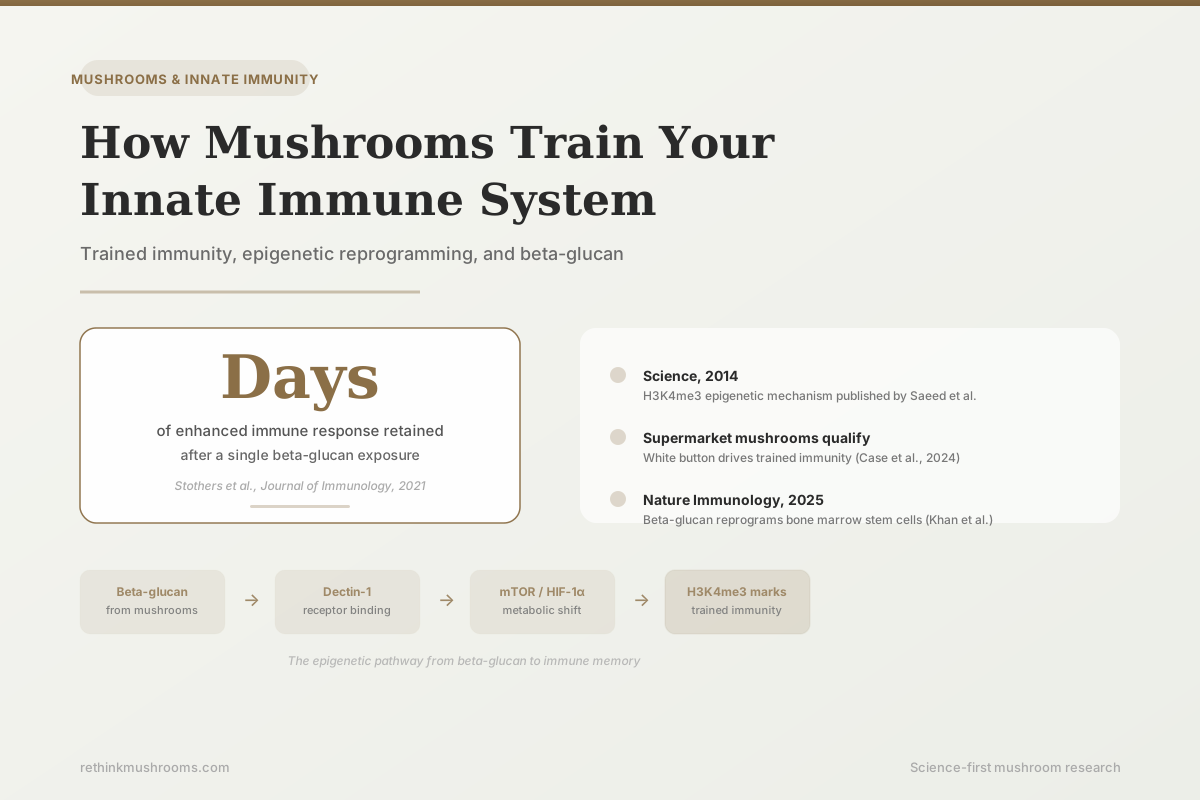
Days of enhanced immune response
After a single beta-glucan exposure, macrophages retain improved cytokine output and phagocytosis capacity for days, without ever encountering the same pathogen again.
Stothers et al., J Immunol, 2021
Science, 2014
Journal where the molecular mechanism for innate immune memory was first published by Saeed et al.
Supermarket mushrooms
White button and portobello mushrooms drive trained immunity in human monocytes (Case et al., 2024)
Nature Immunol, 2025
Journal where neutrophil trained immunity from beta-glucan was first documented at the stem cell level
Stothers et al., J Immunol, 2021
 View as image ↗
Most discussions of immune memory begin with antibodies and T cells. These make up the adaptive branch of the immune system, which takes one to two weeks to build a targeted response but remembers specific pathogens for life. Less widely known is that the faster, older branch of the immune system can also develop innate immune memory. Mushroom beta-glucans are among the most studied triggers for this process, which researchers call trained immunity.
The mechanism was established in a 2014 paper in Science: beta-glucan exposure modifies chemical tags on the DNA packaging inside macrophages, keeping inflammation genes in a persistently ready state.[1] A 2025 paper in Nature Immunology extended the finding to neutrophils, showing that beta-glucan reprograms bone marrow stem cells to generate a protective neutrophil subtype.[2] This article covers what those studies found and where the evidence currently stands. For a broader look at how mushrooms affect all three innate immune cell types, including macrophages, natural killer cells, and neutrophils together, see the complete guide to mushroom beta-glucans and immunity.
Key Takeaways
- Trained immunity is innate immune memory: beta-glucan exposure epigenetically reprograms macrophages so they respond faster and stronger to future threats without needing to recognize a specific pathogen
- The molecular mechanism was published in Science in 2014 by Saeed et al.: beta-glucan exposure adds H3K4me3 activating marks to histones near inflammatory gene promoters, keeping those genes in a ready-to-activate state
- Dectin-1 receptor binding triggers this reprogramming via mTOR and HIF-1α activation, which shifts macrophage metabolism and drives the epigenetic changes (Mata-Martínez et al., Front Immunol, 2022)
- Beta-glucan induced durable trained immunity in fully differentiated macrophages, with enhanced cytokine production and phagocytosis persisting for days after exposure (Stothers et al., J Immunol, 2021)
- Ordinary supermarket white button and portobello mushrooms drove trained immunity in human monocytes through the same H3K4me3 pathway (Case et al., Front Nutr, 2024)
- In 2025, beta-glucan reprogrammed bone marrow stem cells to generate regulatory neutrophils that promoted disease tolerance against influenza independent of viral load (Khan et al., Nature Immunol, 2025)
What Trained Immunity Is and Why It Changes the Standard Story
Trained immunity is a form of innate immune memory in which exposure to a molecular pattern, like a beta-glucan, epigenetically reprograms innate immune cells so they produce faster and stronger responses to future threats. Unlike adaptive immunity, trained immunity does not require recognizing a specific pathogen. It develops within days rather than weeks, and it works across cell types that were long assumed to have no memory at all.
That distinction matters. For most of immunology's history, only the adaptive branch held the monopoly on memory. Antibodies and T cells recognize specific antigens, store that information as long-lived memory cells, and mobilize within hours on re-exposure decades later. The innate branch, including macrophages, neutrophils, and natural killer cells, was understood as fast but fixed: the same generic toolkit deployed every time, no learning between encounters.
That picture changed in 2012 when Quintin and colleagues published in Cell Host and Microbe.[3] They exposed human monocytes (the circulating white blood cells that mature into tissue macrophages) to Candida yeast and then challenged those monocytes weeks later with an entirely different stimulus. Compared to untrained monocytes, the trained ones produced significantly more inflammatory cytokines (the alarm signals that activate the immune response). The memory was not specific to Candida. The monocytes had become broadly more reactive to any immune challenge.
This founding paper established trained immunity as a defined phenomenon and raised an immediate question: if Candida beta-glucan triggers this reprogramming, do beta-glucans from mushrooms do the same?
The answer, developed across the studies below, is yes, including beta-glucans from the white button mushrooms in your grocery store.
The 2014 Science Paper That Defined the Molecular Mechanism
The mechanistic explanation came from Saeed and colleagues in 2014, published in Science.[1] Their question was specific: when a monocyte is exposed to beta-glucan and differentiates into a macrophage, what changes inside the cell at the molecular level?
The answer was histone modification. Every gene in the human genome is wrapped around protein spools called histones. The tightness of that wrapping, which controls whether a gene is easy or hard to activate, is regulated by chemical tags added to or removed from the histones. These chemical modifications are called epigenetic marks because they don't change the DNA sequence itself, only the accessibility of the genes.
Saeed's team found that beta-glucan exposure added a specific activating tag, H3K4me3, to the histones near inflammatory response genes. Think of this mark as a "ready to activate" flag placed on each of those genes. At the same time, a silencing mark called H3K27me3 was removed from the same gene regions, clearing the "stay quiet" flag that normally keeps those genes in check.
The combined result: trained macrophages had inflammatory response genes that were easier to switch on than those in untrained macrophages. When a new immune challenge arrived, they produced more cytokines, faster.
The critical property of these epigenetic marks is persistence. The tags don't disappear when the beta-glucan does. They remain on the histones for the lifespan of the cell. This is what makes trained immunity durable rather than temporary: the stimulus leaves a lasting molecular signature on the gene-regulation machinery of the macrophage.
The Science publication matters beyond the finding itself. Placing this mechanism in the highest-impact scientific journal established trained immunity as a serious immunological concept and invited independent replication, which followed over the next decade.
How Dectin-1 Converts Beta-Glucan Into an Epigenetic Signal
Beta-glucan is a large sugar polymer. It cannot cross the cell membrane to modify histones directly. It works from the outside in, by binding a surface receptor that fires an internal signal chain.
The primary receptor for mushroom beta-glucan on macrophages is Dectin-1, a surface protein that functions as a shape-specific recognition lock for beta-glucan's molecular structure. Lee and Kim's 2014 review of fungal beta-glucan innate immunity established Dectin-1 as the master recognition system for mushroom-derived beta-glucan in macrophages and dendritic cells.[4] The detailed account of how this receptor identifies beta-glucan, and how different structural features of beta-glucan affect receptor binding, is in our article on the Dectin-1 receptor and beta-glucan recognition.
The immediate signal chain runs: Dectin-1 binds beta-glucan, which activates Syk kinase, which activates Card9, which turns on NF-κB (the master switch for inflammation genes). This cascade produces an acute immune response. But trained immunity requires something that outlasts the stimulus.
Mata-Martínez and colleagues' 2022 review of Dectin-1 signaling identified the additional step that bridges receptor binding and epigenetic reprogramming.[5]
The key is a metabolic shift. Dectin-1 activation turns on a cellular energy sensor called mTOR (a protein that monitors the cell's nutrient and energy status and activates growth and production programs when conditions are favorable). mTOR then activates a protein called HIF-1α, which normally switches cells to fast, high-output energy production in low-oxygen conditions. HIF-1α activation shifts the macrophage's metabolism from a slow, efficient baseline to a rapid, high-output mode.
This metabolic shift is what the chromatin-modifying enzymes need to install and maintain the H3K4me3 activating marks that Saeed documented. The epigenetic reprogramming is not a direct effect of beta-glucan touching the nucleus. It is a consequence of a whole-cell metabolic change triggered at the surface receptor.
The full pathway: Dectin-1 binds beta-glucan, mTOR activates, HIF-1α switches on the fast metabolism program, chromatin-modifying enzymes use that energy to add H3K4me3 marks to inflammatory gene promoters, trained immunity is established. This is why trained immunity is cellular-level reprogramming rather than sustained stimulation.
How Long the Trained State Persists in Macrophages
The Saeed 2014 paper worked in monocytes during the developmental window when they differentiate into macrophages. A practical follow-up question: can fully differentiated macrophages already living in tissues also be trained?
Stothers and colleagues answered this in a 2021 paper in the Journal of Immunology. They exposed mature, differentiated macrophages to beta-glucan and then removed the stimulus, measuring how long the trained state persisted.[6]
The trained state persisted for days. The macrophages showed enhanced cytokine production, improved phagocytosis (the process of engulfing and destroying pathogens), and measurable metabolic reprogramming that lasted well after the beta-glucan exposure ended.
The significance extends beyond the duration number. Tissue macrophages in humans live for months to years, not the hours or days that circulating monocytes persist in the bloodstream. If the trained state persists for the lifespan of the macrophage, the effective duration in living tissue could be far longer than the days measured in culture. Macrophages resident in the lung, liver, and intestinal wall could retain a trained state for months after a single induction event.
That inference is biologically plausible but not directly measured. No human trial has tracked how long macrophage training persists after mushroom beta-glucan exposure in vivo. The Stothers result establishes that training works in mature cells; the duration question in living humans remains open.
For a look at how trained macrophage activation differs from standard acute macrophage activation, and what species-specific mechanisms look like across Cordyceps, Phellinus, and Agaricus, see our article on how medicinal mushrooms activate macrophages.
The 2024 Finding That Changes the Practical Picture: Supermarket Mushrooms Do This
The cell culture studies above used purified beta-glucan preparations. A natural question follows: do the beta-glucans inside mushrooms people actually eat produce trained immunity, or does this require pharmaceutical-grade extracts?
Case and colleagues addressed this directly in 2024, publishing in Frontiers in Nutrition.[7] They extracted beta-glucans from commercial Agaricus bisporus mushroom products, specifically white button and portobello mushrooms purchased from ordinary grocery stores, and applied them to human monocytes in culture.
The grocery-store mushroom beta-glucans drove trained immunity through the same H3K4me3 epigenetic pathway Saeed documented in 2014.
This finding reframes the trained immunity conversation. Most of the medicinal mushroom literature focuses on exotic species: Reishi, Cordyceps, Turkey Tail, Maitake. The Case 2024 result establishes that the most common mushroom in most kitchens contains beta-glucans capable of inducing the same fundamental cellular reprogramming. Trained immunity is not a feature exclusive to premium supplements or medicinal extracts.
The honest limitation: this was a cell culture study. The beta-glucan was applied directly to monocytes, bypassing the digestive system entirely. Whether eating white button mushrooms in a normal diet delivers sufficient intact beta-glucan to circulating monocytes to trigger this reprogramming in a living person has not been established in human trials. Oral digestion introduces barriers, including enzymatic breakdown and absorption constraints, that laboratory culture does not.
Neutrophils Can Be Trained Too: What a 2025 Nature Immunology Paper Found
Every trained immunity study discussed above focused on macrophages or monocytes. In early 2025, a paper in Nature Immunology extended the concept to neutrophils through a mechanistically distinct pathway.[2]
Neutrophils are the most abundant white blood cells and the first to arrive at infection sites. Standard neutrophils attack pathogens with oxidative burst (a flood of toxic oxygen compounds) and enzyme release. They are short-lived, highly aggressive, and pro-inflammatory by design.
Khan and colleagues found that beta-glucan pretreatment reprogrammed hematopoietic stem cells, the bone marrow stem cells that generate all blood and immune cell types, to produce a distinct neutrophil population not normally present in untreated animals. These regulatory neutrophils differed from standard neutrophils in two key properties. First, they used mitochondrial oxidative metabolism rather than the rapid glycolysis (fast sugar-burning) that activated neutrophils typically rely on. Second, they produced IL-10, an anti-inflammatory signaling protein, instead of the pro-inflammatory cytokines standard neutrophils release.
These regulatory neutrophils promoted disease tolerance against influenza A virus. Beta-glucan-pretreated mice had significantly higher survival rates when infected with influenza. The effect was independent of how much virus the animals were exposed to. This was not about reducing viral replication. It was about surviving the immune response itself, specifically the inflammatory damage that kills patients during severe respiratory infections more often than the virus does directly.
This mechanism differs from macrophage trained immunity in an important structural way. The macrophage story is about individual cells becoming more responsive after exposure. The neutrophil story from Khan 2025 is about beta-glucan changing what cell types the bone marrow produces, generating an entirely new functional subtype with different behavior. Both are forms of trained immunity. They work through separate pathways and likely have different effects on infection outcomes.
The Khan 2025 study was conducted in mice. Whether human hematopoietic stem cells undergo the same reprogramming after beta-glucan exposure has not been established. The regulatory neutrophil finding is the most recent and most mechanistically novel data point in this space, and it is still at the frontier of what is confirmed.
For a complete picture of how polysaccharides affect neutrophil function, including the CR3 receptor pathway that is distinct from Dectin-1, see our article on mushroom polysaccharides and neutrophil enhancement.
What the Research Hasn't Confirmed: Three Gaps Worth Naming
The mechanistic case for mushroom beta-glucans and trained immunity is well-supported in cell and animal research. Three specific gaps limit what can be said about human outcomes.
Human in-vivo data is absent. No published randomized controlled trial has directly measured trained immunity markers in humans before and after mushroom supplementation. No trial has tracked epigenetic changes in circulating monocytes, enhanced cytokine responsiveness, or macrophage phenotype shifts following dietary mushroom consumption or beta-glucan supplementation in people. The entire human case rests on cell culture data showing the right receptor, pathway, and epigenetic mark are present in human cells. Whether the effect occurs in a living human system at dietary doses is not confirmed.
Oral bioavailability creates uncertainty. Beta-glucans are large polysaccharides that face enzymatic degradation and absorption barriers in the gastrointestinal tract. The Case 2024 study applied extracted beta-glucan directly to monocyte cultures, bypassing digestion entirely. What fraction of beta-glucan from eaten mushrooms reaches circulating monocytes at concentrations sufficient to trigger Dectin-1-mediated epigenetic reprogramming is not established.
Duration in living humans is extrapolation. The "days" figure from Stothers 2021 is a cell culture measurement. The reasoning that tissue macrophage training might last months in vivo, because those cells live for months, is biologically reasonable but not measured. Actual duration data in humans does not exist.
None of these gaps invalidate the mechanistic research. They clarify where evidence ends and where inference begins. For a broader look at how all three innate cell types respond to mushrooms together, see our overview article on mushrooms and innate immunity. For the NK cell evidence specifically, see our natural killer cell research review. The companion piece on innate immune memory as a broader concept, beyond mushrooms alone, is at beta-glucans and innate immune memory. For deeper reading on the trained immunity mechanism across both the innate and adaptive interface, see trained immunity and mushroom beta-glucans.
The Bottom Line
The mechanistic case for mushroom beta-glucans creating trained innate immune memory is well-established at the cellular level. The pathway from Dectin-1 binding to H3K4me3 epigenetic reprogramming is documented in the pages of Science, the effect works in both developing and fully mature macrophages, ordinary grocery-store mushrooms carry the right beta-glucan structure, and a 2025 Nature Immunology paper has now extended trained immunity to neutrophils at the bone marrow stem cell level. What remains unconfirmed is whether eating mushrooms or taking beta-glucan supplements delivers sufficient material to circulating monocytes in a living person to trigger these cellular events, and how long any effects would persist.
Frequently Asked Questions
Sources & References
- 1RTHM-00640·Saeed, Sadia et al. (2014). “Epigenetic programming of monocyte-to-macrophage differentiation and trained innate immunity..” Science (New York.Study breakdown →PubMed →↩
- 2RTHM-02105·Khan, Nargis et al. (2025). “β-Glucan reprograms neutrophils to promote disease tolerance against influenza A virus..” Nature immunology.Study breakdown →PubMed →↩
- 3RTHM-00485·Quintin, Jessica et al. (2012). “Candida albicans infection affords protection against reinfection via functional reprogramming of monocytes..” Cell host & microbe.Study breakdown →PubMed →↩
- 4RTHM-00333·Lee, Dong Hee et al. (2014). “Innate immunity induced by fungal β-glucans via dectin-1 signaling pathway..” International journal of medicinal mushrooms.Study breakdown →PubMed →↩
- 5RTHM-01584·Mata-Martínez, Pablo et al. (2022). “Dectin-1 Signaling Update: New Perspectives for Trained Immunity..” Frontiers in immunology.Study breakdown →PubMed →↩
- 6RTHM-00721·Stothers, Cody L et al. (2021). “β-Glucan Induces Distinct and Protective Innate Immune Memory in Differentiated Macrophages..” Journal of immunology (Baltimore.Study breakdown →PubMed →↩
- 7RTHM-00867·Case, Sarah et al. (2024). “β-glucans from Agaricus bisporus mushroom products drive Trained Immunity..” Frontiers in nutrition.Study breakdown →PubMed →↩