Turkey Tail & Immune Recovery
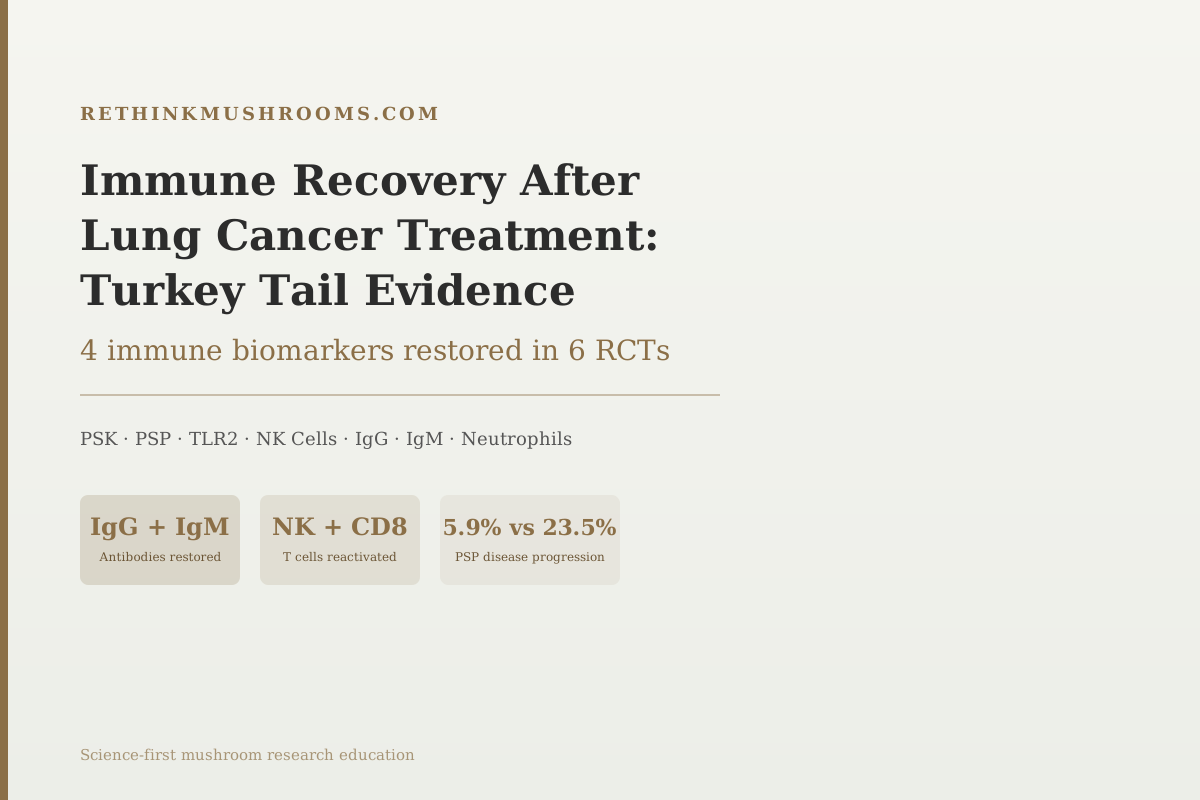
4 biomarkers restored
A systematic review of 6 randomized controlled trials found PSK treatment significantly improved IgG, IgM, total leukocyte counts, and neutrophil counts in lung cancer patients, all at p less than 0.05.
Fritz et al., Integrative Cancer Therapies, 2015
5.9% vs 23.5%
rate of disease progression in PSP-treated versus control NSCLC patients over 28 days post-treatment (odds ratio 4.00, p=0.04), the only double-blind RCT of PSP for lung cancer (Tsang et al., 2003)
TLR2 agonist
the molecular mechanism by which PSK reactivates immune function; it binds TLR2 receptors on immune cells, stimulating CD8+ T cells and NK cells via a pathway that chemotherapy-induced immunosuppression does not block (Hsieh et al., 2011)
Not FDA-approved
the regulatory status of PSK and turkey tail as cancer treatment in the United States; PSK is a prescription cancer drug in Japan (approved 1977) but is not approved by the FDA
Fritz et al., Integrative Cancer Therapies, 2015
 View as image ↗
Chemotherapy and radiation work by targeting rapidly dividing cells. Cancer cells are the target, but immune cells divide rapidly too. By the time lung cancer treatment ends, the immune system has often sustained significant collateral damage: NK cell populations depleted, CD8+ cytotoxic T cells reduced, immunoglobulin levels down, neutrophil counts suppressed. Treatment ends; the immune damage lingers.
This is where the research on turkey tail and immune recovery is most specific. The clinical trial evidence for PSK (polysaccharide-K) focuses heavily on immune biomarkers: which immune cell types and antibody classes improve, at what statistical significance, and how PSK's mechanism allows it to restart immune function through a route that chemotherapy's immunosuppression hasn't closed off.
This article focuses specifically on post-treatment immune recovery. For PSK as an adjunct during lung cancer chemotherapy, see PSK as an adjunct to lung cancer chemotherapy. For the broad clinical evidence overview, see turkey tail and lung cancer: clinical evidence review. For background on PSK itself, see PSK (Krestin): Japan's approved mushroom cancer drug. For the wider turkey tail introduction, see what is turkey tail mushroom: a science-based introduction.
Key Takeaways
- A 2015 systematic review of 6 randomized controlled trials found PSK significantly improved IgG, IgM, total leukocyte counts, and neutrophil counts in lung cancer patients (all p less than 0.05) compared to placebo (Fritz et al., 2015)
- The only double-blind RCT of PSP specifically for NSCLC patients post-treatment found 5.9% disease progression in the PSP group versus 23.5% in controls (OR=4.00, p=0.04), with significant improvements in all four immune biomarkers (Tsang et al., Respiratory Medicine, 2003)
- PSK is a TLR2 agonist: it directly stimulates CD8+ T cells and NK cells through Toll-like receptor 2 signaling, a pathway that chemotherapy-induced immunosuppression (TGF-β driven) does not block (Hsieh et al., Clinical Cancer Research, 2011)
- PSK reverses TGF-beta immunosuppression specifically; chemotherapy elevates TGF-beta, which suppresses anti-cancer immunity; PSK counteracts this mechanism (Kobayashi et al., Surgery Today, 2012)
- PSK activates gamma-delta T cells, a hybrid innate/adaptive immune population that can kill tumor cells without prior sensitization and plays a specific role in lung cancer immune surveillance (Torkelson et al., 2013)
- PSK and turkey tail are not FDA-approved for cancer treatment; PSK is a prescription drug in Japan (approved 1977 for cancer including small-cell lung carcinoma); patients should discuss with their oncologist before adding any supplement during recovery
Why Your Immune System Doesn't Bounce Back When Chemotherapy Ends
The immune suppression from lung cancer treatment is not a single mechanism. It is several layered problems operating simultaneously.
Chemotherapy agents damage rapidly dividing immune cells alongside cancer cells, reducing the circulating pool of NK cells, CD8+ cytotoxic T cells, and neutrophils. Radiation adds localized damage that can affect lymphatic tissue and bone marrow. Beyond direct cell killing, both treatments elevate transforming growth factor-beta (TGF-beta), a signaling molecule that suppresses anti-cancer immune activity. TGF-beta is already elevated in many tumors as a mechanism of immune escape. Treatment adds to it.
The result is a post-treatment immune landscape that can take months to normalize. NK cell counts, CD8+ T cell populations, and immunoglobulin levels (IgG, IgM) all require time and active bone marrow and lymphoid tissue recovery. During this window, both infection risk and potentially recurrence risk are elevated.
The key question for the PSK/PSP research is whether turkey tail compounds can specifically accelerate or restore these immune populations through a mechanism that doesn't depend on the pathways that chemotherapy just suppressed.
The Four Immune Biomarkers PSK Specifically Restored in Clinical Trials
The Fritz 2015 systematic review is the most comprehensive synthesis of PSK for lung cancer, covering 28 studies including 6 RCTs and 5 non-randomized controlled trials.[1] What makes this review particularly useful for understanding immune recovery is that it reports specific biomarker data from multiple trials.
In the RCTs included in the review, PSK treatment (3g/day) produced statistically significant improvements in four immune markers compared to placebo:
IgG (immunoglobulin G): The primary antibody class responsible for long-term immune memory. Chemotherapy reduces IgG production by damaging B cells. PSK-treated patients showed significantly higher IgG levels (p less than 0.05).
IgM (immunoglobulin M): The first-response antibody class activated in acute immune challenges. Elevations in IgM suggest reactivation of humoral immune function. PSK-treated patients showed significantly higher IgM levels (p less than 0.05).
Total leukocytes: The white blood cell count, which drops substantially during chemotherapy as bone marrow output is suppressed. Recovery of leukocyte count is the standard clinical marker for post-treatment immune recovery. PSK-treated patients showed significantly higher leukocyte counts (p less than 0.05).
Neutrophil count: The most abundant white blood cell type, critical for infection defense. Neutropenia (low neutrophil count) is the most dangerous post-chemotherapy immune complication. Neutrophil count restoration is a direct measure of post-treatment immune recovery. PSK-treated patients showed significantly higher neutrophil counts (p less than 0.05).
All four improvements were statistically significant. The immune biomarker pattern is consistent across the trials in the review: PSK specifically targets the immune populations that chemotherapy depletes.
How PSK Reactivates Immunity Through a Route Chemotherapy Didn't Close
The reason PSK can restore immune function during or after chemotherapy is mechanistic, not coincidental. It activates immune cells through a receptor pathway that TGF-beta immunosuppression does not block.
Hsieh and colleagues established in 2011 that PSK is a TLR2 agonist: it binds Toll-like receptor 2 on immune cells and directly activates CD8+ cytotoxic T cells and NK cells.[3] TLR2 is a pattern recognition receptor that functions in innate immune signaling. It is part of the pathway that recognizes pathogens and triggers immune responses. Critically, TGF-beta's immunosuppressive effects primarily target the adaptive immune activation pathways, not the TLR-mediated innate signaling cascade. PSK's TLR2 route sidesteps the TGF-beta suppression.
Kobayashi and colleagues' comprehensive review of PSK's biological mechanisms (the most complete synthesis of the clinical pharmacology) confirmed that PSK specifically reverses TGF-beta-driven immunosuppression in cancer patients.[5] This is the synergistic basis for PSK + chemotherapy: chemo creates TGF-beta-mediated suppression; PSK reverses it through TLR2. The combination isn't just additive.
Wenner and colleagues extended this mechanism further: PSK-activated NK cells also enhanced the antitumor efficacy of targeted therapies (specifically trastuzumab), demonstrating that PSK's immune activation amplifies the effect of other cancer treatments rather than merely running in parallel.[4]
For the broader immune enhancement mechanism applicable across cancer types, see how turkey tail enhances the immune system's anti-cancer response.
The PSP Data for Post-Treatment NSCLC Recovery
While PSK (the Japan-developed compound) has the larger clinical evidence base, the most directly relevant post-treatment immune recovery data for non-small cell lung cancer (NSCLC) patients specifically comes from a PSP trial.
Tsang and colleagues conducted a double-blind, randomized, placebo-controlled trial testing PSP (polysaccharide peptide, the Hong Kong-researched compound from the same mushroom) in 68 patients with advanced NSCLC (specifically stages IIIB and IV) after conventional treatment had been completed.[2] Patients received either PSP (3.06g/day) or placebo for 28 days.
The results on disease progression were striking: 5.9% of PSP patients withdrew due to disease progression, compared to 23.5% of control patients (p=0.04, OR=4.00). Patients in the PSP group were approximately four times less likely to experience rapid disease progression in the 28 days after conventional treatment.
The immune biomarker recovery mirrored what Fritz 2015 documented for PSK: IgG, IgM, leukocyte counts, and neutrophil counts all improved significantly in the PSP group compared to controls. Body fat percentage also increased in the PSP group, reflecting the restoration of physical condition after treatment-induced weight loss.
This is the only double-blind RCT testing PSP specifically in NSCLC patients, and it was conducted in the post-treatment window, making it the most directly relevant study for patients interested in immune recovery support after lung cancer treatment. For more on the NSCLC-specific research, see turkey tail and non-small cell lung cancer: research findings.
Gamma-Delta T Cells: The Tumor-Patrolling Cells That PSK Specifically Wakes Up
Beyond the four classic immune biomarkers, PSK activates a population of immune cells that gets almost no attention in consumer content but is particularly relevant for lung cancer immune surveillance.
Torkelson and colleagues demonstrated in 2013 that PSK specifically activates gamma-delta (γδ) T cells.[7] Gamma-delta T cells are a hybrid immune cell type that bridges innate and adaptive immunity. Unlike conventional CD8+ T cells, which must be specifically sensitized to a target antigen before they can kill tumor cells, γδ T cells can recognize and kill tumor cells without prior sensitization. They patrol tissue looking for cells that display signs of malignancy or stress, including the altered surface markers that lung cancer cells express.
The γδ T cell population declines during chemotherapy, contributing to the post-treatment immune surveillance gap. PSK's specific activation of this population provides an additional layer of anti-tumor immune coverage beyond the NK cell and CD8+ T cell activation that the TLR2 mechanism explains.
Standish and colleagues' review of turkey tail's immune restoration mechanisms in cancer patients confirms that the NK cell and CD8+ T cell recovery pathways are consistent across cancer types, including lung cancer: the restoration mechanisms are not tumor-specific, they are system-level immune recovery.[6]
What Post-Treatment Immune Recovery Looks Like in Practice
Several practical points are important for patients or caregivers evaluating this research.
PSK is not FDA-approved. The Japan approval (1977 for cancer, reapproved 1989 specifically for gastric cancer, colorectal cancer, and small-cell lung carcinoma in combination with chemotherapy) does not apply in the United States. In the US, PSK and turkey tail are dietary supplements, not approved cancer treatments. This regulatory status matters for how any trial data should be interpreted relative to clinical decision-making.
The studied dose is 3g/day. All six RCTs in the Fritz 2015 systematic review used PSK at 3g/day. The Tsang 2003 PSP trial used 3.06g/day. Supplements sold as "turkey tail" vary widely in the concentration and form of active compounds, and most over-the-counter products have not been tested against these clinical doses. PSK (Krestin) as sold in Japan is a standardized pharmaceutical preparation. See PSP vs. PSK: comparing turkey tail's two anti-cancer compounds for details on compound forms.
PSK showed no effect in esophageal cancer. This is an important honesty point: PSK is not universally effective across cancer types. The evidence is strongest for lung, gastric, and colorectal cancer; esophageal cancer trials showed no benefit. The immune recovery mechanism is real but does not translate universally.
Discuss with your oncologist. The PSK trials showing immune recovery were conducted with oncologist oversight, in controlled settings, with specific patient populations. Adding any supplement during cancer recovery should involve the treating oncology team. This is not advisory language; it is the appropriate framing for decisions of this magnitude.
The Bottom Line
PSK and PSP from turkey tail mushroom have specific clinical evidence for post-treatment immune recovery in lung cancer patients. Fritz et al. (2015) synthesized 6 RCTs showing PSK (3g/day) significantly improved IgG, IgM, leukocyte counts, and neutrophil counts (all p less than 0.05). The only PSP-specific NSCLC trial (Tsang et al., 2003) found 4x less disease progression and the same biomarker improvements in advanced NSCLC patients post-treatment. The mechanism involves TLR2 agonism (Hsieh 2011) bypassing TGF-beta-induced immunosuppression and specifically activating CD8+ T cells, NK cells, and gamma-delta T cells (Torkelson 2013). PSK is not FDA-approved; Japan approval since 1977 is for chemotherapy adjunct use. Post-treatment supplement decisions should involve the treating oncology team.
Frequently Asked Questions
Sources & References
- 1RTHM-00684·Fritz, Heidi et al. (2015). “Polysaccharide K and Coriolus versicolor extracts for lung cancer: a systematic review..” Integrative cancer therapies.Study breakdown →PubMed →↩
- 2RTHM-00124·Tsang, K W et al. (2003). “Coriolus versicolor polysaccharide peptide slows progression of advanced non-small cell lung cancer..” Respiratory medicine.Study breakdown →PubMed →↩
- 3. Source details for this reference are not yet available.
- 4. Source details for this reference are not yet available.
- 5. Source details for this reference are not yet available.
- 6. Source details for this reference are not yet available.
- 7. Source details for this reference are not yet available.