Turkey Tail Mushroom
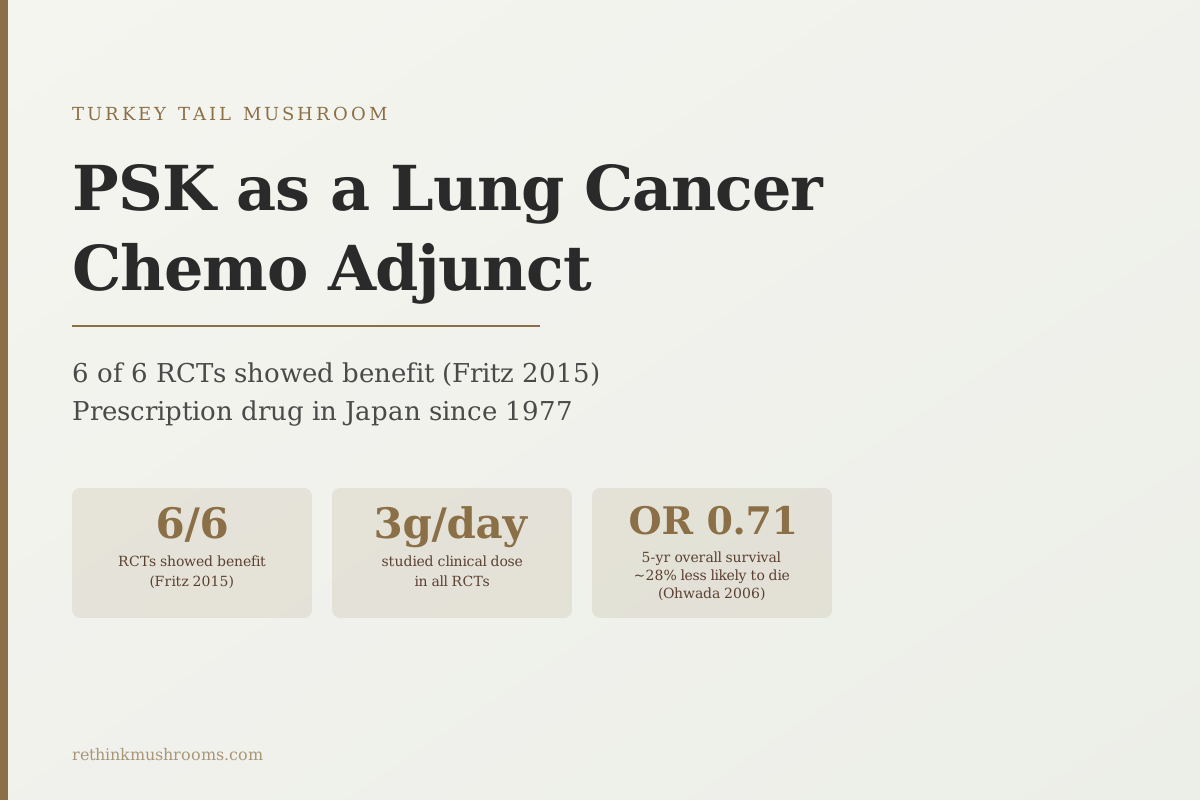
6 of 6 RCTs showed benefit
A 2015 systematic review examined every published clinical trial of PSK with lung cancer treatment and found all 6 randomized controlled trials showed benefit — including significant restoration of immune markers depleted by chemotherapy.
Fritz et al., Integrative Cancer Therapies, 2015
3g/day
PSK dose used in every lung cancer RCT — the studied clinical dose (Fritz 2015)
HR 0.71
5-year overall survival hazard ratio favoring PSK in a 1,094-patient meta-analysis — roughly a 28% lower risk of death at 5 years (Sakamoto 2006)
1977
year PSK (Krestin) was approved as a prescription cancer drug in Japan — 40+ years of clinical use
Fritz et al., Integrative Cancer Therapies, 2015
 View as image ↗
Chemotherapy kills rapidly dividing cells. That includes cancer cells — which is the goal — and immune cells, which is the problem. After a course of chemotherapy, the immune system emerges significantly depleted: cytotoxic T cells reduced, natural killer cells diminished, antibody levels down, white blood cell counts suppressed.
The resulting immunosuppression is not just a side effect. In cancer, it matters because the immune system's capacity to detect and destroy any cancer cells that survive treatment is part of what determines whether the cancer returns.
For more than four decades, Japanese oncologists have given lung cancer patients a mushroom-derived compound called PSK (polysaccharide K, sold under the trade name Krestin) alongside chemotherapy. The rationale: PSK activates specific immune pathways that chemotherapy suppresses, rather than adding another cytotoxic agent. In 1977, Japan's Ministry of Health approved PSK as a prescription cancer drug for use in combination with standard therapy. By the time a comprehensive systematic review was published in 2015, every randomized controlled trial of PSK with lung cancer treatment had shown benefit.
This article covers what PSK is, how it interacts with chemotherapy at the immune level, what the clinical trial data shows, and what the Japan-vs-US regulatory difference means for patients today. For the broader context on turkey tail and cancer evidence, see what is turkey tail mushroom: a science-based introduction and turkey tail and cancer: 40 years of research reviewed. For background on PSK specifically as a cancer drug in Japan, see PSK (Krestin): Japan's approved mushroom cancer drug.
Key Takeaways
- A 2015 systematic review of 28 studies found all 6 RCTs of PSK with lung cancer treatment showed benefit in at least one endpoint; all 5 non-randomized clinical studies showed improved median survival (Fritz et al., Integr Cancer Ther, 2015)
- Every lung cancer RCT used the same PSK dose: 3g/day taken orally alongside concurrent chemotherapy — this is the clinically studied protocol
- PSK improved immune parameters and hematological function in the review's synthesis of NSCLC trial data — including IgG and IgM (antibody proteins), total leukocyte count (white blood cells), and neutrophil count — relative to control (Fritz 2015)
- PSK is a TLR2 agonist — it binds directly to Toll-like receptor 2 on immune cells, stimulating cytotoxic T cells and NK cells to attack tumors, specifically reversing the immunosuppression caused by TGF-β, a signal tumors use to evade immune detection (Lu et al., Clin Cancer Res, 2011; Maehara et al., Surgery Today, 2012)
- A meta-analysis of PSK adjuvant trials in curatively resected colorectal cancer found a 5-year overall survival hazard ratio of 0.71 (95% CI 0.55–0.90) across 1,094 patients — roughly a 28% lower risk of death at 5 years (Sakamoto et al., Cancer Immunol Immunother, 2006)
- PSK is a prescription drug in Japan (approved 1977 for several cancers including lung), but is not FDA-approved in the United States; it is available as a supplement without guarantee of identity or dose
What the 2015 Systematic Review Found: Every RCT Showed Benefit
Fritz and colleagues published a systematic review in Integrative Cancer Therapies in 2015 that collected all published studies on PSK and Coriolus versicolor for lung cancer: 6 randomized controlled trials, 5 non-randomized clinical studies, and 17 preclinical studies — 28 studies in total.[1]
The clinical result was consistent in a way that is unusual for a natural compound: all 6 RCTs showed benefit in at least one pre-specified endpoint. All 5 non-randomized clinical studies showed improved median survival in patients receiving PSK.
Three specific findings stand out from the RCT data.
First, PSK improved the immune and blood-count measures that chemotherapy suppresses. Across the randomized trials, the review reported benefits on immune parameters and hematological function — including IgG and IgM (the antibody proteins the immune system uses to mark threats for destruction) and total leukocyte (white blood cell) and neutrophil counts — in patients receiving PSK relative to control. These are not subjective endpoints. They are laboratory biomarkers reflecting measurable immune system recovery.
Second, the dose was consistent across all RCTs: 3g of PSK per day taken orally during concurrent chemotherapy. This consistency across multiple independent research groups, across different chemotherapy regimens, provides a practical benchmark.
Third, the review noted a striking observational finding from one study: Stage III NSCLC patients taking PSK reportedly had better prognosis than Stage II patients in the same study who were not taking PSK. If replicated in prospective data, that finding would suggest PSK's immune enhancement may partially compensate for higher tumor burden.
For the full clinical picture of turkey tail across all lung cancer trial types, see turkey tail and lung cancer: clinical evidence review.
What Chemotherapy Does to the Immune System (And Why PSK Targets That Specifically)
Chemotherapy kills rapidly dividing cells non-selectively. The intended targets are cancer cells, which divide faster than most normal cells. But the immune system contains cells that also divide rapidly. The result is immunosuppression.
A comprehensive 2012 review of PSK's biological mechanisms by Maehara and colleagues in Surgery Today documented the specific suppressive pathways that PSK appears to reverse.[7] The most important is TGF-β suppression.
TGF-β — transforming growth factor beta — is a protein that signals immune cells to stand down. Tumors produce it to evade detection. Chemotherapy regimens often elevate TGF-β in the tumor microenvironment, further suppressing immune activity at the moment it would be most useful. The Maehara review documented that PSK's mechanism includes recovery from the immunosuppression induced by humoral factors such as TGF-β and by surgery and chemotherapy — restoring immune activation signals that treatment inadvertently dampens.
PSK's effects don't stop at TGF-β. The Maehara review catalogued several additional immune restoration pathways: dendritic cell maturation (dendritic cells are the messenger cells that show T cells what to kill), correction of the Th1/Th2 balance (the ratio between immune responses that attack cells versus those that produce antibodies), and promotion of interleukin-15 (IL-15) production by monocytes, a cytokine that drives natural killer cell activation.
The picture that emerges is not of PSK as a simple immune stimulant. It specifically addresses the immunosuppressive environment that cancer and chemotherapy together create — a targeted restoration rather than a general boost.
The TLR2 Mechanism: How PSK Activates Anti-Cancer Immune Cells
The molecular mechanism behind PSK's immune activation was established more precisely by Lu and colleagues in a 2011 study published in Clinical Cancer Research.[4]
PSK is a TLR2 agonist. TLR2 (Toll-like receptor 2) is a protein on the surface of immune cells that functions like an alarm sensor for foreign threats. When TLR2 is activated, it triggers a downstream signaling cascade that mobilizes two specific immune cell types: CD8+ cytotoxic T cells (the immune system's main cancer-killing cells) and natural killer cells (NK cells — cells that can destroy cancer cells without needing prior exposure to them).
The Lu study tested PSK directly against tumor cells in culture and in animal models, confirming that PSK's TLR2 activation produced real tumor inhibition via this T cell and NK cell pathway — not just immune stimulation in the abstract, but measurable antitumor effects through specific cellular mechanisms.
A companion study from the same laboratory (Lu and colleagues), also in Clinical Cancer Research in 2011, extended this finding in an important direction: PSK's TLR2-mediated NK cell activation also enhanced the antitumor activity of targeted cancer therapies.[5] Specifically, PSK augmented the activity of a HER2-targeted monoclonal antibody (trastuzumab). This has implications for lung cancer patients on targeted therapies such as EGFR inhibitors or PD-1 checkpoint inhibitors, where NK cell activity contributes to treatment response. Whether PSK synergizes with these newer targeted lung cancer therapies in the same way has not been directly tested in RCTs.
A Third Immune Pathway: Gamma-Delta T Cell Activation
PSK's impact on the immune response doesn't end with CD8+ T cells and NK cells. A 2013 study by Inatsuka and colleagues in Cancer Immunology, Immunotherapy identified a third immune pathway that PSK activates.[6]
Gamma-delta T cells — abbreviated γδ T cells — are a unique hybrid immune cell type that sits between the innate immune system (the rapid, non-specific responders) and the adaptive immune system (the precise, antigen-specific responders). Like NK cells, γδ T cells can kill tumor cells without needing to have been previously primed against that specific cancer. They are particularly important for tumor surveillance in the lungs.
Inatsuka and colleagues found that PSK directly activates γδ T cells and that these cells contribute to PSK-mediated inhibition of tumor growth. This is mechanistically distinct from the TLR2 → CD8+ T cell and NK cell pathway, suggesting PSK engages multiple layers of immune defense simultaneously.
The functional significance: a treatment that activates CD8+ T cells, NK cells, AND γδ T cells while reversing TGF-β immunosuppression is targeting the cancer-immune interaction from several independent angles at once.
Mechanism · One Receptor, Three Effectors
How PSK Turns On the Anti-Cancer Immune Response
PSK binds Toll-like receptor 2 (TLR2) and, from that single entry point, mobilizes three separate cytotoxic cell types — while releasing the TGF-β brake that tumors and chemotherapy use to shut immunity down. This is direction of action from the mechanism studies, not a human-quantified effect size.
CD8+ cytotoxic T cells
The immune system’s primary cancer-killing cells — activated downstream of TLR2
Lu 2011 [4]
Natural killer (NK) cells
Destroy tumor cells without prior exposure; also boost antibody-based therapies
Lu 2011 [4]
γδ (gamma-delta) T cells
A hybrid innate/adaptive cell that surveils tissues, including the lungs
Inatsuka 2013 [6]
At the same time · brake released
PSK reverses the immunosuppression driven by TGF-β — the signal tumors and chemotherapy use to switch these same cells off. (Maehara 2012 [7])
The point of the diagram: PSK is not a generic “immune booster.” It engages multiple independent cytotoxic pathways at once and lifts a specific suppressive signal — which is why it is studied as a chemo-adjuvant rather than layered on as a supplement.
Sources: Lu et al., Clinical Cancer Research (2011) [ref 4], RTHM-00419; Inatsuka et al., Cancer Immunology, Immunotherapy (2013) [ref 6], RTHM-00529; Maehara et al., Surgery Today (2012) [ref 7], RTHM-00475
Translating the Survival Data: What Does HR 0.71 Actually Mean?
A meta-analysis by Sakamoto and colleagues, published in Cancer Immunology, Immunotherapy in 2006, pooled data with central randomization from three controlled clinical trials of PSK as an adjuvant in curatively resected colorectal cancer, covering 1,094 patients followed for at least 5 years.[2]
The meta-analysis found:
- 5-year overall survival risk ratio: 0.71 (95% CI 0.55–0.90; P=0.006) in favor of PSK
- 5-year disease-free survival risk ratio: 0.72 in favor of PSK
These numbers need translation. A risk ratio of 0.71 for overall survival means that patients on PSK had 0.71 times the risk of dying by 5 years compared to those who didn't receive PSK. Put in accessible terms: PSK patients had approximately a 28% lower risk of death within 5 years.
For a cancer adjuvant derived from a mushroom, taken orally alongside standard chemotherapy, that is a meaningful effect size. A second meta-analysis from an overlapping Japanese collaborative group in 2007 (Oba and colleagues, also in Cancer Immunology, Immunotherapy) pooled 8,009 patients from eight randomized trials of PSK in curatively resected gastric cancer and found an overall survival hazard ratio of 0.88 — a smaller but directionally consistent benefit.[3]
This data primarily comes from colorectal and gastric cancer trials (the largest PSK RCTs in Japan) rather than lung cancer specifically. The lung cancer RCTs documented by Fritz 2015 are directionally consistent but smaller. A reviewer who requires lung-cancer-specific survival meta-analysis data will find the evidence base more limited than the broad PSK adjuvant literature.
Japan's 40-Year Head Start
PSK has been used in clinical oncology in Japan since 1977. The Ministry of Health first approved it under the trade name Krestin for use alongside chemotherapy in several cancers. The approval was expanded in 1989 to specifically include gastric cancer, colorectal cancer, and small-cell lung carcinoma in combination with standard chemotherapy protocols.[7]
This 40-year clinical history in Japan is among the most extensive real-world track records for any natural compound used as a cancer adjuvant. The tolerability record is favorable: the 2015 systematic review noted that PSK was safely administered both following and in conjunction with standard radiation and chemotherapy, and serious adverse events have not been a feature of the trial literature.[1] PSK appears to be one of the better-tolerated compounds studied in integrative oncology.
A broad 2002 review of PSK by Fisher and Yang in Anticancer Research documented the same pattern across cancers: consistent anticancer and immune-modulating activity for PSK in vitro, in vivo, and in human clinical trials, with positive adjuvant results reported in gastric, esophageal, colorectal, breast, and lung cancers.[8] Despite that evidence base — built largely in Japan and other Asian countries — adoption in Western oncology has lagged, a gap generally attributed to regulatory and commercial factors rather than to negative trial results.
The FDA has not approved PSK for any indication. Japan's approval does not confer approval in the United States. PSK is available in the US as a supplement — under the less-standardized labeling of "turkey tail mushroom extract" or "Coriolus versicolor" — without the quality controls that apply to Japan's prescription formulation.
Practical Questions: Dose, Safety, and Your Oncologist
The studied dose across all 6 lung cancer RCTs in the Fritz 2015 review was 3g/day of PSK taken orally, administered alongside concurrent chemotherapy. No clinical trial has tested whether different doses produce stronger effects. The available evidence base is built on that 3g/day figure.
Several practical questions come up for patients considering PSK alongside chemotherapy:
Is there a risk of interaction with specific chemotherapy regimens? No significant negative interactions between PSK and standard lung cancer chemotherapy protocols have been documented in the trial literature. The mechanistic direction — PSK restoring immune function that chemo depletes — is synergistic rather than antagonistic. However, interactions with newer targeted therapies (EGFR inhibitors, PD-1 inhibitors, ALK inhibitors) have not been tested in RCTs. The preclinical data on PSK enhancing targeted antibody therapy (Lu 2011) suggests the direction may be beneficial, but this has not been confirmed in clinical trials.
What about supplement quality? Japan's Krestin is a prescription pharmaceutical produced to pharmaceutical standards. US supplement products labeled as "turkey tail," "Coriolus versicolor," or "PSK" are not subject to the same quality controls. Extraction method, standardization, and compound identity vary substantially between brands. Anyone considering PSK as a supplement should work with their oncologist to evaluate specific product quality.
The fundamental recommendation from the trial literature: PSK was always studied in combination with, not instead of, conventional cancer treatment. It is an adjunct with specific immune-restoration properties — not an alternative approach. This article is educational and is not medical advice; decisions about PSK or any supplement during cancer treatment should be made with your oncologist.
For the specific data on PSK for non-small cell lung cancer and the PSP NSCLC trial, see turkey tail and non-small cell lung cancer: research findings. For post-treatment immune recovery specifically, see immune recovery after lung cancer treatment: turkey tail evidence. For a comparison of PSK and PSP as distinct compounds, see PSP vs. PSK: comparing turkey tail's two anti-cancer compounds.
The Bottom Line
PSK (polysaccharide K) from turkey tail mushroom has been used alongside chemotherapy for lung cancer in Japan since 1977. A 2015 systematic review found all 6 RCTs of PSK with lung cancer chemotherapy showed benefit, with restoration of immune markers depleted by chemo — including IgG, IgM, leukocytes, and neutrophils. The mechanism is specific: PSK activates TLR2 receptors to stimulate CD8+ T cells, NK cells, and γδ T cells while reversing TGF-β immunosuppression caused by chemotherapy. It is not FDA-approved. The studied clinical dose is 3g/day.
Frequently Asked Questions
Sources & References
- 1RTHM-00684·Fritz, Heidi et al. (2015). “Polysaccharide K and Coriolus versicolor extracts for lung cancer: a systematic review..” Integrative cancer therapies.Study breakdown →PubMed →↩
- 2RTHM-00200·Sakamoto, Junichi et al. (2006). “Efficacy of adjuvant immunochemotherapy with polysaccharide K for patients with curatively resected colorectal cancer: a meta-analysis of centrally randomized controlled clinical trials..” Cancer immunology.Study breakdown →PubMed →↩
- 3RTHM-00226·Oba, Koji et al. (2007). “Efficacy of adjuvant immunochemotherapy with polysaccharide K for patients with curative resections of gastric cancer..” Cancer immunology.Study breakdown →PubMed →↩
- 4RTHM-00419·Lu, Hailing et al. (2011). “Polysaccharide krestin is a novel TLR2 agonist that mediates inhibition of tumor growth via stimulation of CD8 T cells and NK cells..” Clinical cancer research : an official journal of the American Association for Cancer Research.Study breakdown →PubMed →↩
- 5RTHM-00420·Lu, Hailing et al. (2011). “TLR2 agonist PSK activates human NK cells and enhances the antitumor effect of HER2-targeted monoclonal antibody therapy..” Clinical cancer research : an official journal of the American Association for Cancer Research.Study breakdown →PubMed →↩
- 6RTHM-00291·Inatsuka, Carol et al. (2013). “Gamma delta T cells are activated by polysaccharide K (PSK) and contribute to the anti-tumor effect of PSK..” Cancer immunology.Study breakdown →PubMed →↩
- 7RTHM-00475·Maehara, Yoshihiko et al. (2012). “Biological mechanism and clinical effect of protein-bound polysaccharide K (KRESTIN(®)): review of development and future perspectives..” Surgery today.Study breakdown →PubMed →↩
- 8RTHM-00089·Fisher, Monte et al. (2002). “Anticancer effects and mechanisms of polysaccharide-K (PSK): implications of cancer immunotherapy..” Anticancer research.Study breakdown →PubMed →↩