Maitake D-Fraction & Cancer
2022 RCT
Maitake D-fraction is the only mushroom extract tested in a randomized controlled trial during active cancer treatment — showing significantly fewer adverse events and preserved quality of life versus placebo.
Hu et al., Journal of Ethnopharmacology, 2022
5 extracts
compared across clinical and preclinical evidence (Guggenheim et al., 2014)
Synergistic
reishi+shiitake+maitake showed synergistic, not additive, immune activation (Mallard et al., 2019)
PSK leads
turkey tail has the broadest RCT base among all mushroom extracts (2023 systematic review)
Hu et al., Journal of Ethnopharmacology, 2022
 View as image ↗
If you search for the best mushroom for cancer, every supplement brand will name its own product the winner. The actual clinical data offers something more useful: a record of which extracts have been tested, in which patient populations, and under which treatment conditions — and the record is specific enough to matter.
The question of how maitake D-fraction stacks up against turkey tail PSK, reishi polysaccharides, and shiitake-derived compounds got its clearest frame in 2023, when the first systematic review of all medicinal mushroom randomized trials in cancer patients was published.[6] That review found the evidence base is uneven: some extracts had accumulated decades of clinical trials, others just a handful. No single extract had decisive evidence across all cancer types. But each had carved out a distinct evidentiary niche.
For a broader overview of the maitake mushroom itself, see What Is Maitake Mushroom?. For a deep dive into maitake D-fraction's cancer research specifically, see the complete D-fraction cancer review. This article focuses on the comparison: what distinguishes maitake from other well-studied mushroom extracts, where its evidence is strongest, and what the research says about using them in combination.
Key Takeaways
- The 2023 systematic review of all medicinal mushroom RCTs in cancer found turkey tail PSK has the deepest clinical trial base, built over decades of research primarily in Japan
- Maitake D-fraction is the only mushroom extract with an RCT conducted during active chemoradiotherapy — the 2022 Hu trial found significantly fewer adverse events and preserved quality of life versus placebo
- In a direct animal comparison, maitake showed stronger NK cell activation than shiitake extract, though both enhanced T cell and macrophage function (Vetvicka and Vetvickova, 2014)
- Reishi, shiitake, and maitake activate the immune system through partly overlapping, partly distinct pathways — maitake works primarily through a macrophage-to-NK cell cascade (Guggenheim et al., 2014)
- Maitake D-fraction is classified as an immunomodulator, not a simple immune enhancer: at intermediate doses it can suppress immune function; only at higher doses does it enhance it
- When combined, reishi, shiitake, and maitake showed synergistic — not merely additive — immune activation in human macrophage cells (Mallard et al., 2019)
Why "Best Mushroom" Is the Wrong Question
The frame most people bring to this comparison — which mushroom wins — doesn't match how the research developed. Turkey tail PSK was studied primarily in post-surgical Japanese cancer patients over several decades. Reishi was investigated in Chinese and Hong Kong-based trials. Maitake D-fraction's clinical work came mostly from North American researchers, and more recently from a Chinese RCT. Each body of evidence reflects different healthcare systems, different research traditions, and different questions being asked.
A 2009 systematic review of maitake found it was likely safe and showed measurable immunological effects in humans — but concluded the evidence at that time was insufficient for claims of direct anticancer activity.[1] The same could have been said of most mushroom extracts in 2009. The 2023 systematic review covering all mushroom RCTs in cancer patients found the field had advanced since then — but unevenly.[6] Some extracts had accumulated dozens of randomized trials. Others had just one or two.
The more precise question is not which extract is best but which contexts each extract has human data for. That question has real answers.
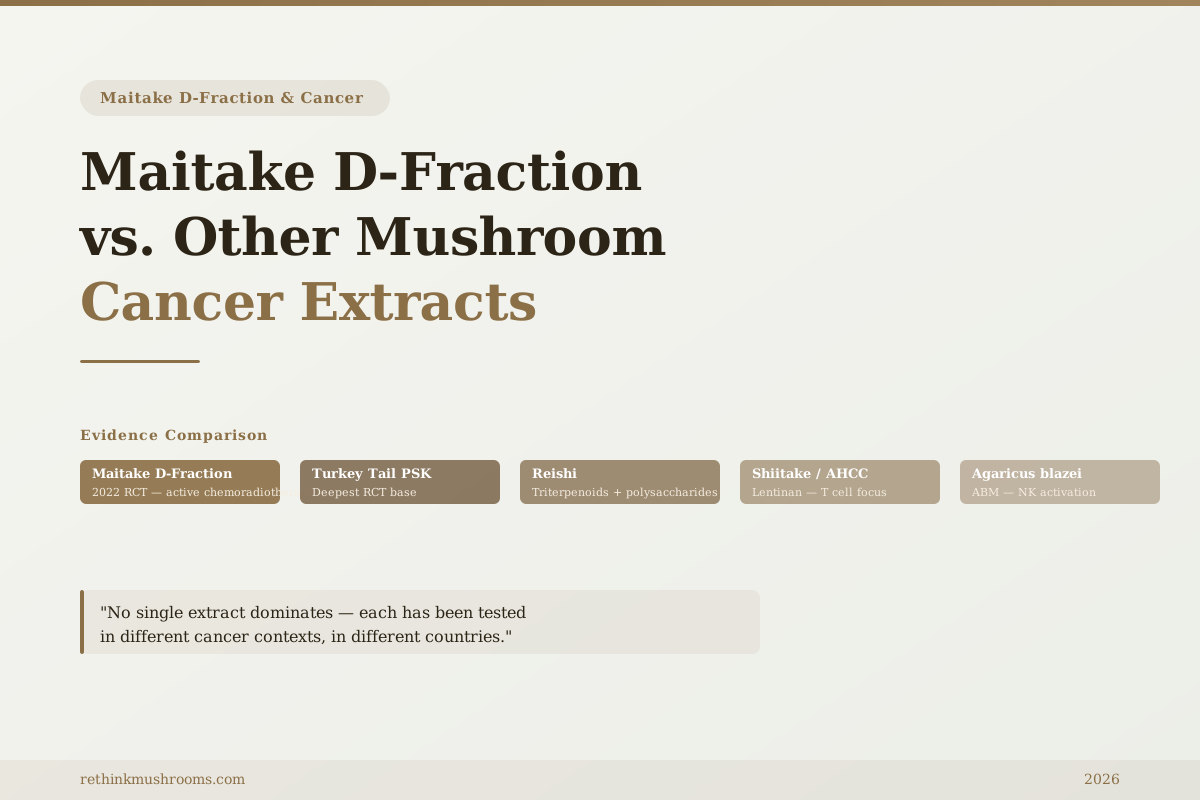
The Evidence Scorecard: Five Extracts Compared
A 2014 review of immune modulation from five major mushrooms examined what each extract does differently in the context of oncology care.[2] Combined with the 2023 systematic review's clinical hierarchy, a comparison emerges:
| Mushroom | Key Extract | Primary Immune Target | Best Clinical Evidence |
|---|---|---|---|
| Maitake | D-fraction (beta-1,6-glucan) | NK cells via macrophage-IL-12 cascade | 2022 RCT during active chemoradiotherapy[5] |
| Turkey tail | PSK (polysaccharopeptide) | T cells and macrophages | Deepest RCT base across all mushroom extracts[6] |
| Reishi | Polysaccharides and triterpenoids | Macrophage and cytokine modulation | Multiple clinical trials as cancer adjuvant[2] |
| Shiitake | Lentinan / AHCC | Macrophage and T cell activation | Animal and human data; NK activation weaker than maitake[3] |
| Agaricus blazei | ABM extract | NK cell and macrophage activation | Preclinical and early clinical data[2] |
No extract fills every cell of this table equally. Turkey tail leads on clinical trial volume. Maitake leads on the specific context of active cancer treatment. Reishi's distinguishing feature is the triterpenoid component, which operates through a different mechanism than any of the other four.
Turkey Tail and PSK: The Extract with the Deepest Clinical Base
Among all mushroom cancer extracts, turkey tail's PSK — a compound derived from the mushroom's polysaccharide fraction — has the longest clinical trial history.[6] The 2023 systematic review of medicinal mushroom RCTs in cancer patients found PSK had accumulated more randomized trials than any other mushroom extract. That body of work was built primarily through decades of Japanese oncology research testing PSK as an adjuvant in surgically treated cancer patients.
The 2014 Guggenheim review placed PSK's primary immune action at the T cell and macrophage level — activating immune cells through toll-like receptor binding and promoting cytokine signaling downstream.[2] This pathway differs somewhat from maitake's, which runs through macrophage activation to natural killer cell cytotoxicity via the IL-12 signaling protein.
The PSK advantage in clinical trial volume matters for a specific reason: it means the evidence has been tested in different cancer types, different surgical contexts, and different patient populations. Repeating an effect across dozens of independent trials reduces the probability that any single positive finding is a statistical artifact.
What PSK's trial history does not include: a randomized trial in patients undergoing active concurrent chemotherapy and radiation, testing quality-of-life endpoints during treatment. That gap is specifically where maitake's 2022 data stands alone.
Reishi: A Different Mechanism from All the Others
Reishi occupies a distinct position in this comparison because it's the only major mushroom extract with meaningful triterpenoid content alongside its polysaccharides.[2] Every other mushroom in this comparison works primarily through polysaccharide-driven immune activation — beta-glucans binding macrophage receptors and triggering cytokine cascades downstream. Reishi does this too, but its ganoderic acids (a class of triterpenoid compounds) operate through an additional pathway: direct modulation of cytokine signaling and influence on inflammatory gene expression.
Guggenheim and colleagues' 2014 review positioned reishi as activating macrophages primarily through cytokine modulation, with secondary effects on natural killer cells and T cells.[2] This two-mechanism profile — polysaccharide-driven activation plus triterpenoid-driven signaling — is unique among the five extracts. It helps explain why reishi frequently appears alongside maitake and shiitake in combination formulas.
For a detailed look at reishi's clinical evidence in cancer contexts, see Ganoderma lucidum as a Cancer Adjunct: Clinical Evidence.
Maitake's Differentiator: Active Treatment, Not Just Recovery
Most mushroom cancer research has tested extracts in one of two situations: before cancer recurrence (to prevent it) or after primary treatment (to support recovery). The question of what happens during active treatment — while a patient is receiving concurrent chemotherapy and radiation — has a very different risk-benefit profile and has been much harder to study.
Maitake is the only mushroom extract with a randomized controlled trial in that active-treatment context. Hu and colleagues' 2022 trial enrolled patients with advanced laryngeal and pharyngeal cancers undergoing concurrent chemoradiotherapy — one of the more intensive treatment regimens in oncology — and randomized them to maitake D-fraction or placebo during the course of treatment.[5] The D-fraction group had significantly fewer adverse events and preserved quality of life versus placebo.
This finding does not make maitake definitively superior to turkey tail for all purposes. PSK's decades of post-surgical RCTs address a completely different clinical question: long-term recurrence prevention in patients whose primary treatment is complete. The Hu 2022 data addresses a specific, underserved question: active-treatment tolerability. The 2023 systematic review positioned mushroom polysaccharides broadly as adjuvant therapy candidates with immunomodulatory and quality-of-life-improving effects,[6] but the active-treatment framing belongs specifically to maitake's 2022 evidence.
For maitake's breast cancer-specific data, including the Memorial Sloan Kettering phase I/II trial, see Maitake and Breast Cancer: D-Fraction Clinical Evidence.
Maitake vs. Shiitake: The Head-to-Head Animal Data
Most mushroom comparisons are indirect — researchers test each extract separately, in different labs, with different protocols. Vetvicka and Vetvickova's 2014 study provided rare direct comparison data: maitake extract versus shiitake extract in the same animal model, measuring immune parameters across the board.[3]
Maitake came out ahead on one specific measure: natural killer cell activation. The maitake group showed stronger NK cell activity than the shiitake group. On other immune parameters — antibody production, T cell activation, macrophage activity — both extracts performed similarly and both enhanced immune function compared to control animals.
The NK cell difference is notable because NK activation is maitake D-fraction's proposed primary mechanism against tumor cells. The head-to-head data supports maitake's relative strength on exactly this measure. Shiitake has its own human clinical data — particularly around AHCC, a standardized shiitake-derived compound tested in clinical trials — that Vetvicka's animal model doesn't fully capture. The head-to-head finding is specific to the animal comparison, but it aligns with the mechanistic data on maitake's NK-focused pathway.
For a deeper look at how maitake activates natural killer cells through the IL-12 signaling cascade, see How Maitake D-Fraction Activates Anti-Tumor Immunity.
The Immunomodulator Distinction: Why More Isn't Always Better
One finding in the maitake literature that competitors consistently miss — and that matters directly for how maitake compares to other extracts — is the non-monotonic dose-response.
Guggenheim and colleagues' 2014 review classified maitake D-fraction as an immunomodulator, not simply an immune enhancer.[2] The distinction is meaningful: immunomodulators can suppress or activate immune function depending on dose and context. With maitake D-fraction specifically, intermediate doses can actually suppress immune activity. Only higher doses consistently produce immune enhancement.
This is not an academic distinction. It means the common assumption — mushrooms boost immunity, so more is better — does not apply to maitake D-fraction. The dose that produces immune suppression exists and is clinically relevant.
The other extracts in this comparison were not characterized the same way in Guggenheim's review. Whether a similar dose-dependent suppression pattern applies to turkey tail PSK or shiitake-derived compounds is not well-characterized in the current literature. What the data clearly documents is this immunomodulatory complexity for maitake D-fraction specifically.
For the comparison, this matters because the Hu 2022 active-treatment RCT was designed with specific dosing protocols, and that trial showed benefit. But the non-monotonic response means dose selection is a more nuanced question for maitake than for some other extracts. For the full spectrum of maitake's biochemical fractions, including the higher-purity MD-fraction version, see Maitake MD-Fraction: The Enhanced Extract for Cancer Research.
The Combination Finding: When Three Mushrooms Produce More Than the Sum of Parts
Mallard and colleagues' 2019 study tested what happens when maitake, shiitake, and reishi are combined — not just whether each one activates immune cells individually, but whether the combination produces a different magnitude of effect.[4]
The effect was synergistic. In human macrophage cell cultures, the three-mushroom combination produced immune activation that exceeded what would be predicted by adding the three extracts' individual effects together. Maitake's beta-glucan was identified as a key contributor to the synergistic response.
Synergy in a cell culture model does not automatically translate to clinical benefit. This was a preclinical study, not a randomized trial. But the mechanistic rationale is plausible: each mushroom activates partially different receptor systems and downstream immune pathways. Maitake D-fraction's macrophage-to-NK-cell cascade, reishi's triterpenoid-plus-polysaccharide signaling, and shiitake's lentinan-driven T cell activation are overlapping but not identical processes. Multiple distinct pathways engaging simultaneously could plausibly produce synergistic rather than merely additive effects.
The 2023 systematic review positioned mushroom polysaccharides as a class — not individual extracts — as adjuvant therapy candidates.[6] The combination framing may eventually become the standard research question, rather than single-extract comparisons against each other.
For context on how the broader population-level association between mushroom consumption and cancer outcomes fits with the extract-level research, see Daily Mushroom Consumption and Cancer Risk Reduction. For a closer look at how Agaricus blazei's NK activation mechanism compares with maitake's, see How Agaricus blazei Activates Anti-Tumor Immunity.
The Bottom Line
The major mushroom cancer extracts each occupy a different evidentiary niche rather than competing on a single dimension. Turkey tail PSK has the deepest randomized trial base, built over decades of Japanese oncology research. Maitake D-fraction holds a unique position as the only extract with an RCT during active chemoradiotherapy, and its non-monotonic dose response distinguishes it from simple immune enhancers. Direct comparison data shows maitake's NK cell activity outpaces shiitake extract. Reishi's triterpenoid component gives it a mechanistic profile no other extract shares. And when combined, the three mushrooms produce synergistic — not merely additive — immune activation, pointing toward combination approaches as a direction the research is beginning to take seriously.
Frequently Asked Questions
Sources & References
- 1. Source details for this reference are not yet available.
- 2. Source details for this reference are not yet available.
- 3. Source details for this reference are not yet available.
- 4. Source details for this reference are not yet available.
- 5. Source details for this reference are not yet available.
- 6. Source details for this reference are not yet available.