Mushrooms & Cancer
1977, year PSK entered regulated cancer care in Japan
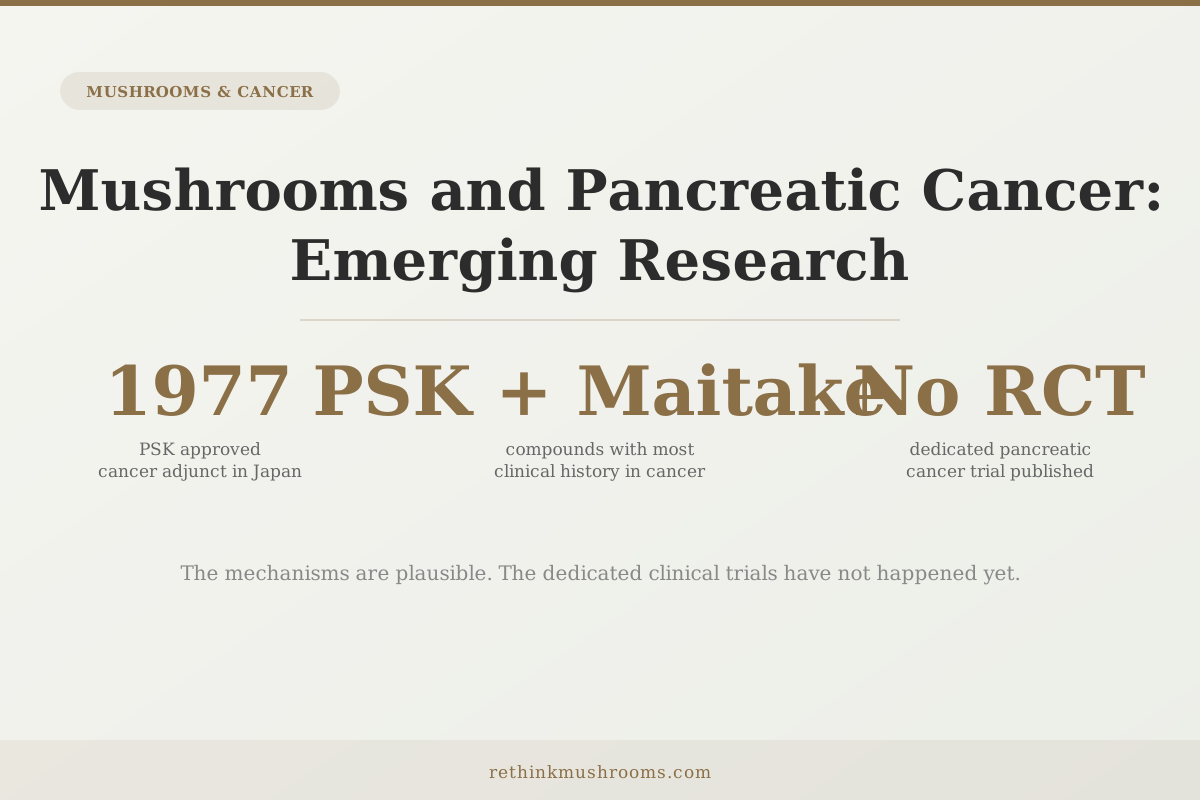
Polysaccharide-K from turkey tail mushroom has been approved as a cancer adjunct in Japan since 1977. Pancreatic cancer is among the disease contexts now being investigated with mushroom-derived compounds.
Gardner et al., Alternative Medicine Review, 2012
Japan-Approved
PSK regulatory status as cancer adjunct therapy
Multiple Types
cancer types included in PSK and maitake clinical research
No Dedicated RCT
pancreatic cancer-specific mushroom trial published to date
Gardner et al., Alternative Medicine Review, 2012
 View as image ↗
Research on mushrooms and pancreatic cancer is genuinely early. No mushroom compound has been approved to treat pancreatic cancer. No randomized controlled trial has been completed specifically for this disease and any mushroom-derived therapy. That is the honest starting point for this article.
What does exist matters, though. Compounds from turkey tail and maitake mushroom have accumulated real clinical data for other cancers over decades. Pancreatic cancer appears in the scope of what researchers have studied. And a growing body of mechanistic work shows that polysaccharides from these mushrooms affect tumor biology through pathways that are relevant to any solid cancer, not just the ones where clinical trials have been completed.
For a broader view of how medicinal mushrooms are being studied across all cancer types, the complete guide to medicinal mushrooms in cancer treatment covers the full research landscape. This article focuses on what the evidence shows specifically for pancreatic cancer, what that evidence is honestly worth, and where the research gaps remain.
Key Takeaways
- PSK (polysaccharide-K from turkey tail mushroom) has been approved as a cancer adjunct in Japan since 1977, with its clinical use extending to pancreatic cancer contexts alongside other cancer types
- The Gardner 2012 comprehensive review of PSK covers its clinical history across multiple cancer types, including pancreatic cancer, and details the immunological mechanisms researchers believe are responsible for its effects
- Maitake MD-fraction showed tumor regression or symptom improvement across multiple cancer types in a case series study; pancreatic cancer was among the cancer types included alongside liver and breast cancer
- Both forms of evidence are real but indirect: neither PSK's broader clinical history nor the maitake case series constitutes a controlled trial specifically designed for pancreatic cancer
- Mushroom polysaccharides work primarily through immunomodulation, activating NK cells, macrophages, and T-cells that can target tumor cells regardless of cancer type
- No published randomized controlled trial has specifically enrolled pancreatic cancer patients to test any mushroom-derived compound; this is the central gap in the current literature
Why Pancreatic Cancer Is One of the Hardest Cancers to Study
Before interpreting any research in this area, it helps to understand why pancreatic cancer presents such a difficult target, both for treatment and for research.
Most pancreatic cancers are surrounded by a dense layer of fibrous tissue called the stroma. The stroma is not just a physical barrier. It actively suppresses immune activity near the tumor. It blocks drug delivery. It creates a hostile microenvironment that conventional treatments struggle to penetrate. This matters enormously for compounds that work primarily through immune activation, because the immune cells they stimulate may not be able to reach the tumor even if they are activated.
Then there is the diagnosis problem. Pancreatic cancer typically causes no symptoms until it is already advanced. More than 80% of patients are diagnosed at Stage III or Stage IV, when the cancer has already spread beyond the pancreas. Clinical trials for late-stage disease are harder to run than early-stage trials: patients have shorter windows of time, often fewer remaining treatment options, and more variables affecting outcomes.
Finally, pancreatic cancer has historically attracted less research funding than more common cancers, partly because its survival rates have seemed to make it a less tractable problem. This has slowed the development of dedicated trials for any therapeutic approach, including mushroom-derived compounds.
None of this means mushroom research here is pointless. It means the research is early and the barriers are real. Understanding why helps calibrate what the existing evidence actually represents.
PSK: The Mushroom Compound With the Longest Documented Clinical Track Record
Polysaccharide-K (PSK) is extracted from the mushroom Trametes versicolor, known as turkey tail. It is a protein-bound polysaccharide, which makes its structure distinct from the simpler beta-glucans in many other medicinal mushrooms. PSK is both a polysaccharide and a glycoprotein; the protein components appear to enhance its immunostimulatory activity beyond what a polysaccharide alone would produce.
PSK was approved in Japan as an adjunct cancer therapy in 1977. That is not a recent development. It is a compound that has been administered to cancer patients alongside chemotherapy for nearly 50 years. The Gardner 2012 comprehensive review of PSK clinical evidence covers its use across multiple cancer types, including pancreatic cancer, and documents the regulatory and clinical history in substantial detail.[1]
The mechanism behind PSK's effects is primarily immunological. PSK binds to pattern recognition receptors on immune cells, specifically toll-like receptors on macrophages and dendritic cells. When these receptors activate, they trigger a cascade: NK cells proliferate, cytokines are released, and T-cell activity increases. The immune system becomes measurably more active against abnormal cells, including tumor cells.
This mechanism is not inherently cancer-type-specific. NK cells recognize and destroy abnormal cells regardless of which organ they originate from. Macrophage activation is a general immune process. This is why PSK's clinical data, developed primarily for lung, gastric, and colorectal cancer, has biological relevance for thinking about pancreatic cancer, even though dedicated randomized trial evidence for that specific disease has not been published.
What the Gardner 2012 review describes for dosing: PSK in Japanese clinical protocols is typically administered orally at doses around 3 grams per day, alongside standard chemotherapy.[1] The compound has a long safety record from this clinical use. Its approved indications in Japan are specific cancer types with robust trial data behind them. The pancreatic cancer application represents an area of investigation rather than an established clinical use, but the compound itself has decades of human safety data.
One structural point worth noting: PSK (polysaccharide-K) is related to but distinct from PSP (polysaccharide-peptide), another extract from the same mushroom. PSP has slightly different structural properties. Both are studied in cancer research. The clinical approval in Japan and the bulk of the trial data is specifically for PSK.
For more on how these polysaccharide compounds work at the cellular level and why the structural differences between species matter, the article on how mushroom polysaccharides kill cancer cells covers the mechanisms in depth.
Maitake MD-Fraction: What the Case Series Data Shows
Maitake (Grifola frondosa) produces a specific subfraction of its beta-glucan polysaccharides called the MD-fraction (also known as D-fraction). This subfraction has a different structural arrangement than standard beta-1,3/1,6-glucans, which researchers believe enhances its biological activity. The molecular branching pattern of the MD-fraction appears to make it more effective at binding to immune cell receptors.
Nanba and colleagues published case series data in 2002 tracking the responses of cancer patients taking maitake MD-fraction, with multiple cancer types included in the data, including pancreatic cancer.[2] The most clearly documented results were in liver cancer and breast cancer patients: 58.3% of liver cancer patients showed tumor regression or symptom improvement, and 68.8% of breast cancer patients showed similar responses.
It is important to be precise about what this data is and is not. A case series is not a controlled trial. There was no placebo group, no randomization, and no blinding. When more than half of liver cancer patients in a case series show some improvement, you cannot conclude that maitake caused the improvement. Other factors could account for the results: concurrent treatment, natural disease variation, and selection bias in who entered the series.
What case series data can do is establish biological plausibility and identify signals worth investigating in controlled trials. The fact that multiple cancer types showed response rates in the Nanba series, including types as biologically different as liver, breast, and pancreatic cancer, suggests the maitake MD-fraction produces real biological effects. The magnitude and specific attribution of those effects require controlled investigation that has not yet been completed for pancreatic cancer.
The broader context for maitake in cancer research, including the question of which cancer types have the most evidence, is covered in the medicinal mushrooms in cancer treatment guide.
Three Mechanisms That Are Particularly Relevant to Pancreatic Cancer
Mushroom polysaccharides do not attack cancer cells the way chemotherapy drugs do. They work primarily through the immune system and by affecting the cellular environment around tumors. Three pathways are especially relevant to pancreatic cancer's biology:
Immune activation inside a suppressed environment. The stroma around pancreatic tumors actively suppresses immune activity. Beta-glucans from mushrooms, including PSK and maitake MD-fraction, activate immune cells through pattern recognition pathways even in immunosuppressive environments. Whether this activation is sufficient to overcome the specific immune suppression of the pancreatic tumor microenvironment is the central unanswered question. The mechanism exists. Whether it is strong enough to matter is what trials would need to establish.
NK cell engagement. Natural killer cells identify and destroy abnormal cells, including cancer cells. Several mushroom compounds, including maitake D-fraction, have been shown to activate NK cells as part of the immunostimulatory cascade described in the clinical literature.[2] NK cell suppression is a documented feature of advanced pancreatic cancer progression, meaning the immune cells capable of targeting the tumor are specifically suppressed. Whether enhanced NK activity from mushroom compounds can partially reverse this suppression is an active area of interest.
Anti-angiogenic effects. Tumors grow their own blood vessels to sustain themselves, a process called angiogenesis. Blocking new vessel formation, a strategy called anti-angiogenesis, is one of the documented mechanisms of several mushroom compounds.[1] Pancreatic cancer develops its own vascular supply as it progresses. Anti-angiogenic mechanisms are therefore particularly relevant to this disease type. For readers interested in the molecular detail of how mushroom compounds affect tumor blood vessel growth, the article on how mushroom compounds inhibit VEGF and tumor blood vessel growth covers the pathway specifically.
These mechanisms are well-documented at the cellular and biochemical level. The jump from documented mechanism to meaningful clinical outcome in a real patient is not guaranteed by any of them. For pancreatic cancer specifically, the stroma barrier, the late-diagnosis problem, and the absence of dedicated trials mean the clinical implications of these mechanisms remain open questions.
What the Research Landscape Currently Looks Like
The evidence base for mushrooms and pancreatic cancer sits at a specific, identifiable point in the research progression.
PSK has been approved as a cancer adjunct in Japan for nearly 50 years, its use has extended across multiple cancer types including pancreatic cancer contexts, and its mechanisms are well-characterized.[1] This is not preclinical evidence; it represents real clinical administration in real patients. The evidence for its approved indications (lung, gastric, colorectal) is substantially stronger than for pancreatic cancer, where the dedicated randomized trial evidence has not been published. For comparison, the research base for mushrooms and lung cancer specifically is much more developed, including a systematic review of six RCTs all showing benefit; that evidence is covered in detail in the article on mushrooms and lung cancer.
Maitake MD-fraction case series data included pancreatic cancer among the cancer types studied, with measurable responses recorded.[2] The case series design means these observations are directional rather than definitive.
The central gap: no published randomized controlled trial has specifically enrolled pancreatic cancer patients to test any mushroom-derived compound as the primary intervention.
Why hasn't that trial been completed? Partly because running pancreatic cancer trials is genuinely difficult given short survival windows, advanced disease at diagnosis, and competing treatment priorities. Partly because complementary oncology research has historically been underfunded. And partly because the existing signals, while real enough to warrant attention from researchers, have not yet generated the institutional momentum to launch a large randomized trial.
For readers interested in how mushroom consumption relates to cancer risk reduction at the population level, including the large Japanese cohort study of more than 36,000 men, the article on mushroom consumption and cancer risk covers that evidence base. Population-level data on consumption and cancer risk is a separate question from the clinical trial question, and both are worth understanding.
The broader picture of how mushroom compounds affect liver cancer, a disease that shares some biological features with pancreatic cancer, is covered in the article on mushrooms and liver cancer. For cancer types with stronger clinical signals, mushrooms and prostate cancer covers Phase I trial data with measurable PSA responses in patients with biochemically recurrent disease. Mushrooms and ovarian cancer covers the epidemiological and preclinical evidence for gynecological cancer contexts.
The Bottom Line
Mushroom compounds, particularly PSK from turkey tail and maitake MD-fraction, have been studied alongside pancreatic cancer as part of broader anti-cancer investigations spanning decades. The evidence base includes a comprehensive review of PSK's clinical history across cancer types including pancreatic cancer, and case series data showing measurable responses across multiple cancer types including pancreatic cancer patients. No randomized controlled trial has been completed specifically for mushroom compounds in pancreatic cancer. The mechanisms are biologically plausible and relevant to this disease, and the compounds are well-tolerated at studied doses. The research is real, and it is early.
Frequently Asked Questions
Sources & References
- 1. Source details for this reference are not yet available.
- 2. Source details for this reference are not yet available.