Mushrooms & Cancer
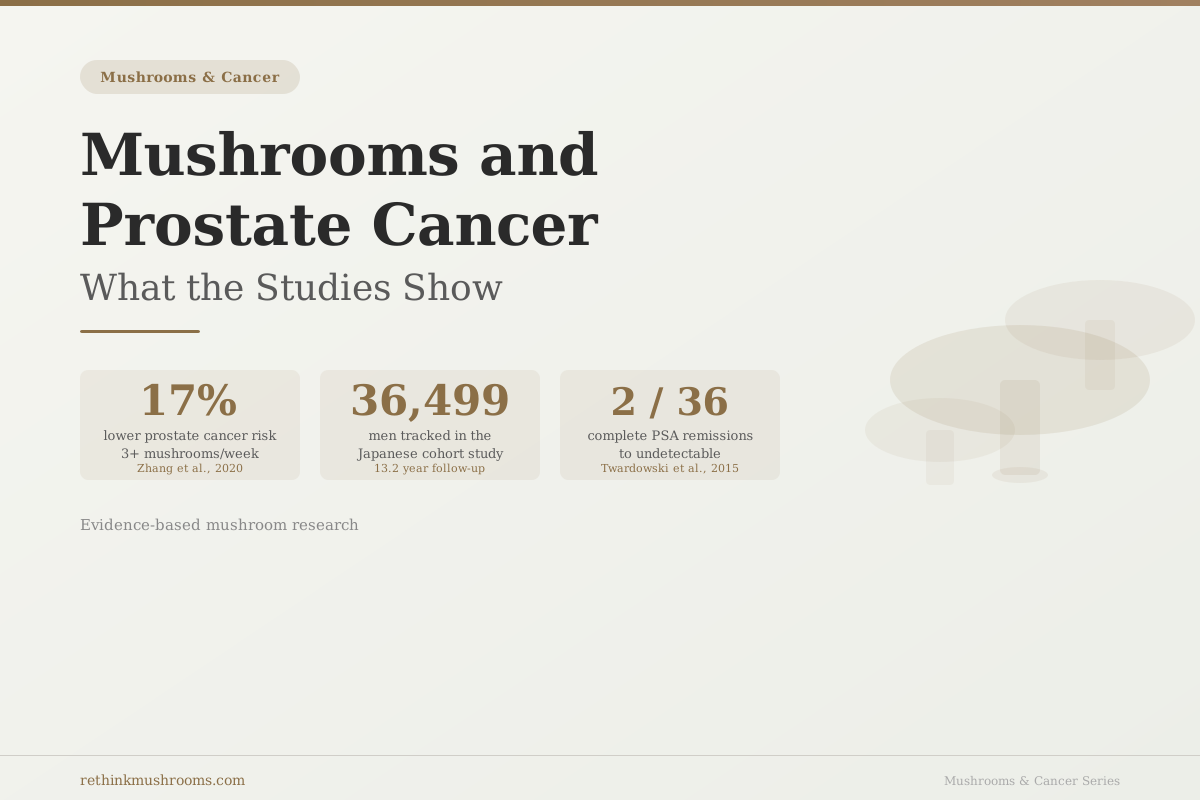
17% lower risk
Men who ate mushrooms three or more times a week had a 17% lower rate of prostate cancer over 13 years of follow-up in a Japanese cohort of 36,499 men.
Zhang et al., International Journal of Cancer, 2020
36,499
men tracked for 13 years in the Japanese cohort study
2 complete
PSA remissions to undetectable in the Phase I clinical trial
49 months
longest PSA remission duration in the Twardowski trial
Zhang et al., International Journal of Cancer, 2020
 View as image ↗
The research on mushrooms and prostate cancer is more developed than most people realize. A 2020 Japanese cohort study tracked 36,499 men for an average of 13.2 years and found that eating mushrooms three or more times per week was associated with a 17% lower rate of prostate cancer compared to men who ate mushrooms less than once a week.[1] That is not a test tube study. That is nearly 37,000 real people eating real food, tracked through the health records of two major Japanese cohort studies.
Alongside that epidemiological data sits a Phase I clinical trial published in Cancer journal. Two patients with recurrent prostate cancer had their PSA, a protein that rises when prostate cancer is growing, drop to undetectable after taking dried white button mushroom powder. Those remissions lasted 30 and 49 months respectively.[2]
Mushrooms and prostate cancer research also spans the lab: lion's mane, cordyceps, and a Japanese mushroom called meshima have each shown activity against prostate cancer cells through distinct biological mechanisms.
This article covers all three layers of evidence. It is part of the Mushrooms & Cancer series.
Key Takeaways
- A pooled Japanese cohort study of 36,499 men found that eating mushrooms 3+ times per week was associated with a 17% lower prostate cancer rate over 13 years; 1–2 times per week was associated with 8% lower risk (Zhang et al., 2020)
- A Phase I trial published in Cancer found that 2 of 36 men with recurrent prostate cancer achieved undetectable PSA levels after taking white button mushroom powder; those remissions lasted 30 and 49 months (Twardowski et al., 2015)
- 36% of patients in the Twardowski trial showed some PSA decrease; the immune mechanism involves MDSCs (immune-suppressing cells that tumors use to hide from the immune system) dropping by 45–94% in responding patients
- Lion's mane extract triggered cell death in prostate cancer cell lines through two growth-control pathways, PI3K/AKT and RAS/MAPK, in 2024 lab research (Li et al., 2024)
- Cordyceps militaris reduced testosterone catabolism and testosterone-driven prostate tissue growth in animal models; most early prostate cancers are driven by androgens, which is why this pathway is relevant (Lin et al., 2020)
- The three evidence layers answer three separate questions: population data addresses long-term risk, the clinical trial addresses PSA response in recurrent disease, and lab studies address whether mushroom compounds have the right biological properties to matter
36,499 Men, 13 Years: The Japanese Cohort Data
Zhang and colleagues pooled data from two long-running Japanese cohort studies, the Miyagi Cohort Study and the Ohsaki Cohort Study, and followed 36,499 men from 1990 onward, tracking both diet and cancer diagnoses over an average follow-up of 13.2 years.[1]
Mushroom consumption was categorized in three groups: less than once a week, one to two times a week, and three or more times a week. Prostate cancer diagnosis was confirmed through regional cancer registries and death certificate data.
The results followed a gradient. Men eating mushrooms once or twice a week had an 8% lower rate of prostate cancer compared to men who ate mushrooms less than once a week. Men eating them three or more times a week had a 17% lower rate. The pattern is a dose-response relationship: as consumption increases, risk decreases, steadily. That kind of gradient matters statistically because it suggests the relationship is not a result of chance.
Japan is useful as a research location for this question for several reasons. Mushroom consumption there is much higher and more varied than in Western countries, which gives researchers statistical power at the high-consumption end of the range. Japanese cohort studies also tend to have long follow-up periods and reliable cancer registries, reducing the measurement errors that undermine dietary research.
The limitations are what you would expect from any observational study. People who eat mushrooms regularly in Japan also tend to eat more vegetables, more fish, and fewer processed foods. Zhang's analysis did control for age, smoking, alcohol intake, and several other dietary and lifestyle factors. But in observational studies, some confounding always remains. Eating mushrooms three times a week and developing prostate cancer less often does not mean the mushrooms caused the difference.
What makes this study hard to dismiss despite that caveat is the scale and the gradient. Thirty-six thousand people is larger than any randomized trial in this space could practically recruit, and tidy dose-response curves do not usually emerge from statistical noise.
For more on the population-level evidence across cancer types, see Daily Mushroom Consumption and Cancer Risk Reduction and Mushroom Consumption and Cancer Risk Reduction: Meta-Analysis of Population Studies.
The Phase I Trial That Landed in Cancer Journal
White button mushrooms (the kind sold in every grocery store) are not typically associated with cancer medicine. Twardowski and colleagues changed that framing in 2015 with a Phase I trial that appeared in Cancer, one of the leading oncology journals.[2]
The trial enrolled 36 men with biochemically recurrent prostate cancer, meaning their PSA had risen after surgery or radiation, but imaging showed no detectable spread. They took dried white button mushroom powder daily in 3-month cycles.
Phase I trials are designed primarily for safety. Their job is to find the right dose and confirm there are no harmful side effects. The researchers also tracked PSA as a secondary measure, which gave them a window into whether the treatment was doing anything biologically.
The secondary results:
- 11% of patients showed a formal PSA response (a decrease of 50% or more, sustained over at least four weeks)
- 36% showed some degree of PSA decrease
- 2 patients achieved complete PSA remission, with levels falling to undetectable
The two complete remissions held. One patient maintained undetectable PSA for 30 months; the other for 49 months. In biochemically recurrent prostate cancer, a setting where PSA typically climbs, this is not what usually happens.
Twardowski's team investigated the mechanism. In patients who responded, levels of a specific type of immune cell called MDSCs (myeloid-derived suppressor cells) dropped by 45–94%. MDSCs are cells that tumors recruit to suppress the immune system's ability to detect and attack cancer cells. Think of them as sentries the tumor posts to wave off the immune response. The mushroom powder appeared to remove those sentries.
This is not a small mechanistic footnote. It provides a biologically coherent explanation for why some patients responded and others did not, and it points toward MDSC reduction as a pathway that has since attracted attention across oncology research broadly.
Understanding Biochemical Recurrence: Who Was in That Trial and Why the Results Are Striking
To appreciate the Twardowski results, it helps to understand what biochemically recurrent prostate cancer actually is.
After prostatectomy (surgical removal of the prostate) or radiation therapy, patients enter a monitoring phase where PSA is measured every few months. When PSA begins rising after a period of undetectable levels, it is called biochemical recurrence, meaning evidence that some cancer cells survived the initial treatment and are producing PSA again. Imaging is usually negative at this stage: the disease is present but not yet visible.
This is a clinically difficult position. PSA continues to rise in most patients. The main options, hormone therapy and salvage radiation, carry significant side effects and are typically held in reserve until imaging confirms spread or PSA doubling time becomes short.
In this context, two patients achieving undetectable PSA that persisted for years is a striking observation. Patel and colleagues documented the clinical pattern of mushroom use in men with PSA recurrence after prostatectomy or radiation, a population closely resembling the Twardowski cohort, and noted that this is a period when many patients seek complementary approaches while waiting to see how their disease progresses.[3]
The Twardowski trial was not designed to prove efficacy. Thirty-six patients cannot do that. The value of the findings is the MDSC mechanism and the two complete responders, which together justify moving to a larger efficacy trial. That is exactly how early-phase oncology research is supposed to work.
In the Lab: Lion's Mane, Cordyceps, and Meshima Target Different Pathways
While the Twardowski trial focused on white button mushrooms, laboratory researchers have been testing other species for prostate cancer activity. Three are worth examining because they work through different biological mechanisms, and because all three are commonly available or well-studied in Western contexts.
Lion's Mane: Two Growth-Control Pathways
Li and colleagues published findings in 2024 showing that lion's mane extract triggered cell death in prostate cancer cell lines through two of the most studied growth-control networks in cancer biology: the PI3K/AKT pathway and the RAS/MAPK pathway.[6]
Both pathways function as internal accelerators: when they run unchecked, cells divide without normal limits. This is a feature of many cancers, including prostate cancer. Lion's mane extract disrupted both.
This is a cell study, not a human trial. But the finding is mechanistically significant because PI3K/AKT is one of the most commonly mutated pathways in advanced prostate cancer and an active target for pharmaceutical development. A mushroom extract that interferes with it is worth taking seriously at the preclinical level.
Cordyceps: The Androgen Pathway
Lin and colleagues tested cordyceps militaris fruit body extract in animal models and found that it reduced testosterone catabolism (the rate at which testosterone breaks down) and slowed testosterone-driven prostate tissue growth.[5]
Prostate cancer is androgen-sensitive in its early stages. Testosterone and its more potent derivative DHT fuel the tumor's growth. Hormone therapy for prostate cancer works by suppressing androgen production or blocking androgen receptors. An intervention that modulates the androgen axis through a different mechanism is of genuine interest, even if Lin's study used non-cancerous prostate hypertrophy as the model rather than cancer directly.
Meshima: Multiple Simultaneous Pathways
Kim and colleagues tested extract from meshima (Phellinus linteus), a mushroom used in Korean and Japanese traditional medicine, against prostate cancer cells in culture and found that it activated multiple cell death pathways simultaneously.[4]
Cancer cells develop resistance to individual death signals. Activating several at the same time is a strategy that drug developers deliberately pursue because resistance to a single signal does not prevent cell death when other pathways are also engaged. The multi-pathway character of the meshima finding is mechanistically sophisticated, though the practical limitation is that meshima is not widely available outside East Asia.
For a detailed look at how mushroom compounds trigger cell death and immune activation across cancer types, see How Mushroom Polysaccharides Kill Cancer Cells: Four Distinct Mechanisms.
Reading the Prostate Cancer Research: What Each Layer Proves and What It Doesn't
It is worth being precise about what each type of evidence answers, and what it does not.
The Zhang 2020 cohort study answers the question: in a large population, do men who eat more mushrooms develop prostate cancer less often? The answer appears to be yes, with a dose-response gradient. It cannot explain why, or establish that mushroom consumption caused the lower rates rather than being correlated with other protective factors.
The Twardowski 2015 clinical trial answers a different question: in men with recurrent prostate cancer, does taking concentrated white button mushroom powder produce any measurable effect on PSA or immune function? The answer appears to be sometimes, and the mechanism involves MDSC suppression. What a 36-patient Phase I trial cannot answer is how common those responses are across a broader population, or whether the two complete remissions reflect a reproducible effect.
The lab studies answer yet another question: do mushroom extracts have the right biological properties to affect prostate cancer cells? The answer is yes, across multiple species and mechanisms. What they cannot establish is whether those properties survive digestion, reach tumors in meaningful concentrations, and produce the same effects in a living person.
None of these layers individually is enough to conclude that mushrooms treat or prevent prostate cancer. Together, prostate cancer has more human evidence supporting serious investigation than most cancer types in this space. For comparison, mushrooms and pancreatic cancer research is almost entirely preclinical, and mushrooms and liver cancer research, while mechanistically interesting, lacks the clinical trial data available here.
For lung cancer, PSK from turkey tail has reached regulatory approval in Japan after decades of clinical trials. Prostate cancer sits in a middle state: more human evidence than most cancer types, not yet at the threshold required for any regulatory indication.
The Bottom Line
Mushrooms and prostate cancer research spans three evidence levels. A 36,499-person Japanese cohort study found a dose-dependent association between regular mushroom consumption and lower prostate cancer incidence. A Phase I clinical trial published in Cancer found that two men with recurrent prostate cancer achieved complete PSA remissions after taking white button mushroom powder, with MDSC reduction confirmed as the mechanism in responding patients. Multiple lab studies show that lion's mane, cordyceps, and meshima each kill or inhibit prostate cancer cells through distinct biological pathways. The clinical and epidemiological evidence here is the strongest across all cancer types in mushroom research, but the clinical trial had 36 participants, and the population study cannot prove causation. This is a compelling area for continued investigation, not an established treatment.
Frequently Asked Questions
Sources & References
- 1RTHM-01313·Zhang, Shu et al. (2020). “Mushroom consumption and incident risk of prostate cancer in Japan: A pooled analysis of the Miyagi Cohort Study and the Ohsaki Cohort Study..” International journal of cancer.Study breakdown →PubMed →↩
- 2RTHM-00741·Twardowski, Przemyslaw et al. (2015). “A phase I trial of mushroom powder in patients with biochemically recurrent prostate cancer: Roles of cytokines and myeloid-derived suppressor cells for Agaricus bisporus-induced prostate-specific antigen responses..” Cancer.Study breakdown →PubMed →↩
- 3. Source details for this reference are not yet available.
- 4. Source details for this reference are not yet available.
- 5. Source details for this reference are not yet available.
- 6. Source details for this reference are not yet available.