FDA & Mushroom Supplement Regulation
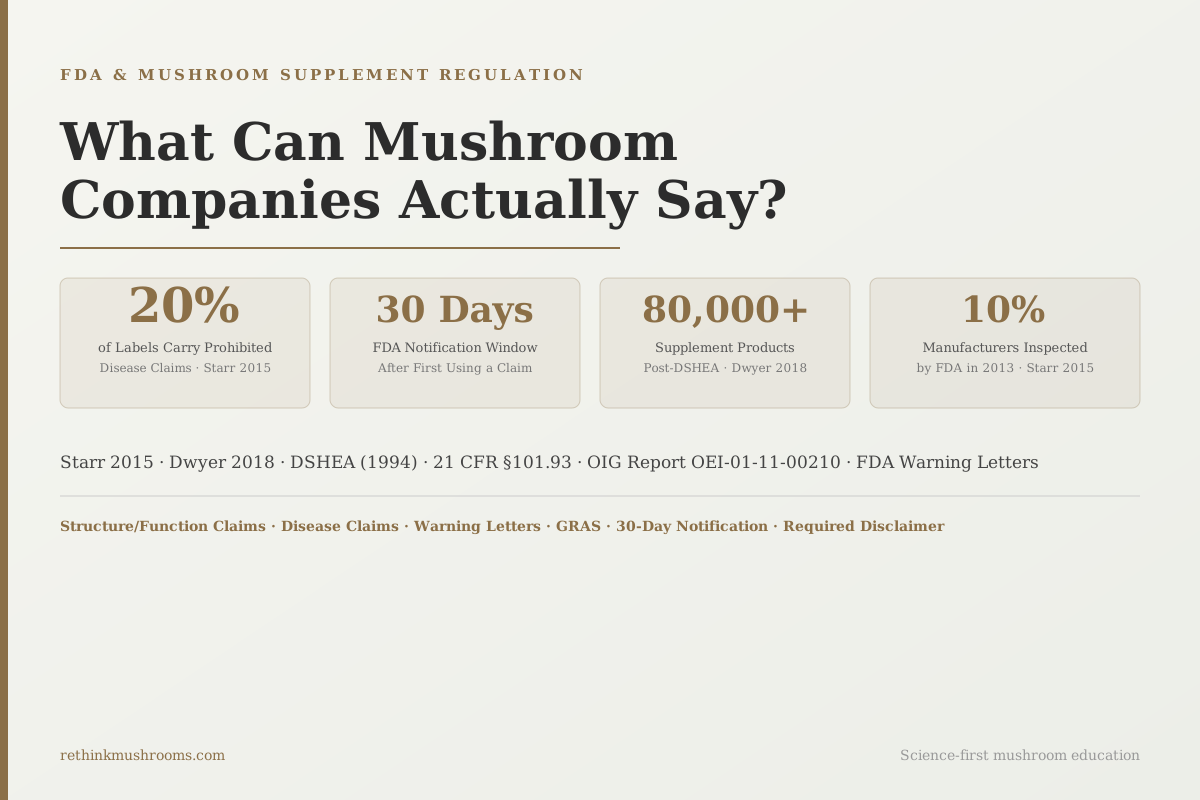
20% of labels
One in five dietary supplement labels carries a prohibited disease claim, according to a federal audit. Mushroom supplements appear with particular frequency in FDA warning letters.
Starr RR, Am J Public Health, 2015
30 days
window to notify FDA after first using a structure/function claim
80,000+
supplement products on the US market since DSHEA passed in 1994
10%
of supplement manufacturers FDA inspected in 2013
Starr RR, Am J Public Health, 2015
 View as image ↗
In July 2021, the FDA sent a warning letter to Brilliant Enterprises LLC for marketing Lion's Mane supplements as treating cancer, Chaga supplements as fighting bacterial infections, and Cordyceps supplements as treating diabetes. All three products were sold as dietary supplements. Under federal law, those claims reclassified the products as unapproved drugs.
This is not an isolated case. A federal audit found that roughly one in five dietary supplement labels carries a claim the law explicitly prohibits.[1] Mushroom supplements appear with particular frequency in FDA warning letters, because their real pharmacological activity makes disease-claim language tempting for companies trying to stand out.
Understanding where mushroom supplement health claims fall under FDA rules is the most practical tool consumers have for evaluating whether a company is operating within legal bounds. The FDA's broader regulatory framework for mushroom supplements was established by DSHEA in 1994. This article covers its specific limits on what companies can say.
Key Takeaways
- Under DSHEA, mushroom supplements cannot legally claim to diagnose, treat, cure, or prevent any disease. Those are drug claims, and making them reclassifies the product as an unapproved drug under the FDCA.
- "Structure/function claims" are permitted: statements that a product supports normal body structure or function. "Disease claims" are prohibited: statements that reference a specific disease or medical condition.
- A federal audit found roughly 20% of dietary supplement labels carried prohibited disease claims despite DSHEA's clear prohibitions.[1]
- Companies must notify the FDA within 30 days of first using a structure/function claim, under 21 CFR §101.93, and include a required disclaimer on every label.
- Making a disease claim does not merely violate a labeling rule. It reclassifies the product as a drug under the FDCA, exposing the company to seizure, injunction, and criminal prosecution.
- Companies are required to hold substantiation for their claims before marketing but are not required to submit that evidence to the FDA. The agency verifies compliance after the fact, not before.[2]
What DSHEA Actually Says: Two Legal Categories for Supplement Claims
The Dietary Supplement Health and Education Act (DSHEA), passed in 1994, created two distinct categories for health-related statements on supplement labels.
Structure/function claims describe how a product affects the normal structure or function of the human body. "Supports healthy immune function" is the standard example. It describes what a supplement does to a body that is already working normally. These claims are legal for dietary supplements.
Disease claims describe effects on a disease or medical condition. "Treats bacterial infections" is a disease claim. So is "prevents cancer" and "reduces Alzheimer's symptoms." Under the FDCA, these claims are reserved for drugs, which must undergo FDA review and approval before being marketed. A supplement cannot make them.
The consequences of crossing this line are more severe than most companies anticipate. A supplement that makes a disease claim does not receive a labeling citation and a fine. It is legally reclassified as a drug. Selling it without drug approval makes it an unapproved drug under the FDCA, which the FDA can remove from market by seizure. The company also becomes exposed to injunctive action and, in serious cases, criminal prosecution.
Since DSHEA passed, the supplement market expanded from approximately 4,000 products to more than 80,000.[2] All of those products operate within this same two-category system.
The Complete Mushroom Claims Comparison: What's Legal and What Gets Companies Warned
The table below shows permitted structure/function claims alongside prohibited disease claims for common mushroom supplement marketing contexts.
| Allowed (Structure/Function) | Prohibited (Disease Claim) |
|---|---|
| "Supports healthy immune function" | "Treats bacterial infections" |
| "Promotes mental clarity and focus" | "Treats Alzheimer's disease" |
| "Supports cellular health" | "Fights cancer cells" |
| "Helps maintain blood sugar levels already in the normal range" | "Treats diabetes" |
| "Supports a healthy stress response" | "Treats depression or anxiety disorder" |
| "Promotes energy and vitality" | "Treats chronic fatigue syndrome" |
| "Supports healthy inflammatory response" | "Treats arthritis" |
| "Promotes restful sleep" | "Treats insomnia disorder" |
| "Supports liver health" | "Treats hepatitis or liver disease" |
The pattern is consistent. Structure/function language describes support for processes in a normally functioning body. Disease language names a condition or describes repair of a broken system.
This is precisely where many mushroom supplement companies stumble. Lion's Mane, for example, has a credible body of research on nerve growth factor (NGF), a protein involved in nerve cell maintenance. "Supports nerve health" is a permitted structure/function claim. "Treats peripheral neuropathy" or "reverses Alzheimer's progression" is a disease claim, and companies have received warning letters for making statements very close to those.
The required disclaimer, which must appear on every supplement label using a structure/function claim, reads exactly as follows under 21 CFR §101.93: "This statement has not been evaluated by the Food and Drug Administration. This product is not intended to diagnose, treat, cure, or prevent any disease."
If a mushroom supplement label includes that disclaimer alongside a statement about supporting memory or immunity, the company is following the law. If the label makes claims about treating Alzheimer's or preventing cancer, the disclaimer does not change the violation.
For a deeper breakdown of exactly how courts and regulators draw this distinction, see the companion piece on structure/function claims vs. disease claims.
1 in 5 Supplement Labels Carries a Prohibited Claim
The gap between the law and actual market practice is large and well-documented. A 2012 report by the Department of Health and Human Services Office of Inspector General (OIG Report OEI-01-11-00210) found that roughly 20% of the dietary supplement labels reviewed carried prohibited disease claims.
An analysis published in the American Journal of Public Health captured why this gap persists. The FDA inspected only 10% of supplement manufacturers in 2013.[1] Enforcement is reactive: a prohibited claim can remain on a label for months or years before the FDA takes action, if it acts at all. The agency prioritizes cases involving safety risks or widespread harm, which means many labeling violations go unaddressed indefinitely.
For consumers, this creates a practical problem. A label carrying a disease claim is not a reliable signal that the underlying product is effective. It is a reliable signal that the company is either unaware of the regulatory rules or is choosing to ignore them. That is relevant information when selecting a brand.
Mushroom supplements attract disproportionate FDA attention partly because their bioactive compounds have enough real pharmacological activity that companies are tempted to overclaim. Cordyceps has genuine evidence in the direction of blood sugar effects. Reishi has documented immune-modulating activity. Lion's Mane has NGF-related data. None of that evidence, however, meets the legal standard required for disease claims on supplement labels.
Three Mushroom Companies That Received Warning Letters for Prohibited Claims
The following cases come from FDA enforcement records and illustrate how the rules are applied in practice.
Brilliant Enterprises LLC (July 2021) received a warning letter after FDA reviewers found disease claims across multiple product pages. The company was marketing Lion's Mane as treating cancer, Chaga as fighting bacterial infections, and Cordyceps as treating diabetes. The FDA's letter specified that those products were being promoted as drugs, not supplements, and required the company to correct or remove the claims.
Entia Biosciences Inc (Letter #610493, January 6, 2021) received a warning letter for drug claims on mushroom supplement products. The letter documented specific marketing language that the FDA determined had crossed from structure/function territory into disease claim territory.
Half Hill Farm Inc (Letter #609440, November 3, 2020) was cited for disease claims on mushroom products. The FDA determined the marketing language reclassified the products as unapproved drugs.
These three letters, issued within a nine-month window in 2020 and 2021, reflect a focused period of FDA attention to mushroom supplement marketing. The pattern has continued. The GRAS status of mushroom ingredients introduces a separate but related concern: when FDA determines a mushroom ingredient is not safe for use in supplements at all, the resulting warning letters reach beyond claims violations into adulteration, as happened with Blue Forest Farms (Letter #711990, September 2025) and its Amanita muscaria products.
For a full case-by-case review of who has been warned and why, the dedicated article on FDA warning letters to mushroom companies covers the complete enforcement record.
FDA is not the only agency involved. The Federal Trade Commission (FTC) also has authority over supplement marketing claims, particularly in advertising. Companies that receive FDA warning letters for disease claims sometimes face subsequent FTC enforcement actions for the same underlying marketing.
The Gray Zone: Claims That Don't Name a Disease but Still Cross the Line
The clearest disease claims are easy to identify. What is harder to spot are implied disease claims, which the FDA also prohibits. An implied disease claim is a statement that references a disease indirectly, without naming it, in a way a consumer would understand as targeting that condition.
These claims are often crafted to sound like structure/function claims while actually targeting disease-aware consumers. Mushroom supplement marketing has produced several recurring examples.
"For memory loss" implies treatment of Alzheimer's or dementia, even without naming those conditions. It frames the product as a solution to a problem rather than support for a normally functioning system.
"For blood sugar control" reads differently from "for blood sugar levels already in the normal range." The first implies treatment of an out-of-range condition. The second restricts the claim to supporting a body that is already functioning normally.
"Cellular protection from free radicals" stays in structure/function territory. "Cellular protection against cancer" is a disease claim, even though cancer appears only as a reference point rather than a named target condition.
"Supports a healthy inflammatory response" is a permitted structure/function claim. "For chronic inflammation" implies treatment of an inflammatory disease condition.
The FDA evaluates these borderline cases by looking at the full context of a product's marketing, including website text, imagery, and customer testimonials, to determine how a reasonable consumer would understand the overall message. A disclaimer on the label does not neutralize disease-claim language elsewhere in the product's marketing ecosystem.
The 30-Day Notification Rule and the Required Disclaimer
When a supplement company first markets a product with a structure/function claim, two obligations activate under 21 CFR §101.93.
First, the company must submit written notification to the FDA within 30 days of first marketing. The notification must include the text of the claim. This is not an approval process. The FDA does not routinely review or respond to these notifications. It is a record-keeping mechanism that gives the agency visibility into what claims are circulating in the market.
Second, the label must carry the required disclaimer verbatim: "This statement has not been evaluated by the Food and Drug Administration. This product is not intended to diagnose, treat, cure, or prevent any disease."
The disclaimer must be set off from surrounding text, typically in a box. It must appear adjacent to the structure/function claim, not only in fine print on a back panel if the claim appears prominently elsewhere.
Both requirements are regularly missed by smaller companies. Failure to notify FDA is itself a labeling violation, separate from whether the claim is otherwise permissible. For consumers evaluating labels, the presence of the required disclaimer at minimum indicates the company is aware of its legal obligations. Its absence is a signal worth noting.
The specific legal consequences when companies make prohibited disease claims are detailed in the companion piece on why mushroom supplements cannot make health claims.
Companies Must Have Evidence. They Don't Have to Show Anyone.
Under DSHEA, supplement companies are legally required to hold "competent and reliable scientific evidence" to substantiate their structure/function claims before marketing begins. This is a genuine legal requirement.
What the law does not require is submission of that evidence to the FDA. Companies design their own substantiation files, apply their own judgment about what constitutes sufficient evidence, and begin marketing. The FDA can request substantiation as part of an investigation or following a warning letter. But the pre-market review that drug companies must complete before any drug can be sold does not apply to supplements.
The scale of this gap became clearer as DSHEA's effects accumulated over time. The supplement market grew from approximately 4,000 products to more than 80,000, with minimal adverse event reporting and inadequate quality assurance processes across a substantial portion of the industry.[2]
The practical consequence: a structure/function claim on a mushroom supplement label tells consumers the company believes it has supporting evidence. It does not indicate how much evidence, how strong it is, or whether it would survive independent scrutiny. For any mushroom supplement, the peer-reviewed literature on the specific compound is a more reliable guide to actual evidence quality than the label claims the product makes.
Manufacturing quality is a separate but related issue. A product can follow claims rules while failing manufacturing standards, and vice versa. How manufacturers are required to operate under FDA's current Good Manufacturing Practice regulations is covered in the companion piece on cGMP compliance for mushroom supplement manufacturers.
The Bottom Line
Under DSHEA, mushroom supplement companies can make structure/function claims describing how their products support normal body processes. They cannot make disease claims describing effects on specific medical conditions. The distinction is enforced through FDA warning letters rather than pre-market review, which is why prohibited claims remain prevalent across the supplement market despite more than 30 years of clear regulation. Consumers who understand the legal line between allowed and prohibited language have a functional tool for evaluating mushroom supplement marketing without needing access to the underlying clinical data.
Frequently Asked Questions
Sources & References
- 1RTHM-00735·Starr, Ranjani R (2015). “Too little, too late: ineffective regulation of dietary supplements in the United States..” American journal of public health.Study breakdown →PubMed →↩
- 2RTHM-00954·Dwyer, Johanna T et al. (2018). “Dietary Supplements: Regulatory Challenges and Research Resources..” Nutrients.Study breakdown →PubMed →↩