Mushroom Supplement Regulation
GRN 1124
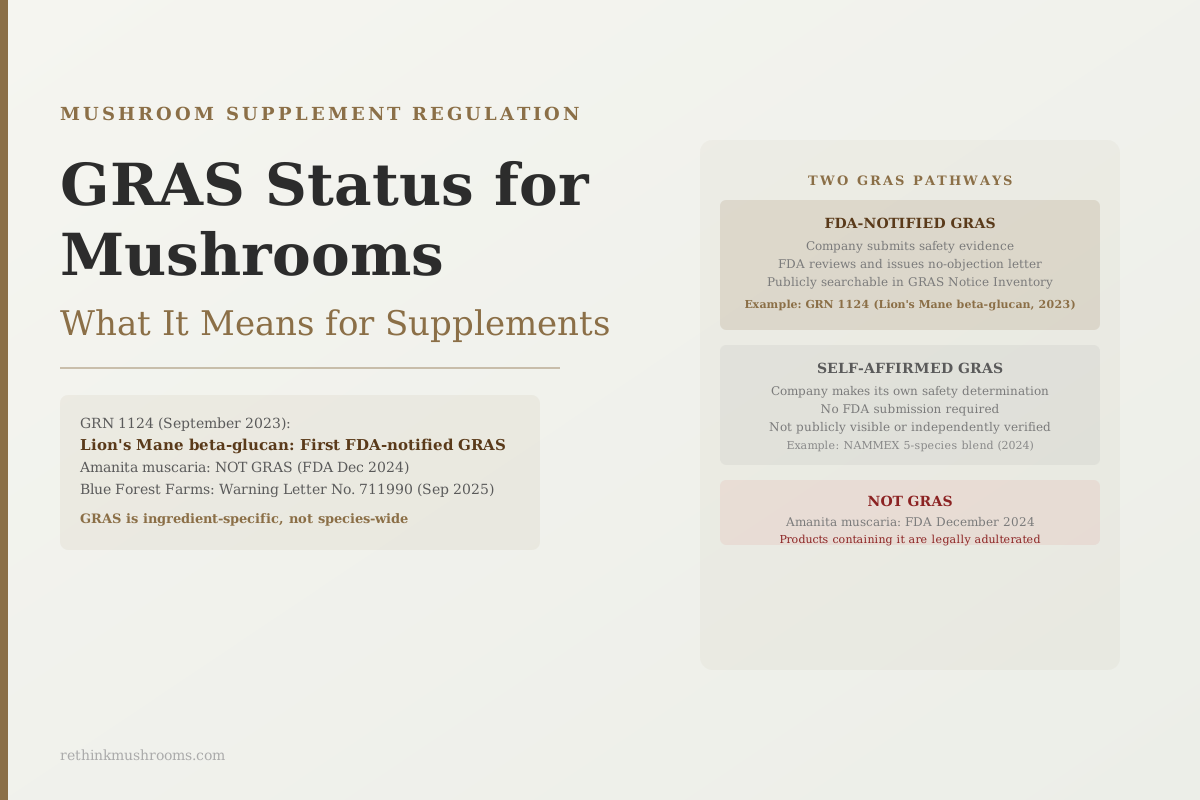
In September 2023, the FDA issued its first GRAS no-objection letter for a Lion's Mane extract (a β-glucan preparation from NAMMEX), making it the first mushroom ingredient with FDA-notified GRAS status for food use.
FDA GRAS Notice Inventory, GRN No. 1124, September 2023
2 pathways
Self-affirmed GRAS (no FDA review) vs. FDA-notified GRAS (public record)
Dec 2024
FDA declared Amanita muscaria NOT GRAS, triggering 2025 enforcement action
≠ approved
GRAS is not FDA approval; it is a safety determination for intended use only
FDA GRAS Notice Inventory, GRN No. 1124, September 2023
 View as image ↗
In December 2024, the FDA sent a letter to industry with an unusually clear message: Amanita muscaria and its constituents are not generally recognized as safe for use in food or dietary supplements. Nine months later, Blue Forest Farms received a formal warning letter (No. 711990, September 11, 2025) citing its Amanita muscaria products as adulterated unsafe dietary supplements under federal food safety law. The legal mechanism that connected those two events was GRAS status, or more precisely, the absence of it.
GRAS (Generally Recognized as Safe) is the regulatory category that governs whether an ingredient is legally permitted in food and dietary supplements. Most consumers have never heard of it. Most mushroom product marketing doesn't mention it. But GRAS status determines which ingredients can lawfully be used in supplement products, and the December 2024 Amanita muscaria determination is the most consequential mushroom-specific GRAS ruling in years.
This article covers what GRAS actually means, the two pathways that lead to it (one of which involves no FDA review at all), the current GRAS status of the mushroom ingredients most commonly found in supplements, and what the Amanita muscaria case shows about how the designation works in enforcement practice. For the broader framework of how the FDA regulates mushroom supplements overall, see How the FDA Regulates Mushroom Supplements: The DSHEA Framework.
Key Takeaways
- GRAS (Generally Recognized as Safe) is the FDA designation indicating an ingredient is safe for its intended use, not a broad safety certification for all uses of a species
- There are two GRAS pathways: self-affirmed (company decides internally, no FDA review) and FDA-notified (company submits a notice and FDA issues a no-objection letter)
- Lion's Mane β-glucan became the first mushroom ingredient with FDA-notified GRAS status in September 2023 (GRN 1124, submitted by NAMMEX)
- A NAMMEX blend of five mushroom extracts (Chaga, Maitake, Reishi, Shiitake, Turkey Tail) received self-affirmed GRAS status in 2024, meaning the company made this determination without FDA review
- The FDA explicitly declared Amanita muscaria NOT GRAS in December 2024, and by September 2025 the first enforcement action against an Amanita muscaria supplement company had been issued
- GRAS status is ingredient-specific: it applies to a specific preparation of a specific species at a specific use level, not to all products containing that mushroom
What GRAS Actually Means (and What It Doesn't)
GRAS stands for Generally Recognized as Safe. It is a legal designation under the Federal Food, Drug, and Cosmetic Act (FDCA) that allows an ingredient to be used in food and dietary supplement products without requiring FDA pre-market approval.
The important word is "recognized." GRAS does not mean the FDA approved the ingredient. It means that qualified scientific experts recognize the ingredient's safety for its intended use based on published scientific evidence, or on a history of common use in food before 1958, when the designation was established.
What GRAS does: It establishes that an ingredient is legally permitted in food or dietary supplements at specified use levels and for specified purposes. Once an ingredient has GRAS status for a given use, manufacturers can use it in products without submitting a separate safety review for each product.
What GRAS does not do: It does not certify that a product containing the ingredient is safe overall. It does not guarantee product quality, potency, or purity. It does not constitute FDA approval of any supplement product. And critically, GRAS status for one preparation of a species does not automatically extend to all preparations. A Lion's Mane β-glucan extract having GRAS status does not mean all Lion's Mane products are GRAS-compliant.
A 2020 review in Critical Reviews in Food Science and Nutrition documented that despite regulatory frameworks like GRAS and Good Manufacturing Practice (GMP) requirements, quality and safety of botanical and herbal supplements remains highly variable in practice, and FDA enforcement is primarily post-market.[1] GRAS determines what can be sold, not whether what's sold meets the standard it was certified under.
The Two GRAS Pathways: Self-Affirmed vs. FDA-Notified
This is the most consequential distinction in the GRAS framework, and the one least understood by supplement consumers.
Pathway 1: Self-Affirmed GRAS
A company determines on its own, based on scientific review, that its ingredient meets the GRAS standard. No submission to the FDA is required. No FDA review takes place. The determination is not publicly visible in any FDA database. The company simply decides its ingredient is safe and begins using it.
Self-affirmed GRAS is legal under current regulations. It is widely used across the food and supplement industries. But it has significant consumer-facing limitations: there is no external validation of the underlying safety determination, no public record of what evidence was reviewed, and no FDA sign-off on the analysis.
Pathway 2: FDA-Notified GRAS
A company voluntarily submits a GRAS Notice to the FDA. The agency reviews the notice over a period of months and either issues a "no objection" letter or closes the notice for other reasons. If the FDA issues a no-objection letter, the notice and its supporting materials are published in the publicly searchable GRAS Notice Inventory.
This is the stronger pathway from a transparency standpoint. The FDA has reviewed the evidence. The determination is on public record. Major retailers are increasingly requiring FDA-notified GRAS as a procurement standard, meaning suppliers without a GRAS notice on file face increasing pressure to obtain one.
The FDA issued a proposal in 2025 that would eliminate the self-affirmed GRAS pathway, requiring all GRAS determinations to go through FDA notification. That proposal has not been finalized. Until and unless it is, both pathways remain available.
Mushroom Ingredients with GRAS Status: A Species-by-Species Overview
| Mushroom Ingredient | GRAS Pathway | FDA Record | Notes |
|---|---|---|---|
| Lion's Mane β-glucan (Hericium erinaceus) | FDA-Notified | GRN 1124, September 2023 | Submitted by NAMMEX; applies to the specific β-glucan extract at specified use levels |
| Chaga (Inonotus obliquus) extract | Self-Affirmed | Not in FDA database | Part of NAMMEX 2024 self-affirmed GRAS blend; no FDA review |
| Maitake (Grifola frondosa) extract | Self-Affirmed | Not in FDA database | Part of NAMMEX 2024 self-affirmed GRAS blend; no FDA review |
| Reishi (Ganoderma lucidum) extract | Self-Affirmed | Not in FDA database | Part of NAMMEX 2024 self-affirmed GRAS blend; no FDA review |
| Shiitake (Lentinula edodes) extract | Self-Affirmed | Not in FDA database | Part of NAMMEX 2024 self-affirmed GRAS blend; no FDA review |
| Turkey Tail (Trametes versicolor) extract | Self-Affirmed | Not in FDA database | Part of NAMMEX 2024 self-affirmed GRAS blend; no FDA review |
| Amanita muscaria | NOT GRAS | FDA December 2024 letter | Explicitly declared not GRAS for food or dietary supplement use |
Reading this table carefully: The self-affirmed GRAS entries above represent a single company's determination for a specific extract blend at specific use levels. Other companies using Chaga, Maitake, Reishi, Shiitake, or Turkey Tail in their products would need to have their own GRAS determination (self-affirmed or FDA-notified) for their specific preparations.
GRAS is always ingredient-specific and use-specific. A species being edible as a culinary mushroom is not a GRAS determination. A species being safe in whole-food form is not a GRAS determination for a concentrated extract. The 2023 Lion's Mane GRAS notice covers β-glucan extract at specific concentrations in specific food uses, not all Lion's Mane supplement products.
The Lion's Mane GRAS Notice: What GRN 1124 Actually Covers
In September 2023, the FDA issued a no-objection letter for GRAS Notice No. 1124, submitted by NAMMEX (North American Medicinal Mushroom Extracts), covering Hericium erinaceus β-glucan extract for use as a food ingredient.
This was the first FDA-notified GRAS determination for a Lion's Mane preparation. It is notable for two reasons: it represents the FDA's review and tacit acceptance (through no-objection) of the safety evidence for this specific preparation, and it provides a public record of what evidence was submitted and reviewed.
The notice covers β-glucan extract specifically, the polysaccharide fraction of Lion's Mane. It does not cover hericenone or erinacine extracts, whole mushroom powders, or other Lion's Mane preparations. A supplement company using a hericenone-enriched fruiting body extract, for example, would be operating under a separate GRAS determination (or no determination at all) for that specific ingredient.
For context on how Lion's Mane's bioactive compounds differ by preparation, see Lion's Mane Bioactive Compounds: Hericenones, Erinacines, and Beyond.
Amanita muscaria: The Most Consequential Mushroom GRAS Ruling in Years
In December 2024, the FDA sent a letter to the dietary supplement and food industry with a direct determination: Amanita muscaria and its constituents (including muscimol and ibotenic acid) are not generally recognized as safe for use in food or dietary supplements.
This was not a routine clarification. It was a formal regulatory position that removed any ambiguity about whether Amanita muscaria products could be marketed as dietary supplements. The FDA's position: they cannot. Products containing Amanita muscaria are adulterated under FDCA Section 402(f)(1)(B), which covers substances that are not GRAS and not subject to an approved food additive petition.
The enforcement action followed quickly. On September 11, 2025, the FDA issued Warning Letter No. 711990 to Blue Forest Farms LLC, citing its Microdose Capsules and Magic Potion Tincture, both containing Amanita muscaria, as adulterated unsafe dietary supplements. The legal mechanism was exactly what the December 2024 letter had established: the ingredient is not GRAS, therefore products containing it are adulterated under federal law.
Regulatory & toxicological
CriticalAmanita muscaria is not GRAS and its active constituents are toxic
Concern
Amanita muscaria contains ibotenic acid and muscimol, psychoactive constituents with known toxicological profiles. The FDA's December 2024 letter stated these substances are not generally recognized as safe for use in food or dietary supplements, and products containing them are adulterated under FDCA Section 402(f)(1)(B).
What the research says
There is no GRAS determination and no approved food additive petition covering Amanita muscaria, so there is currently no lawful pathway to market it as a dietary supplement in the United States. 'Natural' or 'traditional use' framing does not substitute for GRAS status.
Particularly relevant for: Anyone purchasing or consuming Amanita muscaria products marketed as supplements
FDA letter to industry, December 2024; FDA Warning Letter No. 711990 to Blue Forest Farms LLC, September 11, 2025
Why this matters beyond Amanita muscaria: The case illustrates how GRAS status operates as an enforcement trigger. When the FDA determines an ingredient is not GRAS, any product containing it becomes legally adulterated regardless of whether the company believes the ingredient is safe. The burden of proof to establish safety shifts entirely to the manufacturer, and without an approved food additive petition or recognized GRAS status, there is no legal pathway to sell the product as a supplement.
The Blue Forest Farms case is covered in detail in FDA Warning Letters to Mushroom Companies: What Gets Flagged.
What GRAS Status (and the Lack of It) Means for Supplement Consumers
For most of the mushroom species found in functional supplements (Lion's Mane, Reishi, Chaga, Cordyceps, Turkey Tail, Shiitake, Maitake), GRAS status for the specific ingredient type isn't publicly visible, because most companies use self-affirmed GRAS rather than notifying the FDA.
This doesn't mean those products are unsafe. Common culinary mushrooms have long histories of safe human consumption, which supports a GRAS determination based on history of use. But it does mean consumers typically cannot independently verify whether a specific extract formulation has been reviewed by the FDA for safety at the concentration used in a given product.
Practical implications for consumers evaluating supplements:
Products using ingredients with FDA-notified GRAS status (like the NAMMEX Lion's Mane β-glucan extract) have a verifiable, publicly searchable safety determination. Products using self-affirmed GRAS ingredients have a company-internal safety determination with no public record to review.
When a company uses FDA-notified GRAS ingredients, it is a signal of engagement with the regulatory process. When a company makes no reference to GRAS status at all, it likely means one of two things: either its ingredients have self-affirmed GRAS status (acceptable but unverifiable), or it hasn't considered GRAS implications at all (a potential quality indicator).
The GRAS question becomes especially relevant for newer or less common mushroom ingredients, particularly those with psychoactive or pharmacologically active constituents. The Amanita muscaria case established that claiming a mushroom is "natural" or "traditional" does not substitute for established GRAS status when a specific ingredient contains substances with known toxicological profiles.
Consumer misconception
'It's natural and traditional, so it must be safe and legal'
The claim
“If a mushroom has a long history of traditional use, it is automatically safe and legal to sell as a dietary supplement.”
Marketing language that conflates culinary or folk-traditional use with regulatory safety status.
What research shows
MisleadingLegal status in food and supplements turns on GRAS determination for a specific ingredient and use, not on whether a species has been used historically. Amanita muscaria has a long history of traditional use, yet the FDA declared it not GRAS in December 2024 and treated supplement products containing it as adulterated.
Common culinary mushrooms often do have history-of-use support for whole-food consumption, but that support does not automatically extend to concentrated extracts, novel preparations, or species with pharmacologically active toxins.
FDA letter to industry, December 2024; FDCA Section 402(f)(1)(B)
For the quality and manufacturing standards that sit alongside GRAS in the regulatory framework, see cGMP Compliance for Mushroom Products: What Manufacturers Must Do.
For a parallel framework in the European Union, where mushroom ingredients face Novel Food regulations rather than GRAS review, see EU Novel Food Regulations and Mushroom Supplements: What's Approved and What Isn't.
The Changing Landscape: FDA Reconsidering Self-Affirmed GRAS
In 2025, the FDA signaled intent to revisit the self-affirmed GRAS pathway through rulemaking proposals. The FDA's concern is that self-affirmed GRAS determinations are invisible to regulators and consumers alike; the agency has no way of knowing whether the underlying safety review meets the scientific standard required by the regulation.
If the FDA eliminates self-affirmed GRAS and requires all determinations to go through the notification pathway, it would represent the most significant change to the GRAS framework since DSHEA. Companies would need to submit their safety determinations to the FDA and wait for the review process (currently taking several years per notice) before marketing new ingredients.
For the mushroom supplement industry, the practical effect would be a significant increase in time and regulatory cost to bring new mushroom ingredient preparations to market. Ingredients like specific Reishi extract formulations, Chaga concentrate, or novel extraction methods for existing species would require FDA notification before use, rather than the current approach of self-affirmed determination.
This rulemaking has not been finalized as of the publication of this article. The supplement industry has submitted public comments opposing elimination of self-affirmed GRAS. Until a final rule is issued, self-affirmed GRAS remains a legal pathway.[1]
This article explains the regulatory framework around GRAS status and is for educational purposes only. It is not medical advice and is not a safety endorsement of any specific product or species. Regulatory status can change; consult current FDA records and a qualified healthcare professional before using any mushroom supplement, particularly products containing pharmacologically active or psychoactive constituents.
The Bottom Line
GRAS (Generally Recognized as Safe) is the FDA designation governing whether a mushroom ingredient can legally be used in food and dietary supplements. Two pathways exist: self-affirmed GRAS (internal company determination, no FDA review) and FDA-notified GRAS (company submits evidence, FDA issues a no-objection letter, publicly searchable). As of 2023, Lion's Mane β-glucan has the only FDA-notified GRAS notice for a mushroom extract (GRN 1124). The FDA declared Amanita muscaria NOT GRAS in December 2024, triggering enforcement action against Blue Forest Farms in September 2025. GRAS status is always ingredient-specific, not species-wide.
Frequently Asked Questions
Sources & References
- 1RTHM-01165·Bailey, Regan L (2020). “Current regulatory guidelines and resources to support research of dietary supplements in the United States..” Critical reviews in food science and nutrition.Study breakdown →PubMed →↩