GMP / Manufacturing
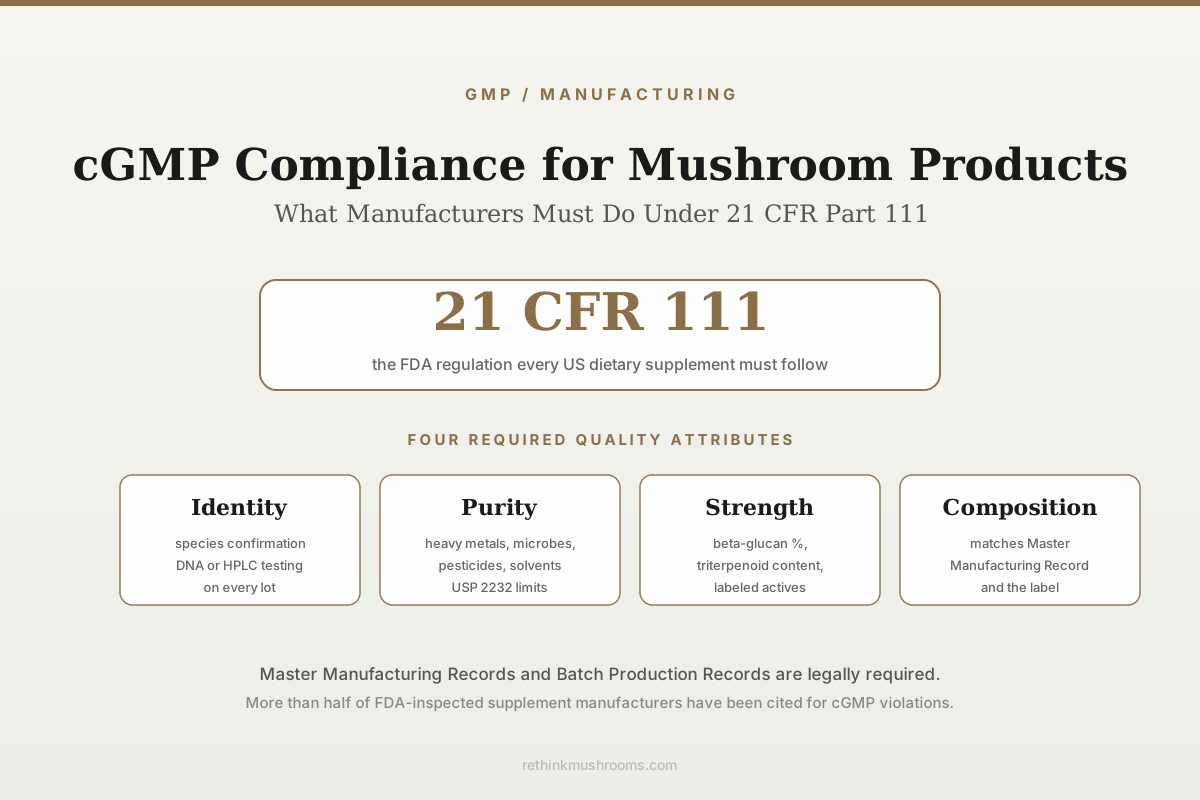
21 CFR 111
The FDA regulation that sets identity, purity, potency, and composition requirements for every dietary supplement sold in the United States, including mushroom products.
US Food and Drug Administration, 2007
4 Quality Attributes
identity, purity, strength, composition
Batch Records
required for every production run
100% Identity
confirmation required for each ingredient
US Food and Drug Administration, 2007
 View as image ↗
Current Good Manufacturing Practice (cGMP) for dietary supplements is not optional. Every company that manufactures, packages, labels, or holds a mushroom supplement sold in the United States must comply with 21 CFR Part 111, the FDA regulation that defines what "quality" actually means for dietary supplements. The regulation became fully enforceable in 2010, and FDA inspections of supplement manufacturers routinely find violations serious enough to trigger warning letters, import alerts, and product recalls.
For mushroom products specifically, cGMP compliance is where most of the gap between label claims and actual contents gets either closed or exposed. Wu et al. (2017) analyzed Ganoderma lucidum (reishi) dietary supplements collected in the United States and found substantial variation in triterpene and polysaccharide content across products, with some samples containing concentrations far lower than their label suggested.[1] The manufacturing controls required by 21 CFR Part 111 are designed to prevent exactly that kind of inconsistency. When manufacturers follow them, products match their labels. When they skip steps, products often do not.
For consumers who want to understand what separates compliant products from noncompliant ones, see 7 red flags in mushroom supplements: what to avoid.
Key Takeaways
- 21 CFR Part 111 requires dietary supplement manufacturers to establish specifications for identity, purity, strength, and composition of every component and finished product, and to verify those specifications through scientifically valid testing
- Wu et al. (2017) found that only 5 of 19 Ganoderma lucidum (reishi) supplements sold in the US (26.3%) had measured ingredients matching their labels, the kind of inconsistency cGMP identity and potency testing is designed to detect
- Mushrooms accumulate heavy metals from their growing substrate, with cadmium, arsenic, lead, and mercury bioaccumulation documented across species and requiring USP-compliant testing of every batch (Ab Rhaman et al., 2021)
- Windsor et al. (2025) showed that wildcrafted chaga canker contained triterpenoids absent from mycelium-on-grain products marketed as chaga, a mislabeling failure that identity testing under 21 CFR Part 111 should catch
- Master Manufacturing Records and Batch Production Records are legally required for every production run and must be retained for at least one year past the product's shelf life
- FDA inspections of supplement manufacturers routinely cite cGMP violations, with the most frequent Form 483 observations involving inadequate identity testing, product specifications, and manufacturing records
The Regulation That Governs Every US Mushroom Supplement
21 CFR Part 111, titled "Current Good Manufacturing Practice in Manufacturing, Packaging, Labeling, or Holding Operations for Dietary Supplements," was published by the US Food and Drug Administration in 2007 and became fully enforceable for all manufacturers by 2010. The regulation applies to every facility that handles a dietary supplement at any stage of production, including contract manufacturers, packagers, and warehouses.
The rule is built around four quality attributes that every dietary supplement manufacturer must control: identity, purity, strength, and composition. These four attributes are not suggestions. They are the enforceable legal framework that defines whether a product meets its label and whether a manufacturer can legally sell it.
For mushroom products, each attribute has specific and nontrivial technical requirements:
Identity means the mushroom in the product is actually the species the label claims. A product labeled "reishi (Ganoderma lucidum)" must contain Ganoderma lucidum, not Ganoderma sinense, Ganoderma lingzhi, or mycelium grown on starch-rich grain substrate with a reishi label. Identity confirmation requires scientifically valid testing of every incoming lot of raw material.
Purity means the product is free from contaminants above specified limits. For mushroom products, the relevant contaminants include heavy metals (cadmium, arsenic, lead, mercury), pesticide residues, microbial contamination, mycotoxins, and chemical solvent residues from extraction.
Strength means the bioactive content matches the label claim. For mushroom extracts, this typically means verifying the beta-glucan percentage, triterpenoid concentration, or other specified actives against the labeled value.
Composition means the finished product contains only what the label says it contains, in the proportions specified. For proprietary blends, the composition must match the Master Manufacturing Record for that product.
21 CFR Part 111 · The Four Quality Attributes
What Each Attribute Requires — and the Failure Testing Catches
Every US dietary-supplement manufacturer must establish and verify specifications for four attributes. For mushroom products, each one maps to a specific test and to a documented, published failure that the test is designed to detect.
Sources: 21 CFR Part 111 (FDA cGMP for dietary supplements); Windsor et al. (2025) [ref 3]; Ab Rhaman et al. (2021) [ref 4]; Wu et al. (2017), Scientific Reports 7:7792 [ref 1].
The Food Safety Modernization Act (FSMA), passed in 2011, added additional requirements for domestic and imported ingredients, including hazard analysis and preventive controls for facilities that manufacture, process, pack, or hold human food. FSMA applies to raw mushroom ingredients alongside the dietary supplement cGMP rules.
Identity Testing: Where Most Mushroom Products Fail
21 CFR 111.75(a)(1)(i) requires manufacturers to establish and conduct at least one appropriate test to verify the identity of each dietary ingredient before using it. For mushroom ingredients, identity testing is where the regulatory rubber meets the road, because mushroom species identification based on morphology alone is unreliable for dried or powdered material.
Compliant identity testing for mushroom ingredients typically involves one or more of these methods:
DNA barcoding compares the internal transcribed spacer (ITS) region or other genetic markers against a reference database. DNA testing can distinguish closely related species (Ganoderma lucidum vs. G. sinense, for example) that look identical as powder.
HPLC fingerprinting compares the chromatographic pattern of a sample against a reference standard. Zhao and Leung (2010) demonstrated HPLC-DAD-MS analysis of Antrodia camphorata mycelial products, showing that chemical fingerprinting can distinguish authentic material from substitutes and detect compositional anomalies.[2]
Microscopic examination can verify presence of mushroom-specific structures (hyphae, basidia, spores) but cannot reliably identify species on its own.
Chemical markers for specific bioactives can confirm species identity when unique compounds are present (ganoderic acids for G. lucidum, antcins for Antrodia, betulinic acid for chaga).
Windsor et al. (2025) illustrated why identity testing matters in practice. Wildcrafted chaga (Inonotus obliquus) canker contained triterpenoids including inotodiol and trametenolic acid, along with characteristic phenolics. Fermented grain products marketed as chaga contained none of these compounds.[3] A manufacturer performing compliant identity testing under 21 CFR 111 would detect this discrepancy and reject the substitute material. A manufacturer skipping identity testing or relying only on supplier documentation would not. For a deeper look at the same quality gap, see mushroom wisdom, mycelium biomass, and other label terms decoded.
Purity Testing: Heavy Metals, Microbes, and Solvent Residues
Mushrooms are efficient accumulators of metals from their growing substrate. Ab Rhaman et al. (2021) reviewed mushroom quality and found that cadmium, arsenic, lead, mercury, and other heavy metals translocate from substrate to fruiting body across many edible and medicinal species. Concentrations depend on the substrate source, the species, and growing conditions.[4] The bioaccumulation is not hypothetical. It is a documented feature of fungal physiology that every mushroom manufacturer must account for.
21 CFR 111.70(b) requires manufacturers to establish purity specifications for each component of a dietary supplement. For mushroom products, those specifications typically reference USP General Chapter <2232> (Elemental Contaminants in Dietary Supplements), which sets limits for arsenic, cadmium, lead, and mercury in supplements. Compliant manufacturers test every lot of incoming raw material against these limits using validated methods such as inductively coupled plasma mass spectrometry (ICP-MS).
Microbial contamination is a parallel concern. 21 CFR 111.70(e) requires finished product specifications that address microbial safety. Compliant manufacturers test for total aerobic plate count, yeast and mold, E. coli, Salmonella, and Staphylococcus aureus, with limits set by species-specific risk assessments and USP General Chapter <2023>.
Solvent residues apply specifically to extracted mushroom products. Ethanol extraction is considered food-grade when conducted with pharmaceutical or food-grade ethanol, and residual solvent testing under USP General Chapter <467> (Residual Solvents) applies to ensure that ethanol residues remain below specified limits. For consumers evaluating tincture and extract products, see capsule vs. powder vs. tincture: bioavailability, cost, and convenience compared.
Pesticide testing is required when the source material could carry pesticide residues. For wildcrafted mushrooms, this risk is generally low. For cultivated mushrooms, risk varies by grower and substrate. Compliant manufacturers test batches against a panel of relevant pesticides using gas chromatography-mass spectrometry (GC-MS) or liquid chromatography-tandem mass spectrometry (LC-MS/MS).
Strength and Composition: Matching the Label
21 CFR 111.70(e) requires finished product specifications for the strength of dietary ingredients and the composition of the finished product. For mushroom supplements, this translates to concrete testing requirements.
Beta-glucan content is the most commonly specified strength parameter for polysaccharide-rich species (reishi, turkey tail, maitake, shiitake). The enzymatic assay developed by Megazyme is the industry standard and specifically measures beta-(1,3)(1,6)-glucans of fungal origin while excluding alpha-glucans from grain substrate. A product labeled "40% beta-glucan" must actually contain at least 40% beta-glucan when tested by a validated method.
Triterpenoid content applies to species where triterpenoids drive biological activity (reishi, chaga, Antrodia). Quantification typically uses HPLC with UV or mass spectrometric detection against reference standards.
Specific compound concentrations apply when a product label references a named bioactive (ganoderic acid A for reishi, hericenones for lion's mane, betulinic acid for chaga).
Wu et al. (2017) showed why this testing matters. When 19 batches of Ganoderma lucidum (reishi) supplements purchased in the United States were analyzed for triterpene and polysaccharide content, only 5 of the 19 products (26.3%) had measured ingredients that matched their labels.[1] A manufacturer operating under compliant cGMP would specify, test, and release only lots that meet the label strength. A manufacturer skipping release testing can ship whatever the supplier sent regardless of content.
For the underlying science on why species chemistry matters across forms, see bioavailability by supplement form: what gets absorbed? and 10:1 extract ratios: what they mean and what they don't.
The Documentation Requirements Most People Never See
Behind every cGMP-compliant mushroom product is a documentation trail that most consumers never see. The regulation requires two primary document types:
Master Manufacturing Record (MMR) is the recipe and process specification for each product. 21 CFR 111.205 requires the MMR to specify the identity and quantity of each ingredient, the specifications at each step of production, sampling points, required tests, and acceptance criteria. The MMR is the source of truth for how a product is supposed to be made.
Batch Production Record (BPR) documents what actually happened during a specific production run. 21 CFR 111.260 requires the BPR to record the date of manufacture, the unique batch identifier, the actual weights and measurements of each ingredient used, the equipment used, the personnel involved, the results of in-process and release testing, and any deviations from the MMR.
Both records must be retained for at least one year past the product's shelf life under 21 CFR 111.605. FDA inspectors review these records during audits, and missing or incomplete records are among the most common citations issued.
Additional required documentation includes supplier qualification records, equipment calibration logs, cleaning records for shared equipment, personnel training records, complaint logs with investigations and corrective actions, and stability study data supporting the labeled shelf life.
Third-Party Certifications Beyond Baseline cGMP
21 CFR Part 111 is the legal baseline. Several third-party certifications build on that baseline with additional requirements and independent audits:
NSF International GMP Registration involves annual unannounced audits against NSF/ANSI 173, which incorporates 21 CFR Part 111 and adds requirements for sanitation, pest control, and facility design. Products from NSF-registered facilities carry the NSF GMP mark.
USP Verified is a certification of finished products (not facilities). USP tests the product against its label, confirms identity, potency, and purity, and audits the manufacturing facility. USP Verified products display the USP Verified mark and are listed in the USP Verified Products directory.
NSF Certified for Sport adds testing for banned substances relevant to athletic competition. Relevant for mushroom products because some hemp-derived or grain-substrate contaminants could trigger positive doping tests.
Informed Choice / Informed Sport (LGC Group) also certifies absence of WADA-banned substances through lot-by-lot testing.
Non-GMO Project Verified and USDA Organic are separate certifications for non-GMO status and organic sourcing, respectively, and do not replace cGMP compliance.
Third-party certifications are not legally required. They provide independent verification that a manufacturer is actually doing what 21 CFR Part 111 already requires them to do. For consumers evaluating whether a product is genuinely high-quality, the presence of a reputable third-party certification is stronger evidence than a marketing claim.
The Inspection Reality
FDA inspections of dietary supplement manufacturers have historically found high rates of cGMP violations. Across FDA inspection cycles, Form 483 observations have concentrated in a consistent handful of areas, with the most common citations being failures related to:
- Inadequate identity testing of dietary ingredients (21 CFR 111.75)
- Inadequate specifications for components, in-process materials, or finished products (21 CFR 111.70)
- Insufficient Master Manufacturing Records or Batch Production Records (21 CFR 111.205 and 111.260)
- Inadequate investigation of deviations or returned products (21 CFR 111.113, 111.353)
- Insufficient qualification of suppliers (21 CFR 111.75)
When violations are severe, FDA issues a Form 483 observation at the end of inspection, followed by a Warning Letter if corrective actions are insufficient. Serious violations can escalate to Import Alerts (for foreign manufacturers), seizures, injunctions, or criminal prosecution.
For mushroom-specific concerns, the most common real-world failures involve identity testing (species confirmation), purity testing (heavy metals), and strength testing (beta-glucan or triterpenoid content). A manufacturer can pass sanitation and documentation audits while still shipping mushroom products that contain the wrong species, excess cadmium, or no measurable bioactive content. This is why consumers evaluating products should look for certifications that specifically address these testing gaps, not just general cGMP compliance claims.
The Bottom Line
21 CFR Part 111 is the enforceable FDA regulation that defines cGMP requirements for every dietary supplement sold in the United States, including mushroom products. Manufacturers must establish and verify specifications for identity, purity, strength, and composition, maintain Master Manufacturing Records and Batch Production Records, and test each lot using scientifically valid methods. For mushroom products specifically, identity testing (DNA or HPLC), heavy metal testing (USP 2232), and strength testing (beta-glucan or triterpenoid content) are the compliance failures most commonly observed in the published literature on supplement quality.
Frequently Asked Questions
Sources & References
- 1RTHM-00499·Wu, Ding-Tao et al. (2017). “Evaluation on quality consistency of Ganoderma lucidum dietary supplements collected in the United States..” Scientific reports.Study breakdown →PubMed →↩
- 2RTHM-00202·Zhao, Sandy Shuo et al. (2010). “Quality evaluation of mycelial Antrodia camphorata using high-performance liquid chromatography (HPLC) coupled with diode array detector and mass spectrometry (DAD-MS)..” Chinese medicine.Study breakdown →PubMed →↩
- 3RTHM-02209·Windsor, Coleton et al. (2025). “What This 2025 Chaga Supplement Authentication Study Actually Found.” International journal of molecular sciences.Study breakdown →PubMed →↩
- 4RTHM-00669·Ab Rhaman, Siti Maryam Salamah et al. (2021). “Mushroom Quality Related with Various Substrates' Bioaccumulation and Translocation of Heavy Metals..” Journal of fungi (Basel.Study breakdown →PubMed →↩