Mushroom Supplement Regulation
85,000+ dietary supplement products on the US market
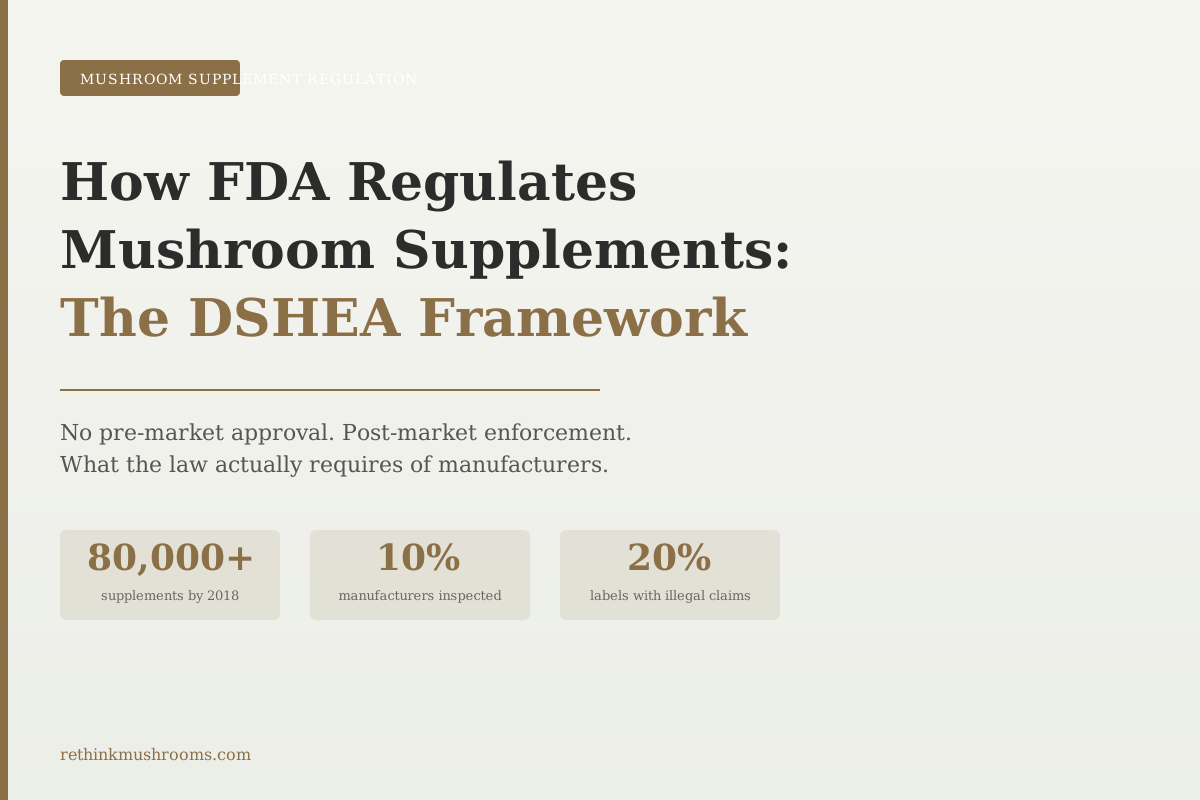
When DSHEA passed in 1994, about 600 US manufacturers made an estimated 4,000 supplement products. Dwyer and colleagues put the current figure at more than 85,000, with FDA's post-market enforcement model essentially unchanged.
Dwyer JT et al., Nutrients, 2018
416
supplement manufacturers FDA inspected for cGMP in 2013, out of roughly 4,000 covered
26 of 127
supplements in a 2012 HHS OIG sample carried prohibited disease claims
93%
of 40 supplements tested by GAO in 2010 held traces of heavy metals or pesticides
Dwyer JT et al., Nutrients, 2018
 View as image ↗
Walk into any health food store and you'll find entire shelves of mushroom supplements: Lion's Mane capsules, Reishi tinctures, Cordyceps powders. Every one of those products reached you without the FDA ever reviewing whether it was safe.
That's not a gap or an oversight. It's how the law was designed.
A 1994 statute called the Dietary Supplement Health and Education Act (DSHEA) fundamentally changed how FDA regulates mushroom supplements and every other dietary supplement sold in the United States. The core shift: manufacturers no longer needed to prove safety before bringing a product to market. The FDA would monitor what happened after.
The supplement market responded accordingly. When DSHEA passed, about 600 US manufacturers were producing an estimated 4,000 dietary supplement products. Dwyer and colleagues put the count at more than 85,000 products, a twenty-fold expansion with no corresponding growth in pre-market safety requirements.[2] Thirty years on, that market is worth roughly $60 billion domestically, and about three-quarters of US adults report taking supplements.[4]
This article explains the full framework: what DSHEA requires of mushroom supplement manufacturers before a product ships, what FDA can and cannot do once a product is on shelves, and where the most significant gaps in the system actually sit.
Key Takeaways
- Mushroom supplements are not FDA-approved before sale. Under DSHEA, manufacturers are legally responsible for safety, and FDA acts only after products are already on the market.
- The supplement market grew from roughly 4,000 products in 1994 to more than 85,000, with FDA's oversight remaining post-market in nature throughout that growth.
- Manufacturers must follow cGMP regulations under 21 CFR Part 111, but in 2013 FDA inspected 416 supplement manufacturers for cGMP compliance, about 10% of the roughly 4,000 covered by those rules.
- In a 2012 HHS Office of Inspector General review of 127 weight-loss and immune-support supplements, 26 (20%) carried prohibited disease claims and 7% lacked the required FDA disclaimer. That sample was purposive, not market-wide, but immune support is precisely the category most mushroom supplements are sold in.
- GRAS (Generally Recognized as Safe) status is ingredient-specific, not species-wide, and no Lion's Mane preparation currently holds it. The one FDA-notified attempt (GRN 1124) was withdrawn before review finished. Two mushroom beta-glucan notices have cleared: reishi mycelium (GRN 413, 2012) and Antrodia cinnamomea (GRN 995, 2022). Amanita muscaria was declared not GRAS in December 2024.
- Mushroom ingredients not marketed in supplement form before October 15, 1994 require a 75-day New Dietary Ingredient notification to FDA before sale, a requirement most manufacturers have not fulfilled.
The FDA's Answer to "Is This Safe?": It's Not What You'd Expect
The FDA regulates mushroom supplements as dietary supplements under DSHEA. Unlike prescription drugs or over-the-counter medications, mushroom supplements do not require FDA review or approval before they are sold. The FDA's authority is post-market: it can investigate and act after a product is already being sold if safety violations or prohibited claims are found.
That one distinction carries enormous practical consequences. Drugs must demonstrate safety and effectiveness to FDA before reaching pharmacies. Supplements reach store shelves the moment a manufacturer decides to sell them, with safety the manufacturer's legal responsibility rather than something FDA confirms in advance.
The framework wasn't always this way. Before DSHEA, the FDA treated many supplements more like food additives, giving the agency stronger pre-market authority. The 1994 law moved the regulatory burden in a significant and lasting direction, shifting the presumption from "prove it's safe before you sell it" to "sell it, and we'll act if we find a problem."
Understanding what FDA does and doesn't do in that post-market role is the foundation for reading any mushroom supplement product, label, or marketing claim with accurate expectations.
The diagram above is worth sitting with, because it explains most of what follows. Only one checkpoint in the entire sequence requires a manufacturer to contact FDA before selling, and that checkpoint applies only to genuinely new ingredients. Everything else is either a rule the company applies to itself or a check that happens after the product is already in someone's cabinet.
What DSHEA Is and Why 1994 Changed the Supplement Market
DSHEA stands for the Dietary Supplement Health and Education Act. Congress passed it in October 1994, and it remains the primary federal law governing mushroom supplements and all other dietary supplements sold in the United States today.
Before DSHEA, the FDA had proposed classifying many supplement ingredients as food additives, which would have required pre-market safety demonstrations similar in structure to the drug approval process. The supplement industry pushed back, arguing that vitamins and herbal products had long histories of safe use. DSHEA was the legislative outcome of that dispute.
The law established a specific legal category for dietary supplements. Under 21 U.S.C. § 321(ff), a dietary supplement is a product intended to supplement the diet containing one or more of the following: a vitamin, a mineral, an herb or other botanical, an amino acid, or a concentrate, metabolite, constituent, extract, or combination of those ingredients. Mushroom supplements fit squarely within this definition. Fungi are treated as botanicals for regulatory purposes, and mushroom extracts qualify as dietary supplement ingredients.
DSHEA drew a clear line between supplements and drugs. Drugs require FDA approval before sale and must demonstrate efficacy through clinical trials. Supplements are assumed safe unless FDA proves otherwise. The manufacturer is responsible for ensuring safety; FDA's role under DSHEA is to police violations after the fact.
The market that emerged from this framework was larger than its architects anticipated, and the statute has not been meaningfully revised since. Writing at DSHEA's thirty-year mark, Wallace and Koturbash noted that scientists, public health officials, clinicians, consumer advocacy groups, and FDA itself have all called the framework outdated and pressed for reform, particularly around supply-chain traceability, labeling, and post-market surveillance.[4]
Despite formal regulatory requirements, the quality and safety of botanical and herbal supplements in this expanded market remains highly variable, according to a 2020 review of the US dietary supplement regulatory landscape.[3] Bailey attributes this partly to scale: the sheer number of products and manufacturing facilities, combined with a lack of validated analytical methods for every ingredient on the market, limits what regulators can verify. The problem is acute for botanical and herbal products, the category mushroom extracts fall into.
The October 1994 Cutoff: New Mushroom Extracts Need an NDI Notice
One of the most overlooked provisions of DSHEA involves what the law calls "new dietary ingredients," and it matters significantly for the mushroom supplement market.
DSHEA grandfathered any dietary supplement ingredient already being marketed in the United States before October 15, 1994. Those ingredients can be sold without any special FDA notification. They are presumed to have a safety record established by their pre-DSHEA marketing history.
But concentrated mushroom extracts weren't widely marketed as dietary supplements in 1994. Common culinary mushrooms like shiitake were food items. The specific standardized extracts found in modern mushroom supplements, such as hot water extracts with defined beta-glucan percentages, dual extracts of reishi, and mycelium-free Lion's Mane preparations, largely did not exist in the supplement market before the cutoff date.
Any dietary supplement ingredient not marketed before October 15, 1994 is classified as a New Dietary Ingredient (NDI). Under FDCA § 413, manufacturers planning to sell a product containing an NDI must submit a notification to FDA at least 75 days before first marketing it. That notification must include information reasonably expected to establish that the ingredient is safe under the intended conditions of use.
FDA publishes a list of NDI notifications it has received, but many mushroom supplement manufacturers have not submitted them for their extract products. Failure to submit a required NDI notification makes a product legally adulterated under federal law, meaning it can be seized or made subject to an injunction even if the ingredient itself poses no known safety risk.
This provision rarely surfaces in consumer-facing discussions about mushroom supplements. Most coverage focuses on GRAS status or health claims. But the NDI requirement is a significant legal boundary, and the regulatory record suggests widespread non-compliance across the mushroom supplement category.
It is also not a dormant rule. When FDA moved against Amanita muscaria products in September 2025, the NDI provision did much of the legal work: the agency stated that Amanita muscaria, its extract, ibotenic acid, muscarine, and muscimol are new dietary ingredients because nothing indicated they were marketed as dietary ingredients in the United States before October 15, 1994. That finding routes directly into the adulteration provision at FDCA § 402(f)(1)(B), which makes a supplement adulterated when it contains a new dietary ingredient for which there is inadequate information to provide reasonable assurance that it does not present a significant or unreasonable risk of illness or injury. The 1994 cutoff and the adulteration standard are not separate topics; the first is the trigger for the second.
Understanding how manufacturers navigate all of FDA's compliance requirements, including NDI, GMP, and health claims rules, is covered in more depth in FDA and Mushroom Supplements: How DSHEA Shapes What Companies Can (and Can't) Say.
What FDA Does Require Before a Product Ships: Good Manufacturing Practices
If DSHEA removed FDA's pre-market approval authority over supplements, it didn't remove all pre-sale requirements. Mushroom supplement manufacturers must comply with current Good Manufacturing Practice (cGMP) regulations, codified at 21 CFR Part 111. These rules govern the manufacturing process from raw ingredient verification through finished product testing.
Under 21 CFR Part 111, supplement manufacturers are required to:
- Establish identity, purity, strength, and composition specifications for each ingredient and finished product
- Test finished products against those specifications before releasing them for sale
- Document all manufacturing steps and maintain records for two years
- Investigate and resolve customer complaints that relate to product quality
- Maintain sanitary facilities, equipment, and personnel practices
For mushroom supplements specifically, these requirements extend to verifying species identity, confirming that a Lion's Mane product actually contains Hericium erinaceus rather than a cheaper substitute. They also require testing for heavy metals, microbial contamination, and pesticide residues, and verifying that extract concentrations match what the label claims.
The regulations are also clear about adverse event reporting. Under the Dietary Supplement and Nonprescription Drug Consumer Protection Act of 2006, manufacturers must report serious adverse events, including hospitalizations, deaths, and life-threatening reactions, to FDA within 15 business days. This gives FDA a mechanism to identify emerging safety signals from products already on the market.
The practical enforcement reality is considerably different from what the regulatory text implies.
Starr's 2015 policy analysis of FDA's supplement oversight put numbers to it: in 2013 the agency inspected 416 supplement manufacturers for cGMP adherence, roughly 10% of the estimated 4,000 manufacturers covered by those regulations.[1] The same paper relays a 2010 Government Accountability Office analysis in which 40 dietary supplements were tested for lead, arsenic, mercury, cadmium, or pesticides, and 93% contained trace amounts of at least one.[1] Those were traces, not doses established to cause harm, and the sample was small. The finding is about how routinely contaminants show up at all, not about how dangerous the average product is.
GMP violations that appear in FDA warning letters to mushroom companies often involve failures in documentation and specification-setting rather than dramatic contamination events. Restorative Botanicals LLC received a warning letter on August 13, 2024 citing, among other things, failure to establish component specifications and failure to establish product specifications for the identity of the finished batch. The most telling detail is what FDA found when it read the company's identity specifications: the entries for Organic Maitake Extract and Organic Agaricus Blazei Extract both described a "yellow to brown" powder, which means the specification could not distinguish one mushroom species from the other. The violation wasn't a discovered contaminant; it was a paper trail incapable of proving the product contained what the label said.
For a full breakdown of what GMP standards require of mushroom manufacturers and what non-compliance typically looks like in practice, see cGMP Compliance for Mushroom Products: What Manufacturers Must Do.
Health Claims: The Line Every Mushroom Supplement Company Is Legally Required to Walk
Under DSHEA, mushroom supplement manufacturers have one category of permitted claims: structure/function claims. These describe how an ingredient supports a normal body structure or function without referencing any specific disease.
Permitted examples:
- "Supports healthy immune function"
- "Promotes mental clarity"
- "Helps maintain normal energy levels"
Prohibited examples:
- "Treats bacterial infections"
- "Cures cancer"
- "For use in managing diabetes"
The legal boundary between these categories is sharper than it looks. Making a disease claim, any claim to diagnose, treat, cure, or prevent a specific disease, doesn't just violate a labeling rule. It legally reclassifies the product as an unapproved drug under the Federal Food, Drug, and Cosmetic Act. An unapproved drug can be seized by FDA. Its manufacturer can face injunction or criminal prosecution.
Companies making structure/function claims are required by 21 CFR § 101.93 to notify FDA within 30 days of first marketing the product with the claim. Every label using a structure/function claim must also carry this exact disclaimer: "This statement has not been evaluated by the Food and Drug Administration. This product is not intended to diagnose, treat, cure, or prevent any disease."
Despite these requirements, compliance is uneven. In October 2012 the HHS Office of Inspector General published Dietary Supplements: Structure/Function Claims Fail To Meet Federal Requirements (OEI-01-11-00210), which examined a purposive sample of 127 supplements marketed for weight loss or immune system support. Twenty percent of them, 26 products, carried prohibited disease claims on their labels; a further 7% were missing the required FDA disclaimer entirely. The products with prohibited claims purported to treat conditions including influenza, the common cold, herpes, and HIV.
That 20% figure is worth handling carefully. OIG deliberately sampled two high-risk categories rather than drawing a representative cross-section of the market, so it does not establish that one in five supplements generally breaks the rules. It does, however, describe the immune-support category directly, and immune support is the shelf where most mushroom supplements are sold.
The reason this violation rate persists is structural: FDA doesn't review labels before they reach store shelves, enforcement requires the agency to investigate specific products, and the market includes thousands of small sellers operating below FDA's enforcement radar.
The mushroom supplement category is no exception. FDA warning letters to companies including Brilliant Enterprises LLC (2021), Half Hill Farm Inc (2020), and Lone Star Botanicals Inc (2023) each cited disease claims on mushroom products. Those are the documented cases; others exist below the enforcement threshold.
For detailed analysis of how mushroom-specific claims are evaluated, where the gray areas lie, and what implied disease claims look like in practice, see Why Mushroom Supplements Can't Make Health Claims: Legal Boundaries and FDA and Mushroom Supplements: How DSHEA Shapes What Companies Can (and Can't) Say.
GRAS: The Safety Designation That's More Complicated Than It Sounds
When consumers see "GRAS" on supplement marketing material, most assume it signals FDA approval. It doesn't.
GRAS stands for Generally Recognized As Safe, a legal designation indicating that an ingredient is safe for its intended use in food or supplements. The critical word is "recognized": GRAS status can be established by the company manufacturing the product, without any FDA review.
This creates a two-tier system that most consumers are unaware of.
Self-affirmed GRAS: A manufacturer convenes a panel of qualified experts, reviews the available scientific evidence, and internally determines that an ingredient is GRAS for a specific intended use. There is no FDA submission and no agency review. The determination exists only in the company's internal records. Consumers have no way to verify the rigor of the underlying safety assessment.
FDA-notified GRAS: A manufacturer submits a GRAS notice to FDA. The agency reviews the supporting evidence and, if it raises no safety objections, issues a "no objection" letter. The notice and FDA's response are publicly searchable in the FDA GRAS Notice Inventory. This is not formal FDA approval, but it is a documented public record of an external safety review.
For mushroom supplements, confirmed FDA-notified GRAS status is rarer than the marketing suggests, and the public record does not say what it is often reported to say.
Two mushroom-derived beta-glucan notices have actually cleared the FDA-notified pathway, and both came from the same notifier, Super Beta Glucan, Inc. of Irvine, California. GRN 413, covering beta-glucans derived from Ganoderma lucidum (reishi) mycelium, closed on August 10, 2012 with FDA stating it had no questions. GRN 995, covering beta-glucans from Antrodia cinnamomea strain ATCC 200183, closed the same way on June 14, 2022.
Lion's Mane is the case most often described incorrectly. Super Beta Glucan did file GRN 1124 for beta-glucans from Hericium erinaceus strain BCRC 35669, but that notice did not end in a no-objection letter. FDA closed it on September 28, 2023 with the disposition "at the notifier's request, FDA ceased to evaluate this notice." The notice was withdrawn before the agency finished its review. A withdrawn notice is not a clearance, and no Lion's Mane preparation currently holds FDA-notified GRAS status. The same disposition applies to two Pleurotus pulmonarius mycelial biomass notices, GRN 1152 (March 2024) and GRN 1220 (August 2025).
Separately, NAMMEX markets a line of trademarked concentrated organic extracts, including RealChaga, RealCordyceps, RealLionsMane, RealMaitake, RealReishi, RealShiitake and RealTurkeyTail, under self-affirmed GRAS determinations. Self-affirmed is a legitimate legal route, but it is not the same thing as an FDA no-questions letter, and no public record of the underlying safety determination exists outside the company's own files. When a mushroom brand says its ingredient is GRAS, this is usually the kind it means.
Fact Check
Does Lion's Mane have FDA-cleared GRAS status?
The claim
“Lion's Mane beta-glucan holds FDA-notified GRAS status, granted in September 2023 under GRN 1124.”
GRN 1124 exists and is dated 2023, so summaries often assume it closed successfully. Supplier marketing that advertises 'FDA-notified GRAS mushroom extracts' reinforces the impression.
What research shows
MisleadingFDA's GRAS Notice Inventory records GRN 1124 as closed on September 28, 2023 with the disposition 'at the notifier's request, FDA ceased to evaluate this notice.' The notifier was Super Beta Glucan, Inc., not NAMMEX, and the notice was withdrawn before FDA completed its evaluation.
Two mushroom beta-glucan notices did clear with 'FDA has no questions': GRN 413 for Ganoderma lucidum mycelium (August 10, 2012) and GRN 995 for Antrodia cinnamomea (June 14, 2022). So mushroom ingredients can and do clear the pathway. Lion's Mane simply is not one of them yet.
FDA GRAS Notice Inventory, GRN 413, GRN 995, GRN 1124
The stakes of these distinctions became most visible on December 18, 2024, when FDA issued a letter to industry stating that Amanita muscaria, its extracts, and the constituents muscimol, ibotenic acid, and muscarine are not GRAS for use in food and are unapproved food additives. The agency said it acted after receiving serious adverse event reports and reviewing more than 600 publications, and it recorded the assessment in its inventory of post-market determinations that a substance is not GRAS.
Roughly nine months later, on September 11, 2025, FDA issued warning letter #711990 to Blue Forest Farms LLC covering three products: Amanita Muscaria Microdose Capsules, Magic Potion Tincture, and Magic Chocolate. For the supplement products the agency cited FDCA § 402(f)(1)(B), the provision that makes a supplement adulterated when it contains a new dietary ingredient for which there is inadequate information to provide reasonable assurance it does not present a significant or unreasonable risk. For the chocolate, sold as a conventional food rather than a supplement, FDA cited the unapproved food additive provisions instead. The December 2024 determination supplied the groundwork for the enforcement action that followed.
Read together, these cases show that GRAS is decided ingredient by ingredient, preparation by preparation, and notice by notice. Reishi mycelium beta-glucan cleared. Lion's Mane beta-glucan was withdrawn mid-review. Amanita muscaria was affirmatively rejected. A species being edible, or even well studied, confers nothing on a concentrated extract of it.
Safety
CriticalAmanita muscaria products are not lawful dietary supplements
Concern
Amanita muscaria and its constituents muscimol, ibotenic acid and muscarine are sold in 'microdose' capsules, gummies, tinctures and chocolates. FDA has determined these uses are not GRAS, and reports to poison centers and FDA have described central nervous system depression, drowsiness, seizures and hospitalizations.
What the research says
FDA's December 18, 2024 letter to industry states these substances are not authorized in conventional food and do not meet the GRAS standard, and the agency has begun issuing warning letters, including #711990 to Blue Forest Farms LLC on September 11, 2025.
Particularly relevant for: Anyone purchasing Amanita muscaria 'microdose' products, which are frequently sold alongside ordinary functional mushroom supplements such as Lion's Mane and Reishi
What to do
Do not treat Amanita muscaria products as equivalent to culinary or functional mushroom supplements. If you have taken one and experience confusion, sedation, or seizures, seek medical care and contact Poison Control at 1-800-222-1222.
FDA Letter to Industry, December 18, 2024; FDA Warning Letter #711990, September 11, 2025
For a species-by-species breakdown of current GRAS status across major mushroom supplement ingredients, see GRAS Status for Mushroom Ingredients: What It Means.
FDA Warning Letters: The Agency's Main Enforcement Tool After the Fact
When FDA identifies violations, whether prohibited disease claims, GMP failures, or adulterated ingredients, its primary response is a warning letter. A warning letter is an official notice to a company identifying specific violations and requiring corrective action, citing the exact statute or regulation at issue.
Warning letters are public record, published on the FDA website. They are not convictions, product recalls, or findings that a product harmed consumers. They represent FDA's documented assessment that a violation has occurred and the company's legal obligation to respond.
The typical sequence after a warning letter:
- Company receives the letter identifying specific violations
- Company has 15 business days to respond
- Company issues a formal response describing corrective actions taken
- FDA follows up to verify the corrections
- If corrective action is inadequate, FDA can escalate to seizure, injunction, or criminal referral, though escalation is uncommon
The loop does close sometimes. Half Hill Farm received its warning letter in November 2020 and FDA issued a closeout letter on September 22, 2021 indicating the company had addressed the violations. A closeout letter is the quiet, unglamorous end state the system is designed to produce, and it is worth knowing it exists before reading a warning letter as a verdict.
For mushroom supplement companies, warning letters fall into two dominant categories.
Disease claims on mushroom products: Several companies have received warning letters for claims that crossed from permissible structure/function language into disease claim territory. Brilliant Enterprises LLC received warning letter #609523 on July 20, 2021 over website and social media claims for its Lion's Mane, BoomChaga, CordaCex and LVL:MAX products, including that Lion's Mane "may be effective in combating Dementia/Alzheimer's Disease" and that Chaga contains antioxidants "known cancer fighters." FDA's position was that such statements make the products drugs under FDCA § 201(g)(1)(B). Half Hill Farm Inc received warning letter #609440 on November 3, 2020 covering its Turkey Tail, Cordyceps, Lion's Mane, Chaga and Red Reishi dual extracts; Entia Biosciences Inc received #610493 on January 6, 2021; and Lone Star Botanicals Inc received #659735 on November 6, 2023. Mushroom Wisdom was cited for both disease claims and cGMP failures, including failure to investigate customer complaints.
That last category matters more than it sounds. Failing to investigate complaints is one of the specific obligations in 21 CFR Part 111 listed earlier in this article, and it is the mechanism by which a manufacturer is supposed to notice a problem before FDA does.
Adulteration under FDCA § 402: The most significant recent enforcement action in the mushroom supplement category involves Amanita muscaria. Blue Forest Farms LLC received warning letter #711990 on September 11, 2025 covering Amanita Muscaria Microdose Capsules, Magic Potion Tincture and Magic Chocolate. FDA cited § 402(f)(1)(B) for the supplement products and the unapproved food additive provisions at § 409(a) and § 201(s) for the chocolate, along with the new dietary ingredient provision at § 413(d). This case stands apart from the disease claims warnings because the violation rests on the ingredient itself rather than on how it was described. A company could have made no health claims at all and still received this letter.
Companies that persist in prohibited marketing claims after receiving FDA warning letters may also face separate enforcement action by the Federal Trade Commission, which operates under a different legal standard focused on substantiation of advertising claims. For more on the FTC's parallel enforcement role, see FTC Enforcement Actions Against Mushroom Supplement Companies: Case Studies.
For the complete case-by-case breakdown of every mushroom company warning letter, see FDA Warning Letters to Mushroom Companies: What Gets Flagged.
The Enforcement Gap: Numbers That Put the System in Perspective
Understanding how FDA regulates mushroom supplements requires confronting an arithmetic problem: in 2013 FDA inspected 416 supplement manufacturers for cGMP adherence out of roughly 4,000 covered by the regulations.[1]
At that rate, the average covered facility would see a cGMP inspection about once a decade. Those 4,000 manufacturers were supplying a market that Dwyer and colleagues counted at more than 85,000 products.[2] An agency examining a tenth of facilities per year cannot verify a catalogue of that size in advance, and that gap has practical consequences for every mushroom supplement sold.
Dwyer and colleagues describe the resulting system as post-market in nature: it pairs a post-market site audit process for GMP compliance with mandatory reporting of serious adverse events, rather than pre-market review. They note that concerns about ingredient misidentification, safety, and quality assurance and control continue to matter for both the industry and the public, and they saw no indication that Congress was preparing to substantially change DSHEA.[2]
The adverse event channel that carries much of this post-market load is not small. Between 2004 and 2021, the FDA's Center for Food Safety and Applied Nutrition received 79,071 adverse event reports related to dietary supplement use through its CAERS system.[5] Li and Wertheimer's review of that record argues the agency's typical response, label guidance updates and consumer warnings, has repeatedly proven insufficient to stop recurring harms. Their conclusion is a policy argument rather than a measurement, and it should be read that way, but the report volume itself is a hard number.
A 2020 review by Bailey reached a similar structural conclusion from a different angle.[3] Despite formal GMP requirements, the quality and safety of botanical and herbal supplements, a category that includes mushroom extracts, remained highly variable. GMP regulations establish requirements but don't guarantee compliance; compliance requires inspection, and inspection capacity hasn't kept pace with market scale.
Three structural features of DSHEA produce these conditions:
Pre-sale freedom: A new mushroom supplement product can go from formulation to retail in a matter of weeks. No application, no FDA review, no waiting period (beyond the 75-day NDI notice for genuinely new ingredients, which many manufacturers skip). The speed-to-market is a feature of DSHEA, not a gap in it.
Reactive enforcement: FDA responds to warning letters, adverse event reports, consumer complaints, and occasional surveillance testing, but not through systematic pre-market review. Violations must be discovered before they can be addressed. The OIG's finding that 26 of 127 sampled weight-loss and immune-support supplements carried prohibited disease claims reflects this directly: prohibited claims exist not because companies uniformly ignore the law, but because the system doesn't require companies to clear their labels with FDA before printing them.
Burden of proof on FDA: If FDA wants to remove a product from the market, the agency must demonstrate that the product poses a risk. The manufacturer doesn't need to prove safety; FDA must prove danger. In practice, this means products can remain on shelves while FDA builds its legal case. DSHEA explicitly placed this burden on FDA as a policy choice, reflecting Congress's 1994 intent to limit pre-market regulatory authority over supplements.
None of this means most mushroom supplement products are unsafe. The majority of commercially available products are probably fine. But the regulatory framework provides consumers with considerably less assurance than the language around FDA oversight might otherwise imply. The presence of regulatory requirements doesn't guarantee those requirements have been met.
What the Framework Means When You're Reading Supplement Labels
The DSHEA framework doesn't leave consumers without information. It means consumers bear more responsibility for product evaluation than they would in a drug-equivalent regulatory system.
Several markers become meaningful with this framework in mind.
Claims that name a disease: Any mushroom supplement claiming to treat, cure, prevent, or diagnose a specific condition is making an illegal drug claim. A product stating that Lion's Mane "treats Alzheimer's" or that Chaga "cures cancer" is either misbranded or legally reclassified as an unapproved drug under federal law. These claims are a concrete indicator of a company's regulatory compliance posture.
The FDA disclaimer: Look for the statement "This statement has not been evaluated by the Food and Drug Administration. This product is not intended to diagnose, treat, cure, or prevent any disease." Its presence doesn't certify safety. It's required language, not earned language. But its absence alongside disease-claim language on the same label is a specific documented violation.
GRAS status claims: When a company states that an ingredient is GRAS, the claim doesn't distinguish between self-affirmed GRAS (a company's internal determination) and FDA-notified GRAS (documented in the public FDA GRAS Notice Inventory). The practical test is whether the company can name a GRN number, and whether that notice actually closed with "FDA has no questions" rather than being withdrawn. Both details are free to check in FDA's GRAS Notice Inventory. As things stand, the mushroom beta-glucan notices that closed successfully are GRN 413 for Ganoderma lucidum mycelium and GRN 995 for Antrodia cinnamomea; the Lion's Mane notice, GRN 1124, was withdrawn before FDA finished evaluating it.
Third-party testing certifications: Because FDA doesn't verify supplement labels before sale, independent third-party testing by organizations like NSF International, USP, or ConsumerLab is the primary mechanism by which label claims are independently verified. These certifications indicate that an organization with no financial stake in the result has tested the product's contents against its label claims.
Understanding how adulteration and contamination are tested for, and what to look for in a manufacturer's certificate of analysis, is covered in Mushroom Supplement Adulteration: Starch Fillers, Grain Residue, and How to Detect Them.
This article explains the regulatory framework governing mushroom supplements and is for educational purposes only. It is not medical advice and is not a safety endorsement of any specific product, company, or species. Regulatory status changes; GRAS notices, warning letters, and FDA determinations cited here are accurate to the dates given, and current records can be checked directly in the FDA GRAS Notice Inventory and warning letter database. Consult a qualified healthcare professional before using any mushroom supplement, particularly products containing pharmacologically active or psychoactive constituents.
The Bottom Line
The FDA regulates mushroom supplements under DSHEA's post-market framework: no pre-sale approval required, but manufacturers must follow cGMP rules and are legally prohibited from making disease claims. The gap between the framework's requirements and its enforcement is documented. FDA inspected 416 of roughly 4,000 covered supplement manufacturers in 2013, and in the HHS Inspector General's 2012 review of 127 weight-loss and immune-support supplements, 26 carried prohibited disease claims. GRAS status is decided notice by notice rather than species by species, and the widely repeated claim that Lion's Mane holds FDA-notified GRAS status is not what the public record shows. The system places significant legal responsibility on manufacturers to self-comply and significant practical responsibility on consumers to evaluate products without government pre-market vetting.
Frequently Asked Questions
Sources & References
- 1RTHM-00735·Starr, Ranjani R (2015). “Too little, too late: ineffective regulation of dietary supplements in the United States..” American journal of public health.Study breakdown →PubMed →↩
- 2RTHM-00954·Dwyer, Johanna T et al. (2018). “Dietary Supplements: Regulatory Challenges and Research Resources..” Nutrients.Study breakdown →PubMed →↩
- 3RTHM-01165·Bailey, Regan L (2020). “Current regulatory guidelines and resources to support research of dietary supplements in the United States..” Critical reviews in food science and nutrition.Study breakdown →PubMed →↩
- 4RTHM-02200·Wallace, Taylor C et al. (2025). “DSHEA 1994 - Celebrating 30 Years of Dietary Supplement Regulation in the United States..” Journal of dietary supplements.Study breakdown →PubMed →↩
- 5RTHM-01729·Li, WeiQi et al. (2023). “Narrative Review: The FDA's Perfunctory Approach of Dietary Supplement Regulations Giving Rise to Copious Reports of Adverse Events..” Innovations in pharmacy.Study breakdown →PubMed →↩