FDA & Mushroom Supplement Regulation
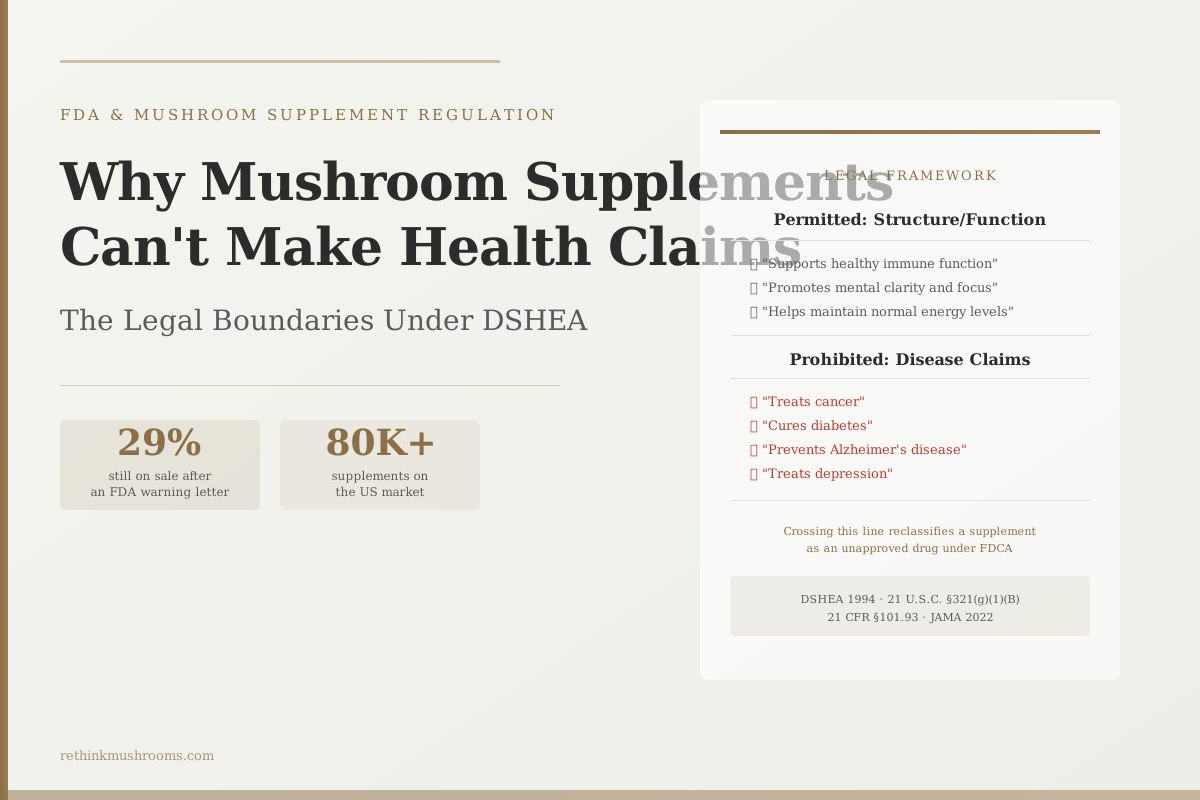
29% of supplements that drew an FDA warning letter were still on sale six years later
The legal line between a supplement and a drug is unambiguous, and crossing it carries serious consequences. What is far less certain is whether anyone will notice. Mushroom supplements appear regularly in FDA enforcement actions — and the language FDA quotes is rarely as blunt as people assume.
Cohen PA et al. JAMA. 2022
80,000+
supplement products now sold in the US, up from about 4,000 when DSHEA passed in 1994
10%
of cGMP-covered supplement manufacturers FDA inspected in 2013 — 416 firms
6
mushroom supplement companies named in FDA warning letters between 2020 and 2025
Cohen PA et al. JAMA. 2022
 View as image ↗
A mushroom supplement cannot legally claim to treat a disease. That much is settled, and has been since 1994. The reason traces to a distinction built into federal law: supplements describe how they support normal body functions; drugs treat disease. Cross that line and the product stops being a supplement.
That reclassification is not a labeling technicality. It means the company is manufacturing an unapproved drug under the Food, Drug, and Cosmetic Act. The FDA can seize the product, seek a federal injunction halting distribution, and in clear cases of knowing violation, refer for criminal prosecution.
What the law says and what happens in practice are two different questions. When researchers tracked 31 supplement products that had received FDA warning letters, only one was recalled. Nine were still available for purchase an average of six years later, and five of those nine still contained a prohibited ingredient when chemically analyzed.[4]
The broader structure of FDA's regulatory framework for mushroom supplements is in How the FDA Regulates Mushroom Supplements: The DSHEA Framework. This article focuses on the health claims question: why the legal line exists, what the reclassification risk actually means, where the gray area is, and what the real enforcement record reveals — including the fact that the language FDA cites is usually hedged, not blunt.
Key Takeaways
- Under DSHEA, mushroom supplements are legally barred from claiming to diagnose, treat, cure, or prevent any disease; a disease claim triggers reclassification of the product from supplement to unapproved drug
- Making a disease claim does not just violate a labeling rule: it reclassifies the product under 21 U.S.C. §321(g)(1)(B), giving FDA authority to seize, enjoin, and criminally prosecute
- The language FDA actually quotes in mushroom warning letters is overwhelmingly hedged — "potential for fighting cancer," "may be effective in combating dementia," "may contain anti-viral properties." Softening a claim does not move it out of drug territory
- The US supplement market grew from roughly 4,000 products in 1994 to more than 80,000 today, now worth about $60 billion domestically, while enforcement stayed reactive (Wallace & Koturbash 2025)[3]
- FDA inspected only 416 supplement manufacturers for cGMP adherence in 2013 — about 10% of the manufacturers covered by those regulations (Starr 2015)[1]
- Implied disease claims are also prohibited: language referencing disease symptoms, or targeting a diagnosed patient population, is still a disease claim even when the disease is never named
- Any label making a structure/function claim must carry this exact required text: "This statement has not been evaluated by the Food and Drug Administration. This product is not intended to diagnose, treat, cure, or prevent any disease."
Why Mushroom Supplements Can't Claim to Treat Disease: The DSHEA Answer
The distinction between supplements and drugs is not arbitrary. It reflects a regulatory bargain Congress made in 1994.
Under 21 U.S.C. §343(r)(6), a dietary supplement may make structure/function claims: statements about how a product supports the structure or function of a normally operating body. "Supports healthy immune function." "Promotes mental clarity." "Helps maintain normal energy levels." These describe normal physiological processes and are permissible.
Disease claims describe something else entirely. They say the product affects a disease or medical condition: treats it, prevents it, cures it, or diagnoses it. Under 21 U.S.C. §321(g)(1)(B), any product intended for use in the treatment, cure, mitigation, or prevention of disease is a drug by legal definition. Intent is established by labeling, advertising, and context — not by the manufacturer's private characterization of what they meant.
The four verbs most often cited are diagnose, treat, cure, and prevent. But as the enforcement record below shows, fixating on those four words badly misreads how FDA actually evaluates a claim. What matters is whether the claim points at a disease, not which verb carries it there.
The Reclassification Trap: Why It's More Serious Than a Fine
Most coverage of supplement warning letters frames them as penalties for "misleading marketing." That framing significantly undersells the legal exposure.
When a mushroom supplement label says its product relieves depression, the company has not simply written an illegal sentence. They have established the intended use of their product as a drug use. Under the FDCA, that makes the product a drug. They are now manufacturing and distributing an unapproved new drug without an approved New Drug Application.
That violation sits in a separate legal category from false advertising. The FDA does not need to prove the product is harmful to act. An unapproved drug can be removed from market regardless of its safety record, because the legal requirement for drug approval was not met before marketing began.
The enforcement tools available to FDA at that point are:
Warning letter. FDA demands the company correct violations, typically within 15 business days. The letter becomes a public record.
Product seizure. Federal marshals act under judicial authorization to remove products from warehouses, distributors, and retail locations. A seizure action is distinct from a recall: the FDA initiates it, not the company.
Injunction. FDA seeks a federal court order prohibiting the company from continuing to manufacture or distribute the product. Injunctions can also restrict a company from operating in the supplement space entirely for a defined period.
Criminal prosecution. For cases involving knowing and willful violation, FDA can refer for criminal prosecution. Company owners and executives may face personal liability, not just corporate liability.
A warning letter is the lowest rung, and in practice the overwhelming majority of supplement enforcement stops there. Companies that continue making disease claims after receiving one, or that reappear under new branding with the same violations, move up the ladder.
For companies cited over ingredient safety rather than claims, the legal track is different. The Blue Forest Farms warning letter (#711990, September 11, 2025) cited Amanita muscaria products as adulterated, with FDA stating it was not aware of any basis to conclude that Amanita muscaria is Generally Recognized as Safe for use in food, and treating it as a new dietary ingredient for which no adequate safety notification had been submitted. The GRAS framework and what it means for mushroom ingredients is covered separately in GRAS Status for Mushroom Ingredients: What It Means.
Ingredient safety
CriticalAmanita muscaria is not an approved supplement ingredient
Concern
Amanita muscaria products are increasingly sold as microdose capsules, tinctures and edibles. FDA has identified published literature, adverse event reports and poison control calls describing serious central nervous system effects — including delirium, seizures, coma, respiratory depression and potentially death.
What the research says
FDA has stated it is not aware of any basis to conclude Amanita muscaria is Generally Recognized as Safe for use in food, and has issued warning letters treating these products as adulterated.
Particularly relevant for: Anyone considering Amanita muscaria products, which are legally distinct from the functional mushrooms (lion's mane, reishi, chaga, cordyceps) discussed elsewhere in this article
What to do
Do not treat Amanita muscaria as interchangeable with culinary or functional mushroom supplements. This article is general legal and regulatory information, not medical advice — discuss any supplement use with a qualified healthcare professional.
FDA warning letter #711990 to Blue Forest Farms, LLC, September 11, 2025; FDA constituent update on Amanita muscaria in food.
The Enforcement Gap: A Market That Outgrew Its Regulator
If the legal boundary is clearly defined and the consequences are severe, why do prohibited claims persist?
The answer is structural, and the numbers tell it clearly.
When DSHEA passed in 1994, roughly 600 US manufacturers were producing an estimated 4,000 supplement products. By 2000 the market had passed 29,000 products.[2] Thirty years on, it exceeds 80,000 products and roughly $60 billion in domestic sales.[3]
Enforcement capacity did not scale with it. In 2013, FDA inspected 416 supplement manufacturers for cGMP adherence — about 10% of the roughly 4,000 manufacturers covered by those regulations, and 2.8% of the nearly 15,000 domestic and international supplement firms registered with the agency.[1]
The FDA's model for supplement oversight is entirely reactive. Labels are not reviewed before products reach shelves. The agency acts in response to complaints, import monitoring, targeted inspections, or its own surveillance of online marketing. There is no point in the supply chain at which a supplement company must submit its claims for FDA review before first using them.
A company can put a disease claim on a product page in January and, with meaningful probability, still be selling that product undisturbed in December.
What a warning letter actually changes
Six Years After the Letter, Most Products Were Still There
A warning letter is often described as the moment a company's risk calculation changes. The one systematic follow-up study suggests that, for a substantial minority of products, it does not.
For the prohibited stimulants BMPEA, methylsynephrine or octodrine (letters issued 2015, 2016, 2019).
Just 3% of the products drew a voluntary recall.
29% of the cited products could still be purchased online in January 2022.
56% of the still-available products tested positive on chemical analysis; 2 still contained the very ingredient that prompted the letter.
Read this carefully
These letters concerned prohibited stimulant ingredients, not disease claims, and none involved mushroom products. It is the closest systematic evidence available on what follows a warning letter — but it is adjacent evidence, not a measurement of how mushroom companies respond to claims enforcement.
Source: Cohen PA, Avula B, Katragunta K, Khan I. Recalls, Availability, and Content of Dietary Supplements Following FDA Warning Letters. JAMA. 2022;328(4):393–395.
That last finding deserves emphasis, because it complicates a comfortable assumption. It is tempting to say that a warning letter is the moment the calculation changes — that a public, documented notice of violation forces correction. The evidence available does not support stating that confidently. In the one systematic follow-up study, 29% of cited products were still purchasable roughly six years later, and more than half of those still contained at least one prohibited ingredient.[4]
Two caveats matter. That study examined letters about prohibited stimulant ingredients, not disease claims, and none of the products were mushroom products — so it is adjacent evidence rather than a direct measurement. And the mushroom-specific record does show correction happening: of the six mushroom companies cited between 2020 and 2025, at least two received closeout letters confirming FDA considered the violations addressed.
Real Warning Letters: What Mushroom Companies Actually Said
The letters issued to mushroom supplement companies since 2020 document what prohibited claims look like in practice. Each is identified below by its FDA letter number and issue date, so every entry can be checked against FDA's public database.
The public record, 2020–2025
Six Mushroom Companies, Six FDA Warning Letters — and What FDA Actually Quoted
Each letter is identified by its FDA CMS number and issue date, so any claim below can be checked against FDA's public warning letter database. Note how little of the quoted language uses a blunt disease verb.
Half Hill Farm, Inc.
#609440Nov 3, 2020Disease claimsProducts cited
Turkey Tail, Cordyceps, Lion’s Mane, Chaga and Red Reishi dual extracts
What FDA quoted
Website claims establishing intended use as a drug. FDA noted that scientific references used commercially to promote a product can themselves become evidence of intended use.
Resolution: Closed out Sep 22, 2021. A further letter (#720213) followed Mar 6, 2026.
Mushroom Revival, Inc.
#610361Dec 1, 2020Disease claimsProducts cited
Cordyceps Militaris, Reishi, Mush-10
What FDA quoted
“may contain anti-viral properties” · “alleviate respiratory diseases” · “one of the most effective mushrooms for chronic viral infections”
Entia Biosciences, Inc.
#610493Jan 6, 2021Disease claimsProducts cited
Mushroom-based supplement products
What FDA quoted
Marketing language FDA determined established the products’ intended use as drugs.
Brilliant Enterprises LLC
#609523Jul 20, 2021Disease claimsProducts cited
Lion’s Mane, BoomChaga, CordaCex, LVL:MAX
What FDA quoted
“Relieves Depression and Anxiety” · “May Be Effective in Combating Dementia/Alzheimer’s Disease” · “Potential For Fighting Cancer” · “Anti-diabetic Effects”
Lone Star Botanicals, Inc.
#659735Nov 6, 2023Claims + cGMPProducts cited
Organic Lion’s Mane, Cordyceps and Reishi superfood powders
What FDA quoted
Drug claims cited alongside current Good Manufacturing Practice and preventive-controls violations found on facility inspection.
Resolution: Closed out Jun 25, 2024.
Blue Forest Farms, LLC
#711990Sep 11, 2025AdulterationProducts cited
Amanita Muscaria Microdose Capsules, Magic Potion Tincture, Magic Chocolate
What FDA quoted
Adulteration, not disease claims: FDA stated it is not aware of any basis to conclude Amanita muscaria is GRAS, and treated it as an unnotified new dietary ingredient.
A warning letter is an allegation of violation, not a finding of guilt by a court. Two of these six companies subsequently received closeout letters confirming FDA considered the violations addressed.
Source: FDA Inspections, Compliance, Enforcement and Criminal Investigations — Warning Letters database, letters #609440, #610361, #610493, #609523, #659735 and #711990.
Read the "what FDA quoted" column closely, because it contradicts the story usually told about supplement enforcement.
The common assumption is that companies who get cited are using flagrant, obviously-illegal language — bare disease verbs on a label. That is not what these letters show. FDA quoted Brilliant Enterprises for phrases including "Potential For Fighting Cancer Due To The Extremely High Level of Anti-oxidants," "May Be Effective in Combating Dementia/Alzheimer's Disease," "Relieves Depression and Anxiety," and "Anti-diabetic Effects." It quoted Mushroom Revival for "may contain anti-viral properties," "alleviate respiratory diseases," and "one of the most effective mushrooms for chronic viral infections."
Every one of those is hedged. "Potential for." "May be effective." "May contain." These are exactly the constructions a company adopts when it believes it is being careful.
Hedging is not a defence
What People Assume FDA Cites vs. What FDA Actually Quoted
Almost none of the language FDA quoted in these mushroom supplement letters used a bare disease verb. Every phrase on the right is hedged — and every one of them still established the product's intended use as a drug.
Commonly assumed (illustrative — not quoted)
Verbatim from the warning letter
Commonly assumed (illustrative)
“Cures cancer.”
Verbatim from the letter
“Potential For Fighting Cancer Due To The Extremely High Level of Anti-oxidants”
Commonly assumed (illustrative)
“Prevents Alzheimer’s.”
Verbatim from the letter
“May Be Effective in Combating Dementia/Alzheimer’s Disease”
Commonly assumed (illustrative)
“Treats depression.”
Verbatim from the letter
“Relieves Depression and Anxiety”
Commonly assumed (illustrative)
“Treats diabetes.”
Verbatim from the letter
“Anti-diabetic Effects”
Commonly assumed (illustrative)
“Cures viral infections.”
Verbatim from the letter
“may contain anti-viral properties” · “alleviate respiratory diseases”
Intended use is established by the disease a claim points at, not by how confidently it is asserted. “May help with” and “potential for” name the same diseases that “treats” does.
Right-hand column quoted from FDA warning letters #609523 (Brilliant Enterprises LLC, Jul 20, 2021) and #610361 (Mushroom Revival, Inc., Dec 1, 2020). Left-hand column is illustrative of common assumption and is not quoted from any letter.
Compliance
Does hedging keep a claim legal?
The claim
“As long as you avoid the words treat, cure, prevent and diagnose — and say "may help" or "supports" instead — a supplement claim stays on the legal side of the line.”
The four prohibited verbs are the most memorable part of DSHEA guidance, so compliance advice often reduces to a forbidden-word list. Softening language feels like it should soften legal exposure.
What research shows
MisleadingFDA evaluates whether a claim establishes intended use against a disease, not which verb delivers it. In the mushroom warning letters issued since 2020, almost none of the language FDA quoted used a bare disease verb — the cited phrases were hedged with "potential for," "may be effective," and "may contain," and were cited anyway.
Hedging is not irrelevant everywhere: for a genuine structure/function claim about normal physiology, "helps support" phrasing is standard and appropriate. What hedging cannot do is rescue a claim that names or points at a disease. "May help fight cancer" names cancer.
FDA warning letters #609523 (Brilliant Enterprises LLC, July 20, 2021) and #610361 (Mushroom Revival, Inc., December 1, 2020).
One further pattern is worth noting: FDA does not limit its review to the label. In the Half Hill Farm letter, the agency noted that when scientific publications or references are used commercially by a seller to promote a product, those references may themselves become evidence of the product's intended use. Citing a study about reishi and tumor response, on a page selling reishi, can help establish a drug claim even if the page never makes the claim in its own voice.
The full case record, organized by violation category and chronology, is covered in FDA Warning Letters to Mushroom Companies: What Gets Flagged.
The Gray Zone: Implied Claims That Never Name a Disease
If hedged language about a named disease is still a disease claim, the harder territory is language that references a disease without naming it at all.
FDA's structure/function claim guidance addresses this category explicitly. A claim implies a disease relationship when it references a symptom that is the primary feature of a specific condition, describes effects on an abnormal body state, or frames the product as a solution to a problem rather than support for a system that is already working.
These examples from mushroom supplement marketing illustrate where the line falls:
"For memory loss and cognitive decline." Memory loss is the primary presenting symptom of Alzheimer's disease and related dementias. A claim targeting "memory loss" as a condition to fix, rather than "healthy memory" as a process to support, implies treatment of a disease condition.
"Helps with insulin sensitivity." In isolation, this might be a structure/function claim. In marketing context targeting people with elevated blood sugar, or appearing alongside imagery associated with diabetes management, it establishes intended use in relation to a disease. FDA evaluates the full context of a product's marketing, including website copy and social media, not only label text.
"Reduces inflammation associated with joint damage." "Joint damage" is an abnormal condition, not a normal process to support. A supplement can claim to "support healthy joint function." Referencing damage implies a therapeutic effect on an injured or diseased state.
"Immune support for cancer patients." This is the most instructive example. "Immune support" is a legal structure/function claim. Adding "for cancer patients" establishes the intended use in relation to a disease. The phrase does not say "treats cancer." It does not need to. The disease relationship is established by who the product is being marketed to and for what purpose.
"For the symptoms of chemotherapy." Chemotherapy is a medical treatment for cancer. Any claim referencing its symptoms targets the disease context directly.
The practical problem the gray zone creates for consumers: a company can strip all explicit disease language from its labels while keeping marketing messaging close enough to disease territory that consumers understand what is implied. FDA has addressed this in guidance, making clear that the determination of intended use is made on the full body of evidence available, not only on the presence or absence of specific forbidden words.
The distinction between structure/function claims and disease claims is explored in more depth in the companion piece on structure/function claims vs. disease claims: the legal line. The claims comparison table showing allowed vs. prohibited language for specific mushroom species is in FDA and Mushroom Supplements: How DSHEA Shapes What Companies Can (and Can't) Say.
Reading a Label Like a Regulator: Patterns FDA Acts On
The same patterns recur across the warning letters. They are recognizable once you know what FDA looks for.
Disease names anywhere in the product ecosystem. Not disease verbs — disease names. A label saying "supports immune function" paired with a website header referencing cancer immunity creates an implied disease claim context for the label. FDA considers the full marketing picture, including social media accounts that direct consumers to purchase.
Hedged efficacy language pointed at a condition. "May be effective in combating," "potential for fighting," "helps relieve." As the letters above show, these are cited routinely.
Symptom-targeting language. "For blood sugar control," "for memory loss," "for joint damage repair." These do not name diseases but describe effects on abnormal states rather than support for normal function.
Patient population targeting. Product names, descriptions, or marketing materials that target people with diagnosed conditions. Selling a reishi supplement "for people with Type 2 diabetes" establishes intended use in disease treatment without making a treatment claim.
Research citations used as marketing. Referencing published studies on a sales page can become evidence of intended use, as FDA noted explicitly in the Half Hill Farm letter.
The disclaimer absent or non-standard. Any supplement making a structure/function claim must carry the required FDA disclaimer verbatim under 21 CFR §101.93. Even where the disclaimer is present, it is frequently rendered in small type and placed away from the claim it qualifies; because no display requirements exist for it, poor practice is common.[1]
The Federal Trade Commission runs a parallel enforcement system focused on advertising rather than labeling, operating under a substantiation standard rather than a claims category rule. Companies that receive FDA warning letters for disease claims sometimes face subsequent FTC actions for the same marketing. That track is covered in FTC Enforcement Actions Against Mushroom Supplement Companies.
Manufacturing quality sits alongside claims compliance as a separate regulatory track. A company can follow every claims rule while failing current Good Manufacturing Practice requirements, and vice versa — the Lone Star Botanicals letter cited both at once. The standards manufacturers must meet are covered in cGMP Compliance for Mushroom Products: What Manufacturers Must Do.
The Bottom Line
Under DSHEA, making a disease claim on a mushroom supplement label does not merely violate a labeling rule; it legally reclassifies the product as an unapproved drug, giving FDA authority to seize it, enjoin its distribution, and pursue criminal charges. The enforcement record from 2020 to 2025 shows six mushroom companies cited by name — and reveals that the language FDA quotes is overwhelmingly hedged rather than blunt: "potential for fighting cancer," "may be effective in combating dementia," "may contain anti-viral properties." Softening a claim does not move it out of drug territory, because intended use is established by the disease a claim points at, not the verb that carries it. Meanwhile the market has grown past 80,000 products against an enforcement model that remains entirely reactive, and follow-up research finds that a substantial minority of cited products remain on sale years after a warning letter. This article is general regulatory information, not medical or legal advice.
Frequently Asked Questions
Sources & References
- 1RTHM-00735·Starr, Ranjani R (2015). “Too little, too late: ineffective regulation of dietary supplements in the United States..” American journal of public health.Study breakdown →PubMed →↩
- 2RTHM-00954·Dwyer, Johanna T et al. (2018). “Dietary Supplements: Regulatory Challenges and Research Resources..” Nutrients.Study breakdown →PubMed →↩
- 3RTHM-02200·Wallace, Taylor C et al. (2025). “DSHEA 1994 - Celebrating 30 Years of Dietary Supplement Regulation in the United States..” Journal of dietary supplements.Study breakdown →PubMed →↩
- 4RTHM-01498·Cohen, Pieter A et al. (2022). “Recalls, Availability, and Content of Dietary Supplements Following FDA Warning Letters..” JAMA.Study breakdown →PubMed →↩