Mushroom Supplement Regulation
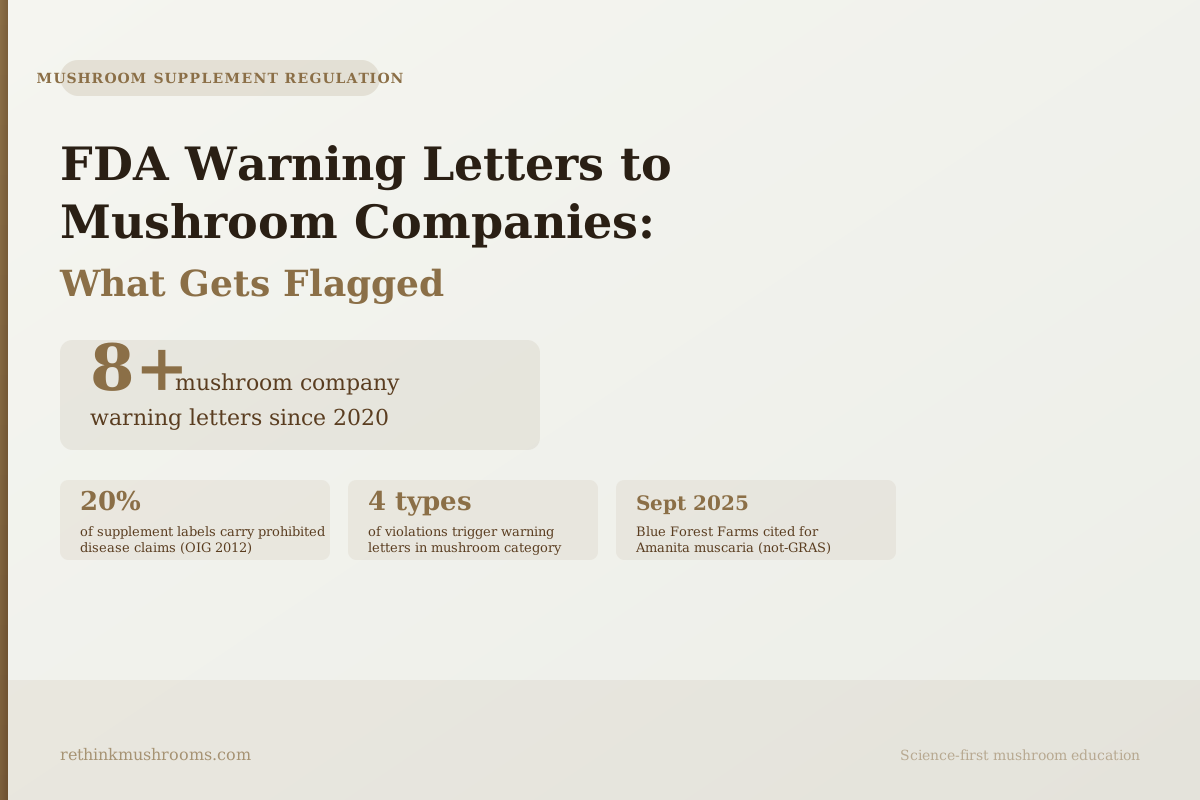
8+ mushroom company warning letters since 2020
In September 2025, FDA issued Warning Letter #711990 to Blue Forest Farms for selling Amanita muscaria products as dietary supplements — following its December 2024 determination that Amanita muscaria is not GRAS.
FDA Warning Letter #711990, September 11, 2025
20%
of dietary supplement labels carried prohibited disease claims per OIG 2012 audit (Starr 2015)
10%
of supplement manufacturers were inspected by FDA in 2013, per Starr et al. (2015)
4 violation types
trigger mushroom supplement warning letters: disease claims, GMP failures, adulteration, NDI violations
FDA Warning Letter #711990, September 11, 2025
 View as image ↗
On September 11, 2025, the FDA sent Warning Letter #711990 to Blue Forest Farms LLC, citing its Microdose Capsules and Magic Potion Tincture — both made with Amanita muscaria — as adulterated dietary supplements under the Federal Food, Drug, and Cosmetic Act. The legal basis was straightforward: nine months earlier, in December 2024, the FDA had issued a letter to industry explicitly stating that Amanita muscaria and its constituents are not generally recognized as safe (GRAS) for use in food or dietary supplements. Blue Forest Farms kept selling. The warning letter was the consequence.
That case is the most recent entry in a pattern that has been building since 2020. Multiple mushroom supplement companies have received FDA warning letters citing violations in four legal categories: disease and drug claims on labels, manufacturing failures under federal good manufacturing practice rules, adulterated ingredients under the Federal Food, Drug, and Cosmetic Act, and failing to notify the FDA about new dietary ingredients before marketing them. Understanding what triggers these letters, and what happens afterward, is useful context for anyone evaluating mushroom supplement brands. The full regulatory framework is covered in How the FDA Regulates Mushroom Supplements: The DSHEA Framework.
Key Takeaways
- FDA Warning Letter #711990 (September 2025) cited Blue Forest Farms for selling Amanita muscaria products as dietary supplements after FDA declared Amanita muscaria not GRAS in December 2024
- Disease and drug claims are the most common warning letter trigger: companies must not state a supplement diagnoses, treats, cures, or prevents any disease — those are drug claims under federal law
- A 2015 policy analysis found FDA inspected only 10% of supplement manufacturers in 2013, helping explain why violations persist despite clear regulatory standards (Starr 2015)
- GMP violations, such as failing to specify heavy metal limits for mushroom raw materials, appear in warning letters independently of any claims violations
- A warning letter requires a company response within 15 business days but does not itself force product removal — FDA must pursue separate injunctive or seizure action for that
- The FDA warning letter database is publicly searchable at fda.gov/inspections-compliance-enforcement/warning-letters, allowing anyone to look up specific companies
Four Categories That Trigger Mushroom Supplement Warning Letters
FDA warning letters for mushroom supplement companies fall into four legal categories. The first two, disease claims and GMP violations, account for the majority of letters. The third, adulteration, is newer and more serious in legal consequence. The fourth, NDI violations, is less visible but a real compliance gap in the industry.
Category 1: Disease and drug claims. Under the Dietary Supplement Health and Education Act (DSHEA), a dietary supplement becomes an unapproved drug the moment its label or marketing states it can diagnose, treat, cure, or prevent a disease. This is not a labeling rule that results in a fine. The product is legally reclassified as a drug — an unapproved drug — and the manufacturer is subject to seizure, injunction, and criminal prosecution. Mushroom products claiming to treat cancer, Alzheimer's, diabetes, depression, or bacterial infections are in this category. So are claims that reference specific disease symptoms when those symptoms would signal to a reasonable reader that the product treats the disease.
Category 2: GMP violations. Under 21 CFR Part 111, dietary supplement manufacturers must follow Current Good Manufacturing Practices: identity testing of raw materials, potency specifications, testing for contaminants including heavy metals, batch record keeping, and investigation of consumer complaints. A warning letter in this category typically documents specific failures in manufacturing records, not just general sloppiness. These violations can appear on their own, independent of any claims issues.
Category 3: Adulteration under FDCA §402(f)(1)(B). This legal category covers a supplement that presents an unreasonable risk of illness or injury, or that contains an ingredient that is not GRAS for its intended use. The Amanita muscaria cases sit here. The ingredient itself, as determined by FDA, is not safe for dietary supplement use.
Category 4: NDI violations. A New Dietary Ingredient is any dietary ingredient first marketed in the United States after October 15, 1994. Under FDCA §413, companies must submit a 75-day pre-market notification to FDA before marketing a product with an NDI, including safety evidence. Many mushroom extracts, particularly concentrated or novel extract forms not commercially available before that date, technically qualify as NDIs. This is a category where mushroom supplement companies have compliance gaps that have not yet been extensively enforced but represent real legal exposure.
A 2015 policy analysis in the American Journal of Public Health found that FDA inspected only 10% of dietary supplement manufacturers in 2013, and that 20% of supplement labels at that time carried prohibited disease claims that violated existing law.[1] That gap between what regulations require and what enforcement catches explains why companies that have been violating these rules continue to operate for years before receiving a warning letter.
Disease Claim Warning Letters: The Case Studies
The first substantial wave of mushroom-specific warning letters arrived in late 2020 and 2021.
Half Hill Farm Inc (November 3, 2020, Letter #609440). FDA cited disease claims on mushroom products. The pattern here, repeated across multiple subsequent letters, is language on product pages and labels describing medicinal effects against specific conditions.
Entia Biosciences Inc (January 6, 2021, Letter #610493). Drug claims on mushroom supplement products. Two warning letters issued within three months reflects the FDA's sustained focus on this category during late 2020 and early 2021.
Brilliant Enterprises LLC (July 2021). This case illustrates the breadth of claims that trigger enforcement. Brilliant Enterprises was cited for making drug claims on Lion's Mane, Chaga, and Cordyceps supplements, specifically claiming the products could treat cancer, depression, and diabetes. Three of the most commonly sold mushroom species, three of the most appealing health conditions to cite, and three of the clearest disease claim violations under federal law.
Mushroom Wisdom (2023). This company received a warning letter combining both disease claims violations and GMP violations, specifically including failure to investigate customer complaints. FDA complaint records are a mandatory element of cGMP compliance, and failure to maintain them is a standalone violation separate from any claims issues.
Lone Star Botanicals Inc (November 6, 2023, Letter #659735). Mushroom supplement disease claims. The November 2023 date indicates the FDA continued active enforcement in this category well into that year.
For a full explanation of why these claims violate federal law and what language is legally permitted on mushroom supplement labels, see Why Mushroom Supplements Can't Make Health Claims: Legal Boundaries.
GMP Warning Letters: What Manufacturing Failures Look Like
Manufacturing violations are the second most common warning letter trigger, and they are sometimes underappreciated as a consumer safety issue.
Restorative Botanicals LLC (August 2024). This warning letter cited GMP violations specifically related to mushroom components: failure to provide toxic element specifications for mushroom raw materials. Under 21 CFR Part 111, manufacturers must establish and document limits for potential contaminants, including heavy metals, in each raw ingredient. Mushroom products are a specific concern here because mushrooms bioaccumulate heavy metals from the soil or substrate in which they are grown. An absence of specifications means no testing requirements and no basis for rejecting contaminated material. Bailey and colleagues reviewed the regulatory framework for dietary supplements in 2020 and found that quality and safety remain highly variable across botanical supplement products despite GMP regulations being in place.[2]
GMP violations in mushroom supplements also appear in broader supplement enforcement actions where mushrooms are one of several ingredients involved. The Mushroom Wisdom 2023 case, which combined disease claims with a failure to investigate consumer complaints, illustrates how GMP violations compound claims violations in enforcement priority.
For a detailed explanation of cGMP requirements and what good manufacturing practices look like in practice, see cGMP Compliance for Mushroom Products: What Manufacturers Must Do.
The Amanita Muscaria Case: How Adulteration Warning Letters Work
The Blue Forest Farms warning letter represents a different and more serious category of enforcement than disease claim letters.
The regulatory sequence unfolded in two steps. In December 2024, FDA issued a letter to the dietary supplement industry explicitly stating that Amanita muscaria, or its constituents (including muscimol and muscarine), are not generally recognized as safe for use in food or dietary supplements. This is the GRAS determination. GRAS status is the foundational safety requirement for any food ingredient used in supplements; without it, using the ingredient means selling an adulterated product under FDCA §402(f)(1)(B). The full framework of how GRAS works for mushroom ingredients is covered in GRAS Status for Mushroom Ingredients: What It Means.
On September 11, 2025, FDA issued Warning Letter #711990 to Blue Forest Farms LLC. The letter cited two products: Microdose Capsules and Magic Potion Tincture, both made with Amanita muscaria. The legal charge was that these products are adulterated dietary supplements because they contain an ingredient that is not GRAS for dietary supplement use. This is a more severe legal situation than a disease claims letter because the problem is the ingredient itself, not just what the company says about it. Removing a disease claim from a website resolves a disease claims violation. The adulteration violation requires removing the ingredient.
Amanita muscaria contains ibotenic acid and muscimol — psychoactive compounds with a different mechanism than psilocybin but that similarly act on the central nervous system. The mushroom is distinctly different, taxonomically and chemically, from psilocybe species. It has a longer folk use history in certain cultural contexts, but that history does not establish GRAS under US regulatory standards, which require documented safety evidence at intended use levels for the specific population that will consume the product.
The Blue Forest Farms case is noteworthy beyond Amanita muscaria specifically. It establishes the FDA's willingness to use adulteration enforcement against novel mushroom ingredients where the GRAS determination has been explicitly addressed. Any company selling products with ingredients that are not GRAS faces the same exposure.
What Happens After an FDA Warning Letter
FDA warning letters are not fines, product recalls, or convictions. They are official notices that a company's products or practices appear to violate the law, and they require a written response within 15 business days.
A typical compliant response involves: (1) acknowledging the violations cited, (2) describing corrective actions taken or planned — which for disease claims usually means removing the language from labels and websites, and for GMP violations means documenting specific manufacturing process changes, and (3) committing to a timeline.
Product seizure requires separate FDA legal action through the federal court system. An injunction requires a consent decree or court order. Criminal prosecution requires referral to the Department of Justice. These steps require significantly more FDA resources and are pursued selectively for persistent or severe violations, or when a company fails to respond adequately to a warning letter. Most companies that receive warning letters do respond, do make corrective changes, and do continue operating — sometimes with the same products under revised labeling.
The warning letters themselves are public documents and remain in the FDA database indefinitely. Receiving a warning letter and correcting the cited violations does not remove the letter from the public record.
How to Check Whether a Mushroom Company Has a Warning Letter
The FDA maintains a searchable public database of all warning letters at fda.gov, under Inspections, Compliance, Enforcement, and Criminal Investigations. Searching a company name returns any letters on record, with the full text of each letter available.
The database reflects only what FDA has issued formal warning letters about. It does not reflect informal correspondence, 483 observations from inspections, or violations that FDA has not yet pursued. Given that FDA inspected only 10% of supplement manufacturers in 2013, and enforcement resources have not grown proportionally with the industry, the database is a meaningful but incomplete signal.[1] A company with no warning letters may still have compliance problems that have not yet been investigated.
The practical use of the database is verifying that a company has not been cited for specific violation types — disease claims, GMP failures, adulteration of the specific ingredient you are evaluating. Warning letters are a floor, not a ceiling, for quality assessment.
The Bottom Line
FDA warning letters to mushroom supplement companies have come in four categories since 2020: disease claims (most common), GMP manufacturing violations, adulteration (the Amanita muscaria case), and NDI violations. The September 2025 Blue Forest Farms letter, following December 2024's GRAS rejection for Amanita muscaria, is the most consequential recent enforcement action because it targets the ingredient itself rather than what a company claims about it. All warning letters are publicly searchable in the FDA database. The enforcement rate is low enough that the absence of a letter is necessary but not sufficient evidence of compliance.
Frequently Asked Questions
Sources & References
- 1RTHM-00735·Starr, Ranjani R (2015). “Too little, too late: ineffective regulation of dietary supplements in the United States..” American journal of public health.Study breakdown →PubMed →↩
- 2RTHM-01165·Bailey, Regan L (2020). “Current regulatory guidelines and resources to support research of dietary supplements in the United States..” Critical reviews in food science and nutrition.Study breakdown →PubMed →↩